eBook - ePub
Orchids Handbook
A Practical Guide to the Care and Cultivation of 40 Popular Orchid Species and Their Hybrids
- English
- ePUB (mobile friendly)
- Available on iOS & Android
eBook - ePub
Orchids Handbook
A Practical Guide to the Care and Cultivation of 40 Popular Orchid Species and Their Hybrids
About this book
Practical introduction to the fascinating world of growing and caring for orchids. Guide to the care and cultivation of 40 orchid species and types. Covers all of the major orchid families. Advice on all aspects of cultivation, from getting started to repotting, dividing, growing from seed, and dealing with pests and diseases. How to choose the right orchid for any climate condition and establish a collection. Everything readers need to know to enter their orchids in competition.
Information
Part One
UNDERSTANDING ORCHIDS

Renanthera Paloma Picasso 'Flame' (Akihito x storiei).
CHAPTER ONE:
AN INTRODUCTION TO ORCHIDS

Angraecum sesqipedale—endemic to Madagascar, this orchid is often referred to as the Star of Bethlehem or Darwin's orchid.
The Orchidaecae are one of the largest families in the plant kingdom, consisting of over 25,000 documented species, some 800 subspecies, and, at recent count, around 110,000 registered hybrids. Most species occur in the subtropical and tropical regions of Asia, South America, and Central America, but this diverse and adaptable family of flowering plants is found all around the globe, except for the polar regions and most arid deserts. Certain orchids live high in the rainforest canopy clinging to the branches of a host tree, some grow on the forest floor, while others have adapted to living in rock crevices or in decaying organic matter.
While climate change and human interference in natural habitats are contributing to the decline and, in some cases, extinction of certain orchid species, exploration in the depths of the rain forests and previously unexplored parts of Asia and South America are revealing exciting new discoveries. Furthermore, new hybrids are being produced all the time.
Orchid flowers come in a wide array of shapes, sizes, colors, and fragrances, that often challenge easy identification. Among the smallest are the pinhead-sized flowers of the miniature moss orchid (Bulbophyllum globuliforme), while the tiger orchid (Grammatophyllum speciosum), the largest orchid plant in the world, produces between 60–100 single flowers up to 6 in. (15 cm) across on stems up to 6.5–10 ft. (2–3 m) long. Flowers may be blousy and frilly or long and slender, and are produced as a single stately bloom or in a neat row atop an arching stalk. They can be delicately striped, boldly spotted, or lightly dappled, sometimes in magnificently intricate patterns. Colors range from pearly whites, pale green, pink, and yellow to rich shades of magenta, orange, or blue. The deepest red shades are sometimes mistaken for black, but there is no true black orchid.
The flowers emit scents that range from delicately sweet to sharply spicy, musty to putrid. The flowers of Encyclia fragrans produce a strong honey-vanilla fragrance; Paphiopedilum malipoense emits a strong fragrance that can be described as rich raspberry. Less alluring is Bulbophyllum graveolens, which smells like rotting meat.
The leaves, too, vary in size, shape, and markings. Some species, such as the jewel orchid (Ludisia discolor), are prized more for their spectacular foliage than their flowers. Others, such as Microcoelia exilis, have no leaves at all and are intriguing for their tangle of flowering stems and visible roots.
THE CLASSIFICATION OF ORCHIDS
Scientific plant names are subject to rules laid down in the International Code of Botanical Nomenclature (ICBN), administered by the International Association for Plant Taxonomy (IAPT), and subject to revision every five years.
Unlike most plants, which are described using just the genus and species, many orchids are hybrids and need a hybrid name. So, in addition to being governed by the ICBN regulations, which apply only to plants found in the wild, orchids are also subject to the International Code of Nomenclature for Cultivated Plants developed for man-made hybrids. The codes were developed to ensure that no two orchids ever have the same name; all orchid names are governed by these codes. Before a new species can be accepted, a scientific name must be described in the prescribed way in Latin and a type specimen cited. The type specimen is usually the first introduction and is often pressed for herbarium collections. To be accepted, the name must be published in a distributed journal, book, or some other recognized publication.
When describing an orchid, the species or genus is followed by a unique name, usually given by the describing botanist. This may represent a characteristic of the flower or plant, its location, or the name of the founder, and is written in Latinized form, even when derived from another language (for example, Cymbidium Cherry Blossom).
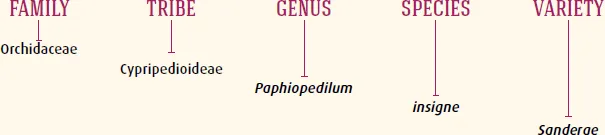
The first part of the scientific label is the generic name or genus, i.e. Paphiopedilum (generic names all start with a capital letter). The second part is the specific scientific adjective or epithet that identifies the species within its genus. When a generic name is repeated in a sentence or list it is abbreviated to just the initial capital letter, followed by a period (e.g., Paphiopedilum insigne, P. rothschildianum). Specific epithets, like insigne, are always written in lower case. The first two parts of the name are often followed by a third, frequently abbreviated, that represents the name of the botanist who first described the species.
Botanical classification is done according to a hierarchical system. This means that each higher rank, such as an order or family (see diagram below), includes a number of subordinate groups that share certain characteristics. A family, for example, consists of one or more genera, each having more in common with one another than with the genera of other families. With genera it’s the same, but they comprise one or more related species.
STRUCTURE OF THE PLANT
Orchids are differentiated from other plants by three characteristics that make them unique: their flowers, reproductive parts, and roots.
The Flower
Orchid flowers are uniquely zygomorphic or bilaterally symmetrical: dividing each flower on the vertical plane, and the vertical plane only, will produce two identical halves (other flowers may be divided on any plane to produce two mirror images). The flowers of orchids come in many sizes, colors, textures, and shapes, from magnificently beautiful to curiously bizarre. Within this vast array, the flowers share a common structure—they are made up of three sepals and three petals arranged in a pinwheel or whorl shape, and a reproductive structure called the column.
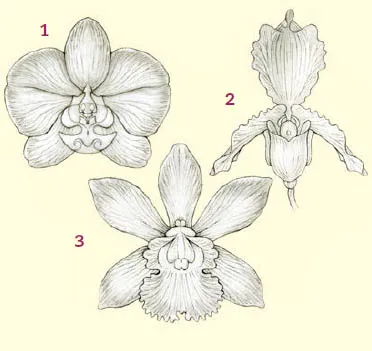
FLOWER SHAPES: The flowers of different orchid species are easily distinguishable by their shapes. 1. Phalaenopsis; 2. Paphiopedilum; 3. Cattleya.
SEPALS AND PETALS
These form the outer and inner ring of the flower respectively. The sepals sometimes resemble petals in color and texture and are generally equal in size; in some species the uppermost (dorsal) sepal may be slightly larger and more prominent than the lower ones.
The two lower (lateral) sepals may appear fused in some species, but close examination will usually reveal their point of separation. Sepals are usually less flamboyant than petals, but in some species, such as Masdevallia, they have developed into the main attraction of the flower. One petal, most often positioned at the bottom of the flower, is modified into an ingeniously engineered and often spectacularly formed seg...
Table of contents
- Cover
- Half title
- Title
- Copyright
- Contents
- Foreword
- Part One Understanding Orchids
- Part Two Orchid Hybrids
- Further Information
Trusted by 375,005 students
Access to over 1.5 million titles for a fair monthly price.
Study more efficiently using our study tools.
Frequently asked questions
Yes, you can cancel anytime from the Subscription tab in your account settings on the Perlego website. Your subscription will stay active until the end of your current billing period. Learn how to cancel your subscription
No, books cannot be downloaded as external files, such as PDFs, for use outside of Perlego. However, you can download books within the Perlego app for offline reading on mobile or tablet. Learn how to download books offline
Perlego offers two plans: Essential and Complete
- Essential is ideal for learners and professionals who enjoy exploring a wide range of subjects. Access the Essential Library with 800,000+ trusted titles and best-sellers across business, personal growth, and the humanities. Includes unlimited reading time and Standard Read Aloud voice.
- Complete: Perfect for advanced learners and researchers needing full, unrestricted access. Unlock 1.5M+ books across hundreds of subjects, including academic and specialized titles. The Complete Plan also includes advanced features like Premium Read Aloud and Research Assistant.
We are an online textbook subscription service, where you can get access to an entire online library for less than the price of a single book per month. With over 1.5 million books across 990+ topics, we’ve got you covered! Learn about our mission
Look out for the read-aloud symbol on your next book to see if you can listen to it. The read-aloud tool reads text aloud for you, highlighting the text as it is being read. You can pause it, speed it up and slow it down. Learn more about Read Aloud
Yes! You can use the Perlego app on both iOS and Android devices to read anytime, anywhere — even offline. Perfect for commutes or when you’re on the go.
Please note we cannot support devices running on iOS 13 and Android 7 or earlier. Learn more about using the app
Please note we cannot support devices running on iOS 13 and Android 7 or earlier. Learn more about using the app
Yes, you can access Orchids Handbook by Michael Tibbs in PDF and/or ePUB format, as well as other popular books in Biological Sciences & Horticulture. We have over 1.5 million books available in our catalogue for you to explore.