Dams for Hydroelectric Energy Barrages pour l’Énergie Hydroélectrique
eBook - ePub

Dams for Hydroelectric Energy Barrages pour l’Énergie Hydroélectrique

  1. 144 pages
  2. English
  3. ePUB (mobile friendly)
  4. Available on iOS & Android
eBook - ePub

Dams for Hydroelectric Energy Barrages pour l’Énergie Hydroélectrique

About this book

The Bulletin is intended as a general document aimed at a wide technical audience involved with or affected by hydropower. Basic background data and some statistics are presented, with specific reference to hydro-electricity production, hydropower dams, hydropower plants, in operation or under construction. Key aspects of hydropower are discussed. Data are presented about typical capital and both internal and external operating costs. Environmental and social impacts are discussed and reference is made to the impact reservoirs have on greenhouse gas emissions. A section is dedicated to the exploitation of tidal energy by means of barrage systems. The current extent of hydropower development and the influence of policies aimed to favour the development of renewable energies are also discussed. Reference sources of information, on hydropower in general and interesting case-histories, are provided.

Le Bulletin se veut un document général destiné à un large public technique impliqué ou affecté par l'hydroélectricité. Des données de base et quelques statistiques sont présentées, avec une référence spécifique à la production hydroélectrique, aux barrages hydroélectriques, aux centrales hydroélectriques, en fonctionnement ou en construction. Les principaux aspects de l'hydroélectricité sont discutés. Les données sont présentées sur le capital type et les coûts de fonctionnement internes et externes. Les impacts environnementaux et sociaux sont discutés et il est fait référence à l'impact des réservoirs sur les émissions de gaz à effet de serre. Une section est dédiée à l'exploitation de l'énergie marémotrice au moyen de systèmes de barrage. L'ampleur actuelle du développement hydroélectrique et l'influence des politiques visant à favoriser le développement des énergies renouvelables sont également abordées. Des sources d'information de référence, sur l'hydroélectricité en général et des études de cas intéressantes, sont fournies.
Frequently asked questions

Yes, you can cancel anytime from the Subscription tab in your account settings on the Perlego website. Your subscription will stay active until the end of your current billing period. Learn how to cancel your subscription.
No, books cannot be downloaded as external files, such as PDFs, for use outside of Perlego. However, you can download books within the Perlego app for offline reading on mobile or tablet. Learn more here.
Perlego offers two plans: Essential and Complete
  • Essential is ideal for learners and professionals who enjoy exploring a wide range of subjects. Access the Essential Library with 800,000+ trusted titles and best-sellers across business, personal growth, and the humanities. Includes unlimited reading time and Standard Read Aloud voice.
  • Complete: Perfect for advanced learners and researchers needing full, unrestricted access. Unlock 1.4M+ books across hundreds of subjects, including academic and specialized titles. The Complete Plan also includes advanced features like Premium Read Aloud and Research Assistant.
Both plans are available with monthly, semester, or annual billing cycles.
We are an online textbook subscription service, where you can get access to an entire online library for less than the price of a single book per month. With over 1 million books across 1000+ topics, we’ve got you covered! Learn more here.
Look out for the read-aloud symbol on your next book to see if you can listen to it. The read-aloud tool reads text aloud for you, highlighting the text as it is being read. You can pause it, speed it up and slow it down. Learn more here.
Yes! You can use the Perlego app on both iOS or Android devices to read anytime, anywhere — even offline. Perfect for commutes or when you’re on the go.
Please note we cannot support devices running on iOS 13 and Android 7 or earlier. Learn more about using the app.
Yes, you can access Dams for Hydroelectric Energy Barrages pour l’Énergie Hydroélectrique by CIGB ICOLD in PDF and/or ePUB format, as well as other popular books in Technology & Engineering & Civil Engineering. We have over one million books available in our catalogue for you to explore.

1 ELECTRICITY DEMAND AND PRODUCTION

As the world’s population grows there is an ever-increasing demand for potable water, food, natural resources, industry and energy. Over millennia man has used energy provided by animals, water, wind and more recently, gas, fossil fuels and electricity.
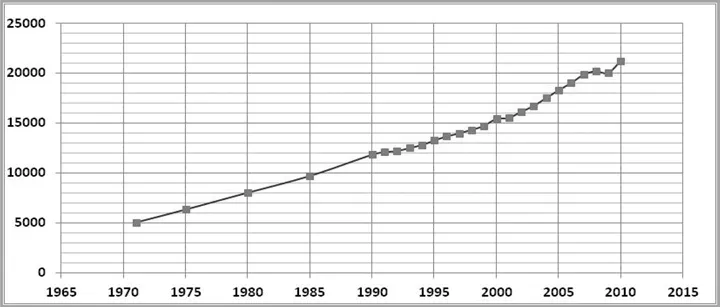
Electricity is unique in its ease of distribution and in its multitude of applications. As a result, the growth in demand for electricity has been faster than any other end-source of energy. Figure 1.1 shows a constant growth in world electricity demand of about 3% per annum over a 30-year period from 1970 to 2000.
Image
Figure 1.1
Electricity production in the world (TWh) – (data from Ref. 1)
Growth in electricity demand in the OECD Countries1 continues at a level close to the historic trend. Emerging countries are however, reporting high rates of economic growth and associated high growth in electricity demand. China has shown the highest levels of growth.
1 Countries belonging to the “Organisation for Economic Co-operation and Development”: Australia, Austria, Belgium, Canada, Czech Republic, Denmark, Finland, France, Germany, Greece, Hungary, Iceland, Ireland, Italy, Japan, Korea, Luxembourg, Mexico, the Netherlands, New Zealand, Norway, Poland, Portugal, Slovak Republic, Spain, Sweden, Switzerland, Turkey, United Kingdom, United States.
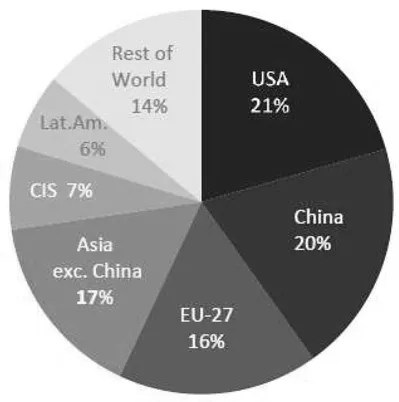
Currently the United States and China are the world’s largest electricity producers (about 20% each). Power generation in Asia, excluding China, now exceeds that produced by North America or Europe. Figure 1.2 shows the current distribution of electricity generation by region.
Image
Figure 1.2
Distribution of electricity generation, by region - (data from Ref. 1)
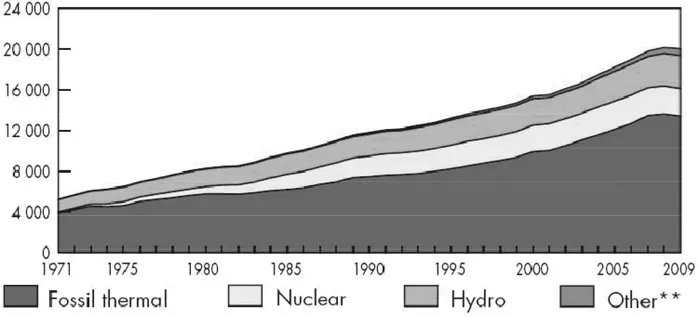
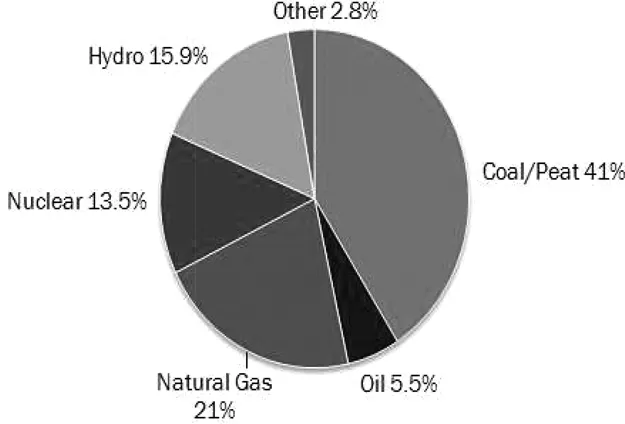
Historically electricity has been generated by burning fossil fuels or by using hydropower. More recently there has been the development of nuclear power stations and generation using wind power, solar, geothermal and other technologies. The growth in electricity production, by fuel, is shown in Figure 1.3. From Figure 1.3 it is clear that more than 60% of the world’s electricity production is currently from fossil fuels, primarily coal, oil and natural gas. Figure 1.4 shows the current world power generation mix by fuel.
Image
Figure 1.3
Electricity production by fuel (TWh) - (from Ref. 3)
(Note: “Other” includes geothermal, solar, wind, combustible renewables & waste, and heat)
Almost invariably electricity generation using fossil fuels is the most economical. Accordingly, developing countries are expected to largely follow a carbon-intensive development path, similar to that taken by industrialised nations in the past. It will require policy changes and considerable investments in new technologies to change this trend. It is unlikely that developing countries will lead the way in this respect.
Various agencies have developed future electricity demand scenarios (see Reference 2). These scenarios indicate that world energy consumption will increase by about 30% by year 2020, primarily as a result of rapid growth in demand in China and India.
As a result of this growth, and the expected focus on fossil fuels, it is anticipated that the world CO2 emissions will also increase by about 30%. This direct link between energy use and greenhouse gas emissions calls for more efficient technologies for the supply and use of energy and a transition to cleaner and renewable energy sources.
The International Energy Agency has considered the role of existing and near-commercial renewable energy technologies in possible future scenarios. They developed two possible scenarios for year 2030 as follows:
  • “Reference Scenario”, in which renewables will constitute about 14% of the world primary energy demand.
  • Alternative Policy Scenario”, in which renewables will constitute about 16% of the world primary energy demand. This scenario assumed implementation of various policies currently being considered to ensure energy security and to reduce greenhouse gas emissions.
In addition to the energy needs illustrated above, it is also useful to keep in mind the eight Millennium Development Goals (MDGs) that 189 United Nations member states and many international organizations have agreed to pursue to improve the social-economic conditions in the world’s poorest countries and to encompass universally accepted human values and rights:
  • Eradicate Extreme Poverty and Hunger,
  • Achieve Universal Primary Education,
  • Promote Gender Equality and Empower Women
  • Reduce Child Mortality
  • Improve Maternal Health
  • Combat HIV/AIDS, Malaria, and Other Diseases
  • Ensure Environmental Stability
  • Develop a Global Partnership for Development
Though access to energy for all is not an MDG in itself, it is evident that it remains crucial for achieving the MDGs.
From the above it is evident that the world needs energy at an ever increasing rate and that much of the energy needs will have to be supplied by generating electricity. It is also clear that man, in his quest for energy, will probably increase greenhouse gas emissions significantly over the next twenty years. Apart from the negative consequences associated with climate change it should also be borne in mind that fossil fuels are not renewable and that resources are finite. Accordingly, there would have to be significant investment in the development of renewable technologies.
Hydropower currently accounts for about 16% of the world’s electricity generation as shown in Figure 1.4. At present it is the biggest source of production from renewable sources. The rest of this report will focus on the role of hydropower only.
Image
Figure 1.4
Current world power generation mix - (from Ref. 2)
(Note: “Other” includes geothermal, solar, wind, combustible renewables & waste, and heat)

1.1 Hydroelectricity

While in the OECD Countries the production of hydroelectricity has remained almost constant over the last decade, after a period of almost thirty years of constant growth, in the non-OECD countries the hydro-electric production shows a continual growth, particularly significant in China, Brazil and India.
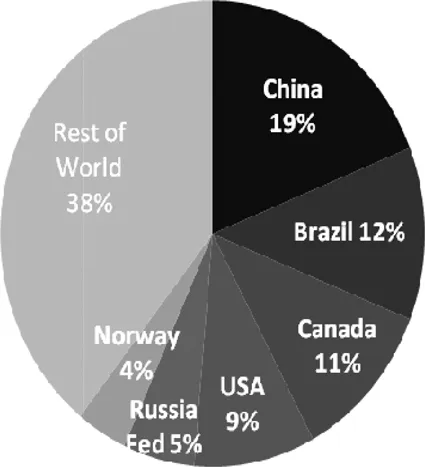
Hydropower plants currently contribute to electricity generation in some 160 countries. More than half of the national electricity supply is produced from hydro in about 60 countries. Despite this large footprint, more than 50% the world’s total hydro production comes from only six countries (China, Brazil, Canada, USA, Russia, Norway) as shown in Figure 1.5. Some notes on the development in each of the countries follow below:
Image
Figure 1.5
Hydro electricity production, by region - (data from Ref. 3)
China currently has the largest hydroelectric production capacity in the world (Reference 14, Reference 15). In addition, it has the largest hydropower development program in the world. This development program reflects China’s commitment to developing its energy production capacity whilst, at the same time, limiting the increase of CO2 emissions. Hydropower installations reached at the end of 2010 about 220 GW, achieving 40% of the technically feasible potential, and accounting for 22% of China’s total installed capacity. The annual hydropower generation is about 690 TWh (2010 data), accounting for about 16% of China’s total power generation. By 2020 the installed hydropower capacity should reach around 300 GW. Although there are some 50 000 hydropower plants in China only about 20 have an installed capacity of more than 1000MW and more than 45 000 plants have an installed capacity of less than 50 MW.
Brazil is currently the second largest hydroelectric energy producer in the world despite the fact that it has a smaller installed capacity than the USA. In 2011 the country produced about 91% of its electric energy demand from hydro. About 82 GW of hydropower are currently installed (2011), accounting for about 70% of the total installed capacity in Brazil (Reference 55). More than 9 GW of hydropower capacity are under construction (60% of which by private developers), and further 32 GW are planned to start operation until 2020. More than 40 new hydropower projects are planned to be commissioned before the end of 2020 (Reference 56) of which the largest are:
  • Belo Monte project with a capacity in excess of 11 GW.
  • Sao Luis do Tapajós project with a capacity in excess of 6 GW.
  • Four other projects each with a planned capacity in excess of 1 GW.
According to the National Energy Plan with a forecast until 2030, the percentage of national energy produced from hydro plants will continue in the 70 to 75% range (Reference 56). The total hydropower potential of Brazil (developed and undeveloped) is estimated in 260 GW, of which 43% are situated in the Northern region. However, considering economic, social and environmental restriction, the potential will be reduced to 174 GW. The Brazilian Government encourages the construction of small hydropower plants and buys the energy produced. According to Brazilian Law and regulations small hydropower plants are defined as an installation with a capacity up to 30 MW and a reservoir with a maximum surface of 13 km2. Usually they are run-of-the-river plants with a small dam and a low environmental impact. In the decade 2001 to 2010 one hundred seventy-eight small hydropower plants entered into operation with a total installed capacity of 2 425 MW (Reference 57). At present (2011) the installed power capacity totals about 3.90 GW.
Canada is currently the third largest hydroelectric energy producer in the world. Hydroelectricity is the leading type of power generation by utilities in Canada, with a share close to 60%. Hydro power is the purpose of the great majority (about 70%) of large dams in Canada. It is estimated (Reference 16) that more than 70 GW of hydropower have been already developed in Canada (a very accurate estimate is difficult, as there are currently many projects coming on stream and in the works), for a hydropower generation of about 370 TWh/year. The hydroelectricity is produced from 450 large and medium scale stations and more than 200 small plants (less than 10 MW). The potential for further hydroelectric development in Canada is large. The undeveloped hydropower potential is estimated to be of the order of 160 GW (capacity that can technically be developed, not considering feasibility factors such as economic or social issues). Some 80% of the countries hydro resources are located in the provinces of Quebec, British Columbia, Yukon, Alberta, Ontario and the Northwest Territory.
The United States of America is currently the world’s fourth largest producer of hydro-electric energy although it has the second largest installed capacity. The relatively low energy production (about 300 TWh/year, accounting for about 7% of the total electricity production, see Reference 41) is as a re...

Table of contents

  1. Cover
  2. Title Page
  3. Copyright Page
  4. Committee On Dams For Hydroelectric Energy
  5. Table of Contents
  6. Foreword
  7. 1. Electricity Demand and Production
  8. 2. Dams and Hydropower Plants
  9. 3. Key Features of Hydroelectricity Production
  10. 4. Hydropower Development
  11. 5. Tidal Power Development
  12. 6. Case Histories (Sources of Information)
  13. 7. Information Sources
  14. 8. References
  15. Table des Matières
  16. Avant Propos
  17. 1. DEMANDE ET PRODUCTION D’ÉLECTRICITÉ
  18. 2. LES BARRAGES ET LES USINES HYDROELÉCTRIQUES
  19. 3. LES FONDAMENTAUX DE LA PRODUCTION HYDROÉLECTRIQUE
  20. 4. DEVELOPPEMENT DE L’HYDROÉLECTRICITÉ
  21. 5. DÉVELOPPEMENT DE L’ÉNERGIE MARÉMOTRICE