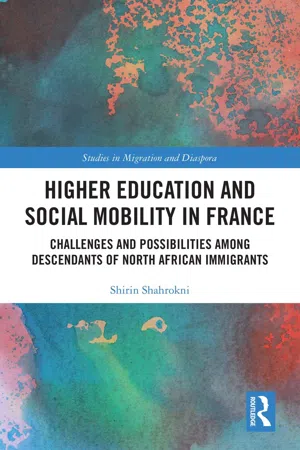
This book offers an in-depth sociological exploration of the social trajectories and experiences of children of post-colonial immigrants in France who are embarking on paths of extreme upward intergenerational mobility. The author draws on life history interviews with young adults of North African immigrant background, enrolled at or having recently graduated from the country's elite higher education institutions, the grandes écoles, to delve into largely under-researched pathways and give a voice to high-achieving members of a population that continues to be collectively associated with difficulties to 'integrate'. The volume constitutes the first sociological study to document, from the individual actor's perspective, the everyday experience of racism within France's elite educational institutions and to reveal the upward mobility experience to be informed by the interlocking effects of racial processes, immigrant ancestry, class background, and gender. Challenging the pervasive representation of descendants of North African immigrants as 'unsuccessful' and 'unable to integrate', this book sheds light on the experiences of the largely silent upwardly mobile members of a stigmatized minority group, revealing the strategies used to respond to the constraints to their mobility and the importance of familial histories of post-colonial migration, characterized by the former generation's efforts, sacrifices, and resilience, in informing these 'success stories'.
eBook - ePub
Higher Education and Social Mobility in France
Challenges and Possibilities among Descendants of North African Immigrants
- 164 pages
- English
- ePUB (mobile friendly)
- Available on iOS & Android
eBook - ePub
Higher Education and Social Mobility in France
Challenges and Possibilities among Descendants of North African Immigrants
About this book
Information
1 Introduction
The Republic and its racial question
Racial and ethnic studies, and race critical approaches in particular, are forced again and again to contend with the mainstream assumption that a focus on race derails ‘serious’ sociological analysis. Several scholars have written about the ‘deniability’ that structures receptions of racism so that a key part of the struggle against racism is the fight for having it recognized as such …. Alongside this is the problem that to think in terms of the centrality of race itself is seen as an overstepping; an (over)reaching for a raced perspective that shifts the focus from, it is claimed, more ‘real’ groundings in class, location, and so on, as though these did not intersect with race. I am fascinated by this deniability, its apparent obviousness, and the rapidity with which it is reached for with discrediting, and thus symbolically violent, repercussions.
We must … place the question of race at the center of the production of democracy and of the reflection on French citizenship. This time, to be credible, the project of radical equality must be aware of its contingency. It cannot be a matter of numbers, of arithmetical or geometrical progression. Race, coupled with poverty and unemployment, ultimately creates a class of sans-parts, that is, of pseudocitizens who, because of their race, not only are excluded from the mechanisms of distribution but are refused recognition, dignity, and respect.
If, as Lentin (2016) contends, the deniability of race has structured the production of sociological knowledge in general, the ‘French backwardness’ on this matter particularly stands out (Brahim, 2017, p. 418). To be sure, as I show later, in the past two decades a growing scholarship has begun to empirically measure the salience of a ‘racial structure’ in the French society – that is, according to Bonilla-Silva (2015), ‘a network of social relations at social, political, economic, and ideological levels that shapes the life chances of the various races’ (p. 1360) – which produces and reproduces the systemic inequities faced by children of post-colonial immigrants across their society’s mainstream institutions. Yet much remains to be done, if a sociology of ethnicity and race relations is to emerge as an independent sub-discipline of sociology in France, and in order to ‘think race and how it makes system in the contemporary world’ (Brahim, 2017, p. 420). While tracing out the roots of this nation-specific deniability, scholars have pointed to the persistent influence of a national myth, a hegemonic Republican ideology institutionalized throughout the 19th century, which has worked to effectively mask the racial inequities and injustices embedded in the French society (Amiraux & Simon, 2006; Juteau, 2006; Silverman, 2007; Larcher, 2014, 2019; Brahim, 2017, 2019). In the ‘one and indivisible’ nation,1 the very use of ethno-racial categories has been believed to produce divisions along lines which did not precede them. The Republic has therefore officially operated on a ‘colour blind basis’ (Silverman, 2007, p. 634). Seeing and naming ethno-racial processes and categorizing French citizens ethnically or racially has been viewed as antinomic to the Republic’s colour blind anti-racism and to its foundational principle of universalism, and conflicting with the French state’s ‘major function’, that of maintaining the public sphere as ‘a space of uniformity, neutrality and equality’ (Silverman, 2007, p. 629). Article One of the 1958 Constitution states that ‘France … ensures the equality of all citizens before the law, without any distinction of origin, race, or religion’.2 As a result, Sabbagh (2006) writes, ‘corrective or “remedial” uses of race by state authorities are the legal equivalent of “invidious” ones and are simply ruled out’. Additionally, ‘not only may no public policy explicitly target segments of the population defined by this forbidden criterion but also, as a result of a 1978 law, the mere collection of statistical data using racial or ethnic categories is prohibited’ (pp. 475–6).3
In recent years, important works have uncovered the abyssal gap between the ‘abstract universalism’ of Republican ideology and the differentiated treatment that the French state has systematically enforced between its white citizens and its racial others, its ‘pseudocitizens’ (Reynaud-Paligot, 2006; Mbembe, 2009, p. 65 – see beginning of this chapter; Larcher, 2014, 2019). Larcher (2014, 2019) shows how the ‘one and indivisible’ Republic historically established a dual legal-juridical regime separating ‘uncontested’ (white) citizens from its racialized others. The contradictions between the Republic’s universalist principle and the salience of the race-based hierarchies on which it was founded were poignantly highlighted in the words of the 18th-century French philosopher Nicolas de Condorcet, who in a piece for the Journal de Paris provocatively noted that Article One of the French Republic’s Declaration of Rights should specify that not ‘all men’, but ‘all white men are born free and equal in rights’ (cited in Larcher, 2019, para. 17).
This ‘abstract universalism’ has significantly influenced the production of sociological knowledge in France. It has commonly led to the disqualification of analyses that point to ethno-racial processes in French society, depicting them as ‘imports’ from Anglo-Saxon societies with no empirical validity (Amiraux & Simon, 2006; Juteau, 2006; Montague, 2013).4 Investigations of racism and racial discrimination have often been discredited for failing to grasp the real issues at stake, namely class-based inequalities and injustices (Amiraux & Simon, 2006; Juteau, 2006; Celestine et al., 2019; Larcher, 2019).5 Similarly, Montague (2013) contends, when critical analyses of the racial question reach the public sphere in France and condemnations of racial inequities are voiced, they are commonly viewed as attacks on the foundational principles of the French Republic and emblematic of the ‘communitarianism’ of those bringing them forward:
Anti-communitarian discourse asserts that recognising group demands would fracture the Republican community and create discord within the nation itself. This idea is grounded in the notion that France lacks any institutional bias towards visible minorities. Anti-communitarianists claim that physical differences have no meaning in Republican society. Those who refute these claims are perceived as subverting the success of Republican colour blind society. Anti-communitarian discourse upholds the image of a non-racial, colour blind society and helps to distinguish French Republicanism as exceptional. France is presented as fundamentally distinct from other Western societies perceived as communitarianist, namely the US and the UK. Anti-communitarianists are therefore tasked with protecting unique universal French values from the encroaching ideas of the Anglo-Saxon world.
This has become a dominant discourse, one which, as Stuart (2001) writes, building on Foucault (1971), serves to define ‘an acceptable and intelligible way to talk, write or conduct oneself’ and, concomitantly ‘“rules out”, limits and restricts other ways of talking, of conducting ourselves in relation to the topic or constructing knowledge about it’ (p. 73).6
One outcome of this discourse has been to actively prevent the development of data and critical analyses that reveal the workings of a ‘racial structure’ (Bonilla-Silva, 2015) within contemporary French society. In 2007, for example, when the Institut national d’études démographiques (National Institute of Demographic Studies, INED) and the Institut national de la statistique et des études économiques (National Institute of Statistics and Economic Studies, INSEE) were to launch the first nation-wide survey to measure the impact of ethno-racial discrimination in the lives of France’s children of immigrants, the national anti-racist organization SOS Racisme7 fiercely objected to questions in the survey about racial self-identification and about the respondents’ perceptions of racial ascription within French society. The organization justified its opposition by referring to the principle of colour blindness entrenched in the Republic’s anti-racist tradition, claiming that the questions ran against this principle and were therefore not only anti-constitutional but also racist. Despite the precautions the institutes took in wording these questions, the petition launched by SOS Racisme and signed by ‘more than 1,000 persons’8 (Sabbagh, 2006, p. 476) led to their removal from the survey. Unsurprisingly, what some scholars see as a growing need to introduce nation-wide ethnic categories into official statistics has also been met with similar resistance for decades (Lepinard & Simon, 2008; Simon, 2008, 2017; Simon & Piche, 2012; Tribalat, 2016).
National censuses have only gathered information about nationality (French national, naturalized citizen, or foreigner), posing important challenges for researchers who seek to rigorously document the trajectories and experiences of France’s racialized populations and the systemic disadvantages they face across multiple areas of life. In the early 2000s, when anti-discrimination measures9 were being increasingly discussed and deemed pressingly needed to identify the possibly distinct challenges faced by France’s minorities, a heated controversy resurfaced on so-called ‘ethnic’ statistics. Once again, as Simon (2008) writes, the ‘choice of ignorance’ prevailed and defenders of ethnic categories in France’s official statistics lost the battle. The choice made was to safeguard a model of integration whose mission has been to erase immigrants’ and their descendants’ cultural and linguistic distinctiveness, and to ‘reinforce assimilation into the nation’ (p. 8). This choice, governed by the imperative to honour the Republic’s universalist doxa, has unsurprisingly made it further difficult to detect, let alone accurately label, processes produced by the country’s racially stratified structure.
Within the national narrative of the ‘one and indivisible’, the ball is therefore in the immigrants’ and their children’s court. In the dominant understanding of ‘integration’ found in political discourses, national debates, and scholarly research on immigrants and their descendants in France, ‘performing Frenchness’ – self-distancing from particularistic attachments and allegiances and thereby erasing one’s distinctiveness – is constructed as the one and only process permitting a successful integration for immigrants and their children into the mainstream institutions of the Republic. The alternative ‘choice’, the choice of failure, is communitarianism. Within the dominant ideological frame of reference in the national imaginary, the weight of state-enforced and institutional racist practices in systematically hindering immigrants and their descendants’, and particularly post-colonial immigrants’ attempts to become successful citizens of the French society has been effectively obscured (Sayad, 1994a, b, 1999a, b; Guénif-Souilamas, 2002; Bouamama, 2005, 2019). The dominant narrative rather emphasizes their ‘desire’, or lack thereof, for ‘integration’. As Bouamama (2005, 2019) suggests, in place of this understanding, rooted in France’s assimilationist model of integration, a far more accurate framework to capture the experiences and trajectories of racialized immigrants and their children would be ‘dominated’ versus ‘egalitarian’ integration.
Despite these ideological and methodological obstacles to seeing and naming racism, in the past two decades scholars have increasingly demonstrated the salience of a racial order. They have shown that race-based hierarchies have, if tacitly, informed the dominant definition of the ‘desirable’ versus the ‘unwanted’ immigrant and the ‘integrated’ versus the ‘unassimilable’ descendant of immigrants, and have shaped, in fine, the historically established distinction between the society’s ‘relative foreigners’ and its ‘absolute outsiders’ (Viet, 1998). Scholars of race have relatedly shown that, in stark contrast to the ‘one and indivisible’ national narrative, immigrants from France’s former colonies, and particularly North African immigrants, have been perpetually constructed as France’s eternal immigrants, and their descendants, born, raised, and schooled in the Hexagon11 as its permanent ‘outsiders within’.
North African immigrants and their descendants in France’s racial structure
Nearly a third of the country’s second-generation immigrants are of Algerian, Moroccan, and Tunisian origins, which makes this group the country’s largest population of immigrant descent (Tribalat, 2004; Barrel & Simon, 2005). The 2008–9 Trajectories and Origins (TeO) survey revealed that while more than 70 percent of this population feels French, over 40 percent consider that their Frenchness is largely denied by members of the dominant group (Beauchemin et al., 2016). This closely resonates with the findings of the 2001 Commission nationale consultative des droits de l’homme Annual Report, which reveal that 63 percent of survey respondents were of the view that there ‘were too many “Arabs” in France’ (Lamont et al., 2002, p. 391). As such, in the national imaginary, Frenchness is racially coded: in contrast with the universalism celebrated by the Republican ideology and its entrenched principle of colour blindness, for many, Frenchness is inherently incompatible with, and superior to, the monolithic and derogatory representation of the Arab figure embodied by North African immigrants and their descendants, inherited from colonial times and perpetually renewed in the contemporary post-colonial context. Members of this population further collectively embody the national figure of the Muslim Other (Galonnier, 2015). Indeed, if the racialization of Islam in France dates back centuries and has been shaped by historically specific contexts, in contemporary French society North African immigrants and their descendants – who, as the TeO survey indicates, make up 78 percent of the country’s Muslims – embody the nation’s Muslim Other, whose values, beliefs, and practices threaten France’s sense of national cohesion and pose a menace to its security (Hajjat &...
Table of contents
- Cover
- Half Title
- Series Page
- Title Page
- Copyright Page
- Table of Contents
- Foreword
- Series editor’s preface
- Acknowledgements
- List of acronyms
- The French Education System
- 1 Introduction
- 2 Succeeding with, succeeding for them
- 3 Routes to elite higher education institutions
- 4 ‘The price of the ticket’. Class, race, and gender hierarchies in elite higher education institutions
- 5 Forging a sense of place in elite academic spaces: ‘accommodating without assimilating’
- 6 From the grande école to the middle class: uncertain journeys ahead
- Conclusion
- Glossary
- Bibliography
- Index
Trusted by 375,005 students
Access to over 1.5 million titles for a fair monthly price.
Study more efficiently using our study tools.
Frequently asked questions
Yes, you can cancel anytime from the Subscription tab in your account settings on the Perlego website. Your subscription will stay active until the end of your current billing period. Learn how to cancel your subscription
No, books cannot be downloaded as external files, such as PDFs, for use outside of Perlego. However, you can download books within the Perlego app for offline reading on mobile or tablet. Learn how to download books offline
Perlego offers two plans: Essential and Complete
- Essential is ideal for learners and professionals who enjoy exploring a wide range of subjects. Access the Essential Library with 800,000+ trusted titles and best-sellers across business, personal growth, and the humanities. Includes unlimited reading time and Standard Read Aloud voice.
- Complete: Perfect for advanced learners and researchers needing full, unrestricted access. Unlock 1.5M+ books across hundreds of subjects, including academic and specialized titles. The Complete Plan also includes advanced features like Premium Read Aloud and Research Assistant.
We are an online textbook subscription service, where you can get access to an entire online library for less than the price of a single book per month. With over 1.5 million books across 990+ topics, we’ve got you covered! Learn about our mission
Look out for the read-aloud symbol on your next book to see if you can listen to it. The read-aloud tool reads text aloud for you, highlighting the text as it is being read. You can pause it, speed it up and slow it down. Learn more about Read Aloud
Yes! You can use the Perlego app on both iOS and Android devices to read anytime, anywhere — even offline. Perfect for commutes or when you’re on the go.
Please note we cannot support devices running on iOS 13 and Android 7 or earlier. Learn more about using the app
Please note we cannot support devices running on iOS 13 and Android 7 or earlier. Learn more about using the app
Yes, you can access Higher Education and Social Mobility in France by Shirin Shahrokni in PDF and/or ePUB format, as well as other popular books in Social Sciences & Ethnic Studies. We have over 1.5 million books available in our catalogue for you to explore.