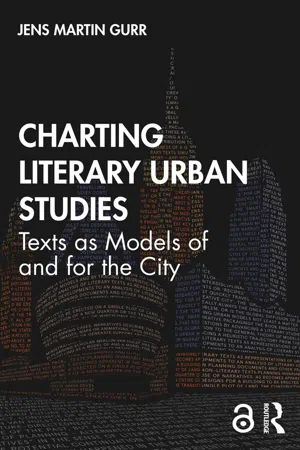
Guided by the multifaceted relations between city and text, Charting Literary Urban Studies: Texts as Models of and for the City attempts to chart the burgeoning field of literary urban studies by outlining how texts in varying degrees function as both representations of the city and as blueprints for its future development. The study addresses questions such as these: How do literary texts represent urban complexities – and how can they capture the uniqueness of a given city? How do literary texts simulate layers of urban memory – and how can they reinforce or help dissolve path dependencies in urban development? What role can literary studies play in interdisciplinary urban research? Are the blueprints or 'recipes' for urban development that most quickly travel around the globe – such as the 'creative city', the 'green city' or the 'smart city' – really always the ones that best solve a given problem? Or is the global spread of such travelling urban models not least a matter of their narrative packaging? In answering these key questions, this book also advances a literary studies contribution to the general theory of models, tracing a heuristic trajectory from the analysis of literary texts as representations of urban developments to an analysis of literary strategies in planning documents and other pragmatic, non-literary texts.
- 204 pages
- English
- ePUB (mobile friendly)
- Available on iOS & Android
eBook - ePub
About this book
1Interdisciplinary Urban Complexity Research and Texts as Qualitative Models
This chapter attempts to sketch a literary and cultural studies approach to the modelling of urban complexity: After briefly commenting on what I perceive as a neglect of cultural phenomena in much urban modelling, I will discuss key characteristics of urban complexity from a literary and cultural studies perspective and will relate these to technical or mathematical notions of complexity. My third section engages with the need for reduction and compression in modelling and with the resulting limitations of urban models before discussing the fundamentally different status of the model in urban complexity studies on the one hand and in literary and cultural studies on the other hand. The chapter thus sets out to show how literary and cultural studies engage with urban complexity and what such an engagement can contribute to truly interdisciplinary work on urban complexity and urban systems. I will argue that literary texts specifically can bring back into the discussion those features of urban complexity that resist quantitative modelling but that are nonetheless crucial to a differentiated understanding of the functioning of urban systems.
The Neglect of ‘Culture’ in Urban Complexity Research
In his masterful study Die komplexe Stadt: Orientierungen im urbanen Labyrinth (2009), one of the most ambitious attempts to provide urban studies with an integrating research agenda, Frank Eckardt goes so far as to propose complexity as the key characteristic of the city and calls for a transdisciplinary research programme organised around the integrating paradigm of ‘complexity’. However, Eckardt then largely pursues a sociological programme.
‘Complexity’ is indeed central to much work in urban modelling (cf. for instance Albeverio et al.; Batty 2013; Portugali 2011; Walloth/Gurr/Schmidt; for a brief and accessible account, cf. Gurr/Walloth). Inter- and transdisciplinary methodological discussions of urban modelling might highlight questions such as the following:
•How is ‘urban complexity’ understood, defined and ‘modelled’ in various disciplines and what is the relation to urban reality these models claim?
•Which subsystems or combinations of subsystems are being modelled by researchers of various disciplines – e.g. is the city considered as a social, ecological, economic, technical or cultural system?
•What are the – normative and/or descriptive – aims and interests pursued with different types of models? Are they designed fundamentally to understand interdependencies within or explain the functioning of urban systems – or do they seek to aid decision-making in concrete situations?
•How can central non-quantifiable phenomena that are especially relevant to a ‘humanities’ understanding of urban complexity be integrated into the dominant types of models? To what extent can they complement mathematical models?
•Which issues and strategies in dealing with urban complexity are already cross-disciplinary? What are the interfaces between disciplines and what bridges can be built here?
•Which of the issues and strategies specific to the individual disciplines dealing with urban complexity can be regarded as complementary? What are the implications of the specific sign systems in which these models are mediated? Are there parallels or analogies between quantitative and narrative models?
•According to which criteria do we make decisions concerning parameters to be included or excluded? To what extent are selection criteria for inclusion and exclusion complementary in different disciplines?
•How can the insights from various types of models be integrated?
It seems that, despite much talk of multi-, inter- or transdisciplinary research in (urban) complexity, the perspective of culture is curiously absent in discussions of urban modelling.1 More specifically, while the consideration of actors and groups of actors and their behaviour as an important dimension of ‘culture’ as studied by the social sciences is clearly central to modelling endeavours, patterns of symbolic representation and patterns of perception and interpretation as less tangible elements of the city largely resist quantitative modelling and are a conspicuous absence in models of urban complexity. A few prominent examples may suffice here: The “Preface” to one of the most ambitious collections on the topic, Albeverio et al.’s The Dynamics of Complex Urban Systems (2008), in its plea for a “fruitful collaboration between natural science” and “regional science” mentions “physics, mathematics, computer science, biology …” (omission original) on the side of “natural science” and “architecture, geography, city plannings [sic], economics, sociology …” (omission original) on the side of “regional science” (v) – and the volume, comprehensive as it is, does not contain anything even remotely from the field of cultural studies. Even in the exhaustive and masterful 2009 Encyclopedia of Complexity and Systems Science, Michael Batty’s state-of-the-art contribution on “Cities as Complex Systems: Scaling, Interaction, Networks, Dynamics and Urban Morphologies” (1041–1071) does not even mention ‘culture’, nor do concepts like ‘individuality’ play any role. Similarly, “Springer Complexity”, according to the description for what is arguably the leading and most prominent book series in the field, is said to “cut across all traditional disciplines of the natural and life sciences, engineering, economics, medicine, neuroscience, social and computer science” (Portugali et al. front matter). Moreover, the outline for Springer’s “Understanding Complex Systems” (UCS) series states the aim of the programme as follows: “UCS is explicitly transdisciplinary”, its first “main goal” being “to elaborate the concepts, methods and tools of complex systems at all levels of description and in all scientific fields, especially newly emerging areas within the life, social, behavioural, economic, neuro- and cognitive sciences (and derivatives thereof)” (Portugali 2011, front matter). The mental, non-institutional dimension of culture in the form of symbolically mediated patterns of perception and interpretation of human environments, it seems, hardly features in discussions of urban complexity.
Characteristics of (Urban) Complexity: Urban Systems Research and the Perspective of Literary and Cultural Studies
Many of the characteristics of urban complexity frequently discussed in research on complex urban systems2 are those that are also of interest to literary and cultural studies. Portugali (2006) conveniently defines the complexity of the city thus: “a very large number of interacting parts, linked by a complex network of feedback and feedforward loops, within a system that is open to and, thus part of, its environment” (657; cf. also Portugali 2011, 232). Further characteristics of complexity frequently discussed include self-organisation, emergence, non-linearity, phase transitions, density, mobility (as one cause of change over time and as the occasion for increased interaction and mixing), ethnic and cultural multiplicity, heterogeneity and hybridity, violence, conflicts over the use of space, intersections of technology and virtual spaces with physical spaces, overlapping and intersecting spatial scales – from the local to the global – and their interdependencies, as well as complex interferences, interdependencies or intersections in the interaction between multiple players, intentions or force fields. Together, these make urban systems prime examples of translocal networks of complex relationships, connections and interdependencies subject to rapid change over time. Moreover, as already indicated in Portugali’s working definition, the city is of course an open or dissipative rather than a closed system (in the technical sense): It exchanges goods, energy, information, people, money, etc. with its environment. All these characteristics, it seems, are more or less part and parcel also of urban simulation models in the more technically oriented disciplines concerned with urban modelling from a complex systems perspective.
However, the ‘softer’, less easily quantified and modelled characteristics of urban complexity are no less central to the ‘urban experience’. In this vein, in addition to the ‘usual suspects’ such as “hierarchy and emergence, non-linearity, asymmetry, number of relationships, number of parts”, Mainzer (374) also lists the following features: “values and beliefs, people, interests, notions and perceptions” (they appear in a visualisation, hence in no particular order – the order is mine). Additionally, while the notion of a system’s ‘history’ – in the sense that previous developments have an impact on the present and future course of the system – is central to urban modelling (if only in the sense that past developments can be extrapolated for predictive purposes), one specific aspect of a city’s history is of particular importance to an understanding of urban systems from the perspective of literary and cultural studies: This is the notion of the city as a palimpsest, a form of layered spatialised memory (this is discussed in detail in Chapters 3 and 4).3 Individual and collective memory and the way it is physically manifested in and evoked by the built environment is a prime concern in many literary texts (for a detailed discussion of a specific key text, cf. Chapter 3).
Arguably the central challenge to literary ‘modelling’, however, lies in the multiplicity of sense impressions and the resulting sensual overload and semiotic ‘overkill’ as a result of a multiplicity of sign systems and ceaseless semiosis. In this vein, Georg Simmel in his influential 1903 essay “The Metropolis and Mental Life”, one of the crucial texts in the early phase of urban studies, defines “the psychological conditions which the metropolis creates” as marked by the “intensification of nervous stimulation which results from the swift and uninterrupted change of outer and inner stimuli […] the rapid crowding of changing images, the sharp discontinuity in the grasp of a single glance, and the unexpectedness of onrushing impressions” (13; italics original).
In his 2011 study Complexity, Cognition and the City, in a remarkably similar way, Portugali speaks of
the really complex situation that concerns individuals under a bombardment of information, that is, under a multiplicity of messages from a multiplicity of sources and of all kinds. This is typical of the dynamics of cities: every agent operating in the city is continually subject to a multiplicity of messages in the form of views, noises, smells etc. In order to behave and survive, the agent […] must make sense of all those signals and messages.(232f.)
As I will argue in Chapter 2, it is precisely the representation of simultaneity that poses the greatest challenge in the narrative representation of urban complexity.
Urban Complexity in Technical and Literary Models: Information, Compression, the Limits of Modelling – and the Status of the Model
In two chapters jointly authored with Herman Haken that largely go back to an earlier joint essay (Haken/Portugali), Portugali (2011) elaborates on the amount of information contained in the physical structure of the city.4 In the subchapter tellingly entitled “How Many Bits to the Face of the City” (179–186), the authors argue: “From the point of view of information theory, the face of the city is a message. As a message it conveys and transmits different quantities of Shannonian information” (Portugali 2011, 201). Conceived in terms of informational complexity, it is obvious that the city contains a virtually endless amount of information – even if we just take its physical shape and ignore, for the moment, the interaction of millions of humans each with their own thoughts, hopes, anxieties, etc.
As far as the ‘measurement’ of complexity from a literary and cultural studies perspective is concerned, it is evident that most mathematical or technical measures are hardly helpful: Neither algorithmic or Kolmogorov complexity (a measurement of the ...
Table of contents
- Cover
- Half Title
- Title Page
- Copyright Page
- Dedication
- Contents
- List of Figures
- Credits List
- Acknowledgements
- Introduction
- 1 Interdisciplinary Urban Complexity Research and Texts as Qualitative Models
- 2 Literary Models of Urban Complexity and the Problem of Simultaneity: A Sketchy Inventory of Strategies
- 3 Palimpsests, Rhizomes, Nodes: Texts as Structural and Functional Urban Models
- 4 Reversing Perspectives: Urban Memory in Built and Literary Post-Industrial Cities
- 5 Urban Activist Writing and the Transition from ‘Models of’ to ‘Models for’ Urban Developments
- 6 Narrative Path Dependencies: From Scenario Building in Literary Texts to the Narratology and Rhetoric of Pragmatic Texts
- 7 ‘Scripts’ in Urban Development: Procedural Knowledge, Self-Description and Persuasive Blueprint for the Future
- 8 From the ‘Garden City’ to the ‘Smart City’: Literary Urban Studies, Policy Mobility Research and Travelling Urban Models
- Conclusion
- Index
Trusted by 375,005 students
Access to over 1.5 million titles for a fair monthly price.
Study more efficiently using our study tools.
Frequently asked questions
Yes, you can cancel anytime from the Subscription tab in your account settings on the Perlego website. Your subscription will stay active until the end of your current billing period. Learn how to cancel your subscription
No, books cannot be downloaded as external files, such as PDFs, for use outside of Perlego. However, you can download books within the Perlego app for offline reading on mobile or tablet. Learn how to download books offline
Perlego offers two plans: Essential and Complete
- Essential is ideal for learners and professionals who enjoy exploring a wide range of subjects. Access the Essential Library with 800,000+ trusted titles and best-sellers across business, personal growth, and the humanities. Includes unlimited reading time and Standard Read Aloud voice.
- Complete: Perfect for advanced learners and researchers needing full, unrestricted access. Unlock 1.5M+ books across hundreds of subjects, including academic and specialized titles. The Complete Plan also includes advanced features like Premium Read Aloud and Research Assistant.
We are an online textbook subscription service, where you can get access to an entire online library for less than the price of a single book per month. With over 1.5 million books across 990+ topics, we’ve got you covered! Learn about our mission
Look out for the read-aloud symbol on your next book to see if you can listen to it. The read-aloud tool reads text aloud for you, highlighting the text as it is being read. You can pause it, speed it up and slow it down. Learn more about Read Aloud
Yes! You can use the Perlego app on both iOS and Android devices to read anytime, anywhere — even offline. Perfect for commutes or when you’re on the go.
Please note we cannot support devices running on iOS 13 and Android 7 or earlier. Learn more about using the app
Please note we cannot support devices running on iOS 13 and Android 7 or earlier. Learn more about using the app
Yes, you can access Charting Literary Urban Studies by Jens Martin Gurr in PDF and/or ePUB format, as well as other popular books in Business & Business General. We have over 1.5 million books available in our catalogue for you to explore.