Wars create their own dynamics, especially with regard to images and language. The semiotic and semantic codes are redefined, according to the need to create an enemy image, or in reference to the results of a war that are post-event defined as just or reasonable. The semiotic systems of wars are central to the discussion of the contributions within this volume, which highlight the interrelationship of semiotic systems and their constructions during wars in different periods of history.
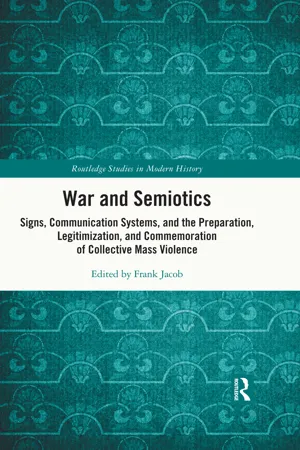
eBook - ePub
War and Semiotics
Signs, Communication Systems, and the Preparation, Legitimization, and Commemoration of Collective Mass Violence
- 324 pages
- English
- ePUB (mobile friendly)
- Available on iOS & Android
eBook - ePub
War and Semiotics
Signs, Communication Systems, and the Preparation, Legitimization, and Commemoration of Collective Mass Violence
Part I
War, semiotics, and the question of interpretation
1Media constructions of war and peace during the war of the Spanish succession
Linking semantics of war with questions of peace can hardly come as a surprise since it was considered to be an essential criterion of early modern war to justify its purpose, which was ultimately the reestablishment of peace.1 The desirability of peace was a common topos in early modern political rhetoric, and the duty of a king to uphold the peace for the benefit of his subjects was a long-established tradition. However, there was a sharp discrepancy between a general expectation for peace and war experiences, because there has hardly been a year without war anywhere in Europe. The War of the Spanish Succession (1701–1714) was not an exception but the rule, not only in this respect but also in that throne vacancies and inheritance disputes were one of the most common causes of international conflicts at this time.2 Linguistically speaking, there was a discrepancy between the general agreement on peace and the social usage of war.3 While historiography makes use of approaches that understand key concepts as constructivist, subjective and volatile factors, there is still no fundamental reassessment in historical semantics and Begriffsgeschichte (history of terminology). The common conception of modern concepts of war and peace consider the Peace of Westphalia in 1648 to be a caesura, which subdivides the Begriffsgeschichte into before and afterward. Thus, after the age of religious wars, war and peace were decoupled from any ideas of justice, while the ius ad bellum was subjected to the principle of sovereignty and peace was reduced to law and order.4 But does the previous research stand up to a wider source-based review? The lexical function of war is essential as a non–self-implicating term, which implies two dimensions: war embodies both an act of violence and a state of “disturbed peace,”5 whose meaning remains untouched by semantic change, which is caused by discord and hostility between states or superior sovereigns in contrast to peace.6 War constitutes a state of strife between something or somebody (reference object) with something or somebody (threat narrative), which means that peace is the absence of the specific threat narrative, i.e. war relating to a specific reference object. This lexical meaning was already available in dictionaries of the period under examination.7 Based on these methodological considerations, it is possible to reconstruct ideas of war by analyzing communicated threat narratives and their reference objects. In this way, subjective ideas of war can be studied where the relationship between the threat narrative and the reference object is expressed through the use of war and terms of the associated semantic field (discord and hostility). This approach is based on Werner Schirmer’s model of “threat communication” and asks which reference object is endangered by which actor by which threat narrative.8 The communication of threat narratives also refers also to ideas of peace, because peace and war remained inseparable and often in coexistent states. They represent two concepts, what Saussure calls the “contrastive relationship”: “They are defined not by their content but by relations of contrast with other terms within the system.”9 War signifies the state of strife as part of a relational system in which peace is taken to be the absence of strife. Of course, there is a large semantic area between war and peace, and what they signify varies greatly by their use in the historical context10—or, linguistically speaking, the connection between semantics and pragmatics.11 As war demands its own narrative to successfully engage with its supporters, one principal aim of war narratives is to justify its purpose, which is ultimately the rearrangement of peace.12 Therefore, the period between war and peace negotiations is of particular importance. This article will explore the semantics of war and peace in their historical context of use within newspapers from 1710 to 1714, since international newspapers have been top-selling news items and, therefore, intensely displayed ever since the Thirty Years” War.13 As a case study, the news coverage of five different newspapers will be scrutinized from July 1710—when the first peace talks at Geertruidenberg failed—until the execution of peace treaties at Utrecht in 1713/1714. In order not only to make simple quantitative statements but also to capture the aforementioned complexity of references, it makes sense to make use of the possibilities of computer-aided text analysis (CAQDA). Programs such as MAXQDA, which enable the capture and coding of large amounts of texts and offer instruments for complex query combinations, are helpful for this purpose.14 For the present work, samples of 1836 newspaper issues from the Gazette d’Amsterdam (Dutch Republic), Hamburger Relations-Courier, Frankfurter Journal, Wiennerisches Diarium (all from the Holy Roman Empire) and the Gazette de France (France) were evaluated with regard to the concepts of war and peace around the peace negotiations at Utrecht. The sources examined include pamphlets, poems, sermons, treaties, diplomatic correspondence and printed parliamentary debates. The text passages were first examined for terms regarding the concepts of war and peace, provided with corresponding codes or categories, and then associated with attributions. With the help of such coding, it is not only possible to determine trends regarding the quantitative use of vocabulary but also to create grids that provide information about the use of words and semantics. The attributions include the assignment of related words belonging to their word fields, since these vary according to the discourse and can thus provide information on the semantic content of the concept of peace. In addition, both concepts were coded by describing attributes and terms that are directly related to the peace negotiations. Before immersing ourselves in the flood of news, I will give a short survey of the war aims and how they were related to the different peace expectations of the involved actors.
The war of the Spanish succession in context15
The Spanish King, Charles II (1661–1700), died in 1700 without a legitimate heir, and two members of the leading dynasties of Habsburg and Bourbon, Charles III (1685–1740), Archduke of Austria, and Philip V of Anjou (1683–1746), the grandson of Louis XIV (1638–1715), both claimed entitlement to his heritage. This prospect alerted other European powers like Great Britain and the States General of the Netherlands, since inheritance of the vast Spanish Empire with its many estates in Europe and colonial possessions abroad would have led to either France or Austria becoming overweighted with power, which had to be prevented. Several partition scenarios of the Spanish monarchy were discussed and fixed in partition treaties to maintain the balance of power in Europe when Charles II decided to designate Philip of Anjou as his sole heir. The French king accepted his last will and thus provoked the outbreak of war in 1701. Great Britain, the States General and the Holy Roman Emperor, Leopold I (1640–1705), forged the so-called Grand Alliance in the same year to fight France and Spain. Taking a look at the contract of the anti-French alliance shows that nothing less than the total ruin of Europe was imminent if France and Spain were to be ruled by one dynasty—a situation “more dangerous than war itself”16—or, to put it another way, the dangerous peace as the result of the decision not to go to war appears as the antonym of war itself. That is why the members of the Grand Alliance decided to help Charles III to get just satisfaction for his succession rights to the Spanish throne, which could mean that the Allies would fight until Philip of Anjou accepted the inheritance of his rival or that Charles would get fair compensation for his renunciation of the Spanish crown. Apart from the dynastic issues, Great Britain and the States General primarily sought to secure their own territorial and global trading interests that a fundamental change of system, in the case of a Bourbon succession, would put at risk. The States General and the Nördlinger Allianz (Alliance of Nördlingen), mainly southwestern territories that were part of the Holy Roman Empire, insisted on a barrier to secure their sovereignty and independence against French invasion plans. Britain’s first aim was to secure the Protestant succession of Braunschweig-Lüneburg by obtaining the guarantees of France and the States General against the “Old Pretender,” James Francis Edward Stuart (1688–1766), who had lived in his French exile since the Glorious Revolution. A change in the ruling dynasty could imply far-reaching consequences for those who supported the defeated dynasty: territorial losses, access to resources and trading networks could be blocked and challenge the economic and political stability of a society. Therefore, the Spanish succession was not only a dynastic question that affected social elites, but only the war aims and the outcome of peace negotiations had to meet the expectations of the people and would prove crucial for the ruler’s legitimacy. This ...
Table of contents
- Cover
- Half Title
- Series Page
- Title Page
- Copyright Page
- Table of Contents
- List of Figures
- List of Contributors
- War and semiotics, war semiotics, and the semiotics of war: An introduction
- Part I: War, semiotics, and the question of interpretation
- Part II: War, semiotics, and identity constructions
- Part III: War, semiotics, and politics
- Epilogue: War semiotics in the post-cold war world
- Index
Trusted by 375,005 students
Access to over 1.5 million titles for a fair monthly price.
Study more efficiently using our study tools.
Frequently asked questions
Yes, you can cancel anytime from the Subscription tab in your account settings on the Perlego website. Your subscription will stay active until the end of your current billing period. Learn how to cancel your subscription
No, books cannot be downloaded as external files, such as PDFs, for use outside of Perlego. However, you can download books within the Perlego app for offline reading on mobile or tablet. Learn how to download books offline
Perlego offers two plans: Essential and Complete
- Essential is ideal for learners and professionals who enjoy exploring a wide range of subjects. Access the Essential Library with 800,000+ trusted titles and best-sellers across business, personal growth, and the humanities. Includes unlimited reading time and Standard Read Aloud voice.
- Complete: Perfect for advanced learners and researchers needing full, unrestricted access. Unlock 1.5M+ books across hundreds of subjects, including academic and specialized titles. The Complete Plan also includes advanced features like Premium Read Aloud and Research Assistant.
We are an online textbook subscription service, where you can get access to an entire online library for less than the price of a single book per month. With over 1.5 million books across 990+ topics, we’ve got you covered! Learn about our mission
Look out for the read-aloud symbol on your next book to see if you can listen to it. The read-aloud tool reads text aloud for you, highlighting the text as it is being read. You can pause it, speed it up and slow it down. Learn more about Read Aloud
Yes! You can use the Perlego app on both iOS and Android devices to read anytime, anywhere — even offline. Perfect for commutes or when you’re on the go.
Please note we cannot support devices running on iOS 13 and Android 7 or earlier. Learn more about using the app
Please note we cannot support devices running on iOS 13 and Android 7 or earlier. Learn more about using the app
Yes, you can access War and Semiotics by Frank Jacob in PDF and/or ePUB format, as well as other popular books in History & 19th Century History. We have over 1.5 million books available in our catalogue for you to explore.