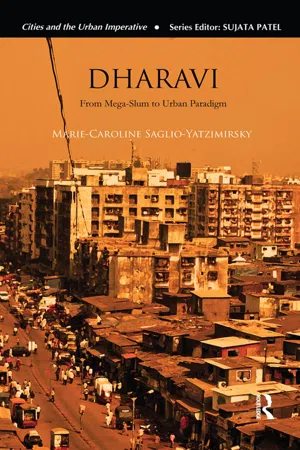
Dharavi
eBook - ePub

Dharavi

From Mega-Slum to Urban Paradigm

  1. 414 pages
  2. English
  3. ePUB (mobile friendly)
  4. Available on iOS & Android
eBook - ePub

Dharavi

From Mega-Slum to Urban Paradigm

About this book

Located in the heart of Mumbai, Dharavi is estimated to be the largest slum in Asia. Often referred to as 'Little India', it has been home to thousands of migrants from across the country providing opportunities for work and livelihood. As such, Dharavi presents a fascinating paradox: the convergence of stereotypes associated with the slum — poverty and misery — and an effervescent economic vitality, impelled by globalisation and international capital flows.

Bringing together 20 years of painstaking fieldwork, this book reveals the social, economic, political, and urban complexities that define Dharavi beneath the shadow of Mumbai, the financial capital of India. It provides a rare account of the slum's history, with a special focus on the original populace of leather workers — who form the backbone of its urban informal economy — their work, organisation and increasing political awareness. Dominated by a population of ex-'untouchables', conventionally stigmatised by poverty and low status, Dharavi illustrates how traditional caste-based occupational and regional divisions continue to be strong and affect structures of political governance and economy. At the same time, it testifies to an intimate encounter with consumerism, liberalisation and technological innovations, and its resultant cultural globalisation under the heady influence of media, advertising and cinema transmitted by the city of Mumbai.

This book traces the mega-slum's gradual transformation as a thriving trade centre, through an informal economy's successful adaptation to global markets, in turn establishing an urban paradigm. It will be useful to those in sociology, anthropology, urban studies, politics, public policy and governance, and to those interested in globalisation, transnational migration and town planning.

Information

Year
2021
Print ISBN
9781138660328
9780415812528
Edition
1
eBook ISBN
9781000084313

Part I
DHARAVI’S ORIGINS

1
Unaccountable land and people

DHARAVI is located in the heart of Mumbai. It stretches between the western and central railway lines, along the border between the city and its suburbs.1 Mahim Cove constitutes a solid border linking the two peninsulas of Mumbai and Salsette through flyovers that facilitate the non-stop flow of traffic and gigantic concrete water distribution pipelines. Whether you are a passenger being given a rough ride on a municipal bus, one of the clusters of people hanging from a crammed train or one of those sitting contentedly in a car, the view is the same: the immense ‘low black line’ (Naipaul 1990: 59) that announces its proximity by its stench, extending beyond the cove in dusty dinginess—that’s Dharavi for you.
1 Greater Mumbai (BMC or Bombay Metropolitan Corporation or Brihan Bombay) is divided between Mumbai Metropolitan City, which covers the stretch from Colaba to Mahim, and its suburbs (Mumbai Suburban Districts).
Everyone in Mumbai knows Dharavi. Everyone has walked along it, seen it or crossed it while taking the Z Bridge—the long, narrow footbridge connecting the two sides of the Matunga district. But very few would enter it 20 years ago. In the Mumbai pocket maps sold at every street corner, giving every detail of all the city’s districts, only the outer limits of the slum used to be marked, corresponding to the railway lines. There was no map of Dharavi, no roads marked, since it was an area that beggared description. But was it indescribable because it had been neglected by the planners, or rather because its changing nature made it impossible to freeze onto a map? Or else, was it because mapping it would mean legalising it in a way? The Mumbai Municipal Corporation’s maps actually describe the Dharavi site as vacant land.
Similarly, it is impossible to know the exact number of the slum’s inhabitants. New migrants in search of employment flow in every day. Periodic censuses conducted by the Mumbai Municipal Corporation and electoral lists provide an estimate that needs to be continually revised upwards.
Conversely, today, everyone and everything has been through Dharavi—people have either gone past the sad sheet-metal walls along its southern section, enclosing it like a fortress, one that is defended by mounds of bags, with recycling material stored on its roofs, bursting out of the inner city, or else they have bought a leather bag or jacket of the latest fashion in the showrooms along the Bandra–Sion Link Road. On the Eicher City Map, which has been the reference point since 2002, updates of the Dharavi site have strangely been few and far between—it has been shown as a gigantic ‘ZP’ zone, an acronym for zopad patti or shanties, with just a few landmarks indicated, apart from its main streets. The spot marking a really vast area in the middle of the city stands out because of its fuzziness—due to its as yet undefined status, preventing it from being registered in the land registry. It contrasts from its neighbouring areas, former middle-class localities now completely saturated with historic landmarks.

Geographical location: Ever-changing maps

What is particular to slums is their changing nature. They are areas with unstable administrative limits that develop in defiance of all the rules, with dwellings that are perpetually destroyed by the monsoons—not to speak of bulldozers—and continually rebuilt. They are indeed difficult to demarcate. Visits to Dharavi are never the same—there are new landmarks every time. Only its inhabitants seem to be able to figure it out and find some logic in what appears to be an enormous jumble of hovels in the eyes of the neophyte. So there are several ways by which Dharavi’s location can be shown in Mumbai—basically corresponding to many different ways of conceiving of the slum’s urban logic—just as there are several ways of mapping it.
Map 1.1: Dharavi: Location in Mumbai
Note: All maps not to scale.

Dharavi, an administrative locality

Dharavi is located at the northern end of the ‘city’. Hence, it is the doorway to a suburban portion of the metropolis that extends over almost 60 km. There are 13 km separating Dharavi from the traditional business centre of Colaba, located in the south. These impressive distances are explained by the narrowness of the city, built on a series of joined-up peninsulas that could only be extended lengthwise.
Mumbai’s maps distinctly show the historical and business centres at the southern end of the city. The Fort district’s banks and offices can be found side-by-side with the airy homes of the well-off, in the neo-gothic architecture style that gives the city the stamp of a former colony. Huge hotels and international centres tower over the Colaba promontory and along the western coast. The old, congested business city is sprawled 5 km further up. Colonies like Girgaum or the Muslim hub of Byculla harbour the typical and popular residential buildings that emerged with the migrations that took place in the last century. The Parel and Worli industrial areas adjoin these colonies and can be spotted by their tall, textile factory chimneys. Dharavi developed on the periphery of these old working-class areas, on the half-submerged marshy zones bordering the cove.
In a single century, Mumbai’s population doubled in size and industrial colonies were pushed even further north, into the suburbs. Thus, the Santa Cruz suburb where the international airport can be found is 26 km from the city-centre, the Mazagaon suburb with its concentration of chemical and mechanical industries is over 30 km away—but they are still integral parts of Mumbai. So much so that today, Dharavi is actually right in the centre of India’s economic capital. And this is even more so because at the turn on the millennium, the new business and commercial district, the Bandra-Kurla Complex, came up right across from Dharavi, on the other side of Mahim Cove. This planned commercial complex is supposed to be the first of a series of growth centres aimed at decongesting southern Mumbai.
One sign of its integration in Mumbai’s urban logic is that today, Dharavi is strictly demarcated by the Mumbai Municipal Corporation, which is responsible for the area’s land management. It is demarcated as an administrative sub-division of Dadar (G-North) and strictly circumscribed by three stations: Mahim Station on the west line and Matunga and Sion stations on the central line, thereby forming an inverted triangle of approximately 4 sq. km whose upper base follows the natural borders of Mahim Cove.2 Its location along the two main railway lines cutting across Mumbai—under the flyovers stretching out across it—have made it a crossroads for thousands of citizens.
2 Mumbai has been divided into sections that include municipal divisions or wards. These divisions were re-defined by the municipal authorities in the course of these areas’ history, as they got populated. Since the 1960s, Dharavi has constituted the northern section of one of these wards in Section G 33, or the Dadar Section. However, the limits of the division do not necessarily correspond to electoral constituencies.
Above all, this area is located at the heart of major urban development operations—the Mumbai Urban Transport Project and Mumbai Urban Infrastructure Project—being undertaken in Mumbai since the early 2000s. In order to decongest an island that turned into a crater and to support the continual growth of the suburbs, Mumbai’s authorities—in the form of the Mumbai Metropolitan Region Development Authority (MMRDA)—came up with the idea of undertaking a major overhaul of the city’s transportation infrastructure: optimisation of railway lines, creation of new railway lines, bus lines, roads, pedestrian structures (pavements or footpaths, skywalks, etc.).3
3 For more details, see http://mmrdamumbai.org/ (accessed 5 February 2012).
Development work at Dharavi’s doors continued with the completion of the Mahim Nature Park that was initiated in the 1980s to convert the mangrove swamps along the cove on the Dharavi Bus Depot side.

Dharavi, the excrescence of a slum area

Dharavi has grown significantly beyond its administrative limits if the underlying logic of its development is considered. The outcome of large migratory flows, it was the southernmost tip of a crescent of slums that extended across 22 sq km up to the international airport in 1990, along key transportation links. Dharavi was the most densely populated section of the crescent since it is located in the city centre and, therefore, close to employment areas, thereby becoming the most attractive residential area for workers. However, in 2010, the old crescent no longer existed. Developments in these central and strategic areas have considerably reduced available space and large tracts have been re-developed, except for the contentious zopad patti or shanty area around the international airport. The only exception is the huge blot formed by Dharavi.

Political situation: A much-coveted area

For a long time, Dharavi did not exist from the legal perspective, because it was an illegal, self-built area. It was originally a vacant piece of land, abandoned by the Municipal Corporation, where the initial migrants settled down and built makeshift shelters. The first to arrive became the owners of the premises. Labour came in large numbers and the slum expanded, turning into a dense, sprawling area posing a real challenge to municipal authorities. Suddenly, in a city with ‘the world’s most expensive housing’, Dharavi became the subject of everyone’s interest.

‘The world’s most expensive city’

By the end of the 1990s, Mumbai had gained the reputation of being the most expensive city in the world. It is true that since Independence, everything played a role in increasing the cost of living in Mumbai.4 On the one hand, the city suffered from a chronic lack of space. It was built on a peninsula and was obliged to expand northwards, whereas the business centre was in the south. Housing within the city limits themselves, with Dharavi as an integral part, has been therefore increasingly coveted.
4 Emerging Market Indicators, The Economist, 24 February 1996, p. 112, and 31 August 1996, p. 84.
On the other hand, real estate laws that were ill-adapted to urban transformations impeded development and led to very high rent inflation. Two Acts were particularly responsible for this situation—one adopted in 1947 and the other in 1976. The 1947 Bombay Rent Act concerned the rental stock and froze rents to 1940 levels, without any possible indexation. Adopted at the time with a view of protecting tenants from excessive post-war inflation, the Act is still applicable today, because of the populist measures taken by politicians. The Act’s consequences have been extremely problematic. In fact, Mumbai’s rental housing stock, which accounted for 80 per cent of the city’s permanent housing in 1988, turned into a captive market, with the consequence that people stopped moving out of rented accommodation, preventing it from being put back on the market. Hence, it often remained with the same family or was subject to illegal transfers, or else was rented out for non-residential purposes.5 Furthermore, owners stopped maintaining the buildings that earned them almost nothing. The highly controversial Bombay Rent Act was finally abandoned in 2000 and replaced by the Maharashtra Rent Control Act, which permitted landlords to gradually raise rents for their private premises—by 5 per cent the first year and 4 per cent each following year. In addition, the 1976 Urban Land Ceiling Act, which set a ceiling on landed estate in urban areas, led to the narrowing of plots of land for building purposes, thereby contributing to an increase in the price of new housing, making it inaccessible for the middle classes and even more so for the poorest sections of society.6 Given the scarcity of land and the high rental costs, migrants with low incomes began to settle on land that had been left vacant and in deteriorating slums. More than half of Mumbai’s population gathered in such areas.7 The 1976 Act was finally repealed in 2007, freeing up the property market and releasing vacant land for redevelopment.
5 These transfers are organised on the basis of the system of paying a security, called pugree. About a third of the commercial value of the property is given to the owner at the time of a change in tenant.
6 Housing legislation will be discussed in more detail in Part IV.
7 Fifty-four per cent of Mumbai’s population, as per the 2001 Census.
Finally, demand among the upper classes, the international business class and the Indian diaspora to whom financial advantages were offered (non-resident Indians or NRIs, but also the newer categories, such as people of Indian origin or PIOs and overseas citizens of India or OCIs) and who had the means to buy into better located property—demand faced with an extreme scarcity of supply—promoted the increase in real estate prices in Mumbai.8 Indeed, the 1990s were marked by an explosion in prices. Between 1991 and 1996, prices went up five times in business localities in the south, where the offices of multinational companies and financial agencies are concentrated, as well as in the Worli and Parel colonies, harbouring a host of industries and their offices. In fact, office premises in these areas are as expensive as in Manhattan, in the heart of New York City. Hence, these areas also became hubs for the laundering of dirty money.9
8 The 1991 liberalisation meas...

Table of contents

  1. Cover
  2. Half Title
  3. Series Page
  4. Title Page
  5. Copyright Page
  6. Contents
  7. List of Plates
  8. List of Maps
  9. Transliteration of vernacular terms
  10. Preface
  11. Acknowledgements
  12. Introduction
  13. Part I: Dharavi’s Origins
  14. Part II: Dharavi’s Population
  15. Part III: Dharavi’s Workers
  16. Part IV: Dharavi’s Citizens
  17. Conclusion: Dharavi: Mumbai’s heartbeat
  18. Select Bibliography
  19. About the Author
  20. Index

Trusted by 375,005 students

Access to over 1.5 million titles for a fair monthly price.

Study more efficiently using our study tools.

Frequently asked questions

Yes, you can cancel anytime from the Subscription tab in your account settings on the Perlego website. Your subscription will stay active until the end of your current billing period. Learn how to cancel your subscription
No, books cannot be downloaded as external files, such as PDFs, for use outside of Perlego. However, you can download books within the Perlego app for offline reading on mobile or tablet. Learn how to download books offline
Perlego offers two plans: Essential and Complete
  • Essential is ideal for learners and professionals who enjoy exploring a wide range of subjects. Access the Essential Library with 800,000+ trusted titles and best-sellers across business, personal growth, and the humanities. Includes unlimited reading time and Standard Read Aloud voice.
  • Complete: Perfect for advanced learners and researchers needing full, unrestricted access. Unlock 1.5M+ books across hundreds of subjects, including academic and specialized titles. The Complete Plan also includes advanced features like Premium Read Aloud and Research Assistant.
Both plans are available with monthly, semester, or annual billing cycles.
We are an online textbook subscription service, where you can get access to an entire online library for less than the price of a single book per month. With over 1.5 million books across 990+ topics, we’ve got you covered! Learn about our mission
Look out for the read-aloud symbol on your next book to see if you can listen to it. The read-aloud tool reads text aloud for you, highlighting the text as it is being read. You can pause it, speed it up and slow it down. Learn more about Read Aloud
Yes! You can use the Perlego app on both iOS and Android devices to read anytime, anywhere — even offline. Perfect for commutes or when you’re on the go.
Please note we cannot support devices running on iOS 13 and Android 7 or earlier. Learn more about using the app
Yes, you can access Dharavi by Marie-Caroline Saglio-Yatzimirsky in PDF and/or ePUB format, as well as other popular books in Social Sciences & Anthropology. We have over 1.5 million books available in our catalogue for you to explore.