Innovation based in data analytics is a contemporary approach to developing empirically supported advances that encourage entrepreneurial activity inspired by novel marketing inferences. Data Analytics in Marketing, Entrepreneurship, and Innovation covers techniques, processes, models, tools, and practices for creating business opportunities through data analytics. It features case studies that provide realistic examples of applications. This multifaceted examination of data analytics looks at:
Business analytics
Applying predictive analytics
Using discrete choice analysis for decision-making
Marketing and customer analytics
Developing new products
Technopreneurship
Disruptive versus incremental innovation
The book gives researchers and practitioners insight into how data analytics is used in the areas of innovation, entrepreneurship, and marketing. Innovation analytics helps identify opportunities to develop new products and services, and improve existing methods of product manufacturing and service delivery. Entrepreneurial analytics facilitates the transformation of innovative ideas into strategy and helps entrepreneurs make critical decisions based on data-driven techniques. Marketing analytics is used in collecting, managing, assessing, and analyzing marketing data to predict trends, investigate customer preferences, and launch campaigns.
The Internet of Things (IoT) paradigm aims to lead us to a new era of computing where the Internet will expand to include billions of new types of devices. The IoT is based on the idea of integrating everyday smart objects equipped with sensors to the Internet. This way these heterogeneous objects become capable of communicating with each other and providing ubiquitous services, which opens a new vista of possibilities. All this pervasiveness will be enabled by sensors that range from battery-less radio frequency identification (RFID) to sensor devices equipped with many sensors. These devices sense different physical phenomena and can actuate different tasks. The cloud computing will provide the required infrastructure to gather and analyze the data generated by these sensors. This infrastructure will enable different applications by enabling the provision of end-to-end services. The analysis of this data will be important for businesses and governments, and eventually will become a key to create new business models.
The Social Internet of Things (SIoT) concept envisions enabling consciousness in the IoT by enabling social networking among the IoT devices (Atzori, Iera, Morabito, & Nitti, 2012). These devices will be able to socialize with each other and create social circles based on mutual interests and goals. This application of social networking will reuse the existing social network models and will address the IoT-specific issues such as scalability. Furthermore, the IoT devices will build trust-based relationships and will leverage these relationships for service provisioning. SIoT will enable the feasibility of managing the ever-growing number of devices in IoT.
Internet of Vehicles (IoV) is an emerging concept derived from its parent domain, IoT. The idea of IoV refers to the dynamic mobile communication between vehicles, infrastructure, drivers, and passengers. This communication is subdivided into V2V (vehicle to vehicle) when vehicles communicate with each other, V2I (vehicle to infrastructure) when vehicles communicate with RSUs (Road-Side Units) and V2H (vehicle to human) when vehicles communicate with drivers or the passengers of the vehicles. The key advantage of IoV is information sharing between different entities that can greatly benefit in improving the traffic on road. IoV promises great commercial interest and wide horizon for research that attracts a lot of researchers and companies (Maglaras, Al-Bayatti, He, Wagner, & Janicke, 2016). All time-connected environment for vehicles on roads provides enormous opportunities for governmental and nongovernmental organizations to connect with the drivers on the roads. For example, Traffic Regulatory Authorities can inform drivers to take an alternate route if there is an accident on the road ahead or if a construction work is in progress. This information can be directly integrated into vehicle navigation systems and effortlessly communicated through the Internet. This method of communicating with cars and drivers can significantly reduce the cost and effort by removing the expensive billboards on the roads.
Social Internet of Vehicles (SIoV) is the latest development in the area of IoV. It’s following the trend of its sister concept, SIoT (Nitti, Girau, Floris, & Atzori, 2014). A key factor that makes SIoV exciting is the fact that vehicles can socialize with themselves and share information of common interests, e.g., road situations, nearby gas stations, and hotels. Socializing in SIoV is not limited to vehicles only as the network can include drivers, passengers, and infrastructure as well.
The main objective of this chapter is to discuss the perspective toward the utilizations and limitations of SIoV. Adaptability of latest technologies in countries makes them an excellent choice for utilizing SIoV and its applications. However, SIoV is still in its early ages and hence requires comprehensive research for development and deployment of these applications. This chapter will provide an insight into challenges and limitations anticipated in providing SIoV solutions.
The rest of this chapter is organized as follows: the Background section provides the introduction of SIoV through the review of literature. The main focus of this section presents the issues and challenges involved in designing and implementing SIoV applications. “Solutions and Recommendations” section delivers an insight into the proposed solutions to the challenges. “Future Research Directions” section provides the research directions in this field, and finally, the “Conclusion” section concludes this chapter.
Background
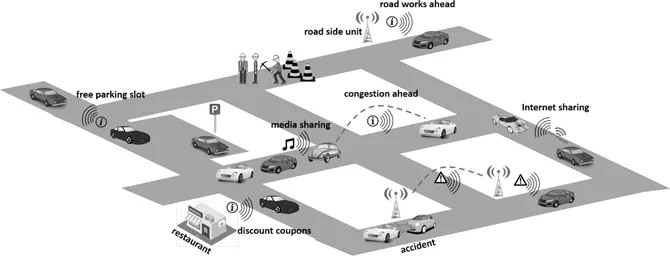
SIoV is comprised of social characteristics, human behavior, and network of vehicles. SIoV is sometimes referred to as vehicular social networks (VSNs) that are assumed to be a group of vehicles and individuals having common interests. SIoV is considered an important concept as vehicles can share a lot like personal information (e.g., location, destination, pictures), traffic information (e.g., accidents, road works, traffic jams), and other common interest information (e.g., nearby hotels, restaurant discounts, free parking slots). Figure 1.1 further illustrates the typical SIoV model.
Figure 1.1 Typical model of Social Internet of Vehicles.
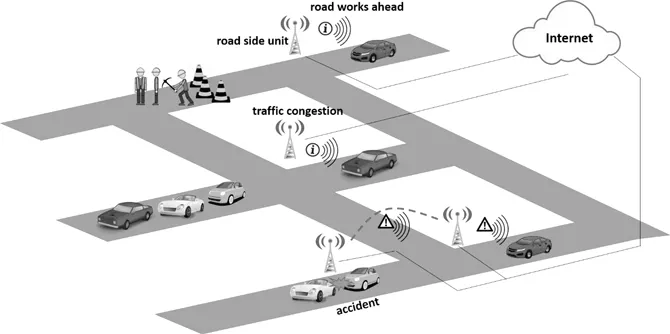
SIoV is a perpetuation of VANETs (vehicular ad hoc networks). VANETs have been around for a few decades now and gained considerable attention from researchers. VANETs are a network of vehicles that can communicate with each other, infrastructure, and drivers. One of the major differences between VANETs and SIoV is that in VANETs, vehicles are not directly connected to the Internet and require an infrastructure (RSU) for connection, whereas in SIoV, all vehicles and infrastructure have Internet connectivity. Figure 1.2 further illustrates the typical VANET model.
Figure 1.2 Typical model of Vehicular ad hoc networks.
SIoV is a fairly new concept in the field of Intelligent Transportation Systems (ITS) and mobile socializing, hence attracting researchers, academicians, and industry professionals. Several research projects are underway for development and deployment of SIoV applications. This section provides the review of literature to build a solid foundation for discussing the state-of-the-art applications along with their challenges and limitations for the region.
Lequerica, Longaron, and Ruiz (2010) discussed a mobile application Drive and Share (DaS), which is installed on passengers’ mobile phones in the vehicle. The application assists passengers in sharing road information such as traffic and infotainment based on their location using cellular network connection. Furthermore, the authors proposed an architecture that is expected to minimize the challenges of socializing in vehicular scenarios. The architecture is based on IP Multimedia Subsystems and the capabilities of vehicles to communicate with each other.
Bai and Krishnamachari (2010) presented a generic framework for enabling information-rich vehicular network applications for social, safety, and interactive services. They referred to this framework as IC NoW (Information Centric Networking on Wheels). The framework is proposed based on three key factors, namely, space, time, and user interest, and it ensures that protocols and applications are employed in a distributed manner based on decisions made locally. The framework is designed in a way that it can be easily integrated with currently available infrastructure of cellular providers. Furthermore, this framework enables modular design, facilitating easy application development, and creating a smooth migration path during the deployment of evolution path.
Smaldone, Han, Shankar, and Iftode (2008) proposed a framework for building communities on the road to facilitate the commuters. As a proof-of-concept, they presented a design of a VSN system they referred to as RoadSpeak that allows drivers to communicate with each other by joining different voice chat groups based on their location.
Maglaras et al. (2016) provide a comprehensive review of research and analysis of smart systems, including smart vehicles. The authors believe that with growth in the autonomous nature of the cars, several applications are being developed for both cars and passengers that can facilitate these entities by sharing information between them. This chapter provides a detailed overview of components and technologies involved in SIoV, context awareness, social network analysis methods, security and trust issues, and current challenges in drivers’ privacy. The authors started by discussing the next generation of vehicles, including self-driving cars, electric cars, and the safety driving aspect of these future cars. Second, they highlighted the importance of enabling context awareness in vehicles while on road. The authors defined context awareness as the ability of the vehicles to adapt to the current contextual environment and provided three subsystems for it: sensing, reasoning, and acting. Sensing helps in gathering information through sensors depending upon the environment, e.g., location of the vehicle; reasoning processes the collected information and extracts high-level contextual data, e.g., detecting driver’s fatigue level; and finally, acting facilitates in taking required action based on the data congregated, e.g., providing warning messages.
Furthermore, social network analysis in SIoVs is provided by discussing the centrality of entities in SIoVs. Centrality of the entities is helpful as it provides a metric of finding entities that are central to a group of vehicles and can act as a relay node to ensure efficient information dissemination. Another important concept besides centrality is clustering or grouping of vehicles based on varying parameters like speed, location, distance, and interests of the vehicles. This clustering of vehicles helps in avoiding broadcast storming (message duplication) problems, increasing throughput, and improving bit error rate.
Finally, the authors have discussed the security and privacy issues by highlighting different potential attacks such as denial of service, false message injection, masquerading, and impersonation attacks.
SIoV relations and interactions can be very complicated as they yield low-level details from the sensors and processing of this information is done at various layers before it can be delivered to the application layer. SIoV life cycle starts at the manufacturing site for the vehicles, where each vehicle is equipped with OBU (On-Board Unit) that forms a POR (Parental Object Relationship) with the manufacturer of the vehicle (Alam, Saini, & El Saddik, 2015). This relationship helps in providing information such as repairs, maintenance, and oil change. Another relationship of the vehicle is with HBU (Home Base Unit) through OBU that assists in connecting the vehicle to the owner’s home, e.g., opening and closing of the garage gate. OBUs installed in vehicles can connect with RSUs to gather information like traffic congestion, alternate routes, free parking slots, and road closures. Finally, OBUs communicate with OBUs of the vehicles in vicinity that helps them socialize with their peer vehicles without interference from any other unit.
It makes profound sense for vehicles to create a network while traveling through highways as the communication time, destinations, speed, and topology are expected to be unchanged. Drivers of the vehicles can maintain a social profile like Facebook where they can share information and content like photos and videos while traveling. Individual drivers in this way can socialize with each other while driving on the highways that not only helps in keeping them up to date about the road conditions but also by making new contacts. Socializing on highways faces several challenges; however, two major challenges are vehicle high mobility and foreignness. To address these issues, Luan, Shen, and Bai (2015) provide a Social on Road (SOR) model. To tackle the issue of high vehicle mobility, SOR provides a proactive technique of estimating connection time between peer vehicles and stipulates peers that are expected to communicate for longer time based...
Table of contents
Cover
Half Title
Series Page
Title Page
Copyright Page
Table of Contents
Editors
Contributors
1 Business Analytics: Through SIoT and SIoV
2 Innovation Analytics
3 Business Predictive Analytics: Tools and Technologies
4 Hospitality Analytics: Use of Discrete Choice Analysis for Decision Support
5 Data Analytics in Marketing and Customer Analytics
6 Marketing Analytics
7 Big Data Analytics
8 New Product Development and Entrepreneurship Analytics
9 Predictive Learning Analytics in Higher Education
Index
Trusted by 375,005 students
Access to over 1.5 million titles for a fair monthly price.
Study more efficiently using our study tools.
Frequently asked questions
Yes, you can cancel anytime from the Subscription tab in your account settings on the Perlego website. Your subscription will stay active until the end of your current billing period. Learn how to cancel your subscription
No, books cannot be downloaded as external files, such as PDFs, for use outside of Perlego. However, you can download books within the Perlego app for offline reading on mobile or tablet. Learn how to download books offline
Perlego offers two plans: Essential and Complete
Essential is ideal for learners and professionals who enjoy exploring a wide range of subjects. Access the Essential Library with 800,000+ trusted titles and best-sellers across business, personal growth, and the humanities. Includes unlimited reading time and Standard Read Aloud voice.
Complete: Perfect for advanced learners and researchers needing full, unrestricted access. Unlock 1.5M+ books across hundreds of subjects, including academic and specialized titles. The Complete Plan also includes advanced features like Premium Read Aloud and Research Assistant.
Both plans are available with monthly, semester, or annual billing cycles.
We are an online textbook subscription service, where you can get access to an entire online library for less than the price of a single book per month. With over 1.5 million books across 990+ topics, we’ve got you covered! Learn about our mission
Look out for the read-aloud symbol on your next book to see if you can listen to it. The read-aloud tool reads text aloud for you, highlighting the text as it is being read. You can pause it, speed it up and slow it down. Learn more about Read Aloud
Yes! You can use the Perlego app on both iOS and Android devices to read anytime, anywhere — even offline. Perfect for commutes or when you’re on the go. Please note we cannot support devices running on iOS 13 and Android 7 or earlier. Learn more about using the app
Yes, you can access Data Analytics in Marketing, Entrepreneurship, and Innovation by Mounir Kehal, Shahira El Alfy, Mounir Kehal,Shahira El Alfy in PDF and/or ePUB format, as well as other popular books in Negocios y empresa & Emprendimiento. We have over 1.5 million books available in our catalogue for you to explore.