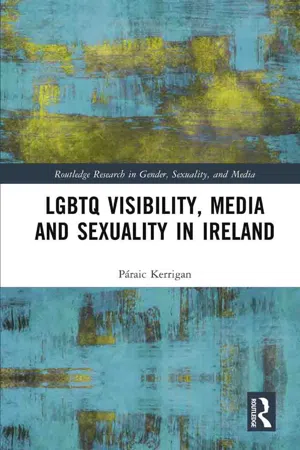
This book traces the turbulent history of queer visibility in the Irish media to explore the processes by which a regionally based media system shaped queer identities within a highly conservative and religious population. The book details the emergence of an LGBTQ rights movement in Ireland and charts how this burgeoning movement utilised the media for the liberatory potential of advancing LGBTQ rights. However, mainstream media institutions also exploited queer identities for economic purposes, which, coupled with the eruption of the AIDS pandemic in the 1980s, disrupted the mainstreaming goals of queer visibility.
Drawing on industrial, societal and production culture determinants, the author identifies the shifting contours of queer visibility in the Irish media, uncovering the longstanding relationship between LGBTQ organising and the Irish media.
This book is suitable for students and scholars in gender studies, media studies, cultural studies and LGBTQ studies.
1 LGBTQ visibility, media and sexuality in Ireland
Breaking silence
In September 1982, Declan Flynn, a young gay man, was ‘queer bashed’ to death in Fairview Park in Dublin by a group of five young men. The murder took place during a period when violence against the gay community had become a recurring issue that culminated in a series of queer-bashing incidents in Fairview Park. Following the murder of Flynn, the five young men responsible received suspended sentences from Judge Seán Gannon, as he declared that Flynn’s death ‘could never be regarded as murder’.1
The outcome of this case ignited public outrage within Ireland’s queer community, prompting the Stop Violence Against Gays and Women March, held on 19 March 1983. This was the first major public and visible demonstration of gay rights in Ireland, considered a ‘pivotal and galvanising moment’ for the Irish LGBTQ community.2 Flynn’s murder has become a touchstone in queer Irish history and has been referred to as Ireland’s Stonewall, a moment when the gay community not only began to claim a visible presence in the media and the public sphere but also began to talk back to the state, be it through public protest or through the media. Following Flynn’s murder, Ireland’s Pride movement, which had been relatively small up to that point, became more organised, militant and public. The first Gay Pride march was organised for Gay Pride Week of 1983, only four months after the mass protest of Judge Gannon’s decision, and over two hundred people participated. This march became the first of its kind, and according to gay rights pioneer Tonie Walsh, it ‘set in motion a tradition of Pride parades we are so familiar with today’.3 The Pride march became an important means of generating visibility for Ireland’s queer community, providing a way of publicly celebrating individual and collective identity and, more importantly, participating in the media, an arena that had eluded Ireland’s queer community in the past.
The 1984 Gay Pride march continued the momentum generated by the 1983 events. A demonstration was held outside of the General Post Office, where members of the community and the centralised main activist body, the National Gay Federation (NGF), spoke about the laws still in place criminalising sex between men, along with the spate of violence against gays and lesbians that still continued following Flynn’s murder. Two such incidents occurred at the 1984 Pride March, when activists Cathal Kerrigan and Joan McCarthy were attacked during the march and demonstration and subsequently received unsympathetic treatment from the Gardaí (Irish police), who seemed to think the whole thing was ‘a joke’.4 In the wake of another annual Pride parade, Walsh, then the president of the NGF, lamented that Pride received ‘zilch coverage in any of the media afterwards’. This stunted the goal of Pride, which as Walsh notes was ‘to become highly visible’.5 This prompted the NGF’s queer publication, NGF News, to question the role of Pride and its significance to the Irish gay civil rights movement, raising a simple question on the cover of the July/August issue: ‘Did they really notice us?’, accompanied by a picture of Walsh speaking from the demonstration stand on O’Connell Street as a child looks up at him (see Figure 1.1).6 The 1984 Pride march raised significant questions for the Irish queer community pertaining to social recognition, but also to visibility in the broader mainstream media.
Figure 1.1 Cover of NGF News, volume 3, number 4, July/August 1984.
Just thirty years later, in 2014, similar questions around queer visibility in the Irish media were instigated when Rory O’Neill, the performer behind popular drag queen Panti Bliss, publicly accused a number of high-profile journalists of homophobia on the prime-time television chat programme The Saturday Night Show. Despite prompting by the show’s host to call out this homophobia and name the public media figures, O’Neill’s comments incited legal action from the individuals, as they threatened both the public service broadcaster (PSB) Raidió Teilifís Éireann (RTÉ) and O’Neill with defamation. In light of legal repercussions, O’Neill’s interview was removed from RTÉ’s online player, The Saturday Night Show issued an apology and RTÉ paid out €85,000 to the offended parties. In the lead-up to the same-sex marriage referendum in 2015, the approach of the national broadcaster to the incident implied that homophobia could not now be named in public, particularly on the PSB’s media platform. The mainstream Irish media initially reflected this by barely documenting the interview, the censored edit or the legal threat.
As ‘old’ modes of censorship through legal action attempted to control the Irish media and the conditions of queer visibility, RTÉ’s actions were confronted by media activism generated by the queer communities’ anger. The Irish queer community began a social movement over new media platforms, such as Twitter, Facebook and YouTube. Through dissemination online, this form of queer media visibility evaded methods of traditional media control, becoming a digital media event. Across social media and blogs, ‘Pantigate’ grew into a national and global event, culminating in Panti’s eventual appearance on the stage of the Abbey Theatre, where she delivered the Noble Call.7 Recorded live on the night, Panti’s speech was uploaded onto YouTube and went viral overnight, and was internationally lauded for its call for tolerance, equality and justice for LGBTQ minorities.8
While set apart by thirty years, in media landscapes and cultural contexts that appear quite different – the 1980s and 2010s, when homosexuality was criminalised in Ireland on the one hand and relatively accepted on the other – these cases share much in common. Both situations and historical periods saw visibility becoming a crucial means of promoting the presence of Ireland’s gay community to various audiences, including the public, state, local and global communities. In both cases, there were struggles to achieve this visibility and recognition, along with asserting a public gay identity, particularly when it came to queer visibility in mainstream media and the PSB RTÉ. Interestingly, both instances reveal the responses of queer minorities in Ireland when they were refused entry into mainstream media, or just completely ignored. As Walsh noted about Pride ’84, not one media outlet in Ireland covered the Pride events, or the march and demonstration; instead, it was left to the NGF and the Irish gay civil rights movement to use media forms, such as print media, to produce a means of establishing networks within the LGBTQ community and generating their own alternative media economy. It was similar with Pantigate, when PSB RTÉ censored O’Neill’s homophobia ‘callout’ and apologised to those who were accused, the silence in the mainstream media prompted the Irish gay community to generate their own visibility and response on social media. Pride ’84 and the NGF News (see Figure 1.1), along with Pantigate, reflect not only the complex and changing dynamics of queer Irish visibility but also how this queer visibility was fostered in a variety of forms over a variety of media, in response to varying factors and dynamics. What is included or considered as part of media institutions has shifted and changed between these two historical moments. On the one hand, the case of Pride ’84 occurred in a media landscape composed almost solely of television, radio, film and print media. On the other hand, by the time Pantigate occurred, Irish media institutions had altered and transformed significantly, with more competition domestically and internationally along with the advent of social media. The changing media and affordances parallel the changing sociocultural context over the course of this historical period. Both instances show the varied influences on queer Irish visibility, deriving from LGBTQ community activism and politics, the sociocultural climate of Ireland and the development and growth of media and media institutions in Ireland over time.
Most crucially, the thirty-year gap between these two instances reveals one of the central arguments and frameworks of this book: that the story of gay Irish media visibility is not simply one of progress from oppression to liberation. Rather, it is one of nuance and complexity, an ever-shifting and changing dynamic between queer community activism, the state and media bodies and institutions – a tug-of-war. Queer Irish visibility is caught up in this tug-of-war power dynamic, between Ireland’s queer community and media institutions, changing and shifting over the historical period of this book. In fact, visibility is not only a tool used by queer communities and activist groups to advance a political agenda; it is also utilised by institutions of power to use queer identities for varying industrial and cultural reasons, such as boosting audience ratings or creating televisual sensationalism. This tug-of-war dynamic defined much of the period of this research and frustrates any attempt to create a convenient, linear historical narrative of the relationship between the media and Ireland’s LGBTQ community. This book uses this Irish-based case study to complicate ideas of queer media visibility research. Further, an examination of queer visibility in Irish media offers a theoretical contribution that moves beyond traditional empirical practices of queer media studies research to expand and incorporate the growing field of queer production studies.
Queer media studies, queer production studies and media activism
Following the 1969 Stonewall riots in New York – which has become understood as the birth of the modern gay liberation movement – gay men and lesbians openly started to come out of the closet. Accordingly, the period following the Stonewall riots saw gay men and lesbians becoming more publicly visible. As activist groups began to emerge, images of gay and lesbians on screen became a site of contention and protest. As Alfred L. Martin Jr. notes in the US context, the ‘early to mid-1970s saw organisations … trying to pressure networks and studios to rehabilitate the ways gayness was mediated’.9 Martin goes on to argue that following this activist turn, much of the early gay and lesbian media scholarship focused on ‘rhetorical analyses of LGBT media images, assessing the semiotic chain that sutured “incorrectly” feminine behaviours to gay men and “butch” behaviours to lesbians’.10 This approach informed much of the early research within queer media studies and research on queer visibility.
With origins in film studies,11 queer media studies began to expand into communications studies, with research focusing more on the cultural role of television and other mass media. Edward Alwood’s Straight News: Gays, Lesbians, and the News Media (1996) explored the processes by which the US gay community was represented within news stories.12 Stephen Tropiano’s The Prime Time Closet: A History of Gays and Lesbian on TV (2002) provided a historical survey of how gays and lesbians have been represented on US television.13 From the 1990s onwards, the increased representation of gays and lesbians in the media led to further growth in academic studies on the topic, which began itself to become rather mainstream within media studies in the 2000s.14 This was in keeping with the normalisation of queer studies in academic writing and popular culture more generally. Most of the work continued to analyse representations, focusing less on negative versus positive representations and more on their heteronormativity.15
The introduction of sexual and gender diversity to television is a particularly salient site in need of diverse perspectives. Works like those of Ron Becker, Suzanna Danuta Walters, Fred Fejes and Kevin Petrich have not only documented the incorporation of queerness into the American small screen but have explored its relation to the conditions, mechanisms and affordances of the US television industry.16 Becker, pointing to shifts from traditional broadcasting schemes to audience segmenting and narrowcasting strategies, convincingly argues that the proliferation of gay and lesbian characters in the course of the 1990s should be understood as a largely commercial evolution. Similarly, authors discussing the representation of sexual and gender diversity in premium cable programming – such as Frederik Dhaenens and Samuel Chambers – show that subscription-based revenue models allow for more subversive takes on representing gender and sexuality than the production of free-to-air television tends to offer.17 Together, this body of scholarship provides insights into the varying forms LGBTQ representation has taken and continues to take in relation to particular industrial models in the US. In doing so, it provides a robust contextualisation for sustained engagements wit...
Table of contents
Cover
Half Title
Series Page
Title Page
Copyright Page
Dedication
Contents
List of figures
Acknowledgements
List of abbreviations
1 LGBTQ visibility, media and sexuality in Ireland
2 Respectably gay?: Gay male visibility on current-affairs television (1974–1980)
3 Fifty shades of gay: Lesbian and gay visibility on The Late Late Show (1980–1989)
4 AIDS and the disruption of queer visibility (1983–1994)
5 Coitus interruptus: Queer visibility on the sitcom and soap opera (1995–1998)
6 Queer visibility, television drama and the Celtic Tiger (1999–2007)
Conclusion: Queer visibility beyond marriage equality and Leo Varadkar
Index
Trusted by 375,005 students
Access to over 1.5 million titles for a fair monthly price.
Study more efficiently using our study tools.
Frequently asked questions
Yes, you can cancel anytime from the Subscription tab in your account settings on the Perlego website. Your subscription will stay active until the end of your current billing period. Learn how to cancel your subscription
No, books cannot be downloaded as external files, such as PDFs, for use outside of Perlego. However, you can download books within the Perlego app for offline reading on mobile or tablet. Learn how to download books offline
Perlego offers two plans: Essential and Complete
Essential is ideal for learners and professionals who enjoy exploring a wide range of subjects. Access the Essential Library with 800,000+ trusted titles and best-sellers across business, personal growth, and the humanities. Includes unlimited reading time and Standard Read Aloud voice.
Complete: Perfect for advanced learners and researchers needing full, unrestricted access. Unlock 1.5M+ books across hundreds of subjects, including academic and specialized titles. The Complete Plan also includes advanced features like Premium Read Aloud and Research Assistant.
Both plans are available with monthly, semester, or annual billing cycles.
We are an online textbook subscription service, where you can get access to an entire online library for less than the price of a single book per month. With over 1.5 million books across 990+ topics, we’ve got you covered! Learn about our mission
Look out for the read-aloud symbol on your next book to see if you can listen to it. The read-aloud tool reads text aloud for you, highlighting the text as it is being read. You can pause it, speed it up and slow it down. Learn more about Read Aloud
Yes! You can use the Perlego app on both iOS and Android devices to read anytime, anywhere — even offline. Perfect for commutes or when you’re on the go. Please note we cannot support devices running on iOS 13 and Android 7 or earlier. Learn more about using the app
Yes, you can access LGBTQ Visibility, Media and Sexuality in Ireland by Páraic Kerrigan in PDF and/or ePUB format, as well as other popular books in Social Sciences & Gender Studies. We have over 1.5 million books available in our catalogue for you to explore.