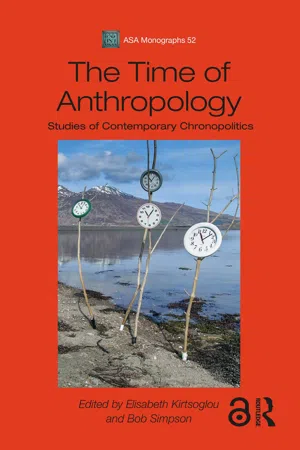
The Time of Anthropology provides a series of compelling anthropological case studies that explore the different temporalities at play in the scientific discourses, governmental techniques and policy practices through which modern life is shaped. Together they constitute a novel analysis of contemporary chronopolitics. The contributions focus on state power, citizenship, and ecologies of time to reveal the scalar properties of chronopolitics as it shifts between everyday lived realities and the macro-institutional work of nation states. The collection charts important new directions for chronopolitical thinking in the future of anthropological research.
The Introduction and Chapters 5, 6, and 8 of this book are freely available as downloadable Open Access PDFs at http://www.taylorfrancis.com under a Creative Commons Attribution-Non Commercial-No Derivatives (CC-BY-NC-ND) 4.0 license.
1 Migrant imaginaries, multiple selves, and the varieties of temporal experience1
Michael D. Jackson
Just as we reinvent ourselves many times over the course of our lives, sometimes becoming strangers to the people we once were, so (one might say) anthropology has undergone so many changes over the course of its life that our intellectual forebears would hardly recognize the subject as it stands today and would undoubtedly be astonished by the range of lifeworlds our discipline now encompasses. Given such changes in individual biographies, theoretical fashions, professional jargons, and empirical subject matter, it would be foolish for anyone to predict the future of our field, let alone claim that his or her particular endeavors might shape it. This does not, however, inhibit us from hoping that the future will take one course rather than another.
My hope is that anthropology will take more seriously what Theodor Adorno called the critique of identity thinking (Adorno 1973; Jackson 2018). Identity thinking assumes an isomorphic relationship between our lived experience and our worldviews – a conflation of experience and episteme. For Adorno, there is always more to life than is covered or contained by the concepts and words with which we represent it. In the same way, our experience of time can never be wholly captured by the ways in which we measure it, whether by circadian rhythms, phases of the moon, the rising and setting of stars, the cycle of the seasons, the swing of a pendulum, the rate of radioactive decay of 14C, or cesium seconds. Yet academe continues to be organized around determinate categories, such as gender, ethnicity, class, culture, and religious identity, that play down the differences between individuals in order to magnify the differences between groups. In treating such collective differences as objective or immutable, we blind ourselves to the fact that variations within a population are as great as variations between populations and persist in defining cultures in terms of a single prevailing modality of time consciousness – hot/cold, stationary/cumulative, and cyclical/linear. For Henri Bergson, however, human consciousness is continually oscillating between multiple perspectives, despite our tendency to reify these as present, past, and future (Bergson 2002: 63). Long ago events come so vividly to mind that they seem to have happened moments ago; time hangs fire in a moment of danger and speeds up in the face of an approaching deadline; an aroma or passage of music instantly transports us to another time; spellbound by a story, we lose all track of time; the future fills us with such dread that we hesitate to bring children into the world. At the same time, historical events – the Holocaust, the crucifixion of Christ, the killing of Imam Hussein, the Atlantic Slave Trade, and the devastation of a traditional way of life – come to figure more compellingly in our experience than events that occurred yesterday.
Abstraction and generalization are magical means of getting a sense of having some purchase on reality, but in forgetting the multiplicity and complexity of reality, we do violence to life as it is actually lived. As Johannes Fabian has reminded us, the social construction of time inevitably reflects political interests, and both historians and anthropologists have been guilty of invoking time past as a stratagem for denying coevalness to our prehistorical forebears and our distant contemporaries alike. In so far as their time and our time are allegedly not one, their humanity and ours are assumed to be essentially different (Fabian 1983).
An equally fundamental issue was raised by Edmund Leach over 50 years ago, when he asked how we come to have a verbal category of time at all and how that category links up with our everyday experience (Leach 1961: 124–125). Henri Bergson might have responded to this question by noting that time and space are metaphors of relative social distance (Bergson 1988: 128) and are interchangeable.
Homogenous space and homogenous time are … neither properties of things nor essential conditions of our faculty of knowing them: they express, in an abstract form, the double work of solidification and division which we effect on the moving continuity of the real in order to obtain there a fulcrum for our actions.
Thus, in Northern Luzon, the Ilongot map mythological events onto the landscape rather than the calendar (Rosaldo 1980: 48). Though Bergson argues against the spatialization of temporality, arguing that duration is our most prescient sense of being-in-time, our consciousness of time passing is inexorably connected to our physical awareness of the places in which we dwell, between which we travel, and wherein we are actively and bodily engaged. Thus, ‘space’ and ‘time’ continually morph into each other. Nostalgia fuses a longing for another place and another time. Here and there readily become metaphors for now and then, and vice versa.
These observations have special relevance to the research I have been doing for several years now with African migrants in London, Amsterdam, and Copenhagen, exploring the dynamic interplay between external circumstances and inner lives – how a person negotiates and responds to the new world into which he is thrown, how he reimagines and relates to the places and people he has left behind, and how he sees his future. This complex consciousness of competing demands, conflicting allegiances, and incommensurable values often engenders deep uncertainty and dissociation, and I have found parallels between a migrant’s struggle to achieve a sense of security and stability and my own anthropological struggles to render coherent accounts of migrant lives.
I have also been struck by the ways in which a migrant’s experience of uncertainty and insecurity – of being out-of-place and somehow illegitimate even when he has found work and acquired a work permit – bears an interesting relationship to the anthropologist’s uncertainty over the relationship between life as lived and the explanatory models or narratives that he or she constructs in making that lived reality intelligible.
There is, in other words, an uncanny connection between a migrant struggling to negotiate the legal labyrinths and bureaucratic protocols of a European nation state and an anthropologist struggling to negotiate the academic jargons, conceptual frameworks, and intellectual fashions that dominate his or her profession.
Multiple self states
When anthropologists and social theorists write about migration, they often invoke binaries, speaking of divided selves and double-binds, of halfies, hybrids, and being in-between. Subjective conflicts are said to mirror social crises, also described in binary terms, suggesting radical breaks between autocratic and democratic regimes, and political and occult economies, and an orientation toward the past and the future (Piot 2010). But to describe the self “as torn between self-interest and collective good, struggling over desire and responsibility, negotiating contradictory emotions” (Kleinman et al. 2011: 5) may give the impression that human beings find little satisfaction in their mutability and prefer the illusion of a unitary and stable sense of self. Rather than imply that people necessarily find fulfillment in being settled in one place or possessing a single core identity persisting over time, I consider it imperative that we complement this view of a stable self with descriptions of human improvisation, experimentation, opportunism, and existential mobility, showing that individuals often struggle not to align their lives with given moral or legal norms but to find ways of negotiating the ethical space between external constraints and personal imperatives. This capacity for strategic shape-shifting, both imaginative and actual, defines our very humanity.
I find it ironic, therefore, that most of the writers who invoke images of psychological division and historical discontinuity would not wish to make a case either for static, one-dimensional personalities or mono-cultural societies in which nothing and no one changed. Why, then, should we not embrace the view that “a pluralistic universe” (James 1977) applies equally to both polis and persons to states and to selves?
Recent psychoanalytical work on selfhood challenges the concept of the person as a seamless, stable, skin-encapsulated monad (Mitchell 1993: 186). Rather than being constant, we constantly change, like chameleons, according to our surroundings, and we possess an extraordinary “capacity to feel like one self while being many” (Bromberg 1983: 186). Indeed, our ability to shift and adjust our self-state in response to who we are with, to what circumstance demands, and to what our well-being seems to require, is not only adaptive; our lives would be impossible without it.
This conception of the self as several rather than singular has a long history.
In 1580, Michel Montaigne observed that, “Anyone who turns his prime attention on to himself will hardly find himself in the same state twice.” “Every sort of contradiction can be found in me,” he wrote:
depending on some twist or attribute … There is nothing I can say about myself as a whole simply and completely, without intermingling and admixture … We are fashioned out of oddments put together … We are entirely made up of bits and pieces, woven together so diversely and so shapelessly that each one of them pulls its own way at every moment. And there is as much difference between us and ourselves as there is between us and other people.
In 1928, Virginia Woolf touched on the same theme, observing that the selves
of which we are built up, one on top of another, as plates are piled on a waiter’s hand, have … little constitutions and rights of their own … One will only come if it is raining, another [will emerge only] in a room with green curtains, another when Mrs. Jones is not there, another if you can promise it a glass of wine – and so on … [E]verybody can multiply from his own experience the different terms which his different selves have made with him – and some are too wildly ridiculous to be mentioned in print at all.
It is not impossible that at the same time Virginia Woolf wrote these lines, Fernando Pessoa was writing that, “Each of us is several, is many, is a profusion of selves … In the vast colony of our being there are many species of people who think and feel in different ways” (Pessoa 2003: 327–328).
All these writers touch on what I have elsewhere called ‘the migrant imagination’ (Jackson 2007: 102) – our human capacity for calling forth or bringing to the forefront of consciousness hitherto back-grounded aspects of ourselves in dealing with changing situations. Psychological multiplicity and dissociation is not, therefore, a problem that requires therapy, returning us to a one-dimensional, stable state that is continuous and consistent over time and in all situations; it is the creative and adaptive expression of sociality itself.
Let us consider three closely related aspects of this adaptability – adapting to other people, adapting to other societies or forms of life, and adapting to changes in our life course. While the first aspect involves being affectively moved in relation to other selves, the second involves movement from place to place, while the third aspect covers the critical transitions that mark our passage through life.
Our capacity for becoming other in relation to other selves is the basis for mutual recognition and empathy. It is the suppressed aspects of ourselves, seldom fully acknowledged and often actively abhorred, that enable us to find common ground with people who initially appear so radically different from us that we sometimes hesitate to call them human. Indeed, this capacity to see others in the light of normally occluded aspects of ourselves may, under certain circumstances, help us recognize animals and objects as sharing in the being we ordinarily attribute solely to ourselves.
The psychoanalytic anthropologist, George Devereux, has argued for the psychic unity of humankind in just these terms – that every individual contains the potential of Everyman, creative as well as destructive – and that what is foregrounded in one person or made normative in one society will exist in a subdominant, repressed, or potential form in another person or another society (Devereux 1978: 74–77).
Our capacity for becoming other in relation to other selves also explains the persistence with which human beings, from time immemorial, have moved, migrated, and mutated, adjusting to radically new circumstances despite the risks involved, the losses incurred, and the suffering undergone.
One of the commonest experiences of encountering a complete stranger, or moving from a familiar to an unfamiliar environment, or in passing from one phase of one’s life to another, is disorientation. This cognitive bewilderment is variously and viscerally experienced as vertigo, nausea, nostalgia, and exhaustion. “I’m the empty stage where various actors act out various plays, living the lives of various people – both on the outside, seeing them, and on the inside, feeling them,” writes Fernando Pessoa, who appears to have lost all sense of any core self (Pessoa 2003: 254).
In this dissociated state, selves that were previously foregrounded are no longer affirmed by others as normal or even as natural or they no longer serve one’s immediate interests. The person you once reviled may now be the person on whom you depend for recognition and succor. You may have become an adult, but the child in you cries out for comfort. You have arrived in Rome and are trying to do as the Romans do, but you crave, if only for a moment, to be able to eat your own food, in your own home, with your own kith and kin. No shift in self-states is straightforward. To be in transition is to be in doubt and adrift and to experience dissociation – to suddenly discover that one has become a stranger to oneself. In this regard, there are uncanny parallels between the ethnographic experience of initial fieldwork and the migrant experience. As Ibrahim Ouedraego – a friend from Burkina Faso – puts it, reflecting on his first few days in Amsterdam:
You cannot do everything you want to do. There are always rules that will stop you crossing borders, stop you going where you want to go, stop you finding an easier path. It’s papers that count, not words. No one trusts anything you say. You can’t talk to people directly. You’ve got to have papers. Even if the papers are false, they will count more than your words. There is no more truth in words.
Sierra Leone...
Table of contents
Cover
Half Title
Series Page
Title Page
Copyright Page
Table of Contents
List of contributors
Preface: Chronocracy and its anthropological alternatives
Introduction: the time of anthropology: studies of contemporary chronopolitics and chronocracy
1 Migrant imaginaries, multiple selves, and the varieties of temporal experience
2 The tree and the net: spatio-temporal narratives of human population genomics
3 The pulverous state: chronocracy and affect in the politics of environmental risk in Italy
4 Contextualising expectations: reconfiguring progressive politics in the post-industrial era
5 Depressing time: waiting, melancholia, and the psychoanalytic practice of care
6 Monsoon uncertainties, hydro-chemical infrastructures, and ecological time in Sri Lanka
7 Partial decomposition: peat and its life cycles
8 Anticipatory nostalgia and nomadic temporality: a case study of chronocracy in the crypto-colony
9 The moment ethnography becomes past: de-temporalising ethnographic nostalgia
Index
Trusted by 375,005 students
Access to over 1.5 million titles for a fair monthly price.
Study more efficiently using our study tools.
Frequently asked questions
Yes, you can cancel anytime from the Subscription tab in your account settings on the Perlego website. Your subscription will stay active until the end of your current billing period. Learn how to cancel your subscription
No, books cannot be downloaded as external files, such as PDFs, for use outside of Perlego. However, you can download books within the Perlego app for offline reading on mobile or tablet. Learn how to download books offline
Perlego offers two plans: Essential and Complete
Essential is ideal for learners and professionals who enjoy exploring a wide range of subjects. Access the Essential Library with 800,000+ trusted titles and best-sellers across business, personal growth, and the humanities. Includes unlimited reading time and Standard Read Aloud voice.
Complete: Perfect for advanced learners and researchers needing full, unrestricted access. Unlock 1.5M+ books across hundreds of subjects, including academic and specialized titles. The Complete Plan also includes advanced features like Premium Read Aloud and Research Assistant.
Both plans are available with monthly, semester, or annual billing cycles.
We are an online textbook subscription service, where you can get access to an entire online library for less than the price of a single book per month. With over 1.5 million books across 990+ topics, we’ve got you covered! Learn about our mission
Look out for the read-aloud symbol on your next book to see if you can listen to it. The read-aloud tool reads text aloud for you, highlighting the text as it is being read. You can pause it, speed it up and slow it down. Learn more about Read Aloud
Yes! You can use the Perlego app on both iOS and Android devices to read anytime, anywhere — even offline. Perfect for commutes or when you’re on the go. Please note we cannot support devices running on iOS 13 and Android 7 or earlier. Learn more about using the app
Yes, you can access The Time of Anthropology by Elisabeth Kirtsoglou, Bob Simpson, Elisabeth Kirtsoglou,Bob Simpson in PDF and/or ePUB format, as well as other popular books in Social Sciences & Anthropology. We have over 1.5 million books available in our catalogue for you to explore.