eBook - ePub
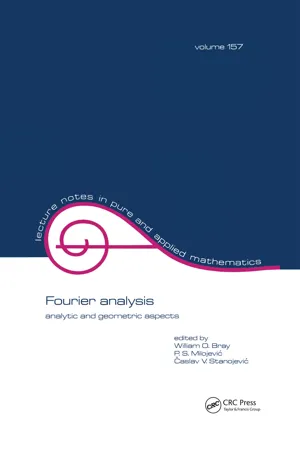
Fourier Analysis
Analytic and Geometric Aspects
- English
- ePUB (mobile friendly)
- Available on iOS & Android
eBook - ePub
Fourier Analysis
Analytic and Geometric Aspects
About this book
Providing complete expository and research papers on the geometric and analytic aspects of Fourier analysis, this work discusses new approaches to classical problems in the theory of trigonometric series, singular integrals/pseudo-differential operators, Fourier analysis on various groups, numerical aspects of Fourier analysis and their applications, wavelets and more.
Information
Table of contents
- Cover
- Half Title
- Title Page
- Copyright Page
- Preface
- Table of Contents
- Contributors
- 1. Ergodic and Mixing Properties of Radial Measures on the Heisenberg Group
- 2. Hp and Weak Hp Continuity of Calderón-Zygmund Type Operators
- 3. A New, Harder Proof That Continuous Functions with Schwarz Derivative 0 Are Lines
- 4. Integrability of Multiple Series
- 5. Aspects of Harmonic Analysis on Real Hyperbolic Space
- 6. Trace Theorems via Wavelets on the Closed Set [0, 1]
- 7. Meta-Heisenberg Groups
- 8. Numerical Approximation of Singular Spectral Functions Arising from the Fourier-Jacobi Problem on a Half Line with Continuous Spectra
- 9. Using Sums of Squares to Prove That Certain Entire Functions Have Only Real Zeros
- 10. An Application of Coxeter Groups to the Construction of Wavelet Bases in Rn
- 11. The Uniform Invertibility of Fourier Transforms of Compositions of Functions in 𝖀(R2) with Certain Quadratic Maps of R2
- 12. On Methods of Fourier Analysis in Multigrid Theory
- 13. Orthogonal Wavelet Bases for L2(Rn)
- 14. The Fourier Transform of Tempered Boehmians
- 15. Approximation-Solvability of Nonlinear Equations and Applications
- 16. Homogeneous Cones and Homogeneous Integrals
- 17. Fourier Inversion in the Piecewise Smooth Category
- 18. Normed Linear Spaces of Trigonometric Transforms and Functions Analytic in the Unit Disk
- 19. Fourier and Trigonometric Transforms with Complex Coefficients Regularly Varying in Mean
- 20. Sampling and the Multisensor Deconvolution Problem
Trusted by 375,005 students
Access to over 1.5 million titles for a fair monthly price.
Study more efficiently using our study tools.
Frequently asked questions
Yes, you can cancel anytime from the Subscription tab in your account settings on the Perlego website. Your subscription will stay active until the end of your current billing period. Learn how to cancel your subscription
No, books cannot be downloaded as external files, such as PDFs, for use outside of Perlego. However, you can download books within the Perlego app for offline reading on mobile or tablet. Learn how to download books offline
Perlego offers two plans: Essential and Complete
- Essential is ideal for learners and professionals who enjoy exploring a wide range of subjects. Access the Essential Library with 800,000+ trusted titles and best-sellers across business, personal growth, and the humanities. Includes unlimited reading time and Standard Read Aloud voice.
- Complete: Perfect for advanced learners and researchers needing full, unrestricted access. Unlock 1.5M+ books across hundreds of subjects, including academic and specialized titles. The Complete Plan also includes advanced features like Premium Read Aloud and Research Assistant.
We are an online textbook subscription service, where you can get access to an entire online library for less than the price of a single book per month. With over 1.5 million books across 990+ topics, we’ve got you covered! Learn about our mission
Look out for the read-aloud symbol on your next book to see if you can listen to it. The read-aloud tool reads text aloud for you, highlighting the text as it is being read. You can pause it, speed it up and slow it down. Learn more about Read Aloud
Yes! You can use the Perlego app on both iOS and Android devices to read anytime, anywhere — even offline. Perfect for commutes or when you’re on the go.
Please note we cannot support devices running on iOS 13 and Android 7 or earlier. Learn more about using the app
Please note we cannot support devices running on iOS 13 and Android 7 or earlier. Learn more about using the app
Yes, you can access Fourier Analysis by William O. Bray, William O. Bray,P. Milojevic,C.V. Stanojevic in PDF and/or ePUB format, as well as other popular books in Mathematics & Analytic Geometry. We have over 1.5 million books available in our catalogue for you to explore.