Putin's Fascists
eBook - ePub

Putin's Fascists

Russkii Obraz and the Politics of Managed Nationalism in Russia

  1. 284 pages
  2. English
  3. ePUB (mobile friendly)
  4. Available on iOS & Android
eBook - ePub

Putin's Fascists

Russkii Obraz and the Politics of Managed Nationalism in Russia

About this book

The Putin regime and its propagandists have long claimed to be fighting the heirs of Nazi Germany. From its crackdown on domestic dissent to its aggression on the international stage, the Kremlin has regularly smeared its adversaries as fascists and fascist collaborators. Russia's invasion of Ukraine, which Putin claimed would achieve its 'denazification', brought this propaganda to a new level of intensity.

This book shines a spotlight on the disturbing reality behind Putin's anti-fascist posturing. It shows how his regime mobilised neo-nazis as proxies during Russia's descent into authoritarianism. Using court records and extensive media and internet sources, it analyses the relationship between the Kremlin and Russkii Obraz, a neo-nazi organization that became a major force on Russia's radical nationalist scene in 2008-10. It shows how Russkii Obraz's rise was boosted by the regime's policy of 'managed nationalism,' which mobilised radical nationalist proxies against opponents of authoritarianism. In return for undermining moderate nationalists and pro-democracy activists, Russkii Obraz received official support and access to public space. This collaboration became politically hazardous for the Kremlin because of Russkii Obraz's neo-Nazi ideology and its connections to BORN, a terrorist group responsible for a series of high-profile killings. When security forces captured the ringleader of BORN, they precipitated the destruction of Russkii Obraz, but veterans of the organisation went on to play a prominent role in Russia's attack on Ukraine in 2014.

Trusted by 375,005 students

Access to over 1.5 million titles for a fair monthly price.

Study more efficiently using our study tools.

Information

Publisher
Routledge
Year
2020
Print ISBN
9780367474133
eBook ISBN
9781000318005

1The genesis of managed nationalism

It seems to me that Putin is engaged in a complex manipulation of all the strategic resources in the country, and he regards us as an object of manipulation. Of course, this linkage would be no less useful to us than to Putin.
– Aleksandr Prokhanov, editor of the ‘red-brown’ newspaper Zavtra, October 20001
Vladimir Putin did not invent ‘managed nationalism’ in Russia. Since the terminal crisis of the Soviet Union, high ranking officials in the Kremlin, regional governments, and the security apparatus had manipulated, courted, and cajoled Russian nationalists. These officials dispensed an array of benefits to their patriotic proteges: covert funding, access to state property, media coverage, and the assistance of political consultants. In return, nationalists performed at least four services for their benefactors. First, they served as scarecrows, a colourful fascist horde who could be used to transform the public narrative about politics into a contest between a virtuous government and its extremist foes. Second, they acted as violent proxies, street fighters who could enforce order and intimidate the opposition without tarnishing the regime’s democratic credentials. Third, they became spoilers, imitative political projects that were designed to weaken the opposition by splitting its electorate and siphoning votes to unelectable rivals. Fourth, nominally independent nationalist politicians and organisations served as dependent allies, who could deliver votes to the regime’s candidates in return for positions in government or the state apparatus.
However, the Putin regime’s manipulation of Russian nationalism differed fundamentally from the schemes of his predecessor. During the 1990s, Boris Yel’tsin was locked in conflict with an ‘irreconcilable opposition’ of red-brown forces, which rejected his liberal democratic project, and which vilified his government as an ‘occupation regime’ serving foreign interests and Jewish oligarchs. The Yel’tsin administration responded to this threat by engaging with nationalists. Some were co-opted, either as spoilers or dependent allies. Others served as scarecrows, who lent substance to the regime’s anti-fascist posturing. But there was always a vast gulf of distrust that separated the Kremlin under Yel’tsin and its nationalist collaborators. Under Putin, that gulf narrowed. During his early years in power, Putin provided opportunities to nationalists who supported the reassertion of state power, the reconquest of Chechnya, the taming of the media, and the subjugation of recalcitrant oligarchs. Yel’tsin’s ‘managed nationalism’ was a rearguard action to defend a beleaguered democracy. By contrast, Putin mobilised nationalists against pro-Western liberals who resisted the slide into authoritarianism. His version of ‘managed nationalism’ was inextricably bound up with the breakdown of democratic institutions.

The politics of nationalism in the Yel’tsin era

Boris Yel’tsin’s struggle with Russian nationalism began during the terminal crisis of the Soviet regime, when conservative nationalists and far-right militants began to collaborate with communist hardliners and the security apparatus. The most visible manifestation of this convergence was the Centrist Bloc, an alliance of parties and movements that was clearly intended to serve as screen for a coup. Unveiled in the autumn of 1990, the Centrist Bloc claimed to unite 21 public organisations. One of them was led by Valerii Skurlatov, a veteran Russian nationalist intellectual who had first attracted attention in 1965 as the author of a ten-point Komsomol manifesto that called for the outlawing of sexual relations between Russians and non-Russians.2 Another was Otechestvo (‘Fatherland’), a ‘Russian patriotic movement’ whose programme asserted ‘the priority of historical values,’ the importance of the Orthodox Church, and the need to strengthen the KGB.3
What lent credibility to the Centrist Bloc was its links to Soyuz, the hard-line faction in the Soviet parliament, which united communist hardliners, Russian nationalists from the ‘Intermovements’ in non-Russian republics, and representatives of the security apparatus. The most menacing of these representatives was Viktor Alksnis, an air force officer nicknamed the ‘Black Colonel,’ an allusion to the Soviet label for the Greek military junta. In October 1990, Alksnis accompanied leaders of the Centrist Bloc to meetings with the prime minister and the chairman of the parliament.4 One month later, when Alksnis called in parliament for Gorbachev’s resignation and the declaration of a state of emergency, he was loudly endorsed by the bloc.5 This pattern was repeated in February 1991, when self-styled ‘National Salvation Committees’ staged abortive coups in the Baltic republics. The bloc responded with a manifesto announcing the formation of its own ‘National Salvation Committee’ and demanding a ban on all political parties.6
Although the Centrist Bloc was ephemeral, it boosted the ascent of one of the leading vehicles of post-Soviet authoritarianism, Vladimir Zhirinovskii’s misnamed Liberal Democratic Party (LDP). Although his original public persona was a caricature of Boris Yel’tsin’s brand of democratic populism, Zhirinovskii quickly adopted radical nationalist themes. As a result, the LDP became a haven for far-right militants, who were attracted by the party’s anti-liberal purpose and the opportunity to spend the party coffers. The pattern was set by Viktor Yakushev, a neo-Nazi best known for shocking Muscovites in the mid-1980s with a skinhead rally marking Hitler’s birthday in Pushkin Square.7 As leader of the National-Social Union (NSS), a neo-Nazi splinter group of the Pamyat’ Society, Yakushev had helped to plaster Moscow subways with placards in support of Zhirinovskii’s overtly nationalist campaign for the RSFSR presidency in the summer of 1991. Grateful for their contribution to his unexpectedly high result, Zhirinovskii granted three major party posts to NSS militants.8
The collapse of the Soviet Union intensified Yel’tsin’s conflict with Russian nationalism. By signing the Belovezh’ accords, the pact that formalised the dismantlement of the Soviet state, Yel’tsin tarnished his own patriotic credentials. In the eyes of many nationalists, this was an act of treason that made him culpable not only for the loss of historic Russian territories but also for the predicament of 25 million ethnic Russians left stranded in successor states. Yel’tsin’s vulnerability was aggravated by the economic crisis and social disruption that accompanied the introduction of market reforms. Some of the most conspicuous beneficiaries of this process were a group of nominally Jewish oligarchs, a development that was exploited by ‘red-brown’ politicians and anti-Semitic publicists to fabricate conspiracy theories about the president.
At the same time, the end of the Soviet Union made it easier for Yel’tsin’s fractious opponents to unite around nationalist slogans. Russian traditionalists could rally alongside communists without contributing to the perpetuation of a Leninist state or condoning its internationalist ideology and history of revolutionary terror. This alliance of ex...
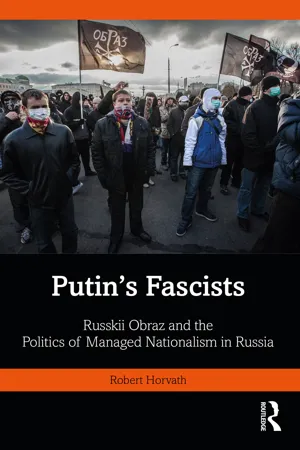
Table of contents

  1. Cover
  2. Half Title
  3. Series Page
  4. Title Page
  5. Copyright Page
  6. Dedication
  7. Table of Contents
  8. List of Illustrations
  9. Acknowledgements
  10. List of Abbreviations
  11. Introduction
  12. Chapter 1: The genesis of managed nationalism
  13. Chapter 2: The rise of a groupuscule
  14. Chapter 3: Foot soldiers of the preventive counter-revolution
  15. Chapter 4: The attack on Orangist nationalism
  16. Chapter 5: Propagandist of the partisans
  17. Chapter 6: The crackdown
  18. Chapter 7: Right-conservatism and the second counter-revolution
  19. Conclusion
  20. Source
  21. Index

Frequently asked questions

Yes, you can cancel anytime from the Subscription tab in your account settings on the Perlego website. Your subscription will stay active until the end of your current billing period. Learn how to cancel your subscription
No, books cannot be downloaded as external files, such as PDFs, for use outside of Perlego. However, you can download books within the Perlego app for offline reading on mobile or tablet. Learn how to download books offline
Perlego offers two plans: Essential and Complete
  • Essential is ideal for learners and professionals who enjoy exploring a wide range of subjects. Access the Essential Library with 800,000+ trusted titles and best-sellers across business, personal growth, and the humanities. Includes unlimited reading time and Standard Read Aloud voice.
  • Complete: Perfect for advanced learners and researchers needing full, unrestricted access. Unlock 1.5M+ books across hundreds of subjects, including academic and specialized titles. The Complete Plan also includes advanced features like Premium Read Aloud and Research Assistant.
Both plans are available with monthly, semester, or annual billing cycles.
We are an online textbook subscription service, where you can get access to an entire online library for less than the price of a single book per month. With over 1.5 million books across 990+ topics, we’ve got you covered! Learn about our mission
Look out for the read-aloud symbol on your next book to see if you can listen to it. The read-aloud tool reads text aloud for you, highlighting the text as it is being read. You can pause it, speed it up and slow it down. Learn more about Read Aloud
Yes! You can use the Perlego app on both iOS and Android devices to read anytime, anywhere — even offline. Perfect for commutes or when you’re on the go.
Please note we cannot support devices running on iOS 13 and Android 7 or earlier. Learn more about using the app
Yes, you can access Putin's Fascists by Robert Horvath in PDF and/or ePUB format, as well as other popular books in Politics & International Relations & Nationalism & Patriotism. We have over 1.5 million books available in our catalogue for you to explore.