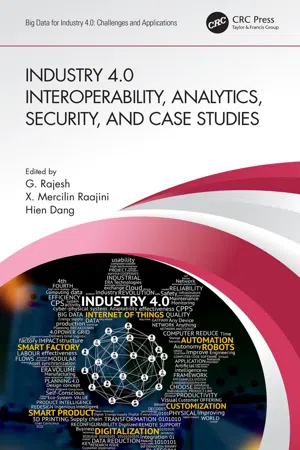
All over the world, vast research is in progress on the domain of Industry 4.0 and related techniques. Industry 4.0 is expected to have a very high impact on labor markets, global value chains, education, health, environment, and many social economic aspects.
Industry 4.0 Interoperability, Analytics, Security, and Case Studies provides a deeper understanding of the drivers and enablers of Industry 4.0. It includes real case studies of various applications related to different fields, such as cyber physical systems (CPS), Internet of Things (IoT), cloud computing, machine learning, virtualization, decentralization, blockchain, fog computing, and many other related areas. Also discussed are interoperability, design, and implementation challenges.
Researchers, academicians, and those working in industry around the globe will find this book of interest.
FEATURES
Provides an understanding of the drivers and enablers of Industry 4.0
Includes real case studies of various applications for different fields
Discusses technologies such as cyber physical systems (CPS), Internet of Things (IoT), cloud computing, machine learning, virtualization, decentralization, blockchain, fog computing, and many other related areas
Covers design, implementation challenges, and interoperability
Offers detailed knowledge on Industry 4.0 and its underlying technologies, research challenges, solutions, and case studies
1Big Data Analytics and Machine Learning for Industry 4.0: An Overview
Nguyen Tuan Thanh Le and Manh Linh Pham
CONTENTS
1.1 Big Data Analytics for Industry 4.0
1.1.1 Characteristics of Big Data
1.1.2 Characteristics of Big Data Analytics
1.2 Machine Learning for Industry 4.0
1.2.1 Supervised Learning
1.2.2 Unsupervised Learning
1.2.3 Semi-Supervised Learning
1.2.4 Reinforcement Learning
1.2.5 Machine Learning for Big Data
1.3 Deep Learning for Industry 4.0: State of the Art
1.4 Conclusion
Acknowledgments
References
1.1 Big Data Analytics for Industry 4.0
1.1.1 Characteristics of Big Data
The concept of “Big data” was mentioned for the first time by Roger Mougalas in 2005 [1]. It refers to a large scale data, one of the characteristics of Industry 4.0, that cannot be stored in a single computer and is almost impossible to be handled using traditional data analytics approaches. Big data applications exploded after 2011 are related to the improvement in computing power and storage as well as the reduction in the cost of sensors, communication and, recently, the development of the Internet of Things (IoT). These advances have leaded to the utilization of multiple sources (sensors, applications, people, and animals) in the generation of data. In 2011, Big data is defined by [2] using 4Vs characteristics, including: Volume, Velocity, Variety, and also Value. Then the fifth one, Veracity, was introduced in 2012 [3], as shown in Fig. 1.1.
FIGURE 1.1 5Vs Characteristics of Big Data
Volume hints to the size and/or scale of datasets. Until now, there is no universal threshold for data volume to be considered as big data, because of the time and diversity of datasets. Generally, big data can have the volume starting from exabyte (EB) or zettabyte (ZB) [4].
Variety implies the diversity of data in different forms which contain structured, semi-structured, or unstructured ones. Real-world datasets, coming from heterogeneous sources, are mostly under unstructured or semi-structured form that makes the analysis challenging because of the inconsistency, incompleteness, and noise. Therefore, data prepossessing is needed to remove noise, which includes some steps such as data cleaning, data integrating, and data transforming [5].
Velocity indicates the speed of processing data. It can fall into three categories: streaming processing, real-time processing, or batch processing. This characteristic emphasizes that the speed of producing data should keep up with the speed of processing data [4].
Value alludes to the usefulness of data for decision making. Giant companies (e.g., Amazon, Google, Facebook, etc.) analyze daily large scale datasets of users and their behavior to give recommendations, improve location services, or provide targeted advertising, etc. [3].
Veracity denotes the quality and trustworthiness of datasets. Due to the variety characteristic of data, the accuracy and trust become harder to accomplish and they play an essential role in applications of big data analytics (BDA). As with analyzing millions of health care entries in order to respond to an outbreak that impacts on a huge number of people (e.g., the CoVid-19 pandemic) or veterinary records to guess the plague in swine herd (e.g., African swine fever or porcine reproductive and respiratory syndrome), any ambiguities or inconsistencies in datasets can impede the precision of analytic process [3], leading to a catastrophic situation.
Generally, big data in the context of Industry 4.0 can originate from several and various sources, such as: product or machine design data, machine-operation data from control systems, manual-operation records performed by staff, product-quality and process-quality data, manufacturing execution systems, system-monitoring and fault-detection deployments, information on operational costs and manufacturing, logistics information from partners, information from customers on product utilization, feedback, and so on and so forth [6]. Some of these datasets are semi-structured (e.g., manual-operation records), a few are structured (e.g., sensor signals), and others are completely unstructured (e.g., images). Therefore, an enterprise 4.0 requires cutting-edge technologies that can fully take advantage of the valuable manufacturing data, including: machine learning (ML) and BDA.
1.1.2 Characteristics of Big Data Analytics
BDA can be referred to as “the process of analyzing large scale datasets in order to find unknown correlations, hidden patterns, and other valuable information which is not able to be analysed using conventional data analytics” [7], as the conventional data analysis techniques are no longer effective because of the special characteristics of big data: massive, heterogeneous, high dimensional, complex, erroneous, unstructured, noisy, and incomplete [8].
BDA has attracted attention from not only academic but also industrial scientists as the requirement of discovering hidden trends in large scale datasets increases. Reference [9] compared the impact of BDA for Industry 4.0 with the invention of the microscope and telescope for biology and astronomy, respectively. Recently, the considerable development in the ubiquitous IoT (i.e., Internet of Things), sensor networks, and CPS (i.e., cyber-physical systems) have expanded the data-collection process to an enormous scale in numerous domains, including: social media, smart cities, education, health care, finance, agriculture, etc. [3].
Various advanced techniques to analyze data (i.e., ML, computational intelligence, data mining, natural language processing) and potential strategies (i.e., parallelization, divide and conquer, granular computing, incremental learning, instance selection, feature selection, and sampling) can help to handle big data issues. Empowering more efficient processing, and making better decisions can also be obtained by using these techniques and strategies [3].
Divide and conquer helps to reduce the complexity of computing problems. It is composed of three phases: firstly, it reduces the large-complex problem into several smaller, easier ones; secondly, it tries to solve each smaller problem; and finally, it combines the solutions of all the smaller problems to solve the original problem [3].
Parallelization allows one to improve computation time by dividing big problems into smaller instances, distributing smaller tasks across multiple threads and then performing them simultaneously. This strategy decreases computation time instead of total amount of work because multiple tasks can be performed simultaneously rather than sequentially [10].
Incremental learning is widely practiced and used to handle streaming data. It is a learning algorithm and can be trained continuously with additional data rather than current ones. In the learning process, this strategy tunes parameters each time new input data comes in [10].
Granular compu...
Table of contents
Cover
Half-Title
Series
Title
Copyright
Contents
Editors
Contributors
Chapter 1 Big Data Analytics and Machine Learning for Industry 4.0: An Overview
Chapter 2 Impact of Blockchain-Based Cyber Security Implementing Industry 4.0
Chapter 3 Hybrid Huffman Tree Model for Securing Medical Data Using Steganography
Chapter 4 Energy Conservation in IOT-Based Intelligent Transport System
Chapter 5 Digital Information System for Attack Reduction in Industry 4.0
Chapter 6 An Intelligent Blockchain-Based Framework for Securing Smart Grid
Chapter 7 Intelligent Fog Computing for Industrial Wireless Sensor Networks
Chapter 8 A Secure Data Sharing Scheme Based on Blockchain for Industrial Internet of Things Using Consensus Algorithm
Chapter 9 Smart Trust Management Scheme for Detecting Attacks in IoT and Ubiquitous Computing
Chapter 10 IoT-Based Smart Pipeline Leakage Detecting System for Petroleum Industries
Chapter 11 IOT-Based Smart Irrigation Systems
Chapter 12 Safety Wing for Industry (SWI 2020) – An Advanced Unmanned Aerial Vehicle Design for Safety and Security Facility Management in Industries
Chapter 13 An Efficient Decentralized Medical Prescription Tracking Using Blockchain
Chapter 14 Blockchain for Industry 4.0: An Assessment of Blockchain Adoptability
Chapter 15 An Effective E-Learning Mechanism to Meet the Learning Demand of Industry 4.0
Index
Trusted by 375,005 students
Access to over 1.5 million titles for a fair monthly price.
Study more efficiently using our study tools.
Frequently asked questions
Yes, you can cancel anytime from the Subscription tab in your account settings on the Perlego website. Your subscription will stay active until the end of your current billing period. Learn how to cancel your subscription
No, books cannot be downloaded as external files, such as PDFs, for use outside of Perlego. However, you can download books within the Perlego app for offline reading on mobile or tablet. Learn how to download books offline
Perlego offers two plans: Essential and Complete
Essential is ideal for learners and professionals who enjoy exploring a wide range of subjects. Access the Essential Library with 800,000+ trusted titles and best-sellers across business, personal growth, and the humanities. Includes unlimited reading time and Standard Read Aloud voice.
Complete: Perfect for advanced learners and researchers needing full, unrestricted access. Unlock 1.5M+ books across hundreds of subjects, including academic and specialized titles. The Complete Plan also includes advanced features like Premium Read Aloud and Research Assistant.
Both plans are available with monthly, semester, or annual billing cycles.
We are an online textbook subscription service, where you can get access to an entire online library for less than the price of a single book per month. With over 1.5 million books across 990+ topics, we’ve got you covered! Learn about our mission
Look out for the read-aloud symbol on your next book to see if you can listen to it. The read-aloud tool reads text aloud for you, highlighting the text as it is being read. You can pause it, speed it up and slow it down. Learn more about Read Aloud
Yes! You can use the Perlego app on both iOS and Android devices to read anytime, anywhere — even offline. Perfect for commutes or when you’re on the go. Please note we cannot support devices running on iOS 13 and Android 7 or earlier. Learn more about using the app
Yes, you can access Industry 4.0 Interoperability, Analytics, Security, and Case Studies by G. Rajesh, X. Mercilin Raajini, Hien Dang, G. Rajesh,X. Mercilin Raajini,Hien Dang in PDF and/or ePUB format, as well as other popular books in Business & Business Law. We have over 1.5 million books available in our catalogue for you to explore.