This book provides an overview of the basic concepts of quality, indoor lighting, and explains concepts like visual comfort, visual interest, and integrated design as they relate to the practice of lighting design. Energy-efficient lighting technologies, including LED lighting and digital control systems, and design strategies that increase visual comfort and productivity are discussed in plain language, and examined in a straightforward way to give the reader, whether an architect, interior designer, engineer, building trades professional, or student a broad understanding of the art and science of energy-efficient quality lighting.
- 300 pages
- English
- ePUB (mobile friendly)
- Available on iOS & Android
eBook - ePub
Quality Lighting for High Performance Buildings
About this book
Information
Part I
Quality Lighting
Chapter 1
What is Lighting Design?
A DEFINITION
Lighting design is the specification of a system of luminaires and controls to create illumination appropriate to a given environment. This means that lighting designers choose which lighting fixtures should go where (specification of a system of luminaires), as well as how they are grouped and which should be on at a given time and at what levels of intensity (controls). But how does the designer determine what illumination is “appropriate to a given environment”? Historically, architectural lighting designers, and to a great degree electrical engineers performing in this capacity, have been concerned with providing enough illumination for a specific visual task. Quantity was the key. And the question was, simply: how much light is enough? It’s been a long time since we’ve considered lighting design in such simple terms. As a culture we accept that good lighting is important in many other ways, whether it’s to create a comfortable, productive environment, or to set a mood. Many other factors are central to the design of a quality lighting system: color temperature, accurate color rendering, volumetric quality, and contrast ratios, to name a few. Yet even so, many of those outside of the profession—and some within it—still focus on the quantity rather than the quality of light delivered by a given system. And it’s easy to see why. Lighting is ethereal. It has physical properties but we can’t touch it. It helps us see, but outside the context of the world of objects, which reflect light back to us to create an image of those objects in our minds, light is, by itself, invisible.
A CASE IN POINT
Recently, at a visit to a medical office comprised of a very well designed suite of examination rooms, I had a brief conversation with one of the staff members about the lighting. This is a facility which clearly has benefited from an integrated design process, with a lot of indirect lighting positioned so as to illuminate appropriately reflective surfaces and light the space with pleasing contrast ratios and as little direct light and glare as possible. The designer specified cove treatments, wall washers, recessed vertical fluorescent lighting in the hallway walls with acrylic diffusers, and backlit mirrors in the restrooms. The examination rooms each contained a fluorescent fixture with diffusing lenses and shielding louvers over the exam area, where higher illuminance levels are necessary. The consultation areas were bathed in an ambient light that helped the doctors to accurately see their patient’s skin tones and facial expressions. The staff’s work-stations were outfitted with under-shelf task lighting. There were decorative pendants that simultaneously provided a gentle accent as well as task lighting on the public-facing counters. The ambient illuminance levels were low—between ten and fifteen footcandles in the circulation areas—yet there was plenty of light for patients of all ages to negotiate their way around. When I asked the staff member whether she liked the lighting in these new offices, and if she thought it was good, she readily agreed that it was. But the way she described the complex, layered, low-ambient lighting design was to simply say it felt “brighter” than her old office—which it undoubtedly wasn’t. What she clearly meant was that she could see better. Maybe she was aware that the lighting in her present facility went a long way towards setting a mood. This was a modern, clinical research facility in New York City. The design was one that lent a serious and reassuring air to a place where visitors bring their greatest anxieties and concerns for their own well-being—a doctor’s office. It was clear from our conversation that the staff member had an awareness of these factors. She knew good lighting when she saw it, but thinking about lighting and articulating her thoughts in terms other than “brightness” was something she had difficulty doing.
Such is the case for many of us in the design professions. Most architects, interior designers, and engineers are aware that a well-designed lighting system is important for many reasons, and that while having enough light is necessary for us to be able to see, lighting can also greatly affect the way we experience our environment in numerous other ways. Anyone who has walked into a poorly maintained store where the fluorescent lighting is a hodgepodge of different color temperatures, or where the lamps have not been changed in many years, and after burning way past their expected lifespan emit only a fraction of their original light output, will tell you that their experience of that store was diminished as a result of the lighting quality. We all know that poor lighting can make a customer feel uncomfortable buying a product that might require advanced support from a store owner; or prompt a client to hire one business over another for a project; or tip the balance for a tenant deciding whether or not to lease a particular apartment or office. But for most of us, the only way we are able to discuss lighting is in terms of whether or not there is enough of it, when in fact the quality of the lighting is as important as the quantity of lighting.

The fact is, in certain situations too much light, coming from the wrong direction, can make it difficult to see. Glare from a direct line of sight to a light source, or lighting that produces high contrast ratios within an environment, can inhibit our ability to discern objects or features that fall within the shadows. Anyone who has had the experience of talking with someone who is standing with their back to a window on a brightly lit day will recognize this right away. Though there may be plenty of light, we still struggle to see those objects that are right in front of us. But though this is a common phenomenon, and one we take for granted in our everyday experience, understanding the nuances of light, and how we experience the lit environment in terms other than brightness, remains a challenge for most people.
Now, let’s circle back to our definition of lighting design: “The specification of a system of luminaires and controls to create illumination appropriate to a given environment.” What constitutes appropriate illumination? Clearly having the right amount of light is important. We need a certain amount of light to see, and, as we will discuss later in the book, more light to see fine details, and even more light as we get older. We may also need different amounts of light depending on the mood we want to convey. Certainly a romantic restaurant will be lit a good deal less brightly than an automobile showroom. Most of us can recall visiting both brightly and dimly lit environments where our visual experience was good, and those where it was not. So if it’s not just about the quantity, what then constitutes quality lighting?

WHAT IS QUALITY LIGHTING?
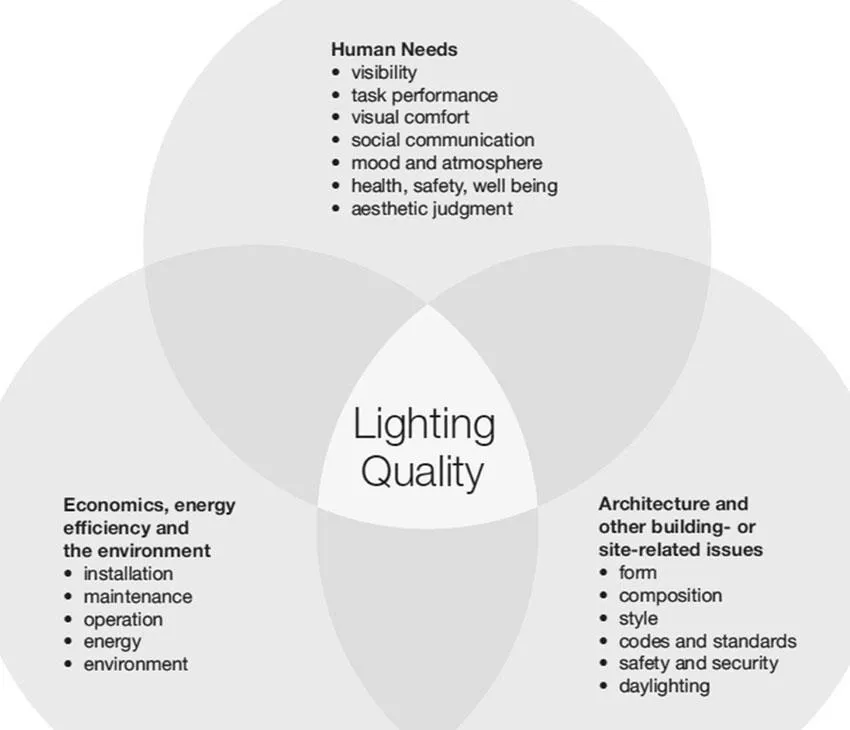
Quality lighting is the result of an integrative design process in which the building design, interior design, and lighting design evolve together to create a built environment that is sustainable, productive, and healthy for the people who occupy it. Quality lighting must support the human activities that each environment is designed for. As designers we start with the assumption that lighting is for people, not just buildings, and so quality lighting must satisfy the needs of the occupants even as it provides aesthetic appeal and reveals and enhances the building’s architectural form.
WHAT IS SUSTAINABLE DESIGN?
A building design is sustainable when it results in lowered energy use and lessened environmental damage during the construction phase and operational lifetime of the building. The concept of sustainability is based on an understanding that there are finite resources, and space, at our disposal, and that we need to limit our consumption of these resources to the amount that can be regenerated, both for our health and to insure we do not run out. This applies to energy, potable water, air, and arable land. To be sustainable, a quality lighting design must be energy-efficient. But using high efficiency lighting and avoiding wasted energy is not enough. The lighting equipment should also be manufactured in a sustainable way that doesn’t waste resources or emit pollutants into the water or atmosphere. It should include as few toxic materials as possible, generate as little waste as possible, and it should be sourced as close to the construction site as possible to avoid expending unnecessary energy in transport.
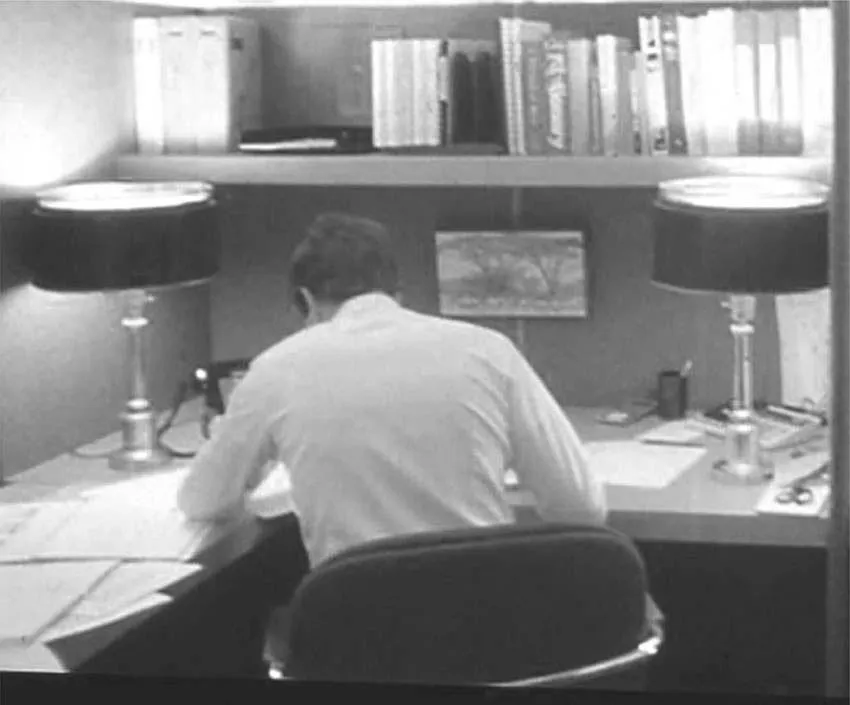
Good design is key to keeping sustainable lighting sustainable. If lighting is for people, and not just buildings, then it follows that if it does not satisfy their human requirements a building’s occupants may modify the lighting in ways that are often contrary to the designer’s intent, and in doing so they may negate any energy efficiencies that would otherwise be realized. These modifications can, and often do, take the form of additional electric lighting that may be from inefficient sources, or disabled energy efficiency controls. An incorrectly commissioned occupancy sensor that automatically turns the lights off in a room while the occupants are still present is a prime example. This will not have to happen more than once or twice before the people who regularly use this room find a way to disable the occupancy sensor, negating any benefit that control device may have brought to the design in the first place. A poorly designed lighting layout that wastefully directs too much light to an open office’s circulation areas, and not enough to the employee’s desks, may result in the facility manager or the employees themselves developing ad-hoc task lighting solutions that are not energy-efficient, and that may push the office out of compliance with the local energy code. And a lighting design that only takes into account the work-plane lighting levels, with no consideration for the contrast ratios between the task area and surrounding surfaces, may have the negative result of creating an uncomfortable environment that leads to employee fatigue and reduced productivity.
So what are the elements of a quality lighting design? As we will discuss in this book, in addition to being energy-efficient and providing the right amount of light, a quality lighting design must minimize glare and manage contrast to create a visually comfortable environment. It must also take into account the color temperature or color quality of the lighting sources employed so that colors are rendered accurately, and the occupants, and the environment itself, look good. It must provide the right amount of light to set the correct tone and to support the visual tasks that will be performed. It should make effective use of any available natural daylight. And it should incorporate a system of controls that allows the lighting to be dimmed, or switched off, as required to suit individual preferences and minimize energy use as much as possible throughout the day.
Chapter 2
Understanding Light: (Luminance, Illuminance and Lumens)
LUMENS & CANDELAS
It’s important to clarify some of the terms we will use throughout this book, and in doing so develop a clearer understanding of how electric lighting works. First, let’s start with the light source and luminaire. The light source, or lamp (commonly called the light bulb), produces a certain amount of visible radiant energy, or light, which we measure in lumens. The lamp, in combination with the luminaire (a fancy term for a lighting fixture), will direct and define how these lumens are projected. Some lamps and luminaires will project the lumens in an omnidirectional pattern (in all directions), like a household light bulb in a table lam...
Table of contents
- Cover
- Half Title
- Title Page
- Copyright Page
- Table of Contents
- Acknowledgments
- Introduction
- Part I—Quality Lighting
- Part II—How Much Light do we Need & Where do we Need It?
- Part III—Sustainability & Electric Lighting Sources
- Part IV—Sustainable Applications: Daylighting & Lighting Controls
- Part V—Building Green
- Appendix A—Color Illustrations
- Appendix B—Lighting Calculations & Calculation Software
- Appendix C—Resources
- Index
Trusted by 375,005 students
Access to over 1.5 million titles for a fair monthly price.
Study more efficiently using our study tools.
Frequently asked questions
Yes, you can cancel anytime from the Subscription tab in your account settings on the Perlego website. Your subscription will stay active until the end of your current billing period. Learn how to cancel your subscription
No, books cannot be downloaded as external files, such as PDFs, for use outside of Perlego. However, you can download books within the Perlego app for offline reading on mobile or tablet. Learn how to download books offline
Perlego offers two plans: Essential and Complete
- Essential is ideal for learners and professionals who enjoy exploring a wide range of subjects. Access the Essential Library with 800,000+ trusted titles and best-sellers across business, personal growth, and the humanities. Includes unlimited reading time and Standard Read Aloud voice.
- Complete: Perfect for advanced learners and researchers needing full, unrestricted access. Unlock 1.5M+ books across hundreds of subjects, including academic and specialized titles. The Complete Plan also includes advanced features like Premium Read Aloud and Research Assistant.
We are an online textbook subscription service, where you can get access to an entire online library for less than the price of a single book per month. With over 1.5 million books across 990+ topics, we’ve got you covered! Learn about our mission
Look out for the read-aloud symbol on your next book to see if you can listen to it. The read-aloud tool reads text aloud for you, highlighting the text as it is being read. You can pause it, speed it up and slow it down. Learn more about Read Aloud
Yes! You can use the Perlego app on both iOS and Android devices to read anytime, anywhere — even offline. Perfect for commutes or when you’re on the go.
Please note we cannot support devices running on iOS 13 and Android 7 or earlier. Learn more about using the app
Please note we cannot support devices running on iOS 13 and Android 7 or earlier. Learn more about using the app
Yes, you can access Quality Lighting for High Performance Buildings by Michael Stiller in PDF and/or ePUB format, as well as other popular books in Business & Industrial Management. We have over 1.5 million books available in our catalogue for you to explore.