This book is written as a practical guide to those interested in the pursuit of energy resilience at a local scale. Energy resilience is defined as the relative ability of an institution to carry out its mission during a shock to the energy system and approach the concept on the level of a single site occupied by a single community or institution. Examples are drawn from four key community types: military bases, healthcare campuses, educational campuses, and municipal governments. The book then describes a framework for developing an energy resilience plan that applies to each. While the focus is clearly on the United States, understanding the energy resilience threat and conducting long-range energy resilience planning will benefit communities all over the globe.
Divided into three main parts, Part One describes the specific energy security threats that are facing local institutions and communities and how an energy shock can affect the mission at each of the four community types and the advantages that each will enjoy in their pursuit of energy resilience. Part Two provides concrete guidance for pursuing energy resilience at a particular institution and allows managers to assess where their institution lies on the energy resilience spectrum and plot a course toward where they would like to be. Part Three describes the three main areas of energy resilience performance: energy efficiency, on-site generation, and emergency planning. Case studies are also provided.
Energy Resilience—Imperatives and Local Advantages
Chapter 1
Today’s Energy Challenges
The reliable access to energy we enjoy in the United States is based on a complex relationship of natural, technological and institutional factors. Each flip of the light switch relies on technology and institutions adequate to extract fuel from the natural environment, transform it into electricity, and distribute it over tens or even hundreds of miles. Each step in this process in turn relies upon social organization and support, from international markets for fossil fuels to the public/private coordination that allows for the generation and distribution of energy on a large scale. For such a complex process, it is remarkably reliable. However, when just one of the necessary natural, technological, or institutional conditions fails, we quickly find ourselves in the dark.
Based on the community-oriented perspective of this book, we discuss energy resilience as the ability of institutional managers and administrators to ensure a constant supply of energy adequate to guarantee the safety of their constituents and the uninterrupted pursuit of their institution’s core mission. Energy resilience has different practical implications at our four community types (hospitals, military bases, educational campuses, and municipalities), but leaders in each should be aware of the factors that pose potential threats to their energy security, and be able to assess each threat to ensure that it is properly addressed. The most likely threats to energy resilience are price volatility, power quality, and full grid outages due to aging energy infrastructure, severe weather events, and threats from sabotage.
This chapter focuses on the nature and severity of threats to the natural, social, and technological systems on which the U.S. energy security relies. First, we describe the factors that affect overall supply and demand trends in our energy system. We will evaluate the potential for energy demand to outstrip the natural resources needed to supply it, and any effects this may have on price volatility. We will then look at the state of the technology necessary to deliver energy to individual communities, with a focus on distribution systems and energy grids. We will describe the threat to these technological systems from the natural forces of climate change and extreme weather.. Finally, we will analyze more active social factors that may affect energy supply, such as such as terrorism and social protest.
SUPPLY AND DEMAND IN THE US ENERGY SYSTEM
For decades, we have been struggling to make the transition from a world in which the supply of fossil fuels seemed endless, to one in which the limits on that supply are making the extraction of these resources increasingly more expensive and difficult. As we have approached the limits of existing extraction capacity, we have sought new, more expensive or technologically complex methods for gathering fuel. To find untapped reserves of fossil fuel, we have moved deeper into the ocean and further into the Arctic than previously thought possible. We have drilled in formerly protected lands, and devised technology to extract gas from shale formations that were previously unreachable. In doing so, we have managed to keep up with ever-rising demand. However, our own ingenuity will only hold out so long against a finite resource, and as the gap between effective supply and demand for fossil fuel widens in the future, new stresses will arise on our energy security, from price volatility to social conflict and climate change.
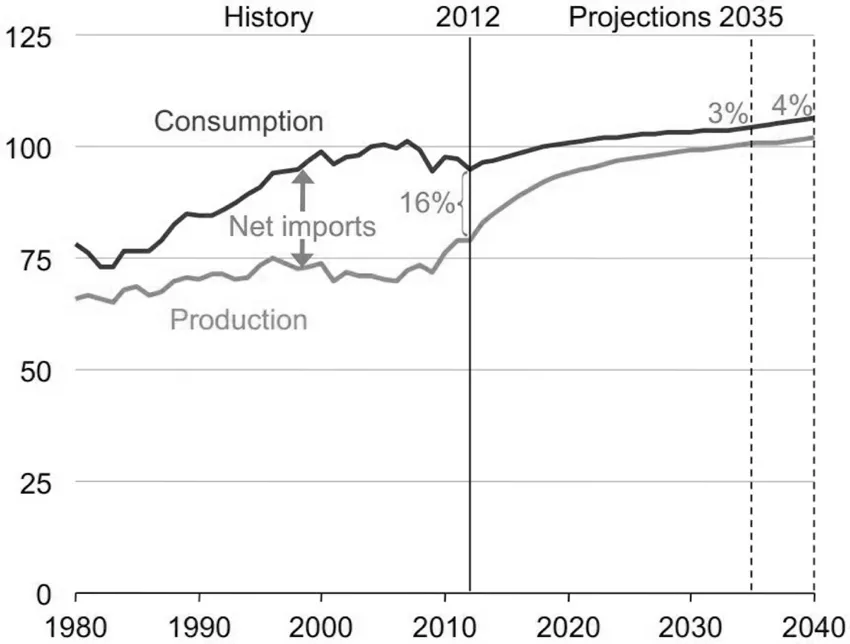
The immediate future of our fuel supply seems to be relatively secure. The U.S. Energy Information Administration (EIA) has reported that it expects the global supply of crude oil and other liquid hydrocarbons to be adequate to meet the world’s demand for at least the next 25 years.2 In the United States, the preliminary EIA 2014 Annual Energy Outlook describes a future of increased domestic fuel production and decreased per capita demand for energy.3 The report predicts that the rate of domestic oil production will soon match its all-time high, set in 1970, of 9.6 million barrels a day—due largely to technological advancements that allow previously unreachable deposits to be effectively exploited.
The outlook is even brighter for domestic natural gas. The report predicts that, while oil production will begin to plateau around 2020, the production of natural gas will continue to grow into the foreseeable future. By the farthest time horizon for EIA predictions in 2040, natural gas production in the United States will have grown by 56 percent over 2012 levels.4
This growth rate will more than keep up with the growth in energy demand domestically, and will result in an overall decrease in the share of U.S. fossil fuel use from imports to 32 percent in 2040, down from its peak at over 60 percent in 2005. The report predicts that the United States will become an overall net exporter of natural gas as soon as 2018.
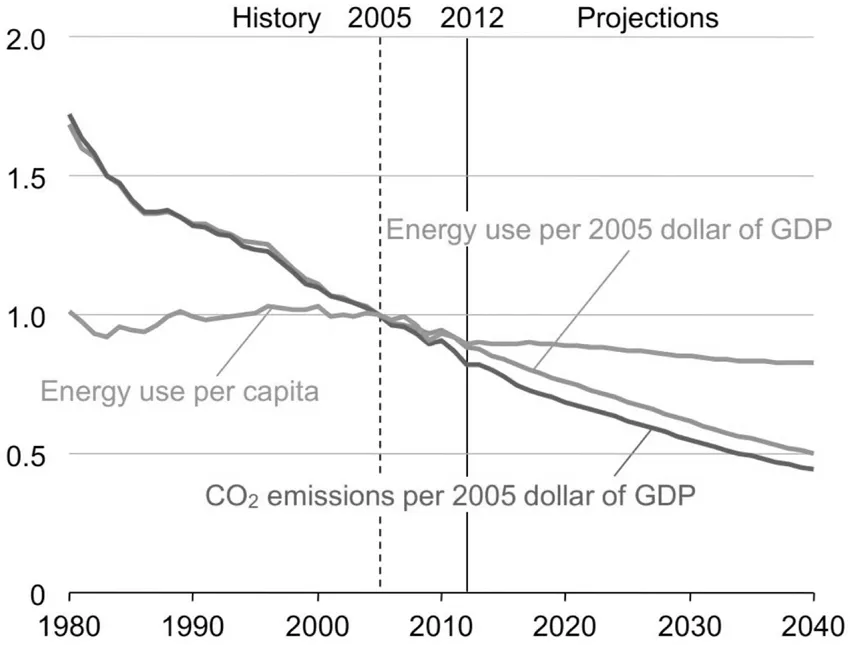
Two of the most important factors behind the country’s ability to meet domestic energy demand are population growth and energy intensity. The first is a measure of birth and immigration rates, and the second is a measure of how much energy each person uses, or how much energy is used per unit of economic activity. When the EIA analyzed these variables in 2013, they found that U.S. population is likely to increase by 0.9 percent per year from 2011 to 2040, and the economy, as measured by GDP, is likely to grow over that same period at an average annual rate of 2.5 percent. Meanwhile, the total energy consumption is expected to increase by 0.3 percent per year, which implies that energy intensity, both per capita and per dollar of GDP, will decline into the foreseeable future.4 Much of this decrease in energy intensity is due to improvements in the efficiency of energy consuming equipment, used in buildings, appliances, cars and factories. Chapter 5 will discuss the ways that energy efficient technologies can be harnessed at the institutional level to improve energy resilience.
Figure 1-1: Total energy production and consumption, 1980–2040, quadrillion Btu. Source: U.S. EIA Annual Energy Outlook, 2014.5
It might seem from these numbers that there is little cause for concern when it comes to the future of our energy supply. Indeed, if the EIA projections are borne out over the next 25 years, there should be ample global supply of fuel to meet energy demands in the United States, an increasing share of which would be produced domestically. However, a secure supply does not necessarily mean low prices, and the steadily rising cost of energy is compelling some communities to trim their loads, and become more energy resilient. The case study that follows describes a healthcare organization that was spurred toward energy efficiency by rising costs, but ended up fully embracing energy resilience.
Figure 1-2: Energy use per capita, energy use per dollar of GDP, and emissions per dollar of GDP 1980–2040 (index: 2005 = 1). Source: US EIA Annual Energy Outlook, 2014.4
Case Study—University Medical Center of Princeton at Plainsboro45:
Like hospital administrators all over the country, the leadership of the Princeton HealthCare System faced a growing dilemma at the beginning of this century. Healthcare costs were rising alongside the cost of doing business, suggesting an undesirable tradeoff between breadth of service and health of the business. As Princeton HealthCare System President and CEO Barry Rabner explained it, “in order to keep the costs for patients from rising, I needed to figure out where to cut back. When compared to cutting staff, or clinical services, or support for patients, cutting energy costs was a no brainer. Honestly, I look at the opportunity to save money on energy as a gift to me as an administrator.”
In recognition of this opportunity, Princeton HealthCare System has sought to make the newly opened University Medical Center of Princeton at Plainsboro (UMCPP) an example for the industry. Princeton worked with the energy contractor NRG Energy to integrate the suite of energy efficiency and generation technologies on display at UMCPP into one hyper efficient, integrated on-site energy system. A 250 kilowatt solar array works in conjunction with a massive $34 million CHP plant, which combined with a chilled water thermal energy storage system maintains the temperature of the buildings, all of which is continually monitored and controlled by a computer system which ensures optimal operational and fiscal efficiency.
The upshot of this system is 100% power redundancy with the grid, with essential clinical equipment backed up with batteries. That means that UMCPP meets all of its energy needs with on-site generation, and uses the grid as a back-up option should its own systems fail. Should there be a simultaneous failure of both the on-site system and the grid, critical equipment is backed up by battery, or in limited cases, by small diesel generators. This arrangement sets a very high standard for energy resilience within the health care industry, and helps Princeton HealthCare System to advance other areas of its mission as well. As Rabnor explained, “we found a system that not only reduces our energy costs, but gives us security in the face of uncertainty in the energy market, which helps us protect our patients. It was that desire to protect our patients that ended up being our main driver in our decision to invest in this system.”
Although patients may not be aware of how much more secure the operations of UMCPP are when compared to a grid dependent hospital, steps that Princeton has taken to improve energy efficiency and environmental stewardship have had a positive effect on the patient experience as well. For instance, the building is designed to take maximum advantage of natural light. It is south-facing, and during the day 90% of interior spaces can be lit with sunlight, a rarity in hospital settings. In developing UMCPP, Princeton demolished an adjacent factory site, remediated the 32-acre plot on which it sat, and converted into a park, planted with indigenous trees and plants.
Although our supply of fuel may not be in danger of drying up in the near future, it is important to remember that fuel is not the only input in a robust energy system, and threats to water supplies and energy delivery infrastructure could soon affect energy security for local communities.
WATER AND THE ENERGY SYSTEM
Supply of fuel is just one variable in the formula that guarantees energy to our homes and business. Increasingly, scientists are singling out water as a possible limiting factor in this equation.5 Water is a key ingredient throughout the energy supply chain. It is used extensively in the drilling and mining of fuels, including natural gas, coal, oil, and uranium. Fuel refining and processing is a water-intensive process in its own right, and is required before oil, uranium, or natural gas can be used in a power plant. Transporting the refined fuel uses still more water. Water is used to test fuel pipelines for leaks, and to transport coal through slurries. Finally, water is an essential element in the vital functions of a vast majority of the power plants in the United States.6
About 90 percent of power generation in the United States is thermoelectric—a term used to describe the process of using heat to create steam and turn a turbine that generates electricity.7 Thermoelectric power plants generate heat through the combustion of fossil fuel, the fission of nuclear fuel, or the concentration of solar radiation. Water is used to generate the steam that turns the turbines in these plants, and sometimes to cool steam to condense it for reuse. More freshwater is withdrawn from natural reserves for thermoelectric power generation than for any other purpose: over 40 percent of the total withdrawn in 2005, the last time a thorough analysis was performed.8 In addition to withdrawing more freshwater than any other industry, energy generation is also one of the largest non-agricultural consumers of freshwater. Water consumption refers to the portion of withdrawn water that is not available for reuse, because it is lost to evaporation during the heating and cooling process in power plants, or because it becomes polluted and must be treated as waste water.
This great reliance on freshwater makes the energy supply chain, and power plants in particular, vulnerable to variations in the water supply. Indeed, we are already seeing cases of powerful energy companies losing the battle over scarce water resources. In a report published by the Union of Concerned Scientists, “Water-Smart Power: Strengthening the U.S. electricity System in a Warming World,” Rogers et. al. note there were many instances between 2006 and 2012 of plants that had to reduce their output or shut down completely because available water supplies were insufficient (either in volume or temperature) to run the plant effectively.5 In 2012, a plan to build a 1,320 megawatt coal plant in Texas was blocked by regulators, out of concern about the impact of the 8.3 billion gallons of water developers were proposing to siphon off the Colorado River each year to run the plant. Plans for the project were scrapped completely in 2013.9
Hydroelectric power plants are not thermoelectric. Instead of using steam to generate power, they rely on running liquid water to turn turbines directly. Water scarcity therefore has a rather obvious potential to limit the output of hydroelectric plants, and we have seen this play out during recent severe droughts in the western United States. A 1 percent reduction in the flow of the Colorado River, for example, can reduce energy output from the river’s various hydroelectric plants by 3 percent.10 In 2014, the California Energy Commission reported that drought would reduce the amount of power generated from California hydroelectric plants, and that the state would have to turn to natural gas to make up the shortfall, increasing emissions beyond what the state had planned.11
All of these pressures are likely to be exacerbated as the effects of climate change mount. As noted later in this chapter, climate scientists believe we can expect more severe and frequent droughts in the future due to climate change. Even under normal precipitation conditions, higher average temperatures will encourage evapotranspiration, and therefore lead to more irrigation for agricultu...
Table of contents
Cover
Half Title
Title Page
Copyright Page
Table of Contents
Acknowledgements
Introduction
Part I—Energy Resilience Imperatives and Local Advantages
Part II—Energy Resilience Management
Part III—Energy Resilience Performance Areas
Conclusion
Citations
Index
Trusted by 375,005 students
Access to over 1.5 million titles for a fair monthly price.
Study more efficiently using our study tools.
Frequently asked questions
Yes, you can cancel anytime from the Subscription tab in your account settings on the Perlego website. Your subscription will stay active until the end of your current billing period. Learn how to cancel your subscription
No, books cannot be downloaded as external files, such as PDFs, for use outside of Perlego. However, you can download books within the Perlego app for offline reading on mobile or tablet. Learn how to download books offline
Perlego offers two plans: Essential and Complete
Essential is ideal for learners and professionals who enjoy exploring a wide range of subjects. Access the Essential Library with 800,000+ trusted titles and best-sellers across business, personal growth, and the humanities. Includes unlimited reading time and Standard Read Aloud voice.
Complete: Perfect for advanced learners and researchers needing full, unrestricted access. Unlock 1.5M+ books across hundreds of subjects, including academic and specialized titles. The Complete Plan also includes advanced features like Premium Read Aloud and Research Assistant.
Both plans are available with monthly, semester, or annual billing cycles.
We are an online textbook subscription service, where you can get access to an entire online library for less than the price of a single book per month. With over 1.5 million books across 990+ topics, we’ve got you covered! Learn about our mission
Look out for the read-aloud symbol on your next book to see if you can listen to it. The read-aloud tool reads text aloud for you, highlighting the text as it is being read. You can pause it, speed it up and slow it down. Learn more about Read Aloud
Yes! You can use the Perlego app on both iOS and Android devices to read anytime, anywhere — even offline. Perfect for commutes or when you’re on the go. Please note we cannot support devices running on iOS 13 and Android 7 or earlier. Learn more about using the app
Yes, you can access Energy Resilient Buildings and Communities by Brian Levite,Alex Rakow in PDF and/or ePUB format, as well as other popular books in Business & Industrial Management. We have over 1.5 million books available in our catalogue for you to explore.