- 280 pages
- English
- ePUB (mobile friendly)
- Available on iOS & Android
eBook - ePub
About this book
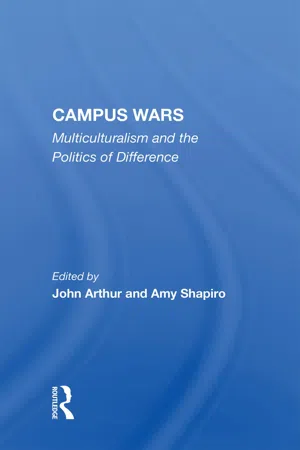
Throughout its history, the United States has struggled with the inevitable tensions of a highly diverse society. With the opening of higher education to women, ethnic minorities, and members of other previously marginalized groups, these tensions are now visited most especially upon our nation's colleges and universities. This collection addresses the most controversial issues now troubling our campuses: the content of the curriculum, sexual harassment and date rape, hate speech v. free speech, and affirmative action. In addition, several contributions probe the fundamental issues underlying the more specific problems of the "politics of difference." The contributions to this volume represent a wide range of disciplines - including philosophy, history, literary theory, law, economics, and politics - as well as views from across the political spectrum. Readers will find both familiar essays and new ones, arranged so that the authors speak directly to one another, thus providing a genuine conversation.
Information
Introduction
John Arthur
Amy Shapiro
Amy Shapiro
Throughout its history, America's task has been the exhilarating one of forging community from multiplicity. From the beginning, the indigenous American population was augmented primarily by northern European settlers, black slaves, and later by immigrants from all the European nations. More recently, however, the descendants of these original settlers have been joined by immigrants whose roots extend from China and Vietnam to Africa, the Islamic World, and Latin America, so that it is sometimes even predicted that during the next century the descendants of European settlers will become a minority.
At the same time that the United States is becoming ethnically more diverse, those who have historically been marginalized in U.S. society are making broader claims for equality and power. With the opening of higher education to women, members of ethnic minorities, and those who could not have afforded it, issues of race, sex, and class have taken on a new urgency both as academic issues and in the day-to-day life of the university. Moreover, postmodernism and deconstruction, whose supporters can be found in both the social sciences and humanities, are questioning not only what is taught and by whom but the very nature of knowledge and the possibility of objectivity. Often these attacks on traditional ideals of knowledge and truth are undertaken explicitly in the name of furthering the political interests of traditionally marginalized groups.
The response to these changes has been varied and complicated, but four are of particular importance to campus life today. First, faculty and students on many campuses have demanded more women and minority professors, ethnic and gender studies departments, and a curriculum that includes voices not traditionally included in the "canon." These demands have often been met. Second, many universities have promulgated codes of conduct banning sexual harassment and date rape. Third, some institutions have abandoned the insistence on free speech that grew out of the student movements of the 1960s and enacted codes punishing racist, sexist, and harassing speech. Fourth, and finally, many schools have adopted affirmative action policies that give preference in hiring and admissions to women and persons of color.
The contributors to the first four parts of this volume provide a wide range of lively and provocative views on all of these topics. The authors included in the last part address these issues from a somewhat greater distance, asking more fundamental questions about the meaning and importance of group identity and the implications of the "politics of difference" for democratic institutions as well as for political theory.
Part One, "Multiculturalism and the College Curriculum," begins with a selection from Allan Bloom's book The Closing of the American Mind. Bloom is one of the most outspoken and influential defenders of the traditional canon, and his views have attracted wide criticism. One critic, Barry W. Sarchett, responds with a sympathetic discussion of the views of the new, "postmodernist" scholars in an essay titled "What's All the Fuss About This Postmodernist Stuff?" The next essay in this section, "Postmodernism and the Western Rationalist Tradition," written by John R. Searle, begins with a description and vigorous defense of the "Western Rationalist Tradition" along with its implicit commitments to objectivity, truth, and rationality. Searle then discusses postmodernism's rejection of traditional standards of truth and objectivity and its impact on the university, including the commitment to reform the curriculum, to redefine academic excellence, and to shift our understanding of the curriculum from a concern with "subjects to be investigated" toward "moral causes to be advanced." Among the issues raised by these authors is the nature of truth and the possibility of objectivity—a topic taken up in "Is There a Text in This Class?" by one of multiculturalism's best known defenders, literary and legal theorist Stanley Fish.
In an essay we titled "Relativism, Deconstruction, and the Curriculum," Amy Gutmann discusses the debate between traditional "essentialists" like Bloom and "deconstructionists" like Sarchett. She follows with an assessment of cultural relativism—a topic that is woven through the four preceding essays.
Part Two, "Sex on Campus: Sexual Harassment and Date Rape," begins with an essay titled "Sexuality" by one of feminism's leading theoreticians, Catharine A. MacKinnon. Placing sexual harassment in the context of a larger political and cultural system of oppression, MacKinnon discusses the nature of sex, gender, and rape and their relationship to the political system. Lois Pineau's article "Date Rape: A Feminist Analysis" discusses a range of issues associated with date tape, including myths about consent and sexuality that make conviction difficult. She defends what she terms a "communicative" mode of sexuality which, she argues, better describes the mutuality of sexual relationships and provides a better test for consent than the contractualist model she believes is currently used by the law. In the final selection, "An Interview About Sex and Date Rape," Camille Paglia argues that feminism's concern about date rape reflects a naive and unrealistic vision of male sexuality. Her understanding of sex marks a fascinating contrast with both MacKinnon and Pineau.
Part Three, "Free Speech, Hate Speech, and Campus Speech Codes," discusses the dispute over campus speech codes. Beginning with an account of his background in Nazi Germany, Gerald Gunther describes the importance of protecting even the most offensive and hurtful speech against censorship, especially on college campuses. The next selection, "Doe v. University of Michigan," is one of a number of cases in which a speech code was rejected on Constitutional grounds. In it, Judge Avern Cohen describes the principles behind free speech, the nature of the code in question, and the dual grounds—vagueness and overbreadth—on which he felt compelled to reject it.
The last selection, "Liberalism and Campus Hate Speech," by Andrew Altman, represents a careful attempt to defend limited restrictions on hate speech from the perspective of a liberal who is also deeply committed to freedom of speech. The fact that such a code is not viewpoint neutral, argues Altman, means that it cannot be justified because of harmful effects on its hearers. Nor, he claims, can hate speech be treated as a form of racial harassment, as others have suggested. Instead, says Altman, hate speech is best understood as an intentional act that is wrong because it treats an individual as a moral subordinate, that is, as a person whose interests are less important or worthy than those of others. He then argues that such a regulation, if narrowly drawn, is compatible with the three principles underlying liberalism's commitment to viewpoint neutrality.
The authors of the essays in the next part, "Race and Affirmative Action on Campus," offer differing perspectives on one of the most important, oft-discussed, and controversial issues facing higher education. The first selection is the leading constitutional case in this area, "Regents of the University of California v. Bakke." The next essay, "Affirmative Discrimination," by Lino A. Graglia, is a broad attack on the philosophical and political rationale behind affirmative action. In the next selection, "A Cultural Pluralist Case for Affirmative Action," Duncan Kennedy assesses what he terms "color-blind meritocratic fundamentalism." That familiar but mistaken position, according to Kennedy, emphasizes the contradiction between "merit" and "preferences" while claiming that institutions should strive to "produce" knowledge in accord with objective merit and therefore should ignore race, sex, class, and other "irrelevant" characteristics of authors and scholars. In response, Kennedy develops a political and cultural case for large-scale affirmative action based on the need to produce an intelligentsia that can both help subordinated cultural communities gain access to resources and improve the quality and social value of scholarship. Beyond these ideas, he argues, is a "cultural pluralist" conception of American life that recognizes the importance of culture and ideology in judging scholarship.
The final essay in Part Four,"The Recoloring of Campus Life: Student Racism, Academic Pluralism, and the End of a Dream," by Shelby Steele, offers an assessment of where we have come in our understanding of race on campus as well as a description of affirmative action's impact on those whom it is meant to help. Based on his own experiences as a student and educator, Steele diagnoses racial tensions as arising from black fears of inferiority and white feelings of guilt. He goes on to question the recent emphasis on the politics of "difference" and the related campus moves toward affirmative action, race, and culturally based curricula, and the view that all minority students suffer victimization, arguing instead that universities should emphasize individual initiative, commonality, and integration.
Essays in the final part, "Identity, Assimilation, and Politics," are considerations of the theoretical issues beneath the surface of many of the previous discussions. These include the nature of individual identity and its connection with cultural membership, conflicts between assimilation and separatism, the political implications of the "politics of difference," and the prospects of liberal, democratic government in a divided, pluralistic society.
In the first essay, "Age, Race, Class, and Sex: Women Redefining Difference," poet Audre Lorde describes political and social reality as it appears from her perspective as a "forty-nine-year-old Black lesbian feminist socialist mother of two." Instead of denying the importance of "difference" and thus distorting its meaning, she claims, we must learn instead to acknowledge its importance in shaping our world. In the next essay, "Social Movements and the Politics of Difference," Iris Marion Young offers a wide ranging and important discussion of the relevance of group difference to politics. Beginning with a critique of assimilation and the humanist ideal of impartiality, she goes on to describe the alternative, "relational" conception of difference and defend the "politics of difference" as the best means to achieve genuine emancipation. Young next defends various group-conscious policies to promote equality for women, Hispanics, and Indians. She concludes with a discussion of democratic government and the need to assure representation of oppressed groups.
In the next essay, taken from his book The Disuniting of America: reflections on a Multicultural Society, noted historian Arthur M. Schlesinger, Jr., first raises questions about separatism, including bilingual education. He then addresses charges that Europe is "evil" and that the United States should reject its legacy. He argues that in fact the Western tradition itself provides the intellectual grounding and institutional protection on which modern multiculturalism rests. In "Separation or Assimilation?" Bernard R. Boxill considers the philosophical issues of assimilation and separatism against the backdrop of W.E.B. Dubois's defense of cultural pluralism. Box-ill discusses the importance of black pride and black culture, the definition of race, and the role of cultural "authenticity," finally rejecting cultural pluralism in favor of individual autonomy.
The last two essays turn to the political question of governing a diverse society. In "The Politics of Recognition" Charles Taylor begins by tracing the historical and philosophical changes that, he argues, underlie the modern emphasis in multiculturalism and the "politics of recognition." Looking next to contemporary politics, he argues that the importance of equal respect has led to two different, sometimes conflicting political demands: universalism and the politics of difference. Taylor concludes with a brief discussion of the position that all cultures must be recognized as "equally valuable."
In the final selection, "Pragmatism, Relativism, and the justification of Democracy," Hilary Putnam brings together a variety of themes that occupy the previous writers by discussing the political thought of American pragmatist John Dewey. Beginning with a description of democratic government as "the precondition for the full application of intelligence to the solution of social problems," Putnam then addresses the relativist's doubt whether moral and political claims—including those justifying democracy—can be rationally defended at all. He rejects what he terms the "noble savage" view of cultural relativists that immunizes oppression in non-Western cultures against criticism. Putnam argues that there are, in fact, better or worse solutions to human problems and, further, that democratic procedures are best suited to find them. He concludes with a brief description of Dewey's critical reflections—including Dewey's rejection of entrenched privilege and his insistence that the underprivileged be provided the opportunity to develop their capacities.
We said at the beginning that America's social and political task of building community out of diversity is an exhilarating one. We believe that the intellectual task of understanding the politics of diversity and its implications can be just as exciting. It is our hope that this generous and varied selection of readings will challenge students and their teachers to think more critically and creatively about the complex of issues we call "campus wars."
The Closing of the American Mind
ALLAN BLOOM
There is one thing a professor can be absolutely certain of: almost every student entering the university believes, or says he believes, that truth is relative. If this belief is put to the test, one can count on the students' reaction: they will be uncomprehending. That anyone should regard the proposition as not self-evident astonishes them, as though he were calling into question 2 + 2 = 4. These are things you don't think about. The students' backgrounds are as various as America can provide. Some are religious, some atheists; some are to the Left, some to the Right; some intend to be scientists, some humanists or professionals or businessmen; some are poor, some rich. They are unified only in their relativism and in their allegiance to equality. And the two are related in a moral intention. The relativity of truth is not a theoretical insight but a moral postulate, the condition of a free society, or so they see it. They have all been equipped with this framework early on, and it is the modern replacement for the inalienable natural rights that used to be the traditional American grounds for a free society. That it is a moral issue for students is revealed by the character of their response when challenged—a combination of disbelief and indignation: "Are you an absolutist?," the only alternative they know, uttered in the same tone as "Are you a monarchist?" or "Do you really believe in witches?" This latter leads into the indignation, for someone who believes in witches might well be a witchhunter or a Salem judge. The danger they have been taught to fear from absolutism is not error but intolerance. Relativism is necessary to openness; and this is the virtue, the only virtue, which all primary education for more than fifty years has dedicated itself to inculcating. Openness—and the relativism that makes it the only plausible stance in the face of various claims to truth and various ways of life and kinds of human beings—is the great insight of our times. The true believer is the real danger: The study of history and of culture teaches that all the world was mad in the past; men always thought they were right, and that led to wars, persecutions, slavery, xenophobia, racism, and chauvinism. The point is not to correct the mistakes and really be right; rather it is not to think you are right at all.
The students, of course, cannot defend their opinion. It is something with which they have been indoctrinated. The best they can do is point out all the opinions and cultures there are and have been. What right, they ask, do I or anyone else have to say one is better than the others? If I pose the routine questions designed to confute them and make them think, such as, "If you had been a British administrator in India, would you have let the natives under your governance burn the widow at the funeral of a man who had died?," they either remain silent or reply that the British should never been there in the first place. It is not that they know very much about other nations, or about their own. The purpose of their education is not to make them scholars but to provide them with a moral virtue—openness. . . .
The old view was that, by recognizing and accepting man's natural rights, men found a fundamental basis of unity and sameness. Class, race, religion, national origin or culture all disappear or become dim when bathed in the light of natural rights, which give men common interests and make them truly brothers The immigrant had to put behind him the claims of the Old World in favor of a new and easily acquired education. This did not necessarily mean abandoning old daily habits or religions, but it did mean subordinating them to new principles. There was a tendency, if not a necessity, to homogenize nature itself.
The recent education of openness has rejected all that. It pays no attention to natural rights or the historical origins of our regime, which are now thought to have been essentially flawed and regressive. It is progressive and forward-looking. It does not demand fundamental agreement or the abandonment of old or new beliefs in favor of the natural ones. It is open to all kinds of men, all kinds of lifestyles, all ideologies. There is no enemy other than the man who is not open to everything. . . .
Liberalism without natural rights, the kind that we knew from John Stuart Mill and John Dewey, taught us that the only danger confronting us is being closed to the emergent, the new, the manifestations of progress. N...
Table of contents
- Cover
- Half Title
- Title Page
- Copyright Page
- Contents
- Preface
- Introduction
- About the Book and Editors
- About the Contributors
- List of Credits
Trusted by 375,005 students
Access to over 1.5 million titles for a fair monthly price.
Study more efficiently using our study tools.
Frequently asked questions
Yes, you can cancel anytime from the Subscription tab in your account settings on the Perlego website. Your subscription will stay active until the end of your current billing period. Learn how to cancel your subscription
No, books cannot be downloaded as external files, such as PDFs, for use outside of Perlego. However, you can download books within the Perlego app for offline reading on mobile or tablet. Learn how to download books offline
Perlego offers two plans: Essential and Complete
- Essential is ideal for learners and professionals who enjoy exploring a wide range of subjects. Access the Essential Library with 800,000+ trusted titles and best-sellers across business, personal growth, and the humanities. Includes unlimited reading time and Standard Read Aloud voice.
- Complete: Perfect for advanced learners and researchers needing full, unrestricted access. Unlock 1.5M+ books across hundreds of subjects, including academic and specialized titles. The Complete Plan also includes advanced features like Premium Read Aloud and Research Assistant.
We are an online textbook subscription service, where you can get access to an entire online library for less than the price of a single book per month. With over 1.5 million books across 990+ topics, we’ve got you covered! Learn about our mission
Look out for the read-aloud symbol on your next book to see if you can listen to it. The read-aloud tool reads text aloud for you, highlighting the text as it is being read. You can pause it, speed it up and slow it down. Learn more about Read Aloud
Yes! You can use the Perlego app on both iOS and Android devices to read anytime, anywhere — even offline. Perfect for commutes or when you’re on the go.
Please note we cannot support devices running on iOS 13 and Android 7 or earlier. Learn more about using the app
Please note we cannot support devices running on iOS 13 and Android 7 or earlier. Learn more about using the app
Yes, you can access Campus Wars by John Arthur in PDF and/or ePUB format, as well as other popular books in Education & Multicultural Education. We have over 1.5 million books available in our catalogue for you to explore.