- 320 pages
- English
- ePUB (mobile friendly)
- Available on iOS & Android
eBook - ePub
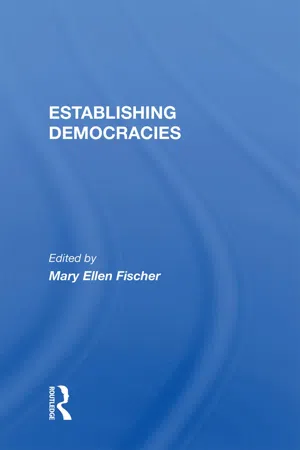
Establishing Democracies
About this book
Balancing historical and contemporary cases, this comparative text examines the crucial question of what promotes or prevents the successful founding of democratic systems. The country case studies are placed in context by a substantial introduction surveying theories of democracy and democratic transition and by a conclusion assessing the cases and suggesting common patterns in the establishment of successful democracies. }Balancing historical and contemporary cases, this comparative text examines the crucial question of what promotes or prevents the successful founding of democratic systems. Underscoring lessons learned from successful regime change and assessing current efforts to establish democracies whose ultimate fate is yet uncertain, this book will enable students to evaluate the chances of success for societies making the transition from an authoritarian or communist regime. The case studies are placed in context by a substantial introduction surveying theories of democracy and democratic transition and a conclusion comparing the cases and suggesting common patterns in the establishment of successful democracies. Created for upper-level students, this book can be used as a primary text to be supplemented by theoretical readings or as a source of additional case studies. Extensive notes provide a wealth of suggestions for further reading and research.
Information
1
ENGLAND: AN UNFINISHED REVOLUTION
PATRICIA-ANN LEE
On January 30, 1649, in the backwash of a civil war and after a trial stage-managed by the victorious parliament, Charles I of England was executed. This was not the first time an English king had been removed from power, but it was the first time a king had been charged with crimes against his people, tried by a court composed of his subjects, and publicly executed. These deliberate and considered acts of policy were part of a process that dismantled and reconstituted what had until that time been universally accepted as the Ancient Constitution. In the weeks and months that followed Charles's execution, the House of Lords was abolished and monarchy itself was formally ended. Kingship having been found "unnecessary, burdensome and dangerous to the liberty, safety and public interest of the people," England temporarily became a republic.1 But a true settlement of the nation, a permanent political solution that would attach to a new government the legitimacy, loyalties, and staying power of the old system, was to prove more elusive. Indeed, it was never to be achieved during this period, because the Stuart monarchy was restored in 1660 under Charles II.
When viewed in this way, the seventeenth-century revolution would seem to have been a failure. However, despite the fact that a Stuart king was restored and the formal acts and ordinances of the Interregnum were swept away, the institution of monarchy would never be the same. Limitations on the king's power, limitations that had been formally accepted by Charles I and were designed to prevent the continuance or resumption of arbitrary royal government, remained in place. Even more significant were the changes that had taken place in the substratum of ideas, assumptions, and understandings that supported the institutional framework. Experience and historical memory after 1660 included not only the martyrdom of Charles I but also the army debates at Putney, not only the rule of the army leaders but also calls by Levellers and other visionaries for a democratization of government. Above all, by 1660, it had become clear that monarchy was neither natural nor essential; the nation could choose some other system if it wished to do so. Never would it be possible thereafter to reconstitute an authoritarian monarchy on the old customary and theological basis. The English had been freed to question the nature of their political process, to speculate about what made power legitimate, and to examine other modes of political activity. Finally, there was the matter of religion, which had played so large a part in igniting the troubles of midcentury and in shaping events of the Interregnum. In that area there was also restoration, with the Anglican church officially reestablished. However, that restoration too was incomplete since it was no longer possible for Anglicanism to compel universal belief or even to include within itself all English Protestants.
These changes formed the foundation for the future development of British political life and thought. They also had an impact upon colonies overseas, because settlers carried with them a view of their traditional rights and liberties that was based on their understanding of what had happened during the century just past.
CLASSES, POLITICS, AND THE ANCIENT CONSTITUTION
The England in which these events took place was a small country, its population numbering perhaps 4.5 million persons, most of them engaged in agriculture. Woolen cloth was still the most important national export, although war and changes in European markets had caused some difficulty for the trade in the first three decades or so of the seventeenth century. There were several important ports, many agricultural villages, a number of smallish market towns, and one large city, London, which was the center of economic as well as national political affairs. However, except for the king, his court, and a group of professional administrators, lawyers, and judges, some merchants, and members of parliament when parliament was in session, life centered in the counties. Ordinary people thought in terms of their neighborhoods, and the gentry focused on their county (or "country"), where local government was carried out in the name of the king by local landowners who served without pay. In the counties the most important officials were the Lord Lieutenants, who were drawn from the highest nobility, the peerage. The real workhorses, however, were omnicompetent local agents of royal government called justices of the peace, who were usually members of the gentry. Through intermarriage, and by working together at the local level, established gentry families formed the county community and were a major force in national as well as local politics.
As Peter Laslett has pointed out, seventeenth-century England was a one-class society.2 That class encompassed all socially, politically, and economically privileged persons, from the peers at the top to the greater and lesser gentry beneath. In terms of actual numbers, the nobility was a small group. By 1633, there were 122 lay peers and twenty-six bishops, who together made up the House of Lords. In contrast, untitled gentry numbered between 18,500 and 24,800, some of them great and wealthy landholders but many others "mere gentlemen."3 All were men. Women took their social status from their fathers and husbands and did not normally participate in the political process. This was a society in which hierarchy and patriarchy were accepted as natural and provided discipline and control. Authority flowed downward from the top, where status, land, and wealth were concentrated. Deference was expected by those above and accorded by those below as a matter of course. Nevertheless, despite limits set by such a pattern of organization, English society was remarkably permeable when compared to societies of other European states. In England, gentle birth certainly gave high status, but there were other ways of gaining entry to the privileged class. For example, important royal officeholders could claim gentility and so could graduates of the two universities. Successful lawyers who bought land moved upward quite easily, and wealthy merchants married their children into well-born families.
Members of this privileged group belonged by definition to the political nation, that is, to that body of persons who traditionally participated in political life and dominated decisionmaking at the national and county levels. For such men, parliament was the most obvious and important arena of political activity. Within parliament, peers and bishops were summoned individually to the House of Lords, but members of the House of Commons (burgesses from the towns and knights of the shire from the counties) had to be elected. Voter qualifications differed from town to town, although in the counties there was a fairly broad and uniform franchise. Under the county franchise all property owners worth forty shillings per year could vote. Yet, whether they came from town or county, those elected under this system were always prosperous and well connected and almost always drawn from among the greater gentry. Their wealth and influence, in addition to the elective nature of the body, tended to give the House of Commons greater and greater importance, so that by the reign of Charles I the lower house was as significant as the once-dominant House of Lords.4
Although most seventeenth-century Englishmen could not vote, the number qualified to do so was increasing. Simple population growth played a part in this as did inflation, which reduced the exclusionary effect of the forty-shilling freeholder franchise. In addition, constitutional and religious controversies drew more people to the polls.5 In the 1640s, one recent estimate suggests that between 27 percent and 40 percent of adult males could have voted. The numbers are small by modern standards, but the English electorate was a large one for its day.6 Numbers of voters alone, however, do not tell the whole story of political participation. Outside the traditionally privileged group were other ordinary English subjects who attended county courts, served on juries, and acted as petty constables or filled other minor offices. By so doing they learned how to represent and be represented and acquired experience in leadership and participation that could be translated into political activity if the occasion arose. Such a group was to be of particular importance in a period in which issues were increasingly national and engaged English men and women at all social levels.
The constitution was the framework for political thought within which national political activity took place. This so-called Ancient Constitution was not a single written document but rather a body of law, custom, and traditional practice that had developed over a long period. It was an understanding about the proper relationships thought to exist among the king, his councillors (including parliament), and his people. The English believed this supposedly ancient and immutable arrangement was based on fundamental laws and embodied their rights and liberties. In practice, however, the constitution was in a constant state of renegotiation, and its laws and liberties could be modified or even abolished by new parliamentary legislation. The English state was described at the time as a mixed monarchy in which both king and parliament had a recognized place. To be sure, the precise nature of their relationship had never been defined, but there was no need to do so as long as crown and parliament were in substantial agreement or the state was under so much pressure from foreign events that disagreements could not be too harshly pressed.
Within this mixed monarchy the king still possessed considerable power. Although parliaments were an accepted part of the system, they met only occasionally, whereas he was continuously present. The king selected his own ministers, judges, and other officials, controlled the money—even that granted by parliament—and made foreign policy. He alone had authority to call a parliament into being, and he could dismiss it whenever he wished. In addition, parliamentary legislation required his assent to become law (giving him an effective veto power), and his officials guided deliberations in both houses. On its side, parliament was a court and the maker of statute (the most important kind of law), and when the king needed more money than he could raise from his rents and other customary sources, he had to obtain its assent to any legislation that imposed taxation. Control of the purse strings gave great potential power to parliament and particularly to the House of Commons (where tax legislation had to originate), but it was a power the members were not at first eager to exploit. Ideally, parliament was thought of as an occasion upon which all elements of the constitution were to be brought into a natural relationship of harmony and unity rather than as an opportunity for working out conflicts. Nevertheless, in spite of such confusions and difficulties, parliament was recognized as a national institution through which the voice of the community of the realm (a broader concept than the political nation) could make itself heard. In parliamentary deliberations, all Englishmen were considered to be represented, whether or not they could actually vote (an idea that would later be called virtual representation).
Within this system, the king was preeminent but not absolute. When, in the course of divorcing Katherine of Aragon, Henry VIII (1509-1547) split with Rome and took over the Catholic Church and its jurisdictions in England, he added greatly to his power and was able to claim the exclusive and undivided loyalty of all his subjects. Yet, without a standing army, a police force, or a paid bureaucracy to collect taxes, and with local government in the hands of the gentry, practical absolutism was harder to achieve. The English, even Henry's sixteenth-century subjects, did not think of their monarchs as absolute. Seventeenthcentury parliamentary critics of the Stuart kings liked to quote Henry de Bracton, a medieval royal judge who had said that the king ruled not under men but under God and the law.7 There was also great veneration for the Magna Carta, which had been wrested by the barons from King John in 1215. Although in reality a rather limited feudal document, the Great Charter was believed to embody the basic rights of the English subject. It also showed the community of the realm imposing the rule of law on a lawless king.
In time, differing views of the constitution would pit king and parliament against each other, but not because either was consciously seeking a new kind of power. Quite the contrary. The early Stuart monarchs, James I (1603-1625) and Charles I (1625-1649), were determined to preserve their rights by turning back parliamentary encroachments upon royal authority, and parliament was equally intent upon preserving its place within the system. Each could and did claim to be defending the proper balance of the constitution. However, these kings, who were Scottish in origin, had a view of kingship different from that held by most of their English subjects. Having obtained the throne by default when Elizabeth I (1558-1603) died without heirs, their claim depended upon birth and blood. This was determined by God, who, they believed, had thus ordained their rule and justified their power as his vice-regents on Earth. But such divine right was historically alien to English constitutional thinking and could be used to justify a kind of monarchy in which the king was not just preeminent within the law and the Ancient Constitution but superior to both. Thus, when the first Stuart monarch (James I) began to theorize about his rights as an absolute ruler, his parliaments were forced to define their own position on the issue. Even so, the members never claimed parliament's rights were superior to those of the king. What they did do was to claim a coordinate place in the constitution and to maintain that "the liberties, franchises, privileges, and jurisdictions of parliament are the ancient and undoubted birthright and inheritance of the subjects of England."8 Indeed, Sir Edward Coke, the noted lawyer and judge, argued that the privileges of parliament were more ancient than monarchy, because they rested upon immemorial law and custom that predated the Norman Conquest. In this view, matters pertaining to parliament could only be changed by parliament itself. In the end, although both king and parliament could agree that parliament had a role within the constitution, they differed on what it was supposed to be.
FINANCIAL...
Table of contents
- Cover
- Half Title
- Title Page
- Copyright Page
- Contents
- Preface
- Introduction
- 1 England: An Unfinished Revolution
- 2 The United States: Creating the Republic
- 3 Germany: Into the Stream of Democracy
- 4 Japan: Foreign Occupation and Democratic Transition
- 5 Argentina: The Melancholy of Liberal Democracy
- 6 Romania: The Anguish of Postcommunist Politics
- 7 Poland: A Troubled Transition
- 8 Russia: Problems and Prospects for Democratization
- Conclusion
- About the Book
- About the Editor and Contributors
- Index
Trusted by 375,005 students
Access to over 1.5 million titles for a fair monthly price.
Study more efficiently using our study tools.
Frequently asked questions
Yes, you can cancel anytime from the Subscription tab in your account settings on the Perlego website. Your subscription will stay active until the end of your current billing period. Learn how to cancel your subscription
No, books cannot be downloaded as external files, such as PDFs, for use outside of Perlego. However, you can download books within the Perlego app for offline reading on mobile or tablet. Learn how to download books offline
Perlego offers two plans: Essential and Complete
- Essential is ideal for learners and professionals who enjoy exploring a wide range of subjects. Access the Essential Library with 800,000+ trusted titles and best-sellers across business, personal growth, and the humanities. Includes unlimited reading time and Standard Read Aloud voice.
- Complete: Perfect for advanced learners and researchers needing full, unrestricted access. Unlock 1.5M+ books across hundreds of subjects, including academic and specialized titles. The Complete Plan also includes advanced features like Premium Read Aloud and Research Assistant.
We are an online textbook subscription service, where you can get access to an entire online library for less than the price of a single book per month. With over 1.5 million books across 990+ topics, we’ve got you covered! Learn about our mission
Look out for the read-aloud symbol on your next book to see if you can listen to it. The read-aloud tool reads text aloud for you, highlighting the text as it is being read. You can pause it, speed it up and slow it down. Learn more about Read Aloud
Yes! You can use the Perlego app on both iOS and Android devices to read anytime, anywhere — even offline. Perfect for commutes or when you’re on the go.
Please note we cannot support devices running on iOS 13 and Android 7 or earlier. Learn more about using the app
Please note we cannot support devices running on iOS 13 and Android 7 or earlier. Learn more about using the app
Yes, you can access Establishing Democracies by Mary Ellen Fischer in PDF and/or ePUB format, as well as other popular books in Politics & International Relations & American Government. We have over 1.5 million books available in our catalogue for you to explore.