This book presents a broad compendium of biodegradation research and discussions on the most up-to-date bioremediation strategies. The most relevant microbiological, biochemical and genetic concepts are presented alongside the fundamentals of bioremediation. The topics include: a wide variety of contaminant impacts evaluation, key methodologies required to measure biodegradation and propose new bioremediation protocols, as well as the handling of microbial communities related to such processes. The selected collaborating authors are renowned for their microbiology expertise and will provide an in-depth reference for students and specialists. The contents provide a valuable source of information for researchers, professionals, and policy makers alike.
eBook - ePub
Biodegradation, Pollutants and Bioremediation Principles
- 352 pages
- English
- ePUB (mobile friendly)
- Available on iOS & Android
eBook - ePub
Biodegradation, Pollutants and Bioremediation Principles
About this book
Information
Introduction
Alkylphenols (APs) and short-chain alkylphenol ethoxylates (APEs) containing 1, 2, and 3 ethoxylene units per molecule are known for their toxic and endocrine disrupting properties. However, despite bans and restrictions introduced by different countries (including the European Union, Canada, and the USA), APs and their ethoxylates are still widely used on a global scale because of their ease of production, low cost, and numerous applications.
In the present chapter, the influence of these compounds on living organisms is presented, including their toxic properties towards different organisms and disruption of the endocrine system, resulting in numerous harmful effects, such as lowered reproductive performance, or even cancer. Different factors affecting endocrine disrupting properties are discussed, including length of both ethoxy and alkyl chains, branching of the alkyl chain, and its substitution position in the aromatic ring. Biodegradation of APs and APEs in both aerobic and anaerobic conditions is also presented, and studies on their bacterial and fungal degradation are discussed. Experiments on removal of these contaminants are described and their environmental fate is shown. Contamination of the environment is discussed separately for water and sediments.
_____________
1 Poznan University of Technology, Institute of Chemistry and Technical Electrochemistry, Berdychowo 4, 60-965 Poznan, Poland.
2 Poznan University of Medical Sciences, Department of Pharmaceutical Technology, Grunwaldzka 6, 60-780 Poznan, Poland.
* Corresponding author: [email protected]
Production and usage of alkylphenols and their ethoxylates
Alkylphenols, mainly nonylphenol (NP) and octylphenol (OP), are widely manufactured chemicals, which are produced during alkylation of phenol with nonene (obtained from trimerization of propene) or octene (obtained from dimerization of butene) in the presence of a catalyst. APs can be transformed to alkylphenol ethoxlyates, which are commonly used surfactants (Reed 1978, Groshart et al. 2001). NP is used mostly for production of nonylphenol ethoxylates (NPEs), and in plastic industry (e.g., for production of resins and tri(4-nonylphenyl) phosphite)—a heat stabilizer), and also in the production of oximes (used for manufacturing metals) (Groshart et al. 2001, SUBSPORT 2013). On the other hand, OP is rarely used in the synthesis of octylphenol ethoxylates (OPEs), and it is estimated that 98% of OP is used in the production of phenolic resins (OSPAR 2006). NPEs are used in many applications, including industrial cleaning, textile and leather processing, paper production, metal processing, extraction of crude petroleum and natural gas, paints and lacquer manufacturing, as well as pest control products (Groshart et al. 2001, SUB SPORT 2013). OPEs are mainly used in emulsion polymerization, but also in the production of octylphenol ether sulphates, textile and leather processing, pesticide formulations, and paints (OSPAR 2006). As a result of their widespread usage and problematic biodegradation, APs and APEs are directed to the environment, and are ubiquitous in both surface waters and sediments (Fig. 1.1).
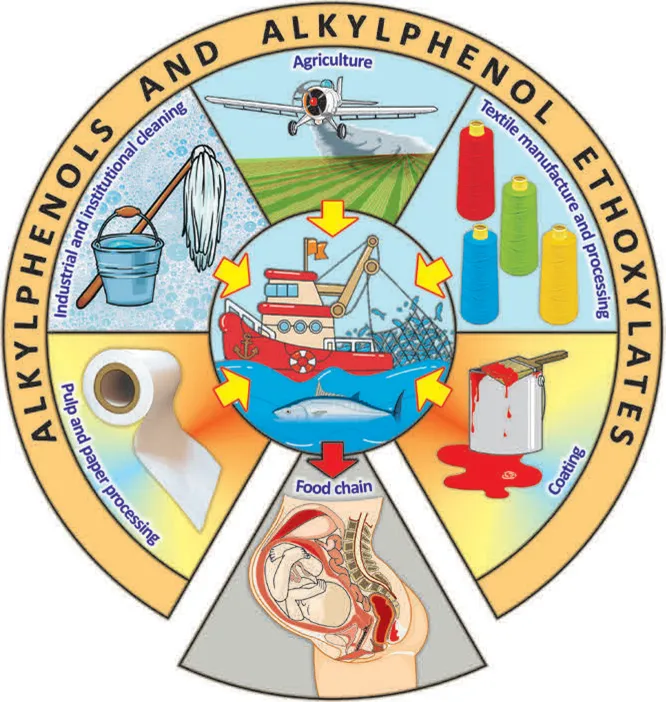
Figure 1.1. Usage and fate of alkylphenol and alkylphenol ethoxylates.
Global production of APEs at the edge of the new millennium was estimated at half a million tons, and it still rises, mainly due to their increased production in Brazil, China, India, and Russia (Renner 1997, Bergé et al. 2012), because usage of NP and NPEs in Europe and North America is a subject of very restrictive law regulations (Directive 2003, Canadian Act 2001, US EPA 2005). These regulations were introduced after a number of studies showed incomplete biodegradation of APEs (Giger et al. 1984, Ahel and Giger 1985, Potter et al. 1999), endocrine disrupting properties of their biodegradation products (including short-chain APEs, as well as APs) (Jobling and Sumpter 1993, White et al. 1994, Soto et al. 1995), and high accumulation of short-chain NPEs and NP in the environment (Ding and Tzing 1998, Shang et al. 1999), while OPEs and OP were present at lower concentrations (Snyder et al. 1999, Loyo-Rosales et al. 2003) due to much lower usage of OPE surfactants (Groshart et al. 2001, OSPAR 2006).
Impact of alkylphenols and their ethoxylates on living organisms
The toxicity of alkylphenols and their ethoxylates was already extensively studied in the 90s. Numerous results were collected for fish, crustaceans, and other organisms. Available data shows that for 4-nonylphenol, lethal concentration killing 50% of tested subjects (LC50) falls between 100 and 1000 ug/L (Fig. 1.2) (Servos 1999, Canadian Water Act 2002), and similar data was also gathered for 4-octylphenol (Brook et al. 2005). Alkylphenol ethoxylates were also found to be toxic (Servos 1999), but their toxicity considerably depends on the number of ethoxy groups in the molecule (Canadian Water Act 2002, Whitehouse 2002). Thus, the Canadian Environmental Quality Guideline on nonylphenol and its ethoxylates gives toxic equivalency factors (’1EFs) for alkylphenols and their ethoxylates. For both NP and OP TEF = 1, for their ethoxylates with 1 to 8 ethoxy groups TEF = 0.5, for ethoxylates with 9 or more ethoxy groups TEF = 0.05, and for short-chained carboxylated ethoxylates TEF is also equal to 0.05 (Canadian Water Act 2002). Moreover, it was also found that toxicity of NPEs for different species (fish, invertebrates, algae) decreases exponentially with increasing ethoxy chain length (Whitehouse 2002). Therefore, the LC50 values of APEs often fall to the mg/L level (Warhurst 1995, Servos 1999).
Apart from their toxic properties, alkylphenols and their short-chain ethoxylates also belong to xenobiotics, which may be harmful to the development and reproduction of humans, wildlife, and aquatic organisms (Darbre 2015). These compounds have the ability to disrupt the functioning of the endocrine systems of humans and wildlife (Warhurst 1995). The first evidence of estrogenic potential of alkylphenols was reported by Dodds and Lawson in 1938 (Dodds and Lawson 1938). Later, these observations were confirmed in the research of Mueller and Kim (Mueller and Kim 1978), who proved the ability of various alkylphenols to displace the prebound estradiol from the estrogen receptor of uterine cytosols, and also to prevent estradiol from binding to the receptor. Moreover, the toxicity increased with the length of the hydrophobic chain For hydrophilic 4-ethoxyphenol or 4-(a-OH-isopentyl)phenol, no activity of inhibiting estradiol binding to the receptor was found (Mueller and Kim 1978).

Figure...
Table of contents
- Cover
- Title Page
- Copyright Page
- Preface
- Table of Contents
- 1. Alkylphenols and Alkylphenol Ethoxylates — Their Impact on Living Organisms, Biodegradation, and Environmental Pollution
- 2. Selective-enrichment as a Tool to Obtain Microbial Degrading Consortia for the Remediation of Pesticide Residues
- 3. Using Molecular Methods to Identify and Monitor Xenobiotic-Degrading Genes for Bioremediation
- 4. Bioprospecting Contaminated Soil for Degradation of the Drimaren X-BN Azo Dye
- 5. Saccharomyces cerevisiae—A Platform for Delivery of Drugs and Food Ingredients Encapsulation and Analysis
- 6. Biotransformation of Toxic Thiosulfate into Merchandisable Elemental Sulfur by Indigenous SOB Consortium
- 7. Removal of Oil Spills in Temperate and Cold Climates of Russia Experience in the Creation and Use of Biopreparations Based on Effective Microbial Consortia
- 8. Microbial Biosurfactants Remediation of Contaminated Soils
- 9. Dual Benefits of Microalgae in Bioremediation Pollutant Removal and Biomass Valorization, a Review
- 10. Bioremediation and Biodegradation of Crude Oil Polluted Soil
- 11. Microbial Recycling of ‘Sustainable’ Bioplastics A Rational Approach?
- 12. Hydrogels and Nanocomposite Hydrogels for Removal of Dyes and Heavy Metal Ions from Wastewaters
- 13. Review on Period of Biodegradability for Natural Fibers Embedded Polylactic Acid Biocomposites
- 14. New Approaches on Phytoremediation of Soil Cultivated with Sugarcane with Herbicide Residues and Fertigation
- 15. Bioactivity and Degradability Study of the Bone Scaffold Developed from Labeo Rohita Fish Scale Derived Hydroxyapatite
- 16. Physiological and Metabolic Aspects of Pesticides Bioremediation by Microorganisms
- 17. Whole Effluent Toxicity Assessment of Sewage Water
- 18. Whole Effluent Toxicity Test for Ambient Water Monitoring
- Index
Trusted by 375,005 students
Access to over 1.5 million titles for a fair monthly price.
Study more efficiently using our study tools.
Frequently asked questions
Yes, you can cancel anytime from the Subscription tab in your account settings on the Perlego website. Your subscription will stay active until the end of your current billing period. Learn how to cancel your subscription
No, books cannot be downloaded as external files, such as PDFs, for use outside of Perlego. However, you can download books within the Perlego app for offline reading on mobile or tablet. Learn how to download books offline
Perlego offers two plans: Essential and Complete
- Essential is ideal for learners and professionals who enjoy exploring a wide range of subjects. Access the Essential Library with 800,000+ trusted titles and best-sellers across business, personal growth, and the humanities. Includes unlimited reading time and Standard Read Aloud voice.
- Complete: Perfect for advanced learners and researchers needing full, unrestricted access. Unlock 1.5M+ books across hundreds of subjects, including academic and specialized titles. The Complete Plan also includes advanced features like Premium Read Aloud and Research Assistant.
We are an online textbook subscription service, where you can get access to an entire online library for less than the price of a single book per month. With over 1.5 million books across 990+ topics, we’ve got you covered! Learn about our mission
Look out for the read-aloud symbol on your next book to see if you can listen to it. The read-aloud tool reads text aloud for you, highlighting the text as it is being read. You can pause it, speed it up and slow it down. Learn more about Read Aloud
Yes! You can use the Perlego app on both iOS and Android devices to read anytime, anywhere — even offline. Perfect for commutes or when you’re on the go.
Please note we cannot support devices running on iOS 13 and Android 7 or earlier. Learn more about using the app
Please note we cannot support devices running on iOS 13 and Android 7 or earlier. Learn more about using the app
Yes, you can access Biodegradation, Pollutants and Bioremediation Principles by Ederio Dino Bidoia, Renato Nallin Montagnolli, Ederio Dino Bidoia,Renato Nallin Montagnolli in PDF and/or ePUB format, as well as other popular books in Biological Sciences & Biology. We have over 1.5 million books available in our catalogue for you to explore.