This book assesses the key definitions, forms, contexts and impacts of terrorist activity on the arts in the modern era, using historical and contemporary perspectives.
Its empirical case studies include theatre, literature, music, visual art, mass media, film and the mores of 'ordinary life.' While its immediate reflective context is Islamic fundamentalist terrorism, the book reviews a broader range of definitions and counter-definitions of 'terrorism', 'state terrorism' and 'states of terror,' examining uses of the terms through a series of comparative analyses. Chapters focus on the intersection of these definitional questions with heuristic analysis of art forms, cultural activities and their socio-historical contexts.
This book will be of interest to scholars in art history, terrorism, politics and the media, and visual culture.
Fear of ‘Replacement’ and the Resurgence of White Nationalism
Dora Apel
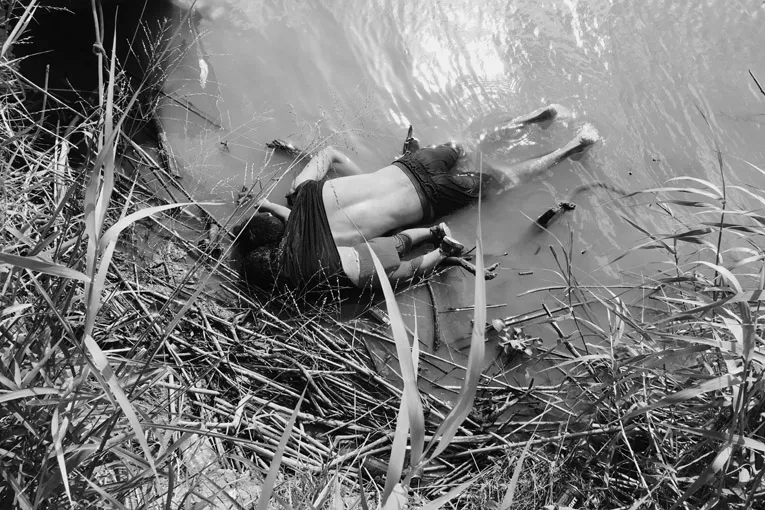
A twenty-five-year-old man tries to swim across the river Rio Grande with his nearly two-year-old daughter on his back; she is tucked under his t-shirt with her arms around his neck. He doesn’t make it. A current sweeps them away and they drown, their bodies washing up facedown along the shore, in the reeds, with blue beer cans bobbing nearby. The child has slipped to the side, one arm still around her father’s neck, evidence of a diaper under her red shorts. A photo of their corpses in the water goes viral, distributed by the Associated Press around the world and picked up by major media, a picture that allows us to look down upon them from a height of safety.1 Is it a picture of a foolhardy venture or an act of desperation driven by terror (1.1)?
The man is Óscar Alberto Martinez Ramirez with his daughter Valeria. Mexican photojournalist Julia Le Duc took the photo. Ramirez and Valeria had traveled from El Salvador and spent some months in Mexico trying to negotiate the nearly impossible asylum process before Ramirez decided to swim from Matamoros to Browns-ville, Texas. His wife, Valeria’s mother, swimming some way behind them, saw them go down and returned to shore. Ramirez and Valeria are only two of thousands who have tried, one way or another, to make the crossing, only to die—by drowning, thirst in the desert, gunfire, animal attack, or abandonment in airless locked trucks by the “coyotes” who took their money and promised to escort them to safety. The hopeful path to a presumed haven in the U.S. is marked by an endless stream of dead bodies.
In an essay in the New York Times Magazine, Teju Cole traces the responsibility of many U.S. presidents for the deaths of those like Ramirez and Valeria. He notes that Ronald Reagan and George H.W. Bush both supported El Salvador’s military-led government in a civil war in which tens of thousands of Salvadorans died and hundreds of thousands fled to the U.S. Bill Clinton conferred only “temporary protected status” on them, forcing them to go back at the end of the war, and many formed or joined gangs now heavily involved in the violence there. Barack Obama oversaw an increase in the apprehension and deportation of almost three million undocumented immigrants, more than any other president so far. In 2016, Donald Trump was elected president after repeatedly calling migrants “drug dealers,” “rapists,” and “criminals,” even though evidence shows that immigration correlates with lower crime rates. His administration funded Salvadoran security forces that illegally executed dozens of suspected gang members. Both Democratic and Republican administrations have clearly played a major role in producing the ongoing social, economic, and humanitarian crisis.
In 2018, Trump declared an end to the temporary protected status of almost 200,000 people from El Salvador who had fled a series of earthquakes there in 2001, cutting off their support to relatives at home and further devastating the Salvadoran economy. This was followed by a “metering” policy that slowed the processing of asylum claims to almost nothing and created a huge backlog, the one in which Ramirez and his family were trapped. Trump then declared that no further aid would be given to Guatemala, Honduras, or El Salvador until they reduced migration to the U.S., exacerbating the very conditions that were driving desperate migration in the first place.2
Teju Cole asks, “Do we need the spectacle of corpses to make the story real?” Cole questions the newsworthiness of picturing destroyed brown bodies, observing that destroyed white bodies seldom make the front page of the newspaper. “These photographs are mirrors, not windows,” asserts Cole, reflecting the fact that
the crime was committed by the viewers of the photograph … not personally but as a member of the larger collective. It is you who have undermined their democracy, you who have devastated their economy, you who have denied their claim to asylum.3
Figure 1.1 The bodies of Salvadoran migrant Oscar Alberto Martínez Ramírez and his nearly two-year-old daughter Valeria on the bank of the Rio Grande in Matamoros, Mexico, June 24, 2019, after they drowned trying to cross the river to Brownsville, Mexico.
Source: AP Photo/Julia Le Duc
But this is wrong-headed. We must not ignore the class divide in the U.S. any more than in Guatemala, Honduras, or El Salvador. It is the ruling class—whose interests are defended by Democratic and Republican presidents alike—that has undermined democracy, devastated economies, and denied asylum claims to those fleeing from violence, poverty, and the destructive effects of climate change on agricultural farms. The oppression of migrants is rooted in social and economic structures marked by class contradictions, a system ruled by profit that devalues the poor and people of color as socially expendable. We do need to see the pictures—to galvanize organized political opposition, document the atrocities, and hold those who are responsible accountable. This is the power of images.
A plethora of art exhibitions on the plight of refugees opened across the U.S., including The Warmth of Other Suns: Stories of Global Displacement at the Phillips Collection in Washington, D.C., in partnership with the New Museum in New York City (June to September 2019). Works in these exhibitions, such as Albanian artist Adrian Paci’s short video Centro di Permanenza Temporanea (‘Centre of Permanent Temporariness’), help illuminate the perspective of refugees and migrants, who feel compelled to leave their country despite becoming stateless and rightless.4
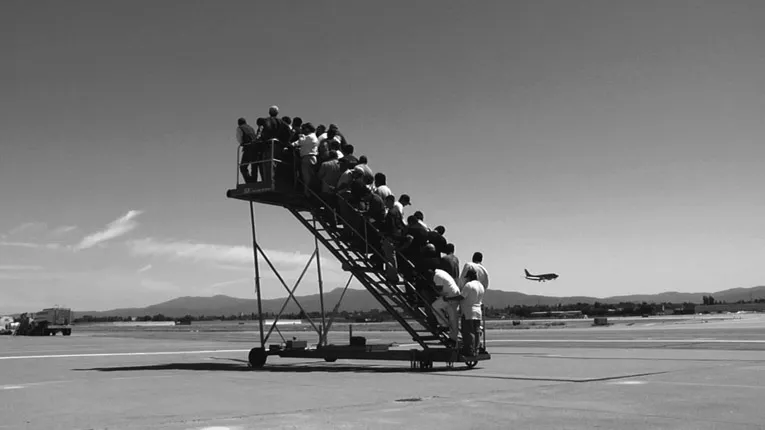
In Paci’s video, a group of refugees approach in single file a set of isolated airline boarding stairs standing near a runway in an open landscape. They climb up to the platform and fill the stairs. Then they wait. Several planes trundle by and take off, but none approach the boarding stairs Centre of Permanent Temporariness (1.2).
Paci focuses on the feet and faces of those who wait, suggesting their fatigue while scanning facial expressions of patience, resignation, numbness, disgust. They remain quietly crowded together on these stairs to nowhere in a no man’s land, apparently abandoned and forgotten. They are rightless people stranded in a placeless place. Paci’s video conveys the ultimate loss of identity and home through migration and displacement.
Figure 1.2 Adrian Paci, Centro di Permanenza Temporanea (Centre of Permanent Temporariness), 2007, video, color, sound, 4’32” (still from video).
Source: Courtesy of the artist and kaufmann repetto Milano/New York and Peter Kilchmann, Zürich
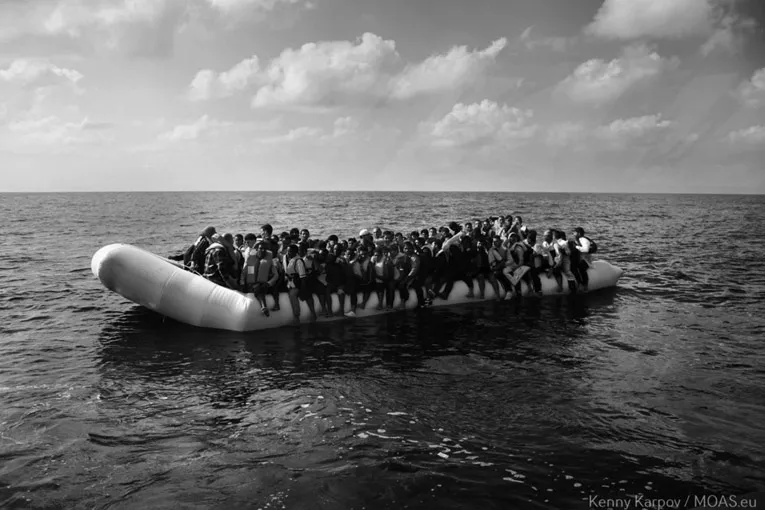
Another real-life version of a doomed venture is pictured by Detroit-based photographer Kenny Karpov in his series of migrant rescues on the Mediterranean from his Detroit exhibition and book Despite It All We Never Learn. Karpov spent more than four years accompanying rescue crews from a number of non-governmental organizations, whose mission is to save as many people as possible from drowning; they also treat injuries and offer food, water, and clothing to migrants escaping from war-torn countries such as Syria, Afghanistan, and Iraq or in search of jobs to support their families. His photo of a white dinghy floating in the sea is overcrowded, with about 180 primarily Nigerian men aboard (Figure 1.3).
Figure 1.3 Kenny Karpov, refugees in the Mediterranean Sea after setting off from Libya to Malta on a flimsy inflatable raft before being rescued, 2016.
Source: Courtesy Kenny Karpov
According to Karpov, the refugees have no idea how long the journey will be when they set off from Libya to Malta and are told by smugglers—sometimes former cops or politicians, who charge them enormous sums for a spot in a raft—that they will reach land in three hours. In reality it will be at least four days—about two days longer than the flimsy rafts can stay afloat. Sometimes smugglers also sell them cheap life vests that will not keep them from sinking for more than five minutes and will not keep their head above water. The far more effective bright orange life vests the men wear in the photo were provided by the rescue ship. And if they are rescued, what happens to most? European countries have slowed acceptance of refugees and established increasingly restrictive policies, or they are put in migrant detention centers, or they end up in underground economies as prostitutes or selling weed, or they are sold into forced labor for slave wages on farms and in restaurants.5
The journeyers in Karpov’s photo are so crowded together that those along the edges of the raft swing their legs over the side, their feet nearly touching the water, while the bodies crammed together and the repetition of dark limbs against the white raft evoke the teeming cargoes of slave ships. Like those once subjugated people, these refugees adrift on the high seas have no control, no agency, no recourse to safety unless they are spotted by a rescue ship. Since 2015, about 16,000 people are estimated to have drowned in similar rafts (though the number may be higher), death traps that are bought by smugglers by the shipping container from China for a few hundred dollars each. The refugees are therefore as subject to death by drowning, injury, or illness as to rescue and survival, and the white raft, like a flattened white whale, becomes an emblem of a quest that often ends in disaster.
Karpov makes it a point never to represent the rescued refugees at their most abject, refusing, in effect, to point the camera down from a privileged position and causing some NGOs to fire him for this reason; instead, he insists on preserving the dignity and humanity of the refugees who have been terrorized in their home countries, abused and deceived by smugglers, and are often terrorized once more if they manage to reach a foreign shore.
The Violence of White Nationalism
If we understand state terrorism to mean violence perpetrated by a government against non-combatants, we may regard the election of Trump as inaugurating a new reign of terror aimed particularly at Muslims, Central Americans seeking asylum in the U.S., and immigrants of color from anywhere. Most of those who make it across the U.S.-Mexican border are imprisoned in detention camps and live in horrendous conditions of squalor, abuse, deprivation, and extreme overcrowding, rendering the U.S. government one of the world’s most active and malicious agents of terror today. Caged and terrified children, who are traumatized, helpless, and forcibly separated from their parents, effectively represent the vulnerability of all refugees produced by global capitalism, who are infantilized, dehumanized, and discarded by the increasingly paranoid and conservative white elite striving to maintain its wealth and privilege. Neoliberalism’s attendant conditions of war, poverty, violence, and ecological disaster, which drive the migration of populations, also drive the intensification and mainstreaming of white nationalist terror, which has found an ardent exponent in the person of Donald Trump and his administration.
In a speech he gave in Poland in 2017, Trump called for the defense of Western civilization, which was widely understood as a white nationalist dog whistle endorsing Islamophobia. Steve Bannon and Stephen Miller, Trump’s white nationalist advisers, shaped this speech, and, despite Bannon’s departure from the administration, Miller continues to shape immigrant policy. As novelist Pankaj Mishra argues, the pseudoscience of racial inferiority and “higher races” has “reached its final and most desperate phase, with existential fears about endangered white power” now rampant in the white Anglosphere. Trump expressed these fears when he asserted in his speech, “The fundamental question of our time is whether the West has the will to survive.” Mishra points out that the global migration and race mixing of the late nineteenth century paved the way for eugenics, social Darwinism, and restrictive immigration laws. In the U.S., this peaked with the 1924 immigration law—admired by Hitler and by former Trump Attorney General Jeff Sessions—that set immigration quotas that impeded Jewish immigrants, among others, and completely barred Asians. “By the early 20th century,” writes Mishra, “violence against indigenous peoples, immigrants and African Americans reached a new ferocity, and nativist and racist demagogues entrenched a politics of dispossession, segregation and disenfranchisement.” We have seen a revival of such violence and white nationalist entrenchment, from Republican efforts to disenfranchise black voters anew in state and national elections to Trump’s ominous war on Muslims and immigrants.6
In Europe, the European Union—a set of treaties designed to maximize profits by increasing exploitation of workers across Europe—has had a devastating impact on working conditions and living standards, from imperialist centers such as England, Germany, and France to economically distressed countries such as Greece, Ireland, Poland, an...
Table of contents
Cover
Half Title
Series Page
Title Page
Copyright Page
Contents
List of Figures
List of Contributors
Introduction: Figure / Trauma / Terror
1 The Migrant Image: Fear of ‘Replacement’ and the Resurgence of White Nationalism
2 Facing Franco’s Terror: Visual Arts and the Fate of Memory
3 A Transgenerational Reparation for the Damage of Torture Through Drawing Dreams and Performance
4 After Mosul: The Cultural and Political Economy of Destruction and Reconstruction
5 ‘They Make a Desert and They Call It Peace’: States of Terror and Contemporary Artistic Response in the Middle East
6 Re-Inscriptions of Terror and Terrorism Since Mallarmé: Wassily Kandinsky and Gerhard Richter
7 Harold Pinter and State Terrorism
8 ‘Terrorism,’ ‘Rebellion,’ ‘Resistance’: Excavating the Role of Art in Activist Social Transformation
9 Shakespeare and Terrorism
10 All That Is Certain Vanishes Into Air: Tracing the Anabasis of the Japanese Red Army
11 Media Hijack: Chris Burden and the Logic of Terrorism
Index
Trusted by 375,005 students
Access to over 1.5 million titles for a fair monthly price.
Study more efficiently using our study tools.
Frequently asked questions
Yes, you can cancel anytime from the Subscription tab in your account settings on the Perlego website. Your subscription will stay active until the end of your current billing period. Learn how to cancel your subscription
No, books cannot be downloaded as external files, such as PDFs, for use outside of Perlego. However, you can download books within the Perlego app for offline reading on mobile or tablet. Learn how to download books offline
Perlego offers two plans: Essential and Complete
Essential is ideal for learners and professionals who enjoy exploring a wide range of subjects. Access the Essential Library with 800,000+ trusted titles and best-sellers across business, personal growth, and the humanities. Includes unlimited reading time and Standard Read Aloud voice.
Complete: Perfect for advanced learners and researchers needing full, unrestricted access. Unlock 1.5M+ books across hundreds of subjects, including academic and specialized titles. The Complete Plan also includes advanced features like Premium Read Aloud and Research Assistant.
Both plans are available with monthly, semester, or annual billing cycles.
We are an online textbook subscription service, where you can get access to an entire online library for less than the price of a single book per month. With over 1.5 million books across 990+ topics, we’ve got you covered! Learn about our mission
Look out for the read-aloud symbol on your next book to see if you can listen to it. The read-aloud tool reads text aloud for you, highlighting the text as it is being read. You can pause it, speed it up and slow it down. Learn more about Read Aloud
Yes! You can use the Perlego app on both iOS and Android devices to read anytime, anywhere — even offline. Perfect for commutes or when you’re on the go. Please note we cannot support devices running on iOS 13 and Android 7 or earlier. Learn more about using the app
Yes, you can access Terrorism and the Arts by Jonathan Harris in PDF and/or ePUB format, as well as other popular books in Arte & Arte generale. We have over 1.5 million books available in our catalogue for you to explore.