- 286 pages
- English
- ePUB (mobile friendly)
- Available on iOS & Android
eBook - ePub
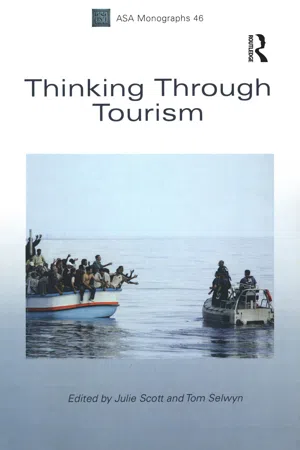
Thinking Through Tourism
About this book
The study of tourism has made key contributions to the study of anthropology. This volume defines the current state of the anthropology of tourism, examining political, economic, ideological and symbolic themes. An extraordinarily rich collection of case studies illustrate topics as diverse as hospitality, sex and tourism, enchantment, colonial and neo-colonial consumption, and the relation between tourism and gender and ethnic boundaries, as well as questions of global, economic and cultural systems, modernism and nationalism. The book also covers practical and policy issues relating to urban, rural and coastal planning and development. Thinking through Tourism assesses the enormous potential contribution that analysis of tourism can offer to mainstream anthropological thinking. The volume opens up new avenues for enquiry and is an essential resource for students and scholars of anthropology, geography, tourism, sociology and related disciplines.
Information
–1–
Introduation
Thinking Through Tourism - Framing the Volume
The three broad aims of this Introduction are to frame the essays presented here in terms of their institutional, epistemological and theoretical contexts and contours; to introduce each essay within a conceptual framework that brings out some of the continuities between them; and to reflect on the contributions anthropology, tourism, and tourism studies make to each other.
Contexts and Contours
Institutional Contexts
The ASA’s sixty-first annual conference, Thinking Through Tourism, marked four noteworthy departures. Firstly, while, in the course of its history, the ASA has deliberated on a wide range of topics at its annual conferences, this was the first on (or near) the subject of tourism. In her foreword to this volume, Maigaret Kenna suggests that part of the reason for this absence derives from the fact that, over a period of three or more decades, the subject of tourism has trodden a rocky path to recognition as a legitimate area of anthropological enquiry in the UK. A second departure was that the conference was the first ASA annual conference to be held in one of the post-1992 ‘new’ universities in the UK - one that, moreover, had no anthropology department of its own. The third was the fact that the conference drew a wider than usual spectrum of participants from beyond traditional anthropology departments: from business schools, schools of tourism and hospitality, departments of geography, architecture and cultural (including ‘cultural heritage’) studies, and museums; and from sixth-form school students studying anthropology as part of their International Baccalaureate curriculum.1
The fourth departure derives from one of the features of the working lives and practices of a good number of anthropologists engaged in research in tourism. In addition to writing academic contributions to journals and books, they routinely become engaged in policy work with private and/or public institutions, including government ministries, and multinational organizations. This is why we include one essay (by Abram) in the present collection that addresses head on the question of ‘intervention’ by anthropologists in the tourism field and draws out the ethical, epistemological and political dilemmas faced by those who have moved into, or move in and out of, ‘applied’ fields of tourism consultancy of one kind or another. Applied work in tourism policy fields is not unrelated to one of the threads linking new universities lacking anthropology departments, tourism studies and contemporary anthropology itself: namely the changing landscape of funding for social-scientific research. At both national and European levels there are recurrent policy steers towards ‘relevance’ and ‘impact’ (the latter term presently finding prominence in the discourse of the forthcoming research assessment exercise in the UK). Part of the relevance of this work is seen by the EC in terms of arguable linkages between tourism and economic, social, and political development, including post-conflict development, in the regions involved. Such programmes of work come with substantial funds, which makes them attractive to the universities that host them.2
These separate yet, we suggest, related features, are key to understanding what anthropology contributes to the study of tourism and, conversely, what anthropology may learn about itself from ‘thinking through tourism’ - the twofold aims of the conference. Before introducing our chapters, then, we start by reflecting on the intellectual and institutional contexts in which the anthropology of tourism finds a place. This involves, inter alia, tracing some of the congruencies and tensions that emerge from the close relationship between them, and considering the nature of the environments in which they are practised, researched and taught. We suggest that this exercise reveals ambivalences at the heart of contemporary anthropology towards its object as well as its aspirations for a wider public role.
Epistemological Contexts
Avoidance Relationship or Unholy Alliance? Anthropologists and tourists do similar things: they travel, spend temporary periods away from home, gather experiences and souvenirs, and tell stories about them when they get home. Numerous commentators have drawn attention to the kinship between them (Burns 1999) but it is a kinship that many others have preferred to ignore. Crick (1995) suggests that comparison with tourists is potentially so threatening that for many anthropologists
…the idea cannot be held in consciousness. Thus, in a discussion of anthropology in the context of other adventurer/travel roles, Peacock can list ‘spies’ and ‘missionaries’ but fails to mention tourists… What is so forgettable or appalling about tourists that provokes these overreactions and avoidances? After all, in our recent reflexive phase, we have been likened to other identities such as con-men, voyeurs and clowns… which might, on first glance, appear to be even less palatable than the tourist comparison. (Crick 1995: 206–7)
Evidently, it is the very similarities that trouble anthropologists. The differences, suggests Crick, are primarily of degree (length of stay; level of language competence; nature of local interaction; the medium and language of storytelling) rather than of kind. Anthropologists may simply be unable to accept that they are just another particularly sophisticated type of traveller; that locals will most likely classify them as such; and that the ethnographic monographs and scientific reports they produce on their return home could be considered just another form of travel writing (Crick 1995). But underlying the classic avoidance relationship described by Crick is a deeper-seated tension. If anthropologists are no longer uniquely placed in terms of access to distant places and people, what then, to echo the question posed by Eriksen (2005), is the difference between anthropology and a piece of intelligent journalism (or travel writing)? Tourism, in other words, calls into question anthropology’s ethnology-based authority - only, it seems, to reincorporate it and reinvest it with a spurious authority within tourism discourse (cf. Bruner 2005).
Critical voices from within anthropology have alleged too close a dependence on ethnography as its prime justification and distinguishing feature. Hart (2004), for example, deplores the failure to find an alternative to ‘[anthropologists’] original raison ďêtre… the study of “primitives’”, and the subsequent trend towards the fragmentation of issue-driven ethnography. His provocative characterization of anthropology’s current raison ďêtre, as ‘long-term, empty-headed exposure to strangers wherever they live’ (2004: 4) could equally be a caricature of the more earnest types of tourist. In an early and now classic essay ‘Tourism as a Form of Imperialism’, Dennison Nash (1989) draws attention to the continuities and structural similarities between tourism and imperialism, and the parallels with anthropology’s roots in colonialism need not be laboured here. But while the intellectual and political certainties of colonial-era anthropology have given way to more equivocal critical reflexivity, ‘tourism’ is accused of being unencumbered by self-doubt, continuing to embrace the narratives, confidence and certainties of earlier anthropological generations, and drawing on ethnographic authority to authenticate its nostalgic versions of colonialism.3 This is a world in which the troubling ethnicity of minority populations inhabiting the cities of the developed world is transformed into the exotic, colourful traditions of the Third World, performed for tourists by ‘ex-primitives’ (MacCannell 1992), and validated by a ‘co-opted’ ethnographic voice (Bruner 2005). Earlier anthropologists’ accounts may serve as templates for the invention of cultural performances for tourists, as Tilley (1997) discovers, along with an audience of fellow anthropologists, in a village in Vanuatu; or anthropologists may be sought as tour guides, to structure and interpret the tourists’ experience for them (cf. Bruner 1995, 2005; Wallace 2005). Bruner writes revealingly of his own experiences as a guide leading small groups of middle-aged North American cultural tourists around Indonesia, where he had spent three years conducting ethnographic fieldwork. For Bruner, his stint as a tour guide was a way of doing fieldwork among tourists; for the tour company, his credentials as a professor of anthropology were part of the brand - a symbol and guarantee of the seriousness and quality of the tour. But, as he discovers, when he is sacked for introducing sessions where he leads the group in deconstructing their touristic experience, what the tour company wants is an old-fashioned ‘1930s realist ethnographer, not one who was beginning a journey to postmodernism’ (Bruner 2005: 4). Tourism, he concludes, is happy ‘… chasing anthropology’s discarded discourse, presenting cultures as functionally integrated homogeneous entities outside of time, space, and history’, but structurally unable to accommodate its contemporary paradigms (2005: 4).
The ‘Black Box’ As Kenna observes in her foreword, most anthropologists in the 1960s and 1970s were content to ignore the presence of tourism and tourists on ‘their’ turf. To the extent that anthropologists noticed tourism at all, it was largely in terms of its local ‘impacts’. A ‘black box’ approach was adopted to the subject of tourism itself, which was treated as another variety of industrial input, albeit particularly rapid and radical in its effects on rural communities (cf. Greenwood 1972; Redclift 1973).
From the late 1970s anthropologists began to unpack this black box and to look directly at tourism itself. In the process, different categories of tourist, styles of travel and development trajectories were identified (e.g. Cohen 1974; Smith 1989). Indeed the production of typologies of tourism and tourists not only resulted in more sophisticated analyses than had been possible when tourism was treated as an undifferentiated input, but effectively put paid to the notion (prevalent in some of the best known early examples of the anthropology of tourism) that tourists, and hence a figure termed ‘the tourist’, derived from the same monolithic category. This stereotype was further undermined by ethnographic research, which drew attention to the phenomenon of domestic tourism, and the fact that the very people traditionally studied by anthropologists could themselves be tourists, both at home and abroad (e.g. Graburn 1983; see also Leite and Grabum 2009). Anthropologists also began explicitly to acknowledge the need to avoid imposing value judgements on the effects of tourism, and to evaluate them against local ideas of development that are the outcome of negotiation and conflict over time (cf. Boissevain 1977; Nash 1981; de Kadt 1990; Wood 1993). However, until the early 1990s or so, anthropological approaches remained largely rooted in ideas of ‘bounded’ communities and ‘cultural islands’ which also characterized tourism discourse (Eriksen 1993; Scott 1995); and even the development of critical concepts, such as cultural commodification (Cohen 1988; Greenwood 1989) initially reinforced rather than challenged underlying functionalist assumptions about culture and authenticity. Tourism did not yield the theoretical breakthroughs sought by anthropologists engaged in its research (cf. Nash 1981) despite a fizzy period when some postmodernist analyses grasped and shook up existing paradigms and found in tourism an ideal metaphor for the proliferation and accelerated circulation of meanings and images, mobilities, scapes and flows, under conditions of globalization. As Crick already noted in 1995: ‘in our present post-modernist, mass communications world we have very much seen a universalization of a mode of perception and being which might be termed “touristic”’ (1995: 206). Tourism and its interstices - including such ‘heteretopias’ as hotels and airports (cf. Augé 1995; Chambers 2000; Gordon 2008), as well as the imaginary spaces of touristic interaction that Bruner terms ‘border zones’ (Bruner 2005) - have become quintessential arenas for ‘capturing’ contemporary processes and relationships.
The study of tourism likewise pushes anthropologists into increasingly interstitial areas of practice, engaging with a wide range of actors, knowledge claims and competing expert discourses, and expanding the range of ‘local’ informants to include tourists, tourism practitioners, developers, entrepreneurs and managers, officials, professionals and specialists of varying hues. Anthropologists of tourism are not alone in finding that actors from ‘the field’ can also become powerful interlocutors ‘at home’; nor that an apparently shared technical vocabulary masks a semantic slippage in the deployment of key terms, pitting anthropologists in an unequal struggle with other, institutionally more entrenched specialist discourses, for control of meaning in the public sphere (a point taken up by Lenz and Abram in this volume). The public life of the ‘culture’ concept offers a particularly pertinent illustration of how outmoded anthropological models - for example, the Týlerian view of culture as a ‘whole way of life of a group or society’ (Wright 1998: 8) - can be appropriated and misapplied by non-anthropologists pursuing a range of agendas, from the justification of organizational reform for the purposes of achieving top-down management control (Wright 1998: 8), to the embedding of corporate ethno-national identities and associated rights in Ireland (Finlay 2006), or the creation of a symbolic vocabulary to promote European unity (Shore 2000).
Tourism thus presents anthropology with both threats and opportunities. Of the more than 50 per cent of British PhDs in anthropology who, according to recent research by Spencer, Jepson and Mills (n.d.), now find employment outside conventional anthropology departments, a good proportion of these are working on tourism-related themes, in the kind of multidisciplinary settings we referred to above. Public familiarity with tourism - in contrast to the general level of public ignorance surrounding anthropology, and what anthropologists do (cf. Caplan 2005) - may offer a route to raising the visibility of anthropology, attracting new students to its study, and all the good things that flow therefrom. At the same time, opportunities to broaden and popularize are often regarded with suspicion by anthropologists, not only because of the perceived risks of oversimplification, misrepresentation and misappropriation, referred to above; but also due to the anxiety surrounding what Mars (2004) identifies as a kind of structural tendency towards disciplinary centrifugalism, bringing with it the fear that the core will be emptied of it...
Table of contents
- Cover
- Half Title
- Title Page
- Copyright Page
- Contents
- List of Figures
- Acknowledgements
- Notes on Contributors
- Foreword
- 1 Introduction: Thinking Through Tourism – Framing the Volume
- 2 Contours of a Nation: Being British in Mallorca
- 3 The Sex of Tourism? Bodies under Suspicion in Paradise
- 4 Belonging at the Cottage
- 5 Tourists, Developers and Civil Society: On the Commodification of Malta’s Landscapes
- 6 Enchanted Sites, Prosaic Interests: Traders of the Bazaar in Aleppo
- 7 Tropical Island Gardens and Formations of Modernity
- 8 Of Jews, Christians and Travellers in Crete: Recovered ‘Roots’, Unwanted ‘Heritage’
- 9 Tourist Attractions, Cultural Icons, Sites of Sacred Encounter: Engagements with Malta’s Neolithic Temples
- 10 ‘Hotel Royal’ and other Spaces of Hospitality: Tourists and Migrants in the Mediterranean
- 11 Anthropology, Tourism and Intervention?
- Postlude
- Index
Trusted by 375,005 students
Access to over 1.5 million titles for a fair monthly price.
Study more efficiently using our study tools.
Frequently asked questions
Yes, you can cancel anytime from the Subscription tab in your account settings on the Perlego website. Your subscription will stay active until the end of your current billing period. Learn how to cancel your subscription
No, books cannot be downloaded as external files, such as PDFs, for use outside of Perlego. However, you can download books within the Perlego app for offline reading on mobile or tablet. Learn how to download books offline
Perlego offers two plans: Essential and Complete
- Essential is ideal for learners and professionals who enjoy exploring a wide range of subjects. Access the Essential Library with 800,000+ trusted titles and best-sellers across business, personal growth, and the humanities. Includes unlimited reading time and Standard Read Aloud voice.
- Complete: Perfect for advanced learners and researchers needing full, unrestricted access. Unlock 1.5M+ books across hundreds of subjects, including academic and specialized titles. The Complete Plan also includes advanced features like Premium Read Aloud and Research Assistant.
We are an online textbook subscription service, where you can get access to an entire online library for less than the price of a single book per month. With over 1.5 million books across 990+ topics, we’ve got you covered! Learn about our mission
Look out for the read-aloud symbol on your next book to see if you can listen to it. The read-aloud tool reads text aloud for you, highlighting the text as it is being read. You can pause it, speed it up and slow it down. Learn more about Read Aloud
Yes! You can use the Perlego app on both iOS and Android devices to read anytime, anywhere — even offline. Perfect for commutes or when you’re on the go.
Please note we cannot support devices running on iOS 13 and Android 7 or earlier. Learn more about using the app
Please note we cannot support devices running on iOS 13 and Android 7 or earlier. Learn more about using the app
Yes, you can access Thinking Through Tourism by Julie Scott,Tom Selwyn in PDF and/or ePUB format, as well as other popular books in Social Sciences & Architecture Essays & Monographs. We have over 1.5 million books available in our catalogue for you to explore.