The 26 recognized minor phyla comprise aberrant clades, as most of them terminate as blind offshoots. Untied from the discussion on their phylogenesis of minor phyla, this book is largely devoted, for the first time, to aspects of reproduction and development in minor phyletics. The minor phyla are not as speciose (1,795 species/phylum) as the major phyla (157,066 species/phylum) are. The accumulation of deleterious genes causes inbreeding depression among progenies arising from parthenogenesis, clonal multiplication and selfing hermaphrodites. The reason for the limited species diversity in minor phyla is traced to (i) eutelism in 65.7% of minor phyletics and (ii) existence of 21.6% clonals, (iii) 6.4% parthenogens and (iv) 1.2% selfing hermaphroditism. Gonochorism obligately requires motility to search for a mate. The combination of low motility and gonochorism from Placozoa to hemocoelomatic minor phyla has limited diversity to < 1,000 species. Over 19% of minor phyletics are hermaphrodites. With the need to manifest and maintain dual sexuality, fecundity of hermaphrodites may be reduced to 50% of that in gonochores. Adopting an array of strategies, < 100 hermaphrodites are selfers. In eutelics, mitotic division is ceased in somatic cells after hatching. For the first time, the prevalence of eutelism has been brought to light in numbers of all the six pseudocoelomate phyla and priapulids. Eutelism limits fecundity to 30–300 eggs in free-living pseudocoelomates, priapulids and possibly other hemocoelomates. In them, sperm production is less than that of egg production; as a result, a large fraction of their eggs is sterile. With a high proportion of non-eutelic gametic cells (35%), Nematoda and possibly Nematomorpha and Acanthocephala are more fecund than rotifers, in which the proportion is 15%. Briefly, the reasons for the limited species diversity in minor phyletics are traced to eutelism, parthenogenesis and clonal multiplication. Surprisingly, parthenogenesis and clonal multiplication mutually eliminate each other. This is also true of hermaphroditism and parthenogenesis. However, clonal multiplication is prevalent from structurally simplest Placozoa to the most complex Ascidiacea, except in pseudocoelomates and hemocoelomates. A limited number of cells and cell types, and the consequent structural simplicity facilitate manifestation of parthenogenesis in pseudocoelomates and parasitism in Mesozoa, Myxozoa, 59% of Nematoda, Nematomorpha, Acanthocephala and Pentastomida. Despite hermaphroditism, Bryozoa (5,700 species) and Ascidiacea (3,000 species) are speciose among minor phyla. For the first time, the importance of fusion of fragments or colonies – an event equivalent to gamete fusion at fertilization – is recognized as a source of new gene combination. Besides, the colonies in these minor phyla degenerate and regenerate more or less regularly. Only the fittest degenerated colonies may be rejuvenated and regenerated.
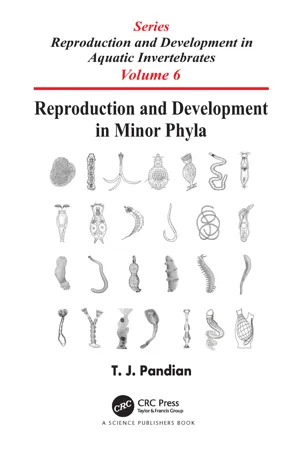
- 302 pages
- English
- ePUB (mobile friendly)
- Available on iOS & Android
eBook - ePub
Reproduction and Development in Minor Phyla
About this book
Information
Introduction
The minor phyla comprise aberrant clades that are not usually considered in the mainstream of evolution. In the phylogenetic tree, most of them terminate as blind offshoots, albeit a few are regarded as a link between two or more major phyla; for example, the velvet worm Onychophora provides a vital link for arthropod evolution. Hyman (1951a, b, 1959) has brought out excellent accounts for 16 minor phyla among the then known 22 aberrant clades. As new taxa are being continuously erected, four minor phyla (Placozoa, Myxozoa, Loricifera, Cycliophora) are now added. Pogonophora is excluded and is now included in polychaetes (see Pandian, 2019). Presently, the aberrant clades are classified into 26 minor phyla. Figure 1.1 shows perhaps for the first time the pictures assembled for representative species from 26 minor phyla. There are a large number of hypotheses and theories describing the phylogenetic relations and affinity between two or more phyla. Discussions, and debates are ongoing on them. A vast majority of publications, reviews, chapters, books and book series elaborate the relationships and affinity between these phyla. As there is more than adequate information on this theme, this account shall not describe or discuss the phylogenetic relations. But it is rather devoted to focus on other aspects, which are not thus far adequately recognized.
Taxonomic Distribution
The minor phyla are not as speciose (1,795 species/phylum, Table 1.1), as the major phyla are (157,066 species/phylum). In six of them, the species number is < 100 (Placozoa, Loricifera, Cycliophora, Gnathostomulida, Priapulida, Phoronida), a few hundred in a dozen of them (Mesozoa, Gastrotricha, Kinorhyncha, Nematomorpha, Sipuncula, Echiura, Onychophora, Pentostomida, Entoprocta, Brachiopoda, Chaetognatha, Hemichordata) and ranges from 1,000 to 3,000 in another six of them (Myxozoa, Nemertea, Rotifera, Acanthocephala, Tardigrada, Urochordata). Only Nematoda (27,000 species) and Bryozoa (5,700 species) are speciose. Further, a few phyla are represented by two-three species (e.g. Placozoa, Cycliophora) and two families (e.g. Priapulida, Onychophora). Some of these values may be compared with the least speciose Echinodermata (7,000 species, Pandian, 2018) and > million speciose Arthropoda (Chapman, 2009). Presently, the minor phyla comprise 46,687 species. They are grouped into (i) Aorganomorpha (a new term coined to indicate the lack of organ, in line with acoelomorpha with no coelom), (ii) Acoelomorpha, (iii) Pseudocolomata, (iv) Hemocoelomata, (v) Lophophorate schizocoelomata and (vi) Eucoelomata. The number of phyla within each of these groups and the number of species in each phylum are shown in Fig. 1.2. Among them, pseudocoelomates with six phyla, each with the highest mean species number of 5,251 per minor phylum, have generated more often aberrant clades. Surprisingly, they are all eutelic, i.e. after hatching, mitosis is ceased in their somatic cells, a feature which has not been adequately recognized. Notably, major phyla have no representative from Pseudocoelomata.

FIGURE 1.1
A. Placozoa: Trichoplax adhaerens (Eitel et al., 2011), B. Mesozoa: Dicyema japonicum. C. Actinospore of Myxozoa. D. Loricifera: Rugiloricus, E. Cycliophora: Symbion pandora, P. Nemertea: Ototyphonemertes sp (after Botosaneanu, 1986), G. Gnathostomulida: Gnathostomula jenneri (drawn from Biocyclopedia), H. a bdelloid rotifer, I. Gastrotricha: Chaetonotus sp (from Biology Discussion), J. Kinorhyncha: Echinoderes sp (free hand drawing from Bumblebee.org), K. Nematoda: Ascaris lumbricoides, L. Nematomorpha: Gordius (from Biology Discussion), M. an acanthocephalan (from NC State University), N. a priapulid (after Kingsley, 1884), O. Sipuncula: Sipunculus nudus (drawn from Maiorova and Adrianov, 2017), P. Echiura: Echiurus (drawn from Biocyclopedia), Q. a tardigrad (from New York Times), R. Onychophora: Peripatus (drawn from BioScience Media), S. Pentastomida: Linguatula serrata (drawn from Saari et al., 2019), T. a phoronidan (drawn from Spektrum.de), U. Entoprocta: Urnatella (from Biology Discussion), V. a bryozoan (drawn from Academic Web Site), W. Brachiopoda: Lingua (drawn from Udo Savalli, Arizona University), X. Chaetognatha: Sagitta elegans (from New World Encyclopedia), Y. Balanoglossus Z. solitary ascidian (all others are free hand drawing from Hyman, 1959).
A. Placozoa: Trichoplax adhaerens (Eitel et al., 2011), B. Mesozoa: Dicyema japonicum. C. Actinospore of Myxozoa. D. Loricifera: Rugiloricus, E. Cycliophora: Symbion pandora, P. Nemertea: Ototyphonemertes sp (after Botosaneanu, 1986), G. Gnathostomulida: Gnathostomula jenneri (drawn from Biocyclopedia), H. a bdelloid rotifer, I. Gastrotricha: Chaetonotus sp (from Biology Discussion), J. Kinorhyncha: Echinoderes sp (free hand drawing from Bumblebee.org), K. Nematoda: Ascaris lumbricoides, L. Nematomorpha: Gordius (from Biology Discussion), M. an acanthocephalan (from NC State University), N. a priapulid (after Kingsley, 1884), O. Sipuncula: Sipunculus nudus (drawn from Maiorova and Adrianov, 2017), P. Echiura: Echiurus (drawn from Biocyclopedia), Q. a tardigrad (from New York Times), R. Onychophora: Peripatus (drawn from BioScience Media), S. Pentastomida: Linguatula serrata (drawn from Saari et al., 2019), T. a phoronidan (drawn from Spektrum.de), U. Entoprocta: Urnatella (from Biology Discussion), V. a bryozoan (drawn from Academic Web Site), W. Brachiopoda: Lingua (drawn from Udo Savalli, Arizona University), X. Chaetognatha: Sagitta elegans (from New World Encyclopedia), Y. Balanoglossus Z. solitary ascidian (all others are free hand drawing from Hyman, 1959).
TABLE 1.1
Number of phyla and approximate species number in major (from different sources) and minor phyla (from this book)
Number of phyla and approximate species number in major (from different sources) and minor phyla (from this book)
| Major Phylum | Species (no.) | Minor Phylum | Species (no.) |
| Aorganomorpha | |||
| Porifera | 8553 | Placozoa | 3 |
| Cnidaria | 10856 | Mesozoa | 150 |
| Acnidaria | 166 | Myxozoa | 2200 |
| Acoelomorpha | |||
| Platyhelminthes | 21810 | Loricifera | 34 |
| Turbellaria | 5500 | Cycliophora | 2 |
| Non-Turbellaria | 16310 | Nemertea | 1300 |
| Gnathostomulida | 100 | ||
| Psuedocoelomata | |||
| Annelida | 16911 | Rotifera | 2031 |
| Echinodermata | 7000 | Gastrotricha | 813 |
| Kinorhyncha | 200 | ||
| Nematoda | 27000 | ||
| Nematomorpha | 360 | ||
| Acanthocephala | 1100 | ||
| Hemocoelomata | |||
| Arthropoda | 1166984 | Priapulida | 19 |
| Crustacea | 54384 | Sipuncula | 160 |
| Non-crustacea | 1112600 | Echiura | 230 |
| Mollusca | 118451 | Tardigrada | 1047 |
| Onychophora | 200 | ||
| Pentastomida | 144 | ||
| Lophophorata | |||
| Entoprocta | 200 | ||
| Phoronida | 23 | ||
| Brachiopoda | 391 | ||
| Bryozoa | 5700 | ||
| Eucoelomata | |||
| Vertebrata | 62869 | Chaetognatha | 150 |
| Hemichordata | 130 | ||
| Urochordata | 3000 | ||
| Major phyla total | 1413600 | Minor phyla total | 46687 |
| Grand total | 1460287 | ||
| 157,066 species/major phylum; 1,795 species/minor phylum | |||

FIGURE 1.2
Number of phyla and species within the major dads of minor phyla. Data are drawn from Table 1.1.
Number of phyla and species within the major dads of minor phyla. Data are drawn from Table 1.1.
Phylogenetic Cladograms
Enormous efforts have been made to construct phylogenetic cladograms to track the history of animal evolution. Based on structural and embryological features, zoologists have traced the animal evolution from simple to complex animals through gradual steps and bridging links, although they are very much aware that parasitism, for example, reverses the course from a complex to simple form, as in parasitic rhizocephalic (e.g. Sacculina carcini) crustaceans (Pandian, 2016). For classification, the conventional cladogram considers the absen...
Table of contents
- Cover
- Half Title
- Title Page
- Copyright Page
- Preface to the Series
- Preface
- Acknowledgements
- Table of Contents
- 1. General Introduction
- Part A: Aorganomorpha
- Part B: Acoelomorpha
- Part C: Pseudocoelomata
- Part D: Schizocoelomata: Hemocoelomata
- Part E: Schizocoelomata: Lophophorata
- Part F: Eucoelomates
- 27. References
- Author Index
- Species Index
- Subject Index
- Author’s Biography
Trusted by 375,005 students
Access to over 1.5 million titles for a fair monthly price.
Study more efficiently using our study tools.
Frequently asked questions
Yes, you can cancel anytime from the Subscription tab in your account settings on the Perlego website. Your subscription will stay active until the end of your current billing period. Learn how to cancel your subscription
No, books cannot be downloaded as external files, such as PDFs, for use outside of Perlego. However, you can download books within the Perlego app for offline reading on mobile or tablet. Learn how to download books offline
Perlego offers two plans: Essential and Complete
- Essential is ideal for learners and professionals who enjoy exploring a wide range of subjects. Access the Essential Library with 800,000+ trusted titles and best-sellers across business, personal growth, and the humanities. Includes unlimited reading time and Standard Read Aloud voice.
- Complete: Perfect for advanced learners and researchers needing full, unrestricted access. Unlock 1.5M+ books across hundreds of subjects, including academic and specialized titles. The Complete Plan also includes advanced features like Premium Read Aloud and Research Assistant.
We are an online textbook subscription service, where you can get access to an entire online library for less than the price of a single book per month. With over 1.5 million books across 990+ topics, we’ve got you covered! Learn about our mission
Look out for the read-aloud symbol on your next book to see if you can listen to it. The read-aloud tool reads text aloud for you, highlighting the text as it is being read. You can pause it, speed it up and slow it down. Learn more about Read Aloud
Yes! You can use the Perlego app on both iOS and Android devices to read anytime, anywhere — even offline. Perfect for commutes or when you’re on the go.
Please note we cannot support devices running on iOS 13 and Android 7 or earlier. Learn more about using the app
Please note we cannot support devices running on iOS 13 and Android 7 or earlier. Learn more about using the app
Yes, you can access Reproduction and Development in Minor Phyla by T. J. Pandian in PDF and/or ePUB format, as well as other popular books in Biological Sciences & Biology. We have over 1.5 million books available in our catalogue for you to explore.