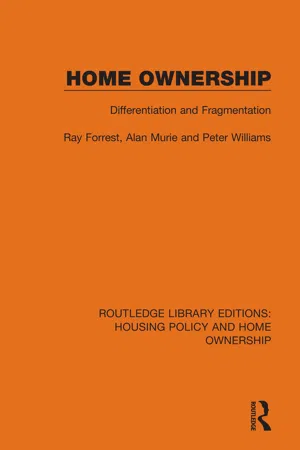
Originally published in 1990 and drawing on extensive research, this book provides an evaluation of the impact of the growth of home ownership in the UK, and of the claims and counter-claims made for its social significance. The book examines critically the evidence for and against the proposition that mass home ownership is contributing towards a more equal society. Wide-ranging in its coverage, the book discusses the changing nature and role of home ownership, wealth accumulation and housing, the relationship between social class and housing tenure, and policy development.
- 242 pages
- English
- ePUB (mobile friendly)
- Available on iOS & Android
eBook - ePub
About this book
Information
1 Understanding Home Ownership
Most people are now home owners. However, the range of individual experience within home ownership is widening. As home ownership has become more significant so it has attracted more commentary and analysis. These commentaries have different starting points, and emphasise different processes, explanations and implications. This chapter introduces and summarises major perspectives and identifies key themes and issues to be explored later in this book. It provides a brief account of the different types and levels of analysis in the literature and focuses in particular on two perspectives: structures of provision and consumption sector cleavages.
Home ownership is in transition. Its history has been and will continue to be one of change. There has been a transition in housing – from a situation in which home ownership was a minority tenure to a situation where it is dominant. In contrast, private renting has moved from dominant to minority status. It is an obstacle to understanding if the imagery of home ownership becomes fixed at a point in time, failing to communicate current realities and future prospects. The tendency for this unchanging imagery derives from the media and from policy advocacy by government, but it is also a consequence of a wider failure to stress elements of change and variation.
A variety of approaches and frameworks have been applied to the analysis of home ownership. Table 1.1 provides a summary of four key perspectives. No reference is made to the ecological tradition, which focused on the patterns of residential stratification but largely ignored the processes that led to this, or blended into those approaches that emphasize choice and make no reference to the structure of the housing market. The development of the debate is simplified in Table 1.1 by presenting it as a succession of approaches growing out of each other. This is a device to highlight particular elements in different contributions. Within this progression it is also argued that elements of previous contributions are incorporated in later contributions. Some brief reference to the major headings identified in Table 1.1 provides some flavour of the debate.
Focus | Process | Implications |
|---|---|---|
I Individuals | Choice and preference. Competition involving large numbers of buyers and sellers seeking to maximize housing services within an income/ budget constraint (and trade-offs with travel to work and other services). | Home ownership is demand led and supply responds to need expressed through the market. Preference is the main determinant of outcomes. |
But no attention is paid to the social contexts in which choice is formed, or to the structure of the housing market and especially the effects of state intervention on market processes. Consistent inequalities exist between households with the same market power. Individual search and information behaviour is not a sufficient explanation for these patterns. | ||
II Social groups | Competition for housing is based on factors other than income and achieved housing status and processes involve bureaucratic allocation systems adopting non-market criteria. | Home ownership reflects unequal power and competitive position, which cuts across market position to form separate housing classes. |
But identifying social groups with the same means of access to housing or in the same housing situation/class does not identify the process or the nature of constraints involved. | ||
III Institutions | Key decisions that mediate competition for housing are exercised by a range of public and private sector institutions and gatekeepers. Who gets what in the housing market is directly explained by this. The interests and actions of the state and of private sector agencies operating within a framework of state policy are reflected in the structure of the market. | Patterns and constraints in home ownership reflect the activities of a range of state and exchange professionals and the choices and decisions of consumers are mediated by this. Home ownership is a product of ideological and political processes. |
But identifying front-line institutions and urban gatekeepers focuses on ‘middlemen’ rather than underlying processes. It implies a degree of power and discretion in decisions and in forming the market that is inaccurate. Too great an emphasis is placed on the state as the orchestrator and on questions relating to the consumption of housing. | ||
IV Political economy of advanced capitalism | Price movements and the structure of the market reflect the operation of the production process in a capitalist economy with decisions about investment in land and housing based on profit taking. The role of the state in this process is not neutral in conflicts between and within classes relating to housing production. | Home ownership is supply led and its structure and growth reflect the process of commodity production under capitalism. |
But the emphasis on production in a capitalist economy caricatures the ‘interests’ of capital and implies a (common) functional logic, which underestimates shifting and conflicting interests and fails to explain differences in home ownership in different countries. | ||
1. Individual choice and preference
The simplest models of individual choice present households as making rational choices relating to their incomes and seeking to maximize their housing situation. This involves trade-offs, particularly relating to travel time and costs (especially travel to work). Whether individuals seek to achieve an optimal level of service relating to some particular attribute or to satisfy a wider range of criteria, and whether they have imperfect knowledge or information, the process that determines the social distribution of housing resources is seen to be the outcome of the individual’s exercise of choice and preference. The distribution reflects differences in preferred lifestyles, culturally determined behaviour and the values attached to different factors. Differences in incomes, house prices and travel costs form the basic components of individual choices and the implication is that persons with similar incomes have the same housing choices open to them between and within tenures. While some approaches seek to refer to an unspecified notion of housing service, others specify tenure and other elements and recognize that decisions about tenure, location and other attributes of housing are influenced by factors other than income. Individual choice models may specify a wider range of attributes, refer to satisfying rather than optimizing and acknowledge the importance of sub-markets relating perhaps to particular neighbourhoods. Nevertheless, they continue to indicate that preference is the main determinant of outcomes.
2. Social groups and competition
The essential alternative to an individual choice model is one that emphasizes constraints. All choices are constrained choices reflecting differential bargaining power and position in relation to bureaucratic allocation systems. Groups of people share common positions in means of access to housing and differences will exist among those with similar incomes or sharing the same relation to the means of production. Rather than individual choice determining where people live, in Rex and Moore’s words the central process of the city as a social unit ‘is a class struggle over the use of houses’ (Rex and Moore, 1967, pp. 273–4). People in the same labour situation may ‘have differential degrees of access to housing and it is this which immediately determines the class conflicts of the city as distinct from those of the workplace’ (p. 274). The concept of housing classes rather than individuals exercising choice has been particularly relevant because it acknowledges that the housing market does not conform to an equilibrium, unified or laissez-faire model. The British housing market, at least since 1915, has been affected by state intervention and regulation. Market pricing does not operate across the system and the relationship between housing costs and housing service is not the same throughout the system. Consequently, competition is not based on income and price alone. Different means of access to housing involve different resources and attributes. Rex and Moore’s identification of housing classes involved a variety of problems, which are fully discussed elsewhere. From the perspective of a book about home ownership it is interesting that the ranking of housing classes by Rex and Moore in 1967 differentiated between three different groups of home owners: outright owners, mortgage payers, and home owners who must take in lodgers to meet loan repayments. The last group was ranked below both council and private tenants and only above lodgers in rooms.
3. Institutions and gatekeepers
Identifying constraints, the importance of bureaucratic allocation systems and differential access to housing leads to a focus on the allocators, the types of constraint and the rules of access rather than on social groups in common positions in terms of access. The search for a classification of groups of households is complemented by an examination of the institutions and policies affecting the experience of these groups (see e.g. Murie et al., 1976; P. Williams, 1982; Karn et. al. 1985). At this point the debate is much more specific and refers to the practices of organizations and managers.
For a tenure dominated by the language of choice, a discussion of access and allocation, rules and procedures may seem inappropriate. However, access to home ownership rests heavily upon the access to and allocation of mortgage finance, property and legal services, and aid and advice. Studies of first-time buyers and movers indicate that, at least until recently, specific groups were sometimes discriminated against by lenders. Examples included single women, minority ethnic groups, the self-employed, indeed anyone who did not appear to have a conventional, white, middle-class family lifestyle and/or a stable income. Such groups could be refused mortgages or offered lower percentage advances.
A similar pattern of discrimination was apparent within lending on properties and in areas. Houses without front gardens, leasehold flats and areas of inner city terraced property were often marked out as undesirable risks and even specifically red- or blue-lined on maps in the lenders’ offices. Just as access to mortgage finance could be problematic, so too, can the issue of finding and buying or selling property. Estate agents have a clear sense of who might buy any particular property or live in any specific area. Potential purchasers are both knowingly and unknowingly screened for their appropriateness and by one means or another encouraged or deterred. Such practices restrict access to some areas by some groups, and there has been evidence that minority ethnic groups in particular have suffered from it. While these practices in relation to mortgaging and estate agency have changed, especially with increased competition in recent years, they have formed a feature of home ownership in the past and few would argue that they no longer obtain.
4. Political economy
In essence this involves a recognition that the housing market and home ownership are structured by a capitalist system in which the search for profit is paramount and in which society is structured by a class system. At its most instrumental, this approach would argue that home ownership has been promoted strongly within capitalist societies because it fosters social stability, offers a stake in the system (however illusory), is based upon individualized family units and is strongly anti-collectivist. Such arguments have often led to a strong anti home ownership stance. Home ownership is represented as encouraging social stability or as anti-collectivist or as a ‘dupe’ that distorts political judgements and other identities of interest. However, the evidence advanced to suggest that the growth of home ownership has independently changed political attitudes and behaviour is limited and unconvincing and the instrumental version of a political economy approach does not stand up to close scrutiny. Moreover, working-class home ownership in the nineteenth century developed in some areas as a conscious collective defensive strategy by employees in communities dominated by a single employer.
Within a political economy perspective, home ownership does not have to be seen either as having an instrumental or functionalist relationship to capitalism or as developing separately and independently of it. What is essential is a recognition that, under capitalism, housing is a commodity produced for profit. Decisions affecting what housing is produced, where, when and at what cost are based on relative profitability. In Britain and other advanced countries, state intervention plays an important part in determining these judg...
Table of contents
- Cover
- Half Title
- Title Page
- Copyright Page
- Fm-chapter
- Original Title Page
- Original Copyright Page
- Table of Contents
- List of figures
- List of tables
- Acknowledgements
- Introduction
- 1 Understanding home ownership
- 2 Home ownership: facts and fictions
- 3 Home ownership: a silent revolution?
- 4 Property, class and tenure
- 5 The fragmented market
- 6 Wealth: realizing the dream
- 7 A tenure in transition
- 8 Home ownership: deconstruction and reconstruction
- References
- Index
Trusted by 375,005 students
Access to over 1.5 million titles for a fair monthly price.
Study more efficiently using our study tools.
Frequently asked questions
Yes, you can cancel anytime from the Subscription tab in your account settings on the Perlego website. Your subscription will stay active until the end of your current billing period. Learn how to cancel your subscription
No, books cannot be downloaded as external files, such as PDFs, for use outside of Perlego. However, you can download books within the Perlego app for offline reading on mobile or tablet. Learn how to download books offline
Perlego offers two plans: Essential and Complete
- Essential is ideal for learners and professionals who enjoy exploring a wide range of subjects. Access the Essential Library with 800,000+ trusted titles and best-sellers across business, personal growth, and the humanities. Includes unlimited reading time and Standard Read Aloud voice.
- Complete: Perfect for advanced learners and researchers needing full, unrestricted access. Unlock 1.5M+ books across hundreds of subjects, including academic and specialized titles. The Complete Plan also includes advanced features like Premium Read Aloud and Research Assistant.
We are an online textbook subscription service, where you can get access to an entire online library for less than the price of a single book per month. With over 1.5 million books across 990+ topics, we’ve got you covered! Learn about our mission
Look out for the read-aloud symbol on your next book to see if you can listen to it. The read-aloud tool reads text aloud for you, highlighting the text as it is being read. You can pause it, speed it up and slow it down. Learn more about Read Aloud
Yes! You can use the Perlego app on both iOS and Android devices to read anytime, anywhere — even offline. Perfect for commutes or when you’re on the go.
Please note we cannot support devices running on iOS 13 and Android 7 or earlier. Learn more about using the app
Please note we cannot support devices running on iOS 13 and Android 7 or earlier. Learn more about using the app
Yes, you can access Home Ownership by Ray Forrest,Alan Murie,Peter Williams in PDF and/or ePUB format, as well as other popular books in Social Sciences & Environmental Law. We have over 1.5 million books available in our catalogue for you to explore.