The Muslim Question in Assam and Northeast India
eBook - ePub

The Muslim Question in Assam and Northeast India

  1. 240 pages
  2. English
  3. ePUB (mobile friendly)
  4. Available on iOS & Android
eBook - ePub

The Muslim Question in Assam and Northeast India

About this book

This book presents a systematic study of the transformation of the specific socio-political identity of the Muslims in Assam. It discusses the issues of Muslims under India's 'indigenous secularism', Hindu nationalism and the rise of majoritarian politics; Muslim immigration into Assam after Independence; the Assam Movement and the shift of Muslims from being a vote bank to an autonomous force in the post-Partition politics of Assam; the role of Jamiat; and the divide between Assamese and the neo-Assamese. It explores the history and contemporary politics of the state to show how they shape the new context of Muslim identity in Assam, where previously an Assamese identity often prevailed over religious and linguistic identity. With the current debates on illegal immigration, the National Register of Citizens of India (NRC) and the Citizenship (Amendment) Act 2019, this book will be a timely addition to the existing literature on Muslim minority politics in Assam and northeast India.

This book will be useful to scholars and researchers of political science, sociology, political sociology, minority studies, northeast India studies, demography and immigration studies, and development studies. It will interest those concerned with minority politics, communal politics, identity politics, migration, citizenship issues, and South Asian studies.

1
Muslims in Assam till independence

The amalgamation of three racial elements, namely, the Australoids, Mongoloids and Caucasoids are the specialty of peopling in Assam. Due to the long-term migratory flow into it, Assam in the modern period emerged as the melting pot of diverse cultural elements with the Indo-Aryans and Austro-Mongoloids being the major ones. This has also made Assam linguistically and ethnically the most diversified state in India. Even in the global context, such diversity in the composition of a population is rare. The immigration of Muslims as a religious group to Assam, however, only started at the beginning of the thirteenth century. But what remains unique in the case of Muslims is that, unlike other groups who immigrated to Assam, their immigration to the state still remains a continuous affair. Even today there is a popular impression in Assam that because of the porous India-Bangladesh border Muslims are illegally immigrating.

Immigration to Assam in pre-historic time

Human skeletal, which indicates the physical features of a man of the pre-historic past of Assam, has not yet been discovered from any part of Northeast India. However, the discovery of various stone tools provides authentic shreds of evidence that pre-historic lithic culture flourished at one time in Assam as well as other parts of Northeast India. The Palaeolithic stone tools were used in the Old Stone Age lasting from about 2.5 million to 9000 BC. On the other hand, the occurrence of the Neolithic stone tools in different parts of Northeast India supports the fact that the Neolithic culture was fairly widespread in the region. This New Stone Age ranged approximately between 9000 BC and 6000 BC (Das 2009: 86).
Based on fossil evidence, it can be presumed that the geographical regions like South China, Southeast Asia and Northeast India were inhabited by people called Australoid. They are considered the earliest people to reach Assam (ibid). It is assumed that their migration to the region happened in 3500 BC (Saikia 2016: 59). After this, the Mongoloids started to immigrate to present Northeast from North east China (Das 2009: 86). This immigration started around 3000 BC (Saikia 2016: 59). Successive waves of migration of Mongoloid occurred from the North, the East and the North East. The Mongoloid race are said to have had an original hearth in eastern Eurasia from where they kept migrating to different parts of Asia, some branches moving southward to the Tibetan plateau and onward to the Himalayan region, other branches taking an eastern route (Taid 2009: 91). For centuries, the immigration of Mongoloid people to Assam continued. At present, several Mongoloid groups are distributed in different parts of Assam. Most of these groups are scheduled as Tribe under the Constitution of India. Some such tribes living in Assam are Boros or Bodos, Kacharis, Deoris, Rabhas, Sonowal Kacharis, Tiwas, Mishings, Karbis, Dimasas, Meches, Garos etc. Notably, the Australoids, who were the earliest settlers of Assam, were completely absorbed or dispersed by the Mongoloid who arrived later (Das 2009: 86). Among different Mongoloid groups, the people of proto-Bodo origin are supposed to be autochthons of Assam (Taid 2009: 92).
Different groups of people belonging to the Caucasoid race also immigrated to Assam in a later phase. It is believed that by 700 BC, the Indo-Aryans, a division of the Caucasoids, migrated from the west to reach North Bihar from where they moved eastwards in smaller groups at different times. They mostly settled in Brahmaputra valley plain and Barak valley. Presently, in general, the Assamese caste Hindu populations as well as Muslim are considered Caucasian in origin. As a result of these primitive waves of immigration, Brahmaputra valley turned out to be a meeting place of two major races of mankind, namely the Mongoloid and the Caucasoid (Das 2009: 87). Following this, people belonging to other major races did not enter Assam, although small groups of Mongoloid and Caucasoid races continued to immigrate to Assam at different points of time in the ancient period.

Immigration to Assam in medieval time

The continuous immigration of different racial groups diversified the demography of Assam. This diverse demography became more complex in the region due to the immigration of some major ethnic groups in the medieval period. In this process, the beginning of the thirteenth century became a turning point in the history of Assam when the state witnessed two major waves of immigration – the Ahom immigration from the east and the Muslim invasions from the west. The immigration of these two groups significantly changed the society and politics of the state in subsequent centuries.
The Ahoms were the offshoot of the great Tai race who constitute the most widespread population in South East Asia. A group of Tai people left Mong Mao in the Yunnan province of China in 1215 AD and moved towards Assam. After 13 years they reached Assam [CHA(II) 2007: 49–52] and ruled their new territory from 1228 AD. The conquest made by the Tai-Ahoms was not an invasion but a gradual and peaceful penetration without causing displacement of the local inhabitants (ibid: 53). The Ahom had their language, religion and culture. Over time, they gradually abandoned their language and accepted the Assamese language. By the seventeenth century, they became Hindu or Hinduised (Das 2009: 88). They ruled Assam for about six hundred years till the state was taken over by the British in 1826. With the beginning of Ahom rule, the Assamese nation-building process was started, and Assamese started to emerge as a common language of different communities living in Brahmaputra valley.

Muslim immigration in medieval time

While the Ahoms did not enter Assam as invaders, Muslims did. Against this, while Ahom, after immigrating to Assam ruled the state for about six hundred years, Muslims could not rule Assam, with the exception of a short-lived occupation by Mughal Emperor Aurangzeb’s General Mir Jumlah, despite their repeated invasions. The soldiers that were with the Muslim invaders taken prisoner by Ahom kings formed the first group of Muslim settlers in Assam. Another three groups of Muslims immigrated to Assam during this period: artisans who were imported by the Ahom kings for different specialised work, Muslim groups immigrated to settle there when provided opportunity by historical developments of the eighteenth century, and preachers who came to spread Islam. These were the total of four groups of Muslims who immigrated to Assam during the medieval period. However, none of these groups were large in number and the Muslim population started to grow in Assam during this period mainly as a result of the conversion of the local population to Islam.

Muslim invasion and beginning of Muslim settlement

Assam was known as ‘Pragjyotisha’ in the Mahabharata and as ‘Kamrupa’ in Purana and Tantras (Gait 2004: 10). In the history of Assam, the first-ever contact of Kamrupa with Muslim invaders was in 1206. The invader was Muhammad-Ibn-Bakhtiyar-Khilji, son of Bakhtiyar and a Turk of the Khilji dynasty. However, it was not an attack on Kamrupa. Bakhtiyar Khilji became the governor of Bihar and later invaded Bengal in 1202. Bakhtiyar’s army easily defeated the king of Bengal. Since then, the Muslim occupation in the capital city of Bengal came to be known as Gaur which is located in the present Indo-Bangladesh border. A few years later, Bakhtiyar’s army marched towards the Northeast to conquer Tibet. In this march, Bakhtiyar’s army entered Kamrupa but surged forward towards Tibet. Before the army reached Tibet, it engaged in battle with the Hindu Brahmans and Nunis in a region called Karampatan where Bakhtiyar’s army was defeated and they were forced to retreat. On his return, Bakhtiyar’s army was blocked and attacked by the king of Kamrupa. Only Bakhtiyar and a few best-mounted soldiers of his army were able to escape and reached Gaur in 1206 (Ahmed 2017: 102–03).
Presumably, most of the soldiers from Bakhtiyar’s army were killed by the army of the king of Kamrupa, however, it is possible that some of the soldiers survived. These soldiers may have been left behind when Bakhtiyar fled the battlefield. In that situation, these deserted soldiers had no option but to stay in Assam. They could be considered the first batch of Muslim settlers in Assam and, their settlement preceded that of the Ahoms in the state. Some political historians believe that the Muslim soldiers were left in Assam because they did not wish to go back with their defeated general (ibid: 104). However, victory and defeat are part of an invasion or war, and it is unlikely that those soldiers would have preferred to stay behind in Assam – an unknown and enemy country – just because they were not willing to return with their defeated general.
The first major conflict between Muslims and the Ahoms took place in April 1532. A Muslim commander, Turbak of Gaur, attacked the Ahom Kingdom with a large army. This attack was foiled by the Ahoms. Meanwhile, Turbak was killed in the battle. His head was buried on top of the Charaideo hill in the present Charaideo district. The Muslims who were taken prisoner in the war against Turbak settled in different parts of the country by the Ahom king. According to contemporary Assam history, they were given the task of cutting grass for the king’s elephants but found to be quite unfit for the job. Their next vocation as farmers was a failure due to their ignorance of agriculture. Left to their own devices, they took to working on brass, an occupation which their descendants, known as Moria, also followed (Gait 2004: 90). The Morias now live in different parts of the middle and upper Assam districts of Brahmaputra valley and are listed as a backward caste by the Assam government.
The number of Muslims increased in Assam with every successive attack on Assam during the reign of the Mughals. Mir Jumlah, the governor of Bengal, marched towards Assam in January 1662. His attack on the Ahom Kingdom was by far the most successful from the Muslims’ perspective. On 17 March, Mir Jumlah’s army entered Gargaon, the capital city of the Ahom Kingdom, and occupied the king’s palace. But the heavy rains in Assam during the monsoon period caused great hardship to the invaders. Meanwhile, the Ahoms kept attacking the invaders to save Gargaon. Finally, a treaty was agreed upon between Mir Jumlah and the Ahom King Jayadhwaj Singha on 9 January 1663. The terms of the treaty were favourable to the Mughals, and Mir Jumlah ordered his army to return to Bengal. Mir Jumlah occupied Gargaon from March 1662 until January 1663 which was the longest occupation of Muslims over the Ahom Kingdom. As a result of the treaty, the Ahom king had to surrender vast territories to the Mughals from west of river Bharali on the north bank of Brahmaputra to the Kallang River on the south bank of Brahmaputra (ibid: 121–31). With the attack of Mir Jumlah, the Muslim population in Assam increased in large numbers.
The last major battle between the Ahoms and the Mughals was fought in March 1671 at Saraighat, near Guwahati. In this battle, the Mughal army under commander Raja Ram Singh was decisively beaten by the Ahom forces under the General Lachit Borphukan. The victory brought the Ahom Kingdom a large portion of Mughal territories up to the river Manaha. Though there was another battle between these two powers in 1682 during the reign of Ahom King Gadhadhar Singha, this was not at the initiative of the Mughals (Baruah 1985: 275–76).
The present lower Assam districts, which were not part of the Ahom Kingdom, have a large Muslim population in comparison to the upper Assam districts where the Ahoms ruled. The Muslim invasions played a role in the case of Muslim settlement in lower Assam too. The southern portion of the Goalpara and Kamrup districts remained under the authority of the Gaur Sultan from 1320 –21 until the Kamata King Mriganko conquered the region sometime during 1397–1407 with the help of Ahom King Sudangpha (Ahmed 2017: 62). Again, in 1498, Nawab Hussain Shah of Gaur made a successful conquest of Kamatapur, the Koch Kingdom, and appointed his son to administer Hajo in Kamrup (Rural) district of present Assam. After conquering Kamatapur, an attempt to annex the Ahom Kingdom led to the destruction of the entire Muslim army and the loss of the whole of the newly conquered country. During the attack of Hussain Shah, a colony of Muslims was established around Hajo. A prominent Muslim shrine known as Poamecca in Hajo was established by Gyasuddin Aulia who had accompanied Hussain Shah in the campaign (Dev and Lahiri 1985: 2). This was perhaps the earliest systematic Muslim settlement in Assam. Hussain Shah, for 17 years between 1502 and 1519, ruled a greater part of the Kamata Kingdom (present Goalpara and Kamrup regions) (Ahmed 2017: 62).
Finally, in 1637, the Nawab of Dhaka sent an army under Mir Zainuddin to seize Goalpara from the Koch Kingdom. In this mission, the Muslim army crossed the Manas River and earned successive victories. At that time, the Koch King Balinarayana was in alliance with the Ahom Kingdom. The Muslim army occupied Ahom forts in Barpeta, Pandu, Saraighat and Kajalimukh among others. Koch King Balinarayana fled to Singri Parbat in Darrang, where the Muslim army killed him in 1637. Since then, Goalpara and a large part of lower Assam were ruled by the Muslim ruler of Dhaka through a governor for 20 years. Only in 1658, Goalpara was taken back from Muslims by Prannarayan, the king of Koch Bihar. Immediately after this, the Ahoms defeated Prannarayan and occupied Goalpara. The Ahoms ruled over Goalpara until it was conceded to Mir Jumlah as a result of the treaty between him and the Ahoms in 1663. Goalpara became a part of the Muslim dominion after it was taken by Mir Jumlah from Ahom until it was ceded to the British in 1765 with the rest of Bengal. Against this backdrop, it could be assumed that a large number of Muslims got the opportunity to migrate and settle permanently in the present Kamrup, Darrang, Dhubri and Goalpara districts during the periods these areas were occupied by Muslim rulers (ibid: 97–98).
On the other hand, the present Barak valley was not much influenced by Muslim invasions. The present Karimganj district and a small south-west part of Hailakandi district were a part of the Sylhet district till it became part of India after partition in 1947. Thus, the history of the Muslim growth of this region formed a part of the history of then Bengal. The other parts of Barak valley, the present Cachar district and the major part of Hailakandi district did not experience major Muslim invasion during the medieval period (Ahmed 2012: 8–9). Other factors, which are discussed later, contributed to the growth of Muslims in this region.
Assam as a whole was never part of the Muslim dominion. Furthermore, the few Muslim victories were also short-lived. Still, it is not historically correct to say that the Muslim rule did not leave lasting effects on Ass...
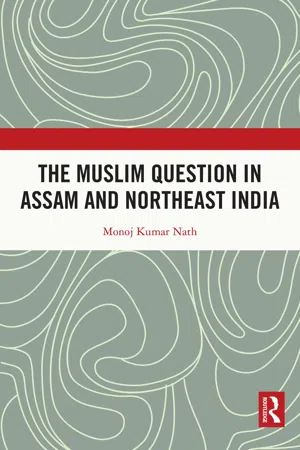
Table of contents

  1. Cover
  2. Half Title
  3. Title Page
  4. Copyright Page
  5. Dedication
  6. Table of Contents
  7. Abbreviations
  8. Acknowledgements
  9. Introduction: Muslims in Assam till independence
  10. Chapter 1: Muslims in Assam till independence
  11. Chapter 2: After independence: Social and political alliance of Muslims
  12. Chapter 3: The Assam Movement: Muslims as the issue
  13. Chapter 4: After Assam Movement: Muslim political mobilisation and demographic change
  14. Chapter 5: The divides: Electoral dominance, citizenship and the idea of ‘Assamese’
  15. Conclusion: The question of identity among the Assam Muslims
  16. Bibliography
  17. index

Trusted by 375,005 students

Access to over 1.5 million titles for a fair monthly price.

Study more efficiently using our study tools.

Information

Edition
1
Year
2021
Print ISBN
9780367752941
9781032125312
eBook ISBN
9781000370317

Frequently asked questions

Yes, you can cancel anytime from the Subscription tab in your account settings on the Perlego website. Your subscription will stay active until the end of your current billing period. Learn how to cancel your subscription
No, books cannot be downloaded as external files, such as PDFs, for use outside of Perlego. However, you can download books within the Perlego app for offline reading on mobile or tablet. Learn how to download books offline
Perlego offers two plans: Essential and Complete
  • Essential is ideal for learners and professionals who enjoy exploring a wide range of subjects. Access the Essential Library with 800,000+ trusted titles and best-sellers across business, personal growth, and the humanities. Includes unlimited reading time and Standard Read Aloud voice.
  • Complete: Perfect for advanced learners and researchers needing full, unrestricted access. Unlock 1.5M+ books across hundreds of subjects, including academic and specialized titles. The Complete Plan also includes advanced features like Premium Read Aloud and Research Assistant.
Both plans are available with monthly, semester, or annual billing cycles.
We are an online textbook subscription service, where you can get access to an entire online library for less than the price of a single book per month. With over 1.5 million books across 990+ topics, we’ve got you covered! Learn about our mission
Look out for the read-aloud symbol on your next book to see if you can listen to it. The read-aloud tool reads text aloud for you, highlighting the text as it is being read. You can pause it, speed it up and slow it down. Learn more about Read Aloud
Yes! You can use the Perlego app on both iOS and Android devices to read anytime, anywhere — even offline. Perfect for commutes or when you’re on the go.
Please note we cannot support devices running on iOS 13 and Android 7 or earlier. Learn more about using the app
Yes, you can access The Muslim Question in Assam and Northeast India by Monoj Kumar Nath in PDF and/or ePUB format, as well as other popular books in Politics & International Relations & Civics & Citizenship. We have over 1.5 million books available in our catalogue for you to explore.