![]()
DON’T MAKE
A FALSE START
WITH YOUR KPI
PROGRAMME
![]()
1
![]()
It’s Thursday and the eHomes management team will convene in ten minutes for the weekly meeting. Vince, the general manager, isn’t happy with yesterday’s kick-off. The launch of the KPI programme was not well-received. That’s annoying, because the management team worked hard on the new strategy for several months and everyone seemed to be on the same page.
eHomes has achieved a number of technical breakthroughs in the past two years. A leading position in the market is now a real possibility. The organisation has the technology at its fingertips to create an intelligent home for everyone. The latest technology makes it possible to create the house of the future and rebuild existing houses at affordable prices. That’s a genuine breakthrough and that’s how the company can differentiate itself from the competition. The new direction and ambitions are summarised in the strategic plan for eHomes for the next few years.
In order for all employees to be part of the new strategy, the management team decided to start a programme. ‘If we want to get 250 people aligned on the new course, we have to measure whether we are making progress’, was the idea. ‘Let’s use KPIs for that. Translating strategy to the work floor, right? Translating the new ambitions into tangible objectives and KPIs. Making performance transparent and creating focus.’
The management team was unanimous about who should lead the KPI programme. That was Martin, the Financial director. When it comes to numbers, he’s your guy and he also takes care of the financial key figures.
But Martin quickly ran into problems during the kick-off session. It was not clear to employees why the management team started the KPI programme and Martin was not able to explain it very well. He had no good answers for questions like: ‘Why do we need KPIs? We’re already transparent!’ and ‘I tell you everything you need to know, and if you think I’m not doing it right, you just ask me’.
Food for thought. Management had to come up with a different pitch.
The example of eHomes is by no means unique. Managers develop an adapted or new strategy. They start an implementation programme and want to monitor progress. The objectives and ambitions at the strategic level are translated to the work floor. They need clear information with which they can manage and improve the organisation. This management information should visualise how things are progressing. It gives management the possibility to press the buttons when things go wrong. When management information is focused too much on its financial performance, many organisations must start to measure other things, using Key Performance Indicators (KPIs).
Organisations that want to work with KPIs can choose from various methods for implementing KPIs and translating them to the work floor. But: What would really work? How do you define the right objectives and KPIs? What buttons can you really press? And how to foster enthusiasm among employees and improve the way departments cooperate?
In any case, your KPI programme – i.e. bringing your strategic objectives and ambitions to life – does not start with KPIs and words such as transparency and focus. Consider objectives and KPIs as the means to get where you want to be. Your goal is not to have KPIs, your goal is realise the new ambition and the dream of your organisation. The ‘why’ according to Simon Sinek (2011) or the profound underlying ‘purpose’. Start your KPI programme, or any type of programme you can come up with, with the dream behind it and the change that is needed to realise the dream.
eHomes has such a dream. The management team is enthusiastic about its latest products and wants to use them to get ahead of the competition. The strategy will determine the route. It’s a beautiful, positive dream that can be translated into a ‘why’ or ‘purpose’, such as safety, convenience, and comfort for as many households as possible. eHomes is not there yet and will have to make several changes successfully in order to realise its dream. That’s quite a journey. A journey is easier with a compass, a compass that redirects the organisation before it takes a wrong turn, a compass that shows you what’s doing well, and one that leads your employees towards your dream. KPIs are an important part of that compass. Starting a KPI programme in which words like focus, transparency, and monitoring are central is not an inspiring starting point. But your dream is.
1.See objectives and KPIs as the means to achieve your dream.
2.Take your dream and the journey to be made as the starting point for your KPI programme.
3.Keep repeating your dream and the journey towards that goal.
![]()
DAILY
DELUSION
RULES YOUR
ORGANISATION
![]()
2
![]()
The meeting of the management team is over. Martin has realised that the approach they took to inform employees about the start of the KPI programme could have been better. But the management team is determined that the KPI programme will go forward. The management team starts with their own measures, and the roll-out continues to the departments – management information is needed at all levels to monitor the progress of the strategy. Martin remains the project leader since it’s about numbers. During the kick-off, it became clear that an additional project was not appreciated. ‘There is already so much going on’ is the response to management. ‘Adding another project is really getting too much’.
The daily delusions rule in many organisations. Everybody’s busy all day. The focus is on things that need to be done today, and employees barely have time to consider tomorrow, let alone the longer term. This lack of time and the hustle and bustle are often caused by flaws in the management control structure. Can we call that ‘misorganisation’ in the same way we refer to mismanagement where misconduct is the main reason for failure, now that the management control structure is the root cause? This leads to doing things unnecessarily or twice, waiting for colleagues, correcting mistakes, making it unclear how the work can best be carried out and so on. This obviously makes time fly.
In addition, all kinds of changes and innovations are ongoing: Implementing new systems, introducing new ways of working, adding new products to the range, attending (competence) training courses – it doesn’t stop. The success of all these changes, which are usually implemented on a project basis, is limited. It turns out that 70% of all change projects fail (Homan, 2005). Every year, companies and governments around the world waste some €4.3 billion on IT projects that are not running well (Schönfeld, 2012).
The failure rate of change projects often has nothing to do with the projects themselves. The cause of poor implementation is usually to be found in the daily delusions. Employees experience a shortage of time. According to the scarcity theory of Shafir and Mullainathan (2013), there are far-reaching consequences to acting when scarcity takes possession of the mind. Their research shows that scarcity leads to ‘limited bandwidth’. The brain chooses to focus on the scarce things, for example money, calories, or time. The result is tunnel vision: the focus on the scarcity problem – ‘I can’t get my work done’ – causes other (long-term) activities to be neglected. It also reduces the ability to make good decisions or to stick to previously made plans. Employees focus on what needs to be done today, and they ignore tomorrow’s tasks which are important but not urgent. The employee has to book that order now, deal with this complaint now, and call that customer back now because she or he wants a different quotation. The daily delusions rule.
And it also works the other way around. Employees who are busy with the daily delusions don’t have time to make their contribution to projects. They are the same highly valued employees who are approached for everything and who have limited availability during the project phase and set up the innovation. However, this is often not seen as a sufficient reason to postpone the project. It has to go ahead (at least that’s what the project leader was hired for) and so we are going live with a project that, due to the daily delusions, did not receive enough attention in the preparation phase. The new system has not been sufficiently tested and it is questionable whether fellow workers really understand how it works. Work instructions will follow later. That’s how daily delusions get perpetuated.
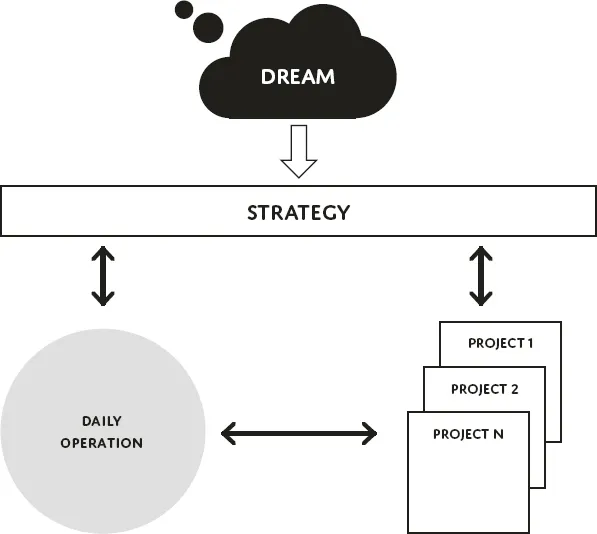
Figure 1. Strategy implementation: daily operations and projects under control.
Turning strategy into results is only possible if you reduce the daily delusions (Figure 1). The daily operation must run smoothly and this can be done by reducing the misorganisation. Furthermore, the number of projects must be manageable. In short, you must have control over your organisation. KPIs can help you with that. Without these basic conditions, every change and renewal will have a false start and the daily delusions continue to rule.
1.Clean up your project list and only fulfil projects that contribute to the strategy (or the projects that comply with legislation and regulations).
2.Bring the delusions of the day – the daily operation – under control to make sure that projects can be successfully implemented.
3.Follow the KPI tips in this book and you’ll really get the daily delusions under control.
![]()
LESS IS MORE
![]()
3
![]()
The management team sits down together. Lauren, Olivia, and Bryan are being led by Martin and are expected to come up with the right KPIs for the management team. Lauren has been working for eHomes for some time now and has become head of HR thanks to her experience at a large employment agency. She has an excellent understanding of HR and has set up the basic HR processes within the organisation successfully. Olivia has been Commercial director for eighteen months and is responsible for Marketing and Sales. She has moved into this important management position from key account management. Selling the products through installation engineers and directly to homeowners requires an effective sales process in which the story of eHomes has to be told properly. That’s why the Marketing department also reports to Olivia. As director of Operations, Bryan is the senior of the team and is responsible for the daily operations. His responsibilities include Planning, Work Preparation, Logistics (including Purchasing), and Service. eHomes outsource...