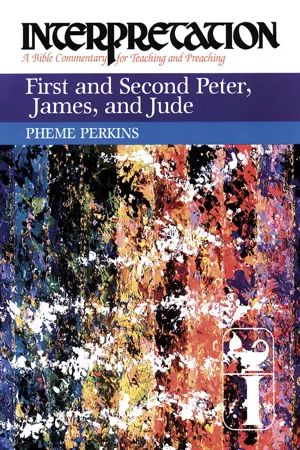
eBook - ePub
First and Second Peter, James, and Jude
Interpretation: A Bible Commentary for Teaching and Preaching
- 218 pages
- English
- ePUB (mobile friendly)
- Available on iOS & Android
eBook - ePub
First and Second Peter, James, and Jude
Interpretation: A Bible Commentary for Teaching and Preaching
About this book
First and Second Peter, James, and Jude have existed on the edges of the canon throughout the centuries. In this volume in the Interpretation series, Pheme Perkins casts light on these often neglected writings. She ably demonstrates that these "catholic epistles" have, in fact, much to offer to today's readers.
Information
Topic
Theology & ReligionSubtopic
Biblical CommentaryTHE BOOK OF
First Peter
Introduction
Authorship
First Peter 1:1 designates the author as the apostle Peter. This identification was not questioned in antiquity (see Eusebius, History of the Church 4.14.9). Some modern scholars continue to accept that view since the letter is close to the form of Christian letters found in Paul and it does not refer to the martyrdom of the apostle under Nero (Dalton; Michaels). The case against direct Petrine authorship seems to be the more plausible. Paul’s letters show that Peter was commonly referred to by the Aramaic form of his nickname, “Cephas” (so 1 Cor. 1:12; 9:5; Gal. 1:18; 2:9,11; also John 1:42). Michaels explains the peculiarity of Peter using a Greek form of his name by linking the Greek form “Peter” with the commission as apostle to the circumcised (as in Gal. 2:7–8). However, Paul had no qualms about using the Aramaic form in writing to the Corinthians. With the exception of John 1:42, the evangelists never use the Aramaic form. Therefore this form of the name is more likely the usage of a later author. Elements in the composition of 1 Peter also differ from what one would expect from the apostle himself. Biblical citations refer to the Greek Old Testament. First Peter also employs techniques of composition and ethical exhortation characteristic of Greek-speaking traditions. Further, the picture of Christian communities projected by the letter suggests that outsiders have established prejudices against anyone who belongs to the Christian group. The author presents himself as “fellow elder,” not apostle (1 Peter 5:1). Although the composition as a whole fits the genre of an early Christian letter, it lacks the personal references to relationships between the author and recipients (or persons known to them) that one finds in personal letters (see Brox, Elliott 1981, Goppelt, Perkins).
Lack of details about Peter’s death does not provide a clue as to when 1 Peter was written (against Dalton). Luke, who must have known that Paul and Peter had been martyred in Rome, does not provide information about the death of either in Acts. Our first direct indication of Peter’s martyrdom appears in the letter from Clement of Rome (c.96 C.E.)to the Corinthians:
Let us set before our eyes the good apostles: Peter, who because of unrighteous jealousy suffered not one or two but many trials, and having thus given his testimony went to the glorious place which was his due. (1 Clement 5.3–4)
First Peter locates the sender and his associates in “Babylon” (5:13). Evidence for the identification of “Babylon” with Rome comes from Revelation (14:8; 18:2). It constitutes our only New Testament evidence for the place of Peter’s death. The letter may presume that its readers know that the apostle lost his life in Rome and so became an example of the suffering endurance being urged upon its readers.
First Peter follows the contemporary letter closing form by referring to others who are associated with the author in sending the letter (5:12–13): Silvanus, who is identified as the person who wrote the letter, and a certain Mark referred to as “my son.” Both Silvanus (= Silas) and Mark were associated with Paul’s missionary efforts. Silvanus worked with Paul and Timothy in the mission to Corinth (2 Cor. 1:19) and Thessalonica (1 Thess. 1:1; 2 Thess. 1:1; further references to Silvanus and the Greek mission appear in Acts 16:19, 25, 29; 17:4, 10, 14, 15; 18:5). Mark is one of those referred to in the final greeting of Philemon (v. 24; also Col. 4:10). Both Silvanus and Mark appear in Acts 15. Acts 15:36–40 asserts that Mark had left the Pauline mission to work with Barnabas after the Jerusalem Council. However, the Pauline letters presume that Mark continued to be part of the Pauline effort (2 Tim. 4:11). Their presence in Rome might have been due to Paul’s imprisonment there. Acts 12:12 asserts that Mark’s mother held meetings of Christians in her Jerusalem home. Mark had met Peter there prior to his activities in the Gentile mission. This detail might be reflected in the epithet, “my son,” that we find in 1 Peter 5:13. Later tradition held that the Gospel of Mark embodied reflections that Peter had given Mark prior to his death (Eusebius, History of the Church 2.15; 3.39. 13–17). Eusebius attributes this tradition to Papias. In both cases, he notes that Papias referred to the fact that Mark was mentioned in 1 Peter.
These notices suggest the possibility that 1 Peter was sent from a group of missionaries who had arrived in Rome with Paul or Peter. Their activities in the Gentile churches of the Pauline mission gave them experience with the difficulties faced by these churches. Elliott (1980) describes this circle as a “Petrine group.” The letter does not create a fictional image of Peter as author by including details about the apostle. The reference to “Peter” as sender strengthens the letter’s claim to apostolic teaching. Its purpose is to commend the content of the letter as fundamental to Christian faith (see Pesch, 150–51).
Addressees
The addressees are referred to as “exiles” (Gr.parepidēmoi) of the Diaspora (NRSV: “Dispersion”). Exegetes often read “exile” solely as a metaphor for the Christian’s separation from Christ in this world (cf. Paul’s reference to the Christian’s “commonwealth in heaven” in Phil. 3:20). However, scholars interested in the social setting of early Christianity now look to these references as clues to the actual situation of the addressees. Elliott’s studies of 1 Peter have emphasized the importance of the various terms for exile, resident alien, and household (Elliott 1981). The Greek word parepidēmos refers to persons who are aliens temporarily resident in another place. They are said to be members of the Diaspora in Pontus, Galatia, Cappadocia, Asia, and Bithynia. The term “diaspora” refers to Jews living among the Gentiles. The Old Testament sees the Diaspora as a continuation of Israel’s exile from its true home. When God gathers the dispersed exiles together, the Gentiles will recognize the truth of Israel’s God (cf. Isa. 49:6; 2 Macc. 1:27). Other texts use the term “diaspora” in the geographical sense of the place where such exiles live (Judith 5:19; T. Asher 7:3).
Since Jews usually could not become citizens in the cities they inhabited, living in the Diaspora always implied some form of alien status. Testament of Asher 7:2 provides a blunt statement of the pain such an existence could cause:
You will be scattered to the four corners of the earth; in the dispersion you shall be regarded as worthless, like useless water, until such time as the Most High visits the earth.
Aliens could always be forced out of the cities in which they were living. The Jewish community in Rome had faced expulsion on several occasions. Some examples are directly associated with proselytizing activity (see Feldman, 47). Under Tiberius, 4,000 descendants of freedmen were shipped to Sardinia and the rest ordered to leave Italy unless they renounced Jewish rites (Tacitus, Annals 2.85.4). According to Suetonius, those of military age were singled out to be banished to an unhealthy region (Suetonius, Tiberius 36). The same author reports that Jews were expelled because of disturbances over a certain “Chrestus” under the emperor Claudius (c.48 C.E.; Suetonius, Claudius 25.4). Acts 18:2 notes this expulsion as the reason Aquila and Priscilla emigrated from Italy to Corinth where Paul met them. Presumably proselytizing by Christians led to the disturbances mentioned by Suetonius.
Civil strife between Jews and non-Jews in Alexandria and other eastern cities erupted during the reigns of Caligula and Claudius (see Feldman, 113–17; White, 125–37). After receiving embassies from both Jews and the Greek citizens of Alexandria, Claudius reaffirmed the right of the Jewish community to their ancestral practices. However, he warned both sides against further hostilities:
I have stored up within me an immutable hostility against those who renewed the conflict. Simply stated, if you do not lay to rest this destructive and obstinate hostility against one another, I shall be forced to show what a benevolent ruler can become when turned to [inflict] a justified wrath. (White, 136)
Nor is the Jewish community to receive new immigrants from other regions:
Nor are they to bring in or to admit Jews who are sailing down from Syria or Egypt, by means of which I will be forced to conceive an even more serious suspicion. Otherwise, I will take vengeance on them in every respect, just as though they were a plague infecting the whole inhabited world. (White, 136)
Claudius’s letter also cut off once and for all any demands for Alexandrian citizenship. Jews cannot be admitted to the “gymnasium” and athletic contests, which are the prerogative of male citizens. Instead, the emperor tells them:
Rather, they must enjoy the advantages that derive from their own status, and, indeed, they have a plentiful abundance of good things in an alien city. (White, 136)
Citizenship in Alexandria made persons eligible for military service and eventual Roman citizenship. Roman citizens and Greek citizens of the city were also exempt from the poll tax assessed against other inhabitants. A fragmentary petition survives in which an Alexandrian Jew whose father was a citizen protests the fact that he has suddenly been required to pay the tax. The petitioner’s education and participation in the rites accorded other citizen males should have ensured his rights as a citizen, the petitioner claims. Presumably, his status has been downgraded because his mother was not a citizen. In any case, he speaks of himself as now “in danger of being deprived of my own homeland …” (White, 128). Presumably the petitioner would not be forced out of Alexandria by this new determination of his legal status. However, his loss of the privilege of citizenship makes him an alien in what he had regarded as his own city.
These examples provide concrete evidence for the social and political tensions massed behind the terms used for the letter’s addressees, “exiles of the Dispersion.” At the conclusion of the letter, readers are reminded that Peter himself is a temporary alien in a hostile city. Though the initial designation refers to foreigners who are only temporary residents, later references speak of those who have “resident alien” status as well (Gr. paroikos; 1:17; 2:11). Although the opening of the letter would suggest that the addressees are Jews living in the Roman provinces of Asia Minor, the rest of the letter indicates that its recipients are converts from paganism (cf. 1:14; 2:10; 4:3–4). They face hostility from friends, associates, and relatives.
The five provinces listed in the letter opening cover the Roman divisions of Asia Minor north of the Taurus mountains. However, the list does not reflect Roman administrative divisions, since Bithynia and Pontus had been a single province since 64 B.C.E. The address does not refer to particular cities, churches, or individuals as was the case with the Pauline letters. First Peter appears to be a general letter directed to Christians living in the rural interior of Asia Minor, not the populous cities of the coast (Elliott 1981, 59–63).
Though the recipients are Gentile converts, 1 Peter consis tently refers to them as heirs to the promises of Israel. These references contain no indications of disputes between Christians and Jews over the Christian claims to be God’s chosen people (see Michaels, x1ix–1). Feldman’s discussion of Judaism in Asia Minor during this period sheds some light on this situation (Feldman, 69–74). Strong ties existed between Jewish communities in the coastal regions of Asia Minor, but inscriptions from the inland cities of the region show that the Greek-speaking population was in the minority. Fewer Jewish cult objects and menorahs have been found in this part of Asia Minor. The Jewish population may have been much smaller and less attached to the traditional symbols of Jewish identity. Feldman notes that Jewish inscriptions from Asia Minor are unlike those from elsewhere in the Diaspora. They lack the conventional pious sentiments that refer to love of the Torah, Jerusalem, or longing for the rebuilding of the Temple. Nor does one find depictions of the ark where the Torah scrolls were kept (Feldman, 72–73).
Feldman concludes that while the number of Christians in Asia Minor during the first two centuries was much smaller than that of Jews, the peculiarities of Jewish life in Asia Minor facilitated conversion to Christianity:
This difference between the Jewish communities of the coast and those of the interior may also perhaps account for the different responses to the message of Christianity. The relative lack of contact between the Jews of Asia Minor and the fountainhead in the Land of Israel may explain why Christianity seems to have made relatively great progress in Asia Minor, presumably among Jews, by the beginning of the second century. (Feldman, 73)
First Peter suggests that the success of the Christian mission lay in its ability to use the communal symbolism of its Jewish heritage to create communal solidarity among persons who were otherwise without a clearly defined social identity. Feldman’s description of the relative isolation of Jews in inland Asia Minor sharpens our picture of life in the region.
Occasion
The danger that persistent, local harassment and persecution might weaken the faith of Christians in Asia Minor led to the dispatch of 1 Peter (1:6–7). There is no evidence that imperial policy dictated the persecution of Christians or outlawed their religious practices. When Pliny, governor of Bithynia (c.117), wrote the emperor Trajan concerning the Christians, he indicates that he has no precedent to guide him in evaluating such cases. Charges are being pressed by local citizens. Trajan has been unable to find any evidence that Christians are disruptive or dangerous to the state. Nevertheless, those whose accusers are willing to bring charges personally will be forced to recant or be punished (Pliny, Letters 10.96 and 10.97 [= Trajan’s reply]). Charges filed anonymously would be thrown out by the governor.
This correspondence indicates that the situation that called forth 1 Peter had continued to exist. Hostility did not destroy the growing movement. Nor did the experience provoke the rhetoric of apocalyptic condemnation that we find in Revelation, where divine vengeance will unseat the “whore of Babylon” (= Rome; Revelation 17—18). Pliny’s reference to the growth of Christianity in the region suggests that opposition to conversion fueled the hostility. Similar objections from the pagan population provoked various expressions of anti-Jewish sentiments in antiquity (Feldman, 119, 298–300). Augustine cites the first-century philosopher Seneca on the spread of Jewish sympathizers, “The vanquished have given laws to the victors” (Augustine, City of God 6.1; Feldman, 299). Until ordered to commit suicide (62 C.E.), Seneca was an adviser to Nero. His comment represents the reaction of Roman intellectuals to Jewish sympathizers within their own circles at the time Peter and Paul were executed.
First Peter does not explain why others are hostile to the Christians (2:12; 3:16; 4:4, 14–16). The mere “name” is sufficient to invoke persecution (4:14). Withdrawal from some earlier associations is provided as a rationale in 1 Peter 4:1–4. Separation from an earlier way of life made it possible for converts to join the new household of the church (1:22; 2:5). Christians are not isolated in their suffering, since they now belong to a family that exists throughout the world (2:17; 5:9; Elliott 1981, 75–76). A letter from Petrine circles in Rome would reinforce that message. The relative isolation of communities in this section of Asia Minor would make receipt of such a message a significant event in the life of those communities.
Theological Themes
Discussions of the social context of the recipients of 1 Peter have highlighted the social importance of the letter. Elliott has pointed out that Christians might have responded to the hostility of outsiders by intensifying their isolation from nonbelievers (Elliott 1981, 83). Instead, 1 Peter insists that their good behavior and ready account of their belief might win others to salvation (2:12; 3:15). Our modern familiarity with sociological categories and political calculations concerning the effectiveness of institutional responses to various crises could produce a one-sided reading of 1 Peter. Its appeal is not grounded in social or political prudence. There is no program for the transformation of social structures (Elliott 1981,78). First Peter’s argument is theological. A sustained vision of the transformation effected by conversion (sanctification, rebirth, purification; 1:2–22) reminds readers that they can...
Table of contents
- Cover
- Half-title page
- Interpretation
- Title page
- Copyright page
- Series Preface
- Contents
- Introdution
- First Peter
- James
- Jude
- Second Peter
- Bibliography
- Reference List
Trusted by 375,005 students
Access to over 1.5 million titles for a fair monthly price.
Study more efficiently using our study tools.
Frequently asked questions
Yes, you can cancel anytime from the Subscription tab in your account settings on the Perlego website. Your subscription will stay active until the end of your current billing period. Learn how to cancel your subscription
No, books cannot be downloaded as external files, such as PDFs, for use outside of Perlego. However, you can download books within the Perlego app for offline reading on mobile or tablet. Learn how to download books offline
Perlego offers two plans: Essential and Complete
- Essential is ideal for learners and professionals who enjoy exploring a wide range of subjects. Access the Essential Library with 800,000+ trusted titles and best-sellers across business, personal growth, and the humanities. Includes unlimited reading time and Standard Read Aloud voice.
- Complete: Perfect for advanced learners and researchers needing full, unrestricted access. Unlock 1.5M+ books across hundreds of subjects, including academic and specialized titles. The Complete Plan also includes advanced features like Premium Read Aloud and Research Assistant.
We are an online textbook subscription service, where you can get access to an entire online library for less than the price of a single book per month. With over 1.5 million books across 990+ topics, we’ve got you covered! Learn about our mission
Look out for the read-aloud symbol on your next book to see if you can listen to it. The read-aloud tool reads text aloud for you, highlighting the text as it is being read. You can pause it, speed it up and slow it down. Learn more about Read Aloud
Yes! You can use the Perlego app on both iOS and Android devices to read anytime, anywhere — even offline. Perfect for commutes or when you’re on the go.
Please note we cannot support devices running on iOS 13 and Android 7 or earlier. Learn more about using the app
Please note we cannot support devices running on iOS 13 and Android 7 or earlier. Learn more about using the app
Yes, you can access First and Second Peter, James, and Jude by Pheme Perkins in PDF and/or ePUB format, as well as other popular books in Theology & Religion & Biblical Commentary. We have over 1.5 million books available in our catalogue for you to explore.