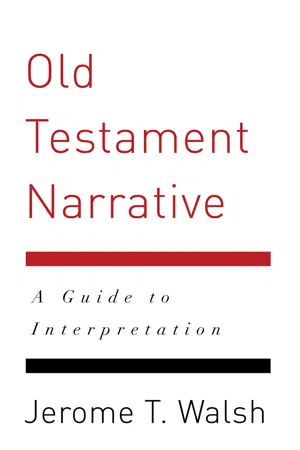
The Old Testament's stories are intriguing, mesmerizing, and provocative not only due to their ancient literary craft but also because of their ongoing relevance. In this volume, well suited to college and seminary use, Jerome Walsh explains how to interpret these narrative passages of Scripture based on standard literary elements such as plot, characterization, setting, pace, point of view, and patterns of repetition. What makes this book an exceptional resource is an appendix that offers practical examples of narrative interpretation- something no other book on Old Testament interpretation offers.
- 272 pages
- English
- ePUB (mobile friendly)
- Available on iOS & Android
eBook - ePub
About this book
Information
Topic
Theology & ReligionSubtopic
Biblical StudiesChapter 1
Two Theoretical Preliminaries
OF MEANINGS AND METHODS
A Parable
One warm, late-summer afternoon, three friends went walking through a state forest. They happened upon a large oak tree to which, years before, someone had nailed a sign. The sign was old and weathered, the trunk had begun to grow over its edges, its paint was faded and its words were only barely legible. When the men managed to make the sign out, they read,

“Look at that,” said the first hiker. “Whoever wrote that sign misspelled it. He meant ‘prosecuted,’ not ‘persecuted.’” “Perhaps,” replied the second. “But it might mean just what it says: ‘Trespass here and you’ll get shot at!’” Their companion laughed, “Not any more it doesn’t! We can’t trespass on state land. That sign doesn’t mean anything!”
The field of biblical studies has been in unusual turmoil for nearly two generations. Whether one thinks of the turmoil as chaos or as creative ferment depends to a great extent on one’s appreciation of some underlying issues. Foremost among these is the question of “meaning.” Our three hikers can help us unravel some of the complexities of this issue.
A written text, such as the sign on the tree, is an instance of a “communication act”—in other words, of an event in which a sender (here, the “author” who painted the sign) produces a message (the sign itself) that reaches a receiver (the three hikers who read it). The structure of communication via written text can be diagrammed:
author → text → reader
The question this simplicity conceals, however, is, Where in this diagram is “meaning” to be located?
Our first hiker identifies the meaning of the sign with what the author wanted to communicate to the reader. He recognizes that the author may not have expressed himself accurately (“He meant ‘prosecuted,’ not ‘persecuted’”); but author’s intention trumps textual imperfection. The sign’s meaning is what the author intended to write, not what he actually wrote. One of the tasks of the interpreter is to identify such instances of disparity between intention and expression and to retrieve the former (the meaning) despite the inadequacies of the latter (the words).
Our second hiker also recognizes that textual expression may not coincide perfectly with authorial intention, but he is not willing to privilege one over the other as the unique meaning of the text. He entertains the possibility that the text as it stands, even though imperfect and inadequate with respect to the author’s intention, may convey coherent and intelligible meaning to a reader (“It might mean just what it says”). Textual meaning then has autonomy as one (though not the only) possible meaning of the text. To put it another way, what the sign says and what the author intended to say can differ from one another, yet each can still be meaningful.
For the third hiker, the meaning of the sign lies in its contemporary impact. We might think of “relevance” or “significance” as synonyms for “meaning” in this sense. When it was originally posted, and for some unknown period of time thereafter, the sign no doubt warned its readers that their actions could trigger real consequences; it meant something. But now, since the sign has no contemporary relevance (“We can’t trespass on state land”), it “doesn’t mean anything.” For this hiker, then, meaning derives above all from the circumstances in which the text is read, and that context determines meaning with greater potency than either the intention of the author or the words of the text itself.
Although it is something of an oversimplification, we might say that our three hikers each locate meaning at different points on the line of communication. The first hiker locates it in the author, the second in the text, and the third in the reader:

Now, the point of this parable is not to set up three rival definitions of “meaning” for the title of “real meaning,” but merely to distinguish them as alternative objects of inquiry. Though they can be quite different from one another, each can be called “meaning” and each is worth investigating. Indeed, each is the central focus of attention for one or another cadre of biblical scholars today.
Biblical Studies Today
In the history of biblical scholarship, the centuries after the Enlightenment saw the gradual triumph of a single critical approach to the Bible, called “historical criticism.” Its goal was to get behind the text to its origins, on the premise that the meaning of the text was what its (human1) author intended to communicate. Our first hiker is a historical critic: he wants to know what the author was thinking, even if the text fails to convey that thought perfectly.
The results of two or three centuries of historical criticism are rich and varied. Scholars have developed several precise and careful methods of analysis to afford access to the world behind the text. Textual criticism retrieves original wording when manuscripts differ because of scribal changes; source criticism reconstructs older written documents that were incorporated piecemeal into our present texts; redaction criticism reveals ways in which editors overlaid their own interpretations onto the materials they transmitted and manipulated; form criticism and tradition history even promise to penetrate the period of oral tradition that predated the written text and thereby to allow glimpses of the originating events themselves. And historical critics have collaborated with other disciplines—history, archaeology, ancient Near Eastern and Mediterranean studies—to coordinate data and integrate interpretations within broader horizons. What historical criticism has achieved is equally rich: the reconstruction of an Israelite history and culture much more complex and nuanced than we find in the Hebrew Bible; the identification of an immensely complex weave of oral traditions, written sources, and editorial hands in the extant text; the revelation of a vibrant and vital theological diversity in ancient Israel; and much, much more.
Historical criticism continues to flourish in the guild of biblical scholars. Excesses and oversights of the past continue to be identified and amended; gains of the past are refined and extended. In recent years, historical criticism has adapted new methods from the social sciences (particularly sociology and anthropology) in an attempt to discern in our texts clues to an ever more detailed and nuanced reconstruction of the society and culture of ancient Israel.
In the second half of the twentieth century, for reasons that would take us too far afield to investigate, some biblical scholars began to ask new questions—questions that focused not on the world behind the text, but on the text itself (sometimes called the “world in the text”), or on the text’s effective presence in the contemporary world (the “world in front of the text”). In other words, our second and third hikers spoke up. It was soon obvious that methods designed to penetrate the world of the text’s origin were not apt for answering these new questions; and so biblical scholars looked to other disciplines for methodological tools.
Those interested in the text itself found immediately to hand all the methods developed over the years by those who read texts for a living, namely, literary critics. Methods such as close reading (borrowed from Russian Formalism and the New Criticism), structuralist analysis (rooted in the mid-twentieth-century European philosophical movement), narrative criticism, rhetorical criticism, reader-response criticism,2 and others enabled interpreters to focus on the final, extant form of the text as having coherent meaning even in the face of historical criticism’s demonstration that the text is the end product of an enormously complex array of oral traditions, written sources, and editorial manipulations.
Today these methods, under the umbrella term “literary criticism,”3 are producing important new insights into ancient Israelite literary conventions and opening our eyes to an unprecedented appreciation of their literary aesthetic. We are learning the stylistic and psychological subtleties of Israelite poets and storytellers, and we are beginning to perceive the unique genius of their literary craft.4 In the course of this book, we will explore one small province of this vast terrain: How do ancient Hebrew prose narratives work their magic on a reader?
Those who, like our third hiker, were most interested in the text’s societal effects found theoretical inspiration in such movements as the critical theory of the Frankfurt School and practical direction in the increased attention to and concern for minority rights that emerged in the West in the 1960s and subsequent decades. Methods were developed to read the biblical text for its power of societal emancipation, particularly in base communities of South America; and these methods and readings received theoretical systematization from liberation theology. Subsequent decades saw the liberation model extended to a wide range of oppressed minorities along classic lines of gender, race, and class, under the general heading of “ideological criticism.” Perhaps the best known of these liberation or advocacy methods is feminist criticism, but gender-oriented approaches today also include gay and lesbian readings, gender-sensitive readings focused on male spirituality, and others. Under the heading of “race,” African American, Hispanic, and Asian readings are the most prominent but by no means the only ethnically oriented approaches. The original liberation theology remains the clearest example of a class-oriented approach, but postcolonial reading is rapidly emerging as a rich new source of insight, particularly in countries in Africa and Asia.
Summary
The ferment in biblical studies today, then, is not so much the result of competing opinions about what the text means as it is of confusion about which meaning we are looking for. That confusion is only compounded when we fail to distinguish the different meanings that are all subject to legitimate inquiry. Once that is recognized, then it becomes possible to see that the field is, in fact, orderly and that beneath the apparent chaos it is simply growing more complex. Elaborating our earlier diagram, we might map the current state of affairs something like this:

Our task in this book is specific and narrow: to explore, in a practical fashion, the method of narrative criticism. As the diagram above shows, this focuses us on a text-oriented definition of “meaning.” We will not then need to argue that our interpretation was “intended by the author” (although, as we shall see in the next section, there is a way to accommodate author’s intention in a text-oriented analysis). Frankly, the only way such a claim could be verified is if the author left us, separately, a commentary on his or her own writings; for better or worse, that is not the case in biblical studies.5 What we must do is identify elements in the text that plausibly ground our interpretations. And since, as we shall see, the reader too is a contributing factor to the creation of meaning (and, like the author, can be accommodated in a text-oriented analysis), our approach will incorporate elements of reader-response criticism as well.
THE WORLD IN THE TEXT
The Structure of Narrative
Let’s return for a moment to the simplicity of our earlier diagram:
author → text → reader
One of the results of several centuries of critical biblical scholarship’s concentration on the author was the discovery of the immense complexities hidden in that simple word. Precritical scholarship held that the Pentateuch, for instance, was the work of a single author, Moses. By the time historical criticism reached a near consensus on the matter, that unity had been fragmented into a veritable mob of four major and several minor narrative source documents; at least four distinct legal corpora, each with its own origin and transmission history; several originally independent poems; and enough editors to weave all these sources together one by one—not to mention the uncountable host of oral storytellers that lay between the originating events and their first reduction to writing. In the face of such a multitude, it is no wonder that historical criticism generally avoided any attempt to deal with the final form of the text as a meaningful and coherent literary unity. Without a singular author it is difficult to speak of a singular author’s intention.
Somewhat ironically, one of the results of a literary critical focus on “text” has been the realization that it too is a surprisingly complex reality. In what follows, I shall restrict myself to narrative texts, though no doubt something comparable could be elaborated for poetic texts, and perhaps even for legal ones. I have taken the diagram below, with only slight modifications, from Terence J. Keegan’s excellent Interpreting the Bible.6
Between “author” and “reader” (here specified as “real author” and “real reader”) lies a “text” that comprises a series of nested boxes, each with its own contents. This diagram, with its various components, is not to be understood as a template consciously used by authors to compose stories, but as an analytic tool that offers the literary critic a number of access points to identify and trace the dynamics of narrative. We will examine each of the components here, some at greater length than others; in the chapters that follow we will revisit many of them (particularly the narrator) in greater detail.
Figure 1

The World of the Story
We begin in the innermost box, the “story.” It is most convenient to imagine this as a “world” (the world of the story), a realm where individuals live (characters) and things happen (events) in particular circumstances (settings). As an analogy, think of the staging of a dramatic production. From the point of view of the actors and their actions, the stage is a self-contained locus that has no relationship to the auditorium and audience that surround it. Similarly, this world of the story is to be carefully distinguished from our own world (the “real world,” as we are prone to call it). This does not mean that it is necessarily dissimilar to our own world, but it can be. Let’s call the world in which the real author and we, the real readers, exist the “primary world,” and the world of the story the “secondary world.”7 The rules by which the secondary world operates may well be like those of the primary world. Historical narrative, for instance, ranging from true history writing to historical fiction, must attempt to duplicate the primary world’s dynamics if it is to possess verisimilitude. On the other hand, the secondary world’s rules may be entirely different from the primary world’s. Science fiction has its spaceships, fantasy its sorcery, there are impossibly handsome heroes in romance novels and impossibly clever sleuths in detective stories, and even the Bible has its talking donkey and its talking snake. The key here, however, is coherence with the primary world on a deeper level: even when we accept the premises of the secondary world, we still expect that world to operate consistently, with causal connections linking its events.
Together, the characters of the world of the story and the events that take place in its settings constitute the plot of the story. In a sense, both “plot” and “story” refer to the same thing, though with a slightly different emphasis.8 We will begin our practical study in the next chapter with a closer examination of plot.
The World of the Narrative
Encompassing the box called “story” we find a larger box called “narrative.” The world of the narrative is identical to the world of the story (the “secondary world”), except that the narrative’s events are chronologically later than those of the story. What happens in the world of the narrative is that a narrator tells the story to a narratee. We will discuss these terms in greater detail in later chapters. Wh...
Table of contents
- Cover
- Title Page
- Copyright
- Dedication
- Contents
- Preface
- Introduction
- Chapter 1: Two Theoretical Preliminaries
- Chapter 2: Plot
- Chapter 3: Characters
- Chapter 4: Characterization
- Chapter 5: Point of View
- Chapter 6: Manipulation of Time
- Chapter 7: Gaps and Ambiguities
- Chapter 8: Repetition and Variation
- Chapter 9: Voice(s) of the Narrator
- Chapter 10: Structure and Symmetry
- Chapter 11: Responsibilities of the Reader
- Appendixes
- Notes
- For Further Reading
- Scripture Index
- Subject Index
Trusted by 375,005 students
Access to over 1.5 million titles for a fair monthly price.
Study more efficiently using our study tools.
Frequently asked questions
Yes, you can cancel anytime from the Subscription tab in your account settings on the Perlego website. Your subscription will stay active until the end of your current billing period. Learn how to cancel your subscription
No, books cannot be downloaded as external files, such as PDFs, for use outside of Perlego. However, you can download books within the Perlego app for offline reading on mobile or tablet. Learn how to download books offline
Perlego offers two plans: Essential and Complete
- Essential is ideal for learners and professionals who enjoy exploring a wide range of subjects. Access the Essential Library with 800,000+ trusted titles and best-sellers across business, personal growth, and the humanities. Includes unlimited reading time and Standard Read Aloud voice.
- Complete: Perfect for advanced learners and researchers needing full, unrestricted access. Unlock 1.5M+ books across hundreds of subjects, including academic and specialized titles. The Complete Plan also includes advanced features like Premium Read Aloud and Research Assistant.
We are an online textbook subscription service, where you can get access to an entire online library for less than the price of a single book per month. With over 1.5 million books across 990+ topics, we’ve got you covered! Learn about our mission
Look out for the read-aloud symbol on your next book to see if you can listen to it. The read-aloud tool reads text aloud for you, highlighting the text as it is being read. You can pause it, speed it up and slow it down. Learn more about Read Aloud
Yes! You can use the Perlego app on both iOS and Android devices to read anytime, anywhere — even offline. Perfect for commutes or when you’re on the go.
Please note we cannot support devices running on iOS 13 and Android 7 or earlier. Learn more about using the app
Please note we cannot support devices running on iOS 13 and Android 7 or earlier. Learn more about using the app
Yes, you can access Old Testament Narrative by Jerome T. Walsh in PDF and/or ePUB format, as well as other popular books in Theology & Religion & Biblical Studies. We have over 1.5 million books available in our catalogue for you to explore.