eBook - ePub
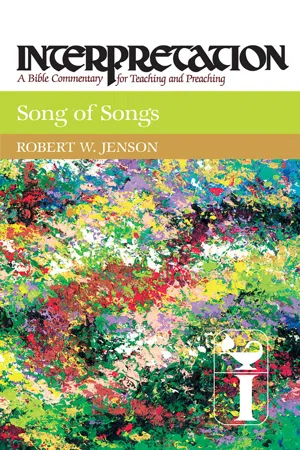
Song of Songs
Interpretation: A Bible Commentary for Teaching and Preaching
- 118 pages
- English
- ePUB (mobile friendly)
- Available on iOS & Android
eBook - ePub
About this book
Robert Jenson offers a systematic theologian's careful reading of the Song of Songs. Jenson focuses on the overt sense of the book as an erotic love poem in order to discover how this evocative poetry solicits a theological reading. Jenson finds a story of human love for God in this complex poetic book and offers a commentary that elucidates and inspires.
Information
Topic
Theology & ReligionSubtopic
Biblical CommentaryIntroduction and Title (1:1)
“Blessed is he who enters holy places, but much more blessed is he who enters ‘the Holy of Holies.’ … Likewise, blessed is he who knows holy songs and sings them …, but much more blessed is he who sings ‘the Song of Songs’” (Origen, 266).
Initial Questions
The Song of Songs appears in the Christian canon of the Old Testament as the last of five books grouped together as books of “wisdom.” But those who read it for a first time, or perhaps for a first time with full attention, may be surprised by what they find, for its overt content is very different from that of the other books of wisdom—or indeed from that of any other book in the Bible. They will find neither ethicaltheological reflection as in Job, nor exemplification of that fear of the Lord which is wisdom, as in the Psalms, nor the dicta of sages as in Proverbs or Ecclesiastes—and assuredly not history of salvation or torah or prophecy as in the rest of the Old Testament. Instead, they will find explicit, though never quite pornographic, poetry of physical love. Sexual yearning and fulfillment are sung without reticence, moral judgment, or great deference to legal or social constraints. The opening lines set the tone for the whole: without identification or preamble a woman cries, “Let him kiss me with the kisses of his mouth …,” and when her lover appears immediately urges haste in moving to a more private chamber. She is, as twelfth-century commentator William of St. Thierry wrote, with a mixture of fascination and alarm, “wholly without modesty” (Norris, 17).
The poetry is in a general sense lyric, presumably intended for some sort of cantillation. It sings the love of a passionate woman and her sometimes elusive and sometimes importunate lover. Most passages tell or suppose some incident in the lovers’ affair; some are brief dramatic exchanges. The woman’s voice and desires dominate. Besides these two, there are a female chorus and briefly a male chorus or choruses; once or twice the poet may speak in her own voice. Several poems are or include a known Middle Eastern form for which scholarly jargon appropriates an Arabic term: a wasf details and praises the person of the beloved. Overtly, the poetry is wholly secular: neither God nor any religious practice or belief is mentioned.
It is therefore not surprising that the Song is one of the three most commented-upon books in the Bible. In the first place, its presence there urgently calls for explanation. Can a canonical book of Scripture really be as secular as this poetry seems to be? In a second place, if it has some hidden religious or theological meaning, how do we discover it? To those who think they know the answer to that last question, the Song then offers unique opportunity for exegetical virtuosity—not to say uncontrolled fantasy.
Yet for all the scholarly and imaginative labor expended over the millennia, there is no long-term consensus in even the most elementary points of the Song’s interpretation. The very title can be read differently according to an interpreter’s antecedent opinions. For simplicity’s sake we will in this commentary continue to call our text simply “the Song.”
The usual English translation of the full title is The Song of Songs, Which Is Solomon’s (1:1). The first part, “Song of Songs,” is the literal translation of a Hebrew phrase that is grammatically clear enough. “F(singular) of F(plural)” is a Hebrew idiom for the superlative, for example, “Lord of Lords” meaning “the most lordly Lord” or “Holy of Hohes” meaning “the holiest Holy Place.” But then we may observe that this is not a common idiom in the Bible and that most of its other biblical uses are, like these two, somehow related to the superlative being of God (Davis, 240). We may be led to ask: Could someone have intended the construction’s theological environment to be noticed? Are we being nudged to think of “The Godliest Song”? The earliest surviving scholarly reference to the Song, from around A.D. 100 by the revered Rabbi Aqiba, laid it down that the Song of Songs is the “Holy of Holies” among the holy books of Scripture; perhaps there was some link in tradition between the grammar of his dictum and that of this part of the title—or perhaps there was not.
Then there is the clause “which is Solomon’s.” This is not necessarily an ascription of authorship, “by Solomon.” It could also be rendered “dedicated to Solomon” or “about Solomon” or “in Solomon’s style,” or perhaps in yet other ways.
Moving on with matters usually covered in the introduction to a biblical commentary, it is a necessary early step in reading any text to get the genre right. If, for example, we read a fictional travel narrative under the impression that it reports an actual journey and try to take the same trip, we court disaster. Unfortunately for those concerned with the Song—whether preachers, teachers, private readers for devotion or pleasure, or writers of commentaries—if we consider the full history of the Song’s interpretation and not just the modern period, genre is the chiefly controverted matter. That same first scholarly mention by Rabbi Aqiba was already a polemic against persons who assigned the Song to a different genre than did he—indeed, he consigned them to eternal damnation for profaning so holy a text. Moreover, we will find that interpretation of this text depends even more on the identification of genre than is usually the case.
To be sure, we have already noted some clear points about genre: the Song is lyric love poetry with a continuing cast of personae. But two questions then arise: Is the book simply a collection of poems, or is there some structure of the whole? And above all, who are those lovers? As we shall shortly see, also this second question is a question about genre.
We might expect to get help with both questions—and with the sense of “which is Solomon’s”—from the provenance of the poetry, another usual topic in introductions to biblical commentaries. But proposals in this case vary so widely that if we survey them with a minimum of precommitment we must conclude that, pending new discoveries, we can know very little about when—within a span of centuries—where, by whom, or on what occasion or occasions this poetry was written (Murphy, 5).
The Song’s great consistency of matter and tone does suggest that one poet or closely knit group of poets is responsible for all or most of it, and this commentary will refer simply to “the poet.” Given the viewpoint from which much of the poetry is cast, the poet or a dominating figure among the poets may well have been a woman; our pronoun for the poet will be “she.” Past that, there is, in the present commentator’s judgment, only one usable lead. Two contemporary commentators of otherwise antithetical views have pointed out a phenomenon insufficiently noted in modern scholarship: the Song is constructed from the language and imagery of the rest of the Old Testament in a fashion unique among the biblical books (LaCocque; Davis). Whoever the poet was otherwise, she was a devotee of the sort of literature that now makes up our Old Testament. We can therefore at least exclude origin outside the culture of Israel—or anyway that part of it represented by the Old Testament—and with it such scholars’ fantasies as that the Song was originally a liturgy for the fertility cult of Ishtar and Tammuz, or is an adaptation from the Egyptian.
Moreover, for our poet to have become so steeped in the specific images and language found in the Old Testament canon, many of the documents now in that canon must have been extant and available together in such a way as to speak with one voice; when the Song was written, there must have been a formal or informal library anticipating a canon. Thus very early provenance, certainly Solomon’s own time, seems excluded. But these are meager results.
As to a possible overall structure of the Song, agnosticism seems again the wisest course. There have been attempts to construe the Song as a drama, or as a long recitation, perhaps for use at weddings, or as a liturgy (Pope). These have convinced few but their proposers, and all require reconstructive hypotheses supported only by their own internal coherence and the history-of-religions predilections of the proposers. The more modest proposal, that the Song is a structured suite of poems building to an emotional climax, does indeed seem plausible at most points in the Song, but is less easy precisely in the chapter containing the putative climax (8:6-7). The present commentary will therefore adopt another minimal position and take the Song simply as a collection of verses, with consistent personae, a consistent theme and attitude, and some patterns of diction linking groups of poems. Occasionally we will note closer connections between two or three poems in a row. The Song in fact may be more organized, in some way yet to be divined, but we will rely on no supposition about that.
Indeed, of attempts to discover a unifying plot for the Song, the one most influential through history, and one of the most intrinsically interesting, is also one of the least likely. Rabbinic Judaism’s exegesis always tended to historicize the Song, to connect events in the lovers’ affair with events in Israel’s history with the Lord. The Aramaic paraphrase-commentary of the Song, Targum Canticles, in its present form probably coming from the seventh century and Palestine (Targum, 55-60), took this a step further and found in the Song a complete sequential history of Israel from Abraham to the eschaton. Moreover, according to the Targum, the Song portrays a periodic-theological pattern of that history: it presents three cycles of beginning, disaster, and restoration. This reading decisively influenced later Jewish commentary and a minority stream of medieval Christian exegesis. Such interpretation is now likely to be pejoratively labeled “allegorical”; we will come back to that. And we will in the commentary see that on individual passages the Targum is well worth citing.
What Plain Sense?
So we have before us a collection of highly sensual love lyrics. It is tempting to leave it at that, as most modern commentators do, even those who then try hard to give the presence of the Song in the canon some theological significance. But rabbinic and churchly scholarship has in any longer run not been able to accept this limit. The Song, after all, is a concern of Christian or Jewish exegesis, and indeed has been preserved at all, only because it is in the Jewish and Christian canons of Scripture. It need not—as some modern commentators have assumed—be prudery that moves us to ask what such lyrics are doing there (e.g., Pope, 114). All other books of the Old Testament in some way concern Israel’s relation to her God; the supposition is not immediately likely that a collection of sheerly secular lyrics came among them by pure accident. The present commentator will claim that the Song indeed provides “a theology of human sexuality” (Murphy, 101) but pace the excellent commentator just cited, the overt sense by itself offers no such thing. Which brings us to that second question: Who are the lovers?
It was the unanimous answer of Jewish and Christian premodern exegesis—of the ancient rabbis and the later Jewish commentators, and of the Fathers of the church and the medieval and Reformation commentators—that these poems belong in the canon because the lovers are the biblical Lord and his people, whether YHWH and Israel or Christ and the church, or therein comprised Christ and the believing soul. The near-unanimous answer of interpreters in the modern period was that this is “allegorical exegesis” and that such exegesis is a bad thing.
In modern discussions of premodern exegesis, “allegorical” is regularly used imprecisely, and usually pejoratively, for the more correctly so-called “spiritual” exegesis of the Fathers and medievals, of which allegory was only one mode. The church has read “spiritually” because she reads the whole of Scripture as a dramatically coherent narrative plotted by the Spirit from creation to consummation, with nonnarrative genres present to point the moral and religious import and context of the narrative. It was a consequent principle of the church’s older exegesis that in such a dramatically connected narrative all events before the last are most interesting just as they point forward in the story, which will usually be perceptible only from the viewpoint of what they point to, and that one way this happens is that earlier events figure later events.
Thus when, for example, Martin Luther in the preface to his translation of the Pentateuch called Aaron a figure of Christ, he did not mean to deny that there was an Aaron who lived earlier in Israel’s history than Christ, or to say that Aaron’s story as a person of that time and place was unimportant. Quite to the contrary, he meant that in what Aaron did and suffered, and in how the narrator tells of him, one could see something of why there would be the Christ and so something of what he would be like, and that in reading passages about Aaron the church must reckon with this figuration. And, in general, the locus of the church’s spiritual exegesis was in thus reading the Old Testament from the viewpoint of the New; within this broad sweep of spiritual exegesis, “allegory” was then the most specifically christological of several types. However, to avoid repeated pedantic explanation, this commentary will use the current idiom, and usually speak in its loose general fashion of “allegory.”
Allegoncal exegesis—also as loosely so called—is thus a churchly exegetical procedure applied principally to narrative texts of the Old Testament. The above paragraphs were needed because for our present task it is vital to be clear: it is one thing to exegete a narrative text allegorically, and a different thing to make the genre judgment that a text presented for interpretation is itself an allegory; that is, that its plain sense is precisely its solicitation of realities other than those it overtly mentions—and there are of course many such texts. When the ancient rabbis judged that the Song speaks overtly about two human lovers in order to tell the mutual passion of the Lord and Israel, and when the church’s exegetes made a parallel decision, this judgment was not itself allegorical exegesis, in either the current or the more precise use of the term. If the rabbis and the Fathers were right in their judgment about genre, then construing theological allegory for the Song’s overtly secular poems is in fact plain-sense reading, and is an allegorizing reading just in the sense that allegory is the sort of interpretation which the text invites the interpreter to employ. In the church’s traditional exegesis of the Song, more narrowly named allegorical exegesis then occurred as a second step: when the church read the theological story about the Lord and Israel as a story about Christ and the church. With most of the Song, this step is so short that our commentary will not trouble to announce it, but with a few poems, observation of the step will be important.
Of course the next question is: Were the rabbis and the Fathers right in their assignment of genre? There is again a modern near-consensus: they were not. According to most modern commentators, the poems must have been written as secular love poems and then appropriated for the canon by arbitrarily allegorizing exegesis. We may instance two recent and often helpful commentators who span an ecclesial spectrum: Evangelical (Longman) and Catholic (Bergant). The rabbis, or earlier savants of similar bent, may be thought to have done this on purpose or to have done it unwittingly. They may be supposed to have done it in order to bring the poems into the canon in the first place, or they may be supposed to have found the Song already in the canon and to have made them be allegory to justify their presence after the fact.
The warrants for that “must have been” are, however, surprisingly few and weak—and indeed modernity’s dominant position is more often assumed than actually argued. Chief among its warrants is the existence in neighboring ancient cultures of love poetry that the Song strongly resembles and that celebrates love purely between human lovers. The refutation of argument based on this warrant is a simple “So what?” That there is love poetry between creatures scarcely implies there can be no love poetry between Creator and creatures; indeed the contrary inference is the more plausible in the case of Israel’s God, who is so deeply involved with his creatures. We may, in fact, speculate further: in Israel’s immediate environment there was love poetry between gods and goddesses, which also resembles the secular love poetry; it would have been precisely in line with Israel’s general position in that milieu to replace love poetry between deities with love poetry between the one deity and Israel. Finally, the delicately evocative lyricism of the Song would have been the obvious form for a theological poet immersed in the ancient Eastern traditions, as our poet manifestly was—the moderns are indeed right about that.
A second warrant, plainly operative but rare...
Table of contents
- Cover
- Half-title Page
- Title Page
- Copyright Page
- Series Preface
- Author’s Preface
- Contents
- 1:1 Introduction and Title
- Bibliography
Trusted by 375,005 students
Access to over 1.5 million titles for a fair monthly price.
Study more efficiently using our study tools.
Frequently asked questions
Yes, you can cancel anytime from the Subscription tab in your account settings on the Perlego website. Your subscription will stay active until the end of your current billing period. Learn how to cancel your subscription
No, books cannot be downloaded as external files, such as PDFs, for use outside of Perlego. However, you can download books within the Perlego app for offline reading on mobile or tablet. Learn how to download books offline
Perlego offers two plans: Essential and Complete
- Essential is ideal for learners and professionals who enjoy exploring a wide range of subjects. Access the Essential Library with 800,000+ trusted titles and best-sellers across business, personal growth, and the humanities. Includes unlimited reading time and Standard Read Aloud voice.
- Complete: Perfect for advanced learners and researchers needing full, unrestricted access. Unlock 1.5M+ books across hundreds of subjects, including academic and specialized titles. The Complete Plan also includes advanced features like Premium Read Aloud and Research Assistant.
We are an online textbook subscription service, where you can get access to an entire online library for less than the price of a single book per month. With over 1.5 million books across 990+ topics, we’ve got you covered! Learn about our mission
Look out for the read-aloud symbol on your next book to see if you can listen to it. The read-aloud tool reads text aloud for you, highlighting the text as it is being read. You can pause it, speed it up and slow it down. Learn more about Read Aloud
Yes! You can use the Perlego app on both iOS and Android devices to read anytime, anywhere — even offline. Perfect for commutes or when you’re on the go.
Please note we cannot support devices running on iOS 13 and Android 7 or earlier. Learn more about using the app
Please note we cannot support devices running on iOS 13 and Android 7 or earlier. Learn more about using the app
Yes, you can access Song of Songs by Robert W. Jenson in PDF and/or ePUB format, as well as other popular books in Theology & Religion & Biblical Commentary. We have over 1.5 million books available in our catalogue for you to explore.