![]()
Chapter 1
What Is Mission Today?
Many Parts, One Mission: Integrating Evangelism, Compassion, and Justice
The new pastor was encouraged by all of the activities of the urban 300-member congregation but sensed a certain fragmentation and isolation, maybe even rivalry among the many groups and committees. She decided to plan a retreat for the members to reflect and play together and was pleased at the number of folks who signed up to attend.
After a good time of worship and fellowship together, she gathered everyone for an open conversation in the morning session. The topic she chose was “mission.” She decided that it was best to see where the members were in their conceptions and practices, so she simply began with the question “What is mission today for you?” The first person to speak was the chair of the Mission Committee. “It is what the five mission workers we support in other countries do. We pledge to support them financially and pray for their mission work.” A young person responded, “The youth group goes on a mission trip to Mexico one year and another trip to help rebuild damaged houses in the U.S.A. the next year.” Giggling, the girl next to him replied, “I remember last year when one young Mexican asked us how youth do evangelism in the United States, and I responded in shock that we don’t.”
An outspoken member continued, “That is the problem with our church. We don’t know how to do evangelism anymore. It is the dirty e-word. So we don’t grow. Evangelism is the most important part of mission. We must fulfill the Great Commission.” Quickly a member of the Outreach Committee remarked, “Yes, we do, but we don’t call it evangelism. We receive new members.” Someone asked, “Is being a greeter on Sunday morning doing mission?” A new Peruvian member shyly added, “When I first arrived, I saw someone from this congregation deliver a loaf of bread to a doctor in my neighborhood who had visited worship, but I never received one.” Another person reflected, “I think receiving leaders from our partner churches to share their witness and to teach us is what some people call mission-in-reverse.” Then someone shouted, “Social justice is the essence of mission. Look at the prophets and Jesus’ declaration in Luke 4 about liberating the oppressed.” He then shared that the Presbyterian Peace Fellowship trains and sends volunteers to Colombia in a ministry of accompaniment, being with our partners who suffer in their struggle for human rights. Immediately another person said, “I have never heard of Presbyterian Peace Fellowship, but Presbyterian Frontier Fellowship supports groups in Central Asia who are planting new Christian communities.” Someone added, “Matthew 25 says we should feed the hungry and clothe the needy, and we do that together with other religious groups.” People then started mentioning local soup kitchens, Habitat for Humanity, disaster assistance, and other ministries of compassion.
At the end it was clear that everyone had a definition of mission and an emphatic preference for what they felt was important. However, many folks had no real understanding of or appreciation for the opinions and practices of others. The pastor closed by reading Ephesians 4:1–6 and asking, “Is the church an organization of individuals and special-interest groups who do mission their own way and ignore or judge those who do it other ways? Or could we all be members of one team who encourage, affirm, support, and need one another as we engage in the many parts of God’s one mission together? Might there be a way for us to renew our organizational structures and deepen our dialogue to promote more interaction and unity in mission?
“Let’s start our session tomorrow morning with those questions. This afternoon our Brazilian fellowship will be coaching us in our soccer match to pass the ball as in a coordinated ballet. There will be other group and individual sports activities. Also several big jigsaw puzzles have been started in the dining room. Let’s have fun together.”
How many definitions do Presbyterians have for mission? How do folks who engage in mission in very different ways relate to each other in and beyond the PC(USA) and in the world? Could we do mission better together? Can we learn to work cooperatively and even become partners in mission?
What Is Holistic Mission?
When I was growing up, I savored lots of fresh tomato sandwiches—on white bread, of course. Peanut butter and grape jelly sandwiches too—on white bread. It was only later that I discovered the nutritional value of whole grain bread and cereals. My niece recently told me that she was twelve years old before she ever had white bread! Now I know all about complex carbs and mostly eat whole-grain breads, rice, and cereals. And I know that a complete diet combines carbohydrates, proteins, and fruits and vegetables of all colors.
Diet and physical activities go together. In exercises, I have traveled a similar path. First, I included only walking or swimming: cardiovascular training. Then I discovered water aerobics with lots of fun accessories. My trainer convinced me that I also need weight training. And stretching certainly comes before and after all of the above. I try to complete my program by using a Pilates or yoga tape at least once a week. I have an exercise tape called “Total Body Workout.” Once I took a class on holistic gymnastics. My goal now is to have a balanced diet and a complete exercise program.
From the Hebrew Scriptures and especially from non-Western cultures, I have gleaned how to think about life holistically, not to separate body and soul, physical and spiritual. Reformed Christians from Africa have taught me about the importance of holistic or balanced living, in which nothing in life is underutilized and nothing is neglected. Fullness of life is important not only with food and exercise, but also in mission. Holism challenges the general imbalance in our lives and in our mission. My personal journey toward integration in God’s holistic mission has been a process of learning from Latin Americans and others that the realm of God’s kingdom covers every area of life. I came out of a very evangelical background that emphasized evangelism, one’s vertical personal relationship with the Lord Jesus, and the spiritual aspects of mission. The first time I heard the term “holistic” in reference to mission as a “unitary, indivisible whole” was from Orlando Costas in Montreat, North Carolina. He said: “The true test of mission is not whether we proclaim, make disciples, or engage in social, economic, and political liberation, but whether we are capable of integrating all three in a comprehensive, dynamic, and consistent witness. We need to pray that the Lord will … liberate us for wholeness and integrity in mission.”1 Little did I realize that thirty years later I would still be thinking and writing about the ideas he planted in my mind.
While teaching at the seminary in Londrina, Brazil, in the late 1980s, I started learning about liberation theology. It was born in Latin America as a missionary theology that took seriously the socioeconomic context of poverty and injustice and insisted that evangelization could not occur in a vacuum. These theologians used political language to express the two complementary dimensions of mission: personal and social transformation. I was converted to the equal importance of this second dimension.
The person who epitomizes holistic mission for me is C. René Padilla. I remember when I went to the lovely Kairos Community outside Buenos Aires to meet him and spend an afternoon talking about mission. Padilla insists that the fullness of mission includes evangelism and discipleship, partnership and unity, development and justice. It is “centered in a prophetic lifestyle” and points to “Jesus Christ as the Lord over the totality of life, to the universality of the church, and to the interdependence of human beings in the world.”2 What most amazes me is the deep passion he has both for evangelism and for social justice. Frequently people in churches in the United States choose to emphasize one or the other. For Padilla, they are distinct, like two wings of a bird, but integrally connected. Our cutting edge is experiencing the connection, the interaction, the convergence, the wholeness, the fullness of mission.
In Buenos Aires I also encountered José Míguez Bonino. For him, mission begins with the Trinitarian dialogue between Father, Son, and Spirit, and we are included in God’s “missionary dialogue.” He encourages us to emphasize both the unity of God’s one mission and the distinctions of its dimensions. Consider all the ways we participate in the liberating and evangelizing task. For example, look at the case study at the beginning of this chapter. Notice the particularity of each task mentioned and the attitude of the speaker. Their kind of mission seems to be the best. Bonino helped me see that often we have “failed to participate in the fullness” of God’s mission. A better understanding of each part in the context of the “total ‘mission’ of God can guide us to correct our mistakes.”3 We have an opportunity today to reintegrate the many pieces.
When I taught at Austin Presbyterian Theological Seminary, I used South African David J. Bosch’s Transforming Mission, which speaks of a “comprehensive,” “integral,” or “total” view of salvation. Bosch admonishes us to “minister to people in their total need” and “involve individual as well as society, soul and body, present and future in our ministry of salvation.”4 For him, like whole multigrain bread, “Mission is a multifaceted ministry, in respect of witness, service, justice, healing, reconciliation, liberation, peace, evangelism, fellowship, church planting, contextualization, and much more.”5 By connecting our dots in mission, we can eat healthy whole-grain mission.
My Roman Catholic colleagues Steve Bevans and Roger Schroeder propose “prophetic dialogue” as a model for this “single but complex reality.” I suggest “evangelistic and prophetic dialogue.” Recognizing the multidimensional nature of mission, they suggest six key components: (1) witness and proclamation; (2) liturgy, prayer, and contemplation; (3) justice, peace, and the integrity of creation; (4) interreligious dialogue; (5) inculturation;6 and (6) reconciliation. The six elements are “all distinct from one another and yet intricately intertwined as well” because “there is one mission: the mission of God that is shared, by God’s grace, by the church.”7
A recent important book is Mission in the Twenty-first Century: Exploring the Five Marks of Global Missions, edited by Andrew Walls and Cathy Ross, with essays from voices in the majority world that “urge us, disturb us, encourage us, and challenge us.” The Five Marks “are neither a perfect nor a complete definition of mission, [but] they do form a good working basis for a holistic approach to mission.” The Five Marks call for Christians
1. To proclaim the good news of the kingdom.
2. To teach, baptize, and nurture new believers.
3. To respond to human need by loving service.
4. To seek to transform unjust structures of society.
5. To strive to safeguard the integrity of creation and sustain and renew the life of the earth.8
In what follows I combine the first two marks into one part: evangelism and discipleship. I then treat the third mark under compassionate service. I combine the fourth and fifth marks because I see the ecological crisis as a social justice issue.
Three Essential and Related Parts of God’s One Holistic Mission
Do you and people in your congregation or mission group truly believe that there is one mission—God’s holistic mission? When you are engaged in some particular aspect of mission, are you aware of the fact that you are part of a much bigger picture? Jesus demonstrated this awareness when talking about God’s reign. He defined his mission in Luke 4: “The Spirit of the Lord … has anointed me to bring good news to the poor. He has sent me to proclaim release to the captives and recovery of sight to the blind, to let the oppressed go free, to proclaim the year of the Lord’s favor.” Jesus’ mission included proclamation of the good news (evangelism), compassion, and justice. Do you affirm all three of these essential distinct interrelated parts of mission that are practiced in accord with different gifts and situations?
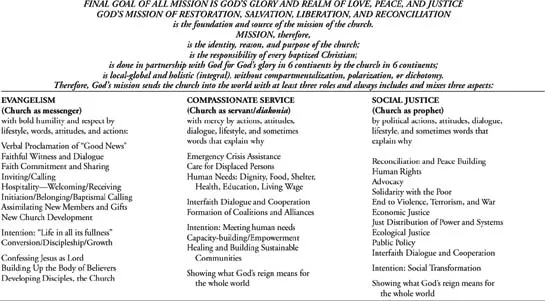
My cutting-edge proposal in this book is that a “missionary dialogue” between people involved in ministries of evangelism, compassionate service, and social justice that mutually feeds, complements, and corrects one another should guide the PC(USA). Unity and a common witness will bring renewal to all. However, to embrace the fullness of God’s holistic mission, we must understand and honor each distinct part (see fig. 1.1).9
The Presbyterian Church (U.S.A.) Book of Order tells us that the church is a messenger “called to be Christ’s faithful evangelist going into the world [and across the street], making disciples.”10 We must do this with bold humility and respect for the freedom and beliefs of those who hear our message. Our lifestyle, attitudes, and actions must be consistent with the gospel and prepare the way for our words. Evangelism is most often the verbal proclamation, communication, or sharing in word and deed of the good news of the love and saving grace of God. Jesus’ ministry clearly demonstrates that evangelization includes a gracious invitation (without pressure, imposition, or manipulation) and a call to decision and discipleship. Again, the Book of Order says, “The Church is called to present the claims of Jesus Christ, leading persons to repentance, acceptance of him as Savior and Lord, and new life as his disciples.”11
Through faithful witness and discerning dialogue, every baptized Christian and every local congregation has the responsibility of sharing our faith commitment with others. Some people are more gifted for verbal proclamation than others. We learn in 1 Corinthians 12 that we have different gifts, which come from the one Spirit. Wholeness is the complementary nature of those gifts within the church. In addition to a verbal proclamation, the evangelistic ministry of the church includes the practices of hospitality, inviting, welcoming, and receiving new persons into the faith community. We follow the example of Philip, who invited the cynical Nathanael, “Come and see” (John 1:46). Important questions to ask ourselves are these: Do new people “feel” welcomed in our midst? Are we a welcoming congregation?
In holistic evangelism, followers of Jesus Christ are assimilated and initiated into a community where they experience a sense of belonging, a baptismal calling to mission, and nurturing with the recognition and development of their gifts. When we understand evangelism from the perspective of God’s holistic mission, we earnestly desire “life in all its fullness” for all (John 10:10 NLT). Evangelism results in personal transformation or conversion, an intimate personal faith experience, discipleship, and a lifelong process of growth and service in a local faith community, which is part of the church universal.
Evangelism leads both to new church development and to church growth and maturity. The church today is worldwide, present in virtually every country in the world. But the evangelistic task is not complete. The church in every place has the primary responsibility for evangelism in that place. Where are the frontiers today? Wherever people have not heard or understood the gospel of Jesus as good news that gives meaning to their lives and brings healing to their brokenness. Wherever there is no indigenous church, the message must be communicated with authenticity and relevance. In the Western context this often means reaching out to postmodern and secular people, who may be resistant to the institutional church yet seeking a spiritual experience. Jesus is building his church (Matt. 16:18), which is a living organism with institutional structures in need of continual reform to better equip it for transforming mission.
However, we must always remember that the church is only an instrument, witness, and sign of God’s mission and reign. The goal of God’s mission is captured in the words of the Lord’s Prayer: “Your kingdom come” (Matt. 6:10). Mission is for the glory of God and the establishment of God’s reign on earth. By bearing faithful witness to Christ, the church glorifies God. The church, however, is not the end that we seek. Nor is proselytism the end. Mission activity and church growth are not the ends. A closed inward-focused group for fellowship is not the end. The church is composed of those whom God calls and gathers for worship, nurture, preparation, and fellowship in order to be scattered and sent back into the world to evangelize and engage in compassionate service and social justice. The church exists for mission to the glory of God.
Compassionate Service Is One Part
In addition to proclaiming the good news, Jesus engaged in mission by feeding the hungry and by “curing every disease and every sickness. When he saw the crowds, he had compassion for them, because they were harassed and helpless, like sheep without a shepherd” (Matt. 9:35–36). He practiced ministries of healing, wholeness, and compassionate service, ministering to the total needs of the whole person, and said that when we feed the hungry, welcome strangers, offer clothing, care for the sick, and visit prisoners, we do it to Jesus himself (Matt. 25:35–36).
The church is not only a messenger; it must also be a servant active in the ministry of diakonia (serving others in need). In a world of brokenness and suffering, the church reaches out with mercy and compassion, responding to the needs around us in concrete actions accompanied by coherent attitudes and lifestyles and sometimes by words that explain why we take these actions.
Because of our common humanity with all of God’s creatures, we must reach out in compassion wherever there is human need for welcome, dignity, self-respect, food, clothing, shelter, safety, health, education, or a living wage. Mission begins at home in our own land, where people suffer from domestic violence, sexual abuse, abandonment, loneliness, depression, and chemical dependencies. A vital part of the church’s mission is emergency crisis assistance near and far away. We must be sensitive and open to the needs and calamities of the multitudes of displaced persons, survivors, refugees, and immigrants in our nation and world. We cannot ignore the global food crisi...