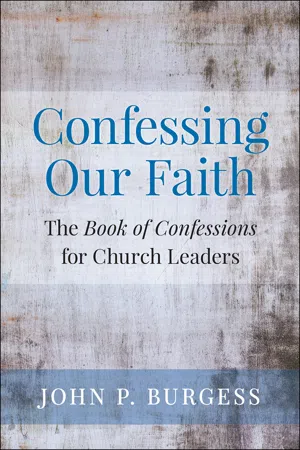
How can the Book of Confessions help elders and lay leaders when they face challenging situations within their congregations? John P. Burgess offers answers in Confessing Our Faith. Using the confessions as a framework, Burgess covers areas of ministry such as stewardship, evangelism, discipleship, and conflict resolution, offering in each case ways in which the lay leader can respond. A unique and practical reference, Confessing Our Faith is designed to aid church leaders in understanding how their work can be informed by the confessional documents.
- 176 pages
- English
- ePUB (mobile friendly)
- Available on iOS & Android
eBook - ePub
About this book
Information
Topic
Theology & ReligionSubtopic
Christian ChurchCHAPTER 1

WHY DO WE HAVE
CONFESSIONS, AND
WHAT ARE THEY?
CONFESSIONS, AND
WHAT ARE THEY?
Opening Prayer: Holy God, teach us to confess you as the Father Almighty, Maker of heaven and earth; the Lord Jesus Christ, who is God of God and Light of Light; and the Holy Spirit, the Lord and Giver of life. Teach us to proclaim your story of salvation, which reaches from the creation of all things visible and invisible to the resurrection of the dead and the life of the world to come. And guard us as your church that we may be one, holy, catholic, and apostolic. In Christ’s name. Amen.1
Martha: | I notice that the Constitution of the Presbyterian Church (U.S.A.) has two parts: a Book of Confessions (part 1) and a Book of Order (part 2). How do they fit together? |
Jerry: | That’s a good question. It seems to me that the confessions should make a difference for the way we govern the church, but I have no idea how we would make practical use of them. |
Lisa: | I see that the Book of Confessions has twelve documents representing nearly twenty centuries of Christian history. They can’t all be talking about the same thing. |
Max: | Well, even though we have taken vows to be guided and instructed by them, I’m not even sure what a confession is. |
When we hear the word “confession,” we often think about the Bible’s charge to us to confess our sins. But confession can also mean declaring what we believe, as we see in the opening words of the First Letter of John: “We declare to you what was from the beginning, what we have heard, what we have seen with our eyes, what we have looked at and touched with our hands, concerning the word of life” (1 John 1:1).
The church of Jesus Christ came into existence because of what the first disciples had experienced: that the Jesus who had died on the cross was now the Jesus whom God had raised from the dead. The new way of life that Jesus’ followers had received from their Savior on earth had not come to an end with his death. God had been faithful still. Early Christians, therefore, could not keep quiet about what they had experienced. Like their Hebrew forebears, they searched for the right words to make witness to God’s mighty acts. Jewish Christian communities declared that Jesus is the Christ (Greek for Messiah; see, for example, Mark 8:29). Gentile Christian communities proclaimed Jesus as Lord (typical for Paul, as in Rom. 10:9).
Soon other and more developed confessions of faith emerged:
Who, though he was in the form of God, did not regard equality with God as something to be exploited, but emptied himself, taking the form of a slave, being born in human likeness. And being found in human form, he humbled himself and became obedient to the point of death—even death on a cross. Therefore God also highly exalted him. . . . (Phil. 2:6–9)
He is the image of the invisible God, the firstborn of all creation; for in him all things in heaven and on earth were created, things visible and invisible. . . . He himself is before all things, and in him all things hold together. He is the head of the body, the church; he is the beginning, the firstborn from the dead. . . . (Col. 1:15–18)
He was revealed in flesh, vindicated in spirit, seen by angels, proclaimed among Gentiles, believed in throughout the world, taken up in glory. (1 Tim. 3:16)
Christians further developed their confession of Jesus Christ, the Lord, as they delivered sermons, wrote letters, and composed gospels. Each of the New Testament writings is an extended reflection on what it means that the crucified One is now the risen Son of God.
The Old Testament, too, came to be understood as witnessing (in advance) to Jesus’ life, death, and resurrection: “We were Pharaoh’s slaves in Egypt, but the LORD brought us out of Egypt with a mighty hand. The LORD displayed before our eyes great and awesome signs and wonders” (Deut. 6:21). Now Christians had experienced the greatest wonder of all: God’s raising Jesus from the dead.
Confessing the faith has five dimensions, and they characterize the documents in the Book of Confessions:
First, the church’s confessions grow out of Christians’ deep, inner conviction that Jesus has risen indeed from the dead. Confessing is a matter of both heart and head. When we feel “convicted,” we publicly declare what we believe to be true and trustworthy.
Second, the church’s confessions are an effort to understand our conviction that “he is risen.” In the words of the great medieval theologian Anselm of Canterbury, “Faith seeks understanding.” Those who confess Jesus’ resurrection want to know what their faith means for every area of their lives.
Third, the church’s confessions aim at strengthening our conviction that Christ truly lives. They offer us an anchor in times of confusion and doubt. They bind us to a truth that is larger than ourselves. People who make confession cannot easily be manipulated. They know who they are and to whom they belong.
Fourth, the church’s confessions convey our conviction about the resurrection to the world around us. Our confession of faith can awaken faith in others. God can and does use our faith, however weak, to bring other people to faith, so that they will join in the church’s confession.
Fifth, the church’s confessions demand that we commit our very lives to what convicts us. The confessions ask us to acknowledge that we are no longer our own but rather belong to the One who has been raised from the dead and raises us to new life in the Spirit. And confessing the faith may sometimes mean sacrificing even our physical lives. Since the earliest centuries of the church’s life, there have been Christian believers who were willing, if necessary, to die for their faith.
This willingness to die for God’s truth has itself been a form of confession—in Greek, the word “martyr” means witness. As Ignatius of Antioch wrote so vividly in the early second century, “Come fire, cross, battling with wild beasts, wrenching of bones, mangling of limbs, crushing of my whole body, cruel tortures of the devil—only let me get to Jesus Christ!”
The Book of Order states that the church adopts confessions in order to declare “to its members and the world
who and what we believe
what it [the church] believes
what it resolves to do.” (G-2.0100)
The church’s confessions are more than personal statements of faith, although individuals may claim the confessions for themselves. The documents in the Book of Confessions represent what we together as a church have resolved to believe and do. This kind of public, corporate confession of faith has typically taken place when the church has felt that it can no longer remain silent.
Sometimes the church has confessed its faith in response to particular crises in a confused and troubled world: The Confession of 1967 called for reconciliation in a United States riven by war, racial discrimination, and other social conflicts. The Confession of Belhar spoke out against apartheid as practiced in South Africa until the 1990s.
At other times the church has chosen to confess its faith because of disagreements within the church itself. The Nicene Creed responded to an early church heresy that regarded Christ as less than God. The Theological Declaration of Barmen sought to clarify faithfulness to the gospel in a time in which some Christians in Germany welcomed Hitler as a new Lord and Savior.
At still other times, the church has written confessions in an effort to deepen its unity. In the sixteenth century, the Heidelberg Catechism aimed at the peaceful coexistence of Lutherans and Calvinists. A Brief Statement of Faith gave expression to the reunion of northern and southern Presbyterians in 1983. And some confessions have resulted from the church’s efforts to state more systematically and comprehensively what it believes, as in the case of the Westminster Confession of Faith and its two catechisms.
While each confessional document comes out of a specific situation in the past, the church has adopted these confessions for the present. Just how does that work? On the one hand, it would be a mistake to see the church’s historic confessions as divinely revealed truths set in stone, never to be supplemented or revised. Reformed Christians have always been open to amending their confessions or writing new ones when circumstances arise that call for clarifying what we resolve to believe or do. On the other hand, the church’s confessions are not merely curious artifacts from a remote, ancient world. They are not dead museum pieces, only of interest to enthusiasts of history.
The ordination vows to accept and receive the confessions’ essential tenets and to be instructed, led, and guided by the confessions suggest that the confessions are distillations of the church’s best wisdom from over the centuries. The confessions are not equivalent in authority to Scripture, but they do have key insights that help us read the Bible as the authoritative witness to Jesus Christ. The confessions are provisional and limited expressions of faith from past times and places, yet they have unique value for us in the present, precisely because they help us see beyond our own time and place.
We might regard the confessions as beloved grandparents or elderly friends. Our elders cannot live our lives for us. Often they are unfamiliar with the social forces that have shaped us as a younger generation. Elderly people sometimes seem old-fashioned and part of a passing age. But wise elders have insights about living and growing older that we do not yet have. Their life experience offers us points of view that we might never discover on our own. Perhaps more than ever the church needs that kind of wisdom today. In an era of rapid social and technological changes, Christians often struggle to know what the church should be and do. We long for a compelling vision of Christian faith and life. We want to be able to say more clearly what is so special about our faith. The confessions can help us see our way ahead.
For most of its history in North America, the Presbyterian Church was guided by the Westminster Standards of the seventeenth century—the Confession of Faith, the Larger Catechism, and the Shorter Catechism. Whenever the church arrived at new confessional insight, it amended the Confession of Faith. In the late 1950s, the United Presbyterian Church formed a committee to propose additional revisions. The committee soon concluded, however, that the church needed a new confession of faith, in addition to the historical legacy represented by Westminster. The result was the Confession of 1967 and the creation of a Book of Confessions that united documents from early Christianity, the Reformation, Westminster, and the twentieth century.
The idea of a Book of Confessions was not entirely new. Early Reformation churches had sometimes adopted several confessional statements. Nevertheless, for North American Presbyterians, having a Book of Confessions, rather than just the Westminster documents, raised new questions. Were newer confessions more authoritative than older ones? Or vice versa? How should the church resolve differences or even contradictions among the confessions?2
Even today, the Presbyterian Church (U.S.A.) is still feeling its way into how to use the Book of Confessions. Many church leaders, even pastors, do not know these documents well or how to put them together as a whole. When the church had only the Westminster Standards, the church’s key teachings seemed clear. But what are the key teachings or “essential tenets” of twelve documents that come from such different times and places?
Nevertheless, there is wisdom in having a Book of Confessions. For one thing, the Book of Confessions represents the full sweep of historical insights that have shaped our church. And for another, despite their diversity of time and place, these documents are remarkably consistent in what they teach. Their differences are minor compared to what they affirm in common. It is these commonalities—these shared, core affirmations of what the church believes and resolves to do—that we will explore in this book. We will think of the Book of Confessions as a good teacher who welcomes various points of view but then draws them together into a coherent vision of who God is and therefore of who we are.
When the Book of Confessions was adopted in 1967, it included the Nicene Creed, the Apostles’ Creed, the Scots Confession, the Heidelberg Catechism, the Second Helvetic Confession, the Westminster Confession of Faith, the Shorter Catechism, the Theological Declara...
Table of contents
- Cover
- Half Title
- Title Page
- Copyright
- Contents
- Acknowledgments
- How to Use This Book
- Abbreviations
- Introduction: The Responsibility of Church Leaders for the Book of Confessions
- 1. Why Do We Have Confessions, and What Are They?
- 2. Learning to Listen for God’s Word
- 3. What God Is Asking Us to Do
- 4. Confessing Sin and Renewing Relationships
- 5. Evangelizing Ourselves and Others
- 6. The Gifts of the Spirit
- 7. Living Out the Christian Life
- 8. The Meaning of Church Membership
- 9. Preparing for Baptisms and Supporting the Baptized
- 10. Celebrating the Lord’s Supper and Living in Community
- 11. Facing Death
- 12. The Church’s Responsibility to Society
- Conclusion: The Church Leader as Spiritual and Theological Leader
- Appendix: The Ordination Vows of the Presbyterian Church (U.S.A.)
- Excerpt from Book of Confessions, Study Edition, Revised
Trusted by 375,005 students
Access to over 1.5 million titles for a fair monthly price.
Study more efficiently using our study tools.
Frequently asked questions
Yes, you can cancel anytime from the Subscription tab in your account settings on the Perlego website. Your subscription will stay active until the end of your current billing period. Learn how to cancel your subscription
No, books cannot be downloaded as external files, such as PDFs, for use outside of Perlego. However, you can download books within the Perlego app for offline reading on mobile or tablet. Learn how to download books offline
Perlego offers two plans: Essential and Complete
- Essential is ideal for learners and professionals who enjoy exploring a wide range of subjects. Access the Essential Library with 800,000+ trusted titles and best-sellers across business, personal growth, and the humanities. Includes unlimited reading time and Standard Read Aloud voice.
- Complete: Perfect for advanced learners and researchers needing full, unrestricted access. Unlock 1.5M+ books across hundreds of subjects, including academic and specialized titles. The Complete Plan also includes advanced features like Premium Read Aloud and Research Assistant.
We are an online textbook subscription service, where you can get access to an entire online library for less than the price of a single book per month. With over 1.5 million books across 990+ topics, we’ve got you covered! Learn about our mission
Look out for the read-aloud symbol on your next book to see if you can listen to it. The read-aloud tool reads text aloud for you, highlighting the text as it is being read. You can pause it, speed it up and slow it down. Learn more about Read Aloud
Yes! You can use the Perlego app on both iOS and Android devices to read anytime, anywhere — even offline. Perfect for commutes or when you’re on the go.
Please note we cannot support devices running on iOS 13 and Android 7 or earlier. Learn more about using the app
Please note we cannot support devices running on iOS 13 and Android 7 or earlier. Learn more about using the app
Yes, you can access Confessing Our Faith by John Burgess in PDF and/or ePUB format, as well as other popular books in Theology & Religion & Christian Church. We have over 1.5 million books available in our catalogue for you to explore.