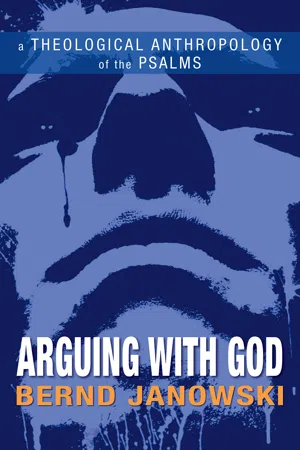
This is the first English translation of Bernd Janowski's incisive anthropological study of the Psalms, originally published in German in 2003 as Konfliktgespräche mit Gott. Eine Anthropologie der Psalmen (Neukirchener). Janowski begins with an introduction to Old Testament anthropology, concentrating on themes of being forsaken by God, enmity, legal difficulties, and sickness. Each chapter defines a problem and considers it in relation to anthropological insights from related fields of study and a thematically relevant example from the Psalms, including how a central aspect of this Psalm is explored in other Old Testament or Ancient Near Eastern texts. Each chapter concludes with an "Anthropological Keyword, " which explores especially important words and phrases in the Psalms. The book also includes reflections on reading the Psalms from a New Testament perspective, focusing on themes of transience, praising God, salvation from death, and trust in God. Janowski's study demonstrates how the Psalms have important theological implications and ultimately help us to understand what it means to be human.
- 458 pages
- English
- ePUB (mobile friendly)
- Available on iOS & Android
eBook - ePub
About this book
Information
1. Fundamental Questions of Old Testament Anthropology
True and substantial wisdom principally consists of two parts, the knowledge of God and the knowledge of ourselves.
John Calvin, Institutes of the Christian Religion 1.1.1
Thinking about human beings of the past, considering their needs, hopes, and passions, one imagines what human beings desire and what their needs are. The natural sciences as well as the humanities have for a long time been trying to answer the question what or who a human being is; they have always developed new images of humanity according to the condition of their times.1 Theological anthropology and biblical anthropology in particular also confront this challenge, contributing their own specific perspective, without losing or dismissing the connection to neighboring disciplines. But what do we mean when we speak of an Old Testament human being, with needs, hopes, and passions? Is it even possible to develop an image of such a being?
a. The Image of the Human Being
Already the singular form “the human being” proves to be problematic, because it suggests the existence of a basic, anthropological constant that has remained the same across times and spaces.2 But is it possible to discover the same type of human being in Jerusalem, in Samaria, in the Negev, in Galilee, in Elephantine, and by the “rivers of Babylon” (Ps. 137:1)? Moreover, is this Old Testament human being the premonarchic hero of the book of Judges, or rather the radically different type of human being envisioned by the prophets of the eighth and seventh centuries, or by priests of the sixth and fifth centuries? The image of the human being, like all manifestations in nature and society, is also subject to historical change. An Old Testament anthropology that incorporates this insight can rely on the research of historical anthropology.
α. Historical Anthropology
To avoid the danger of an ahistorical perception of human beings in ancient Israel,3 while keeping open the question of their nature, this study will examine a limited body of literature—individual psalms of lament and of thanksgiving—and consider the life situations in which a human being in ancient Israel is portrayed as harassed, persecuted, ill, or dying, but also as saved, praising, or giving thanks. It is therefore not a matter of general characteristics of human nature or of “basic anthropological constants,” but rather of the unique experiences and behavior patterns that show the speakers of these psalms in existential conflict situations, which they seek to overcome through lament and prayer.
The problem associated with the term “basic anthropological constants” has been of concern to the humanities and social sciences for some time now. Thus the question of human nature, which moved to the center of natural and human sciences with the “anthropological revolution”4 of the eighteenth century, has been categorically relativized by twentieth-century philosophical anthropology,5 and especially through a growing familiarity with human biology, psychology, and sociology. If we are both nature and history, as Wilhelm Dilthey thought,6 is it reasonable to expect a definitive answer to the question of human nature? Is it possible, asks Helmuth Plessner in following Dilthey,
to define definitively a being whose evolution from prehuman life-forms can be doubted as little as the open-endedness of its future possibilities and whose origin and destiny are equally obscure to us? Can the different ways in which human beings have understood themselves in the course of history and in many cultures which are not part of one history be passed over through a generalizing process and fit into a formulaic nature?7
On the other hand, the evolutionary derivation of the human species from prehuman life-forms not only had repercussions for traditional anthropology, but also gave rise to an exploration of a dimension encompassing the “entire” nature of humanity. Here we find, beginning in the 1920s (Max Scheler, Arnold Gehlen, Adolf Portmann), the discoveries and insights of medicine, biology, psychology, sociology, linguistics, and history, as well as religious and cultural studies.8
In the past few decades, cultural studies have turned increasingly toward the reciprocal relationships between body and soul, society and individual, person and world, as well as self and others; through the incorporation of these aspects, such studies have learned to ask the basic anthropological question “What is a human being?” both more comprehensively and with more specific detail.9 A philosophical anthropology that excludes medical, psychological, sociological, and cultural experiences, and therefore does not acknowledge human openness toward the world, will not be able to answer the question of human nature and destiny. In other words, “an answer to the question of humanity without reference to the human sciences is now no longer realistically possible.”10 The same is true for theological anthropology, as Wolfhart Pannenberg has rightly emphasized.11 In the twentieth century, philosophical anthropology learned to express its insights with new terminological tools gained by the cognitive sciences and to apply them to their own question of human nature; thus it became increasingly evident that human nature is itself historical. Human self- perceptions and self-expressions seen throughout the course of history can therefore not be subsumed by a single formula but need to account for historical change.
This also applies to biblical views of humanity. Here too we must note differences in our ways of thinking, feeling, and acting, which may still be so familiar that they appear completely natural to us. “The dictum of every assessment of the past,” argues legal historian Wolfgang Schild, “must be: everything was different than it is today, different even from the way it can be understood.”12 Whoever ignores this dictum runs the risk of assuming too readily a consistent context and experience for the ancient world, or a “more or less uniform anthropology (and by implication psychology) applicable to all times.”13 It is essential to understand the conceptual autonomy and dissimilarity of biblical texts and ideas in comparison to our own thought. “For it is the dissimilarity of the text, rather than our affirmation of it, that constitutes the basis of a critical function to correct our view of God and the world.”14
To attempt to do justice to the distinctiveness of Old Testament anthropology, it is therefore essential to combine “objective analysis and empathetic considerations”15 and to look at the texts and their view of the human being, sometimes up close and other times from a distance. What is called for is the historical work of understanding,16 which in itself—in the spirit of the historian Peter Brown17—cannot and must not dispense with either an “expanded sensitivity” nor a “deeper sense of empathy.” Anyone who is only concerned with the similarities between our own views and those of the Old (and New) Testament, or who even judges ancient texts on the basis of our own moral understanding, as frequently happens with the so-called Enemy Psalms—such a person forfeits the opportunity to bring the Bible’s dissimilar and at times strange view of reality into conversation with our own, and thus to understand that which is different. Yet precisely that must be the goal of an...
Table of contents
- Cover
- Half-title Page
- Title
- Copyright
- Acknowledgments and Permissions
- Contents
- List of Figures
- Preface to the U.S. Edition
- Preface
- Abbreviations
- Introduction: What Is a Human Being?
- 1. Fundamental Questions of Old Testament Anthropology
- 2. The Psalms as Fundamental Anthropological Texts
- Part 1: From Life to Death
- 3. “How long will you hide your face?” (Ps. 13:1/2): The Complaining Human Being
- 4. “Swords are on their lips” (Ps. 59:7/8): The Hostile Human Being
- 5. “Establish justice for me according to my righteousness, YHWH!” (Ps. 7:8/9): The Persecuted Human Being
- 6. “When will he die and his name perish?” (Ps. 41:5/6): The Human Being in Sickness
- Interlude: The Gate to the Abyss
- Part 2: From Death to Life
- 7. “My life has touched the underworld” (Ps. 88:3/4): The Transitory Human Being
- 8. “You have girded me with gladness” (Ps. 30:11/12): The Praising Human Being
- 9. “You show me the path of life” (Ps. 16:11): The Gifted Human Being
- 10. “My God, my God, why have you forsaken me?” (Ps. 22:1/2): God’s Human Being
- Postscript: The Way toward Life
- Excursuses 1. The Biblical Worldview
- Excursuses 2. The Whole Human Being
- Excursuses 3. Light and Darkness
- Excursuses 4. The Enigma of Evil
- Excursuses 5. Connective Justice
- Excursuses 6. The World of the Sick
- Excursuses 7. Life and Death
- Excursuses 8. The Beautiful Day
- Excursuses 9. Closeness to God
- Excursuses 10. Ecce homo
- Reviews of Editions 1–3
- Bibliography
- Index of Ancient Sources
- Index of Modern Authors
Trusted by 375,005 students
Access to over 1.5 million titles for a fair monthly price.
Study more efficiently using our study tools.
Frequently asked questions
Yes, you can cancel anytime from the Subscription tab in your account settings on the Perlego website. Your subscription will stay active until the end of your current billing period. Learn how to cancel your subscription
No, books cannot be downloaded as external files, such as PDFs, for use outside of Perlego. However, you can download books within the Perlego app for offline reading on mobile or tablet. Learn how to download books offline
Perlego offers two plans: Essential and Complete
- Essential is ideal for learners and professionals who enjoy exploring a wide range of subjects. Access the Essential Library with 800,000+ trusted titles and best-sellers across business, personal growth, and the humanities. Includes unlimited reading time and Standard Read Aloud voice.
- Complete: Perfect for advanced learners and researchers needing full, unrestricted access. Unlock 1.5M+ books across hundreds of subjects, including academic and specialized titles. The Complete Plan also includes advanced features like Premium Read Aloud and Research Assistant.
We are an online textbook subscription service, where you can get access to an entire online library for less than the price of a single book per month. With over 1.5 million books across 990+ topics, we’ve got you covered! Learn about our mission
Look out for the read-aloud symbol on your next book to see if you can listen to it. The read-aloud tool reads text aloud for you, highlighting the text as it is being read. You can pause it, speed it up and slow it down. Learn more about Read Aloud
Yes! You can use the Perlego app on both iOS and Android devices to read anytime, anywhere — even offline. Perfect for commutes or when you’re on the go.
Please note we cannot support devices running on iOS 13 and Android 7 or earlier. Learn more about using the app
Please note we cannot support devices running on iOS 13 and Android 7 or earlier. Learn more about using the app
Yes, you can access Arguing with God by Bernd Janowski, Armin Siedlecki in PDF and/or ePUB format, as well as other popular books in Teologia e religione & Critica e interpretazione biblica. We have over 1.5 million books available in our catalogue for you to explore.