For each of the lectionary days and Holy Days for Justice there is an essay that helps the preacher integrate a variety of social justice concerns (including racial/ethnic issues, sexism, classism, ecology, and violence) into their preaching. The contributors are a diverse group of homileticians, pastors, biblical scholars, theologians, and social activists.
eBook - ePub
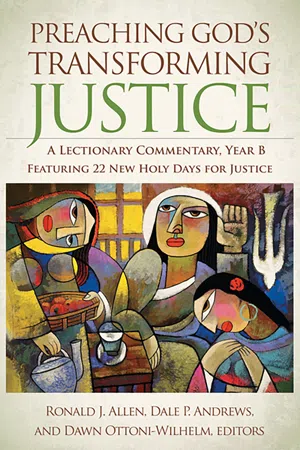
Preaching God's Transforming Justice
A Lectionary Commentary, Year B
- 544 pages
- English
- ePUB (mobile friendly)
- Available on iOS & Android
eBook - ePub
Preaching God's Transforming Justice
A Lectionary Commentary, Year B
About this book
This unique commentary is the first to help the preacher identify and reflect theologically and ethically on the social implications of the biblical readings in the Revised Common Lectionary. In addition to providing commentary for each day in the lectionary calendar, this series introduces twenty-two Holy Days for Justice. These days are intended to enlarge the church's awareness of God's call for justice and of the many ways that call comes to the church and world today. The days include Martin Luther King Jr. Day, Earth Day, World AIDS Day, International Women's Day, Cesar Chavez Day, Yom HaShoah, and Juneteenth.
Information
Publisher
Westminster John Knox PressYear
2011Print ISBN
9781611641240
9780664234546
eBook ISBN
9781611641240
Topic
Theology & ReligionSubtopic
Christian MinistryWorld AIDS Day (December 1)
Chris Glaser
ZEPHANIAH 3:14–20
PSALM 103:6–18
1 THESSALONIANS 5:1–11
MATTHEW 22:34–39
PSALM 103:6–18
1 THESSALONIANS 5:1–11
MATTHEW 22:34–39
As always, children and women carry the burden of abandonment, vulnerability, stigma, shame, poverty and desperation. They constitute, for you, the cause you must lead. You constitute, for them, the meaning of salvation in terms both spiritual and practical.… The sacred texts, from which all religion flows, demand a higher level of morality. And if ever there was an issue which bristles with moral questions and moral imperatives it’s HIV/AIDS.
Stephen Lewis1
One of the first films about AIDS, Longtime Companion, concluded with a euphoric reunion on the shore of survivors with their friends, partners, and family members lost to AIDS, with smiles and hugs abounding.2 As I watched it through tears when it was released in 1990, I glimpsed the “day of the Lord” (1 Thess. 5:2), when Christ would return to uplift the living and the dead, a vision that helped the early Christians withstand their persecution and suffering. When I think back on those years, it amazes me that we were not overwhelmed. It’s hard to think that what we experienced then is being experienced again by those in developing countries, those in poorer populations, and those of younger generations.3
We held “celebrations” of those who died—of their humor, their gifts, their love—and found a way to celebrate them in panels assembled as the Names Project AIDS Quilt, providing comfort and catharsis. Gray tombstones were not for us. Colorful fabrics and photos and mementoes better represented the vibrancy of our friends, our partners, our family members. These were our shrouds, our icons, our sacramental items that represented their sacred worth.
World AIDS Day observed as a Holy Day for Justice gives occasion to join in such celebrations with panels from the AIDS Quilt and worship that is hopeful, uplifting, and re-creational. It is about a vision of reunion with those we’ve lost to God’s eternal realm. A friend whose partner died in his arms told me a week later, on Easter, “I felt him leave his body. That’s why I know I will see him again.” What faith!
Zephaniah 3:14–20
Zephaniah’s ministry is believed to date from 630 BCE. The prophet was concerned with God’s judgment on spiritual complacency and religious malpractice. Our particular text speaks of deliverance from all this, but may have been added to the original.
Nonetheless, its hopeful tone gives a much needed reprieve from the doleful tone of Zephaniah’s concerns. Decades ago, the National Conference on Christians and Jews (now the National Conference for Community and Justice) recommended that for Holocaust Remembrance Day, positive instances of courage and faithfulness be highlighted and celebrated, including the actions of Christians who hid Jews from the Nazis at great risk to themselves. World AIDS Sunday could follow this lead of positive reinforcement by celebrating stories of faith in the midst of AIDS.
“Sing aloud, O daughter Zion; shout, O Israel! Rejoice and exult with all your heart, O daughter Jerusalem! The LORD … is in your midst; you shall fear disaster no more” (vv. 14–15). No explication can substitute for the boundless joy leaping from these words. Though well-meaning Christians might want to beat their breasts and say, “Mea culpa,” to those the church initially abandoned or ignored in the AIDS crisis, that may prove self-indulgent when those living and dying with HIV and AIDS now need uplifting spiritual practices.
In the communities initially touched by AIDS, I believe many people flocked to New Age spirituality meetings, not only because of their distrust of the church, but to hear affirmations rather than confessions. That’s why this Scripture from Zephaniah works; it lends its vision of a day when true religion is restored in Zion and, for us in the church, when God is the friend we were taught God was in Jesus: “The LORD, your God, is in your midst; … [God] will rejoice over you with gladness, [God] will renew you in love; [God] will exult over you with loud singing, as on a day of festival” (vv. 17–18). How marginalized people, how people with a life-threatening illness, long to hear such words!
The verses that follow speak of removing disaster and oppressors, and changing shame to praise, even as God gathers the physically impaired and the outcast to bring them home. I think of the T-shirts with letters writ large: “HIV-POSITIVE”—surely an antidote to the ostracism once experienced by the AIDS community. A social-service worker counseling a homeless man with AIDS said she tried “every trick in the therapeutic book” to get him to turn from suicidal thoughts and take his medications. Finally, she decided to use the “F-word—Faith,” and, by getting him to talk about his Christian faith, this Jewish therapist helped him to find a way home. The good news of faith has been vastly underestimated as a restorer for those cast out of family homes, church homes, and hometowns.
Psalm 103:6–18
Though there are things in our lives worthy of judgment, the psalmist declares, God’s anger is slow to rise and quick to dissipate (v. 9). God’s mercy, grace, love, and justice are eternal (vv. 6, 8). God is not a cosmic clerk who pays tit for tat (v. 10), but compassionately divorces our transgressions “as far as the east is from the west” (v. 12) from our identity as beloved children (v. 13). God “remembers that we are dust,” mere mortals, whose days are brief on earth, like flowers and grass, while God’s love and righteousness last eternally for those who hold God in awe and extend for generations to those who keep God’s covenant and commandments.
I witnessed the Midwestern parents of a young man dying of AIDS who embodied this love for their son. But the church had ingrained in him more about God’s judgment than God’s love, and he died believing AIDS was God’s judgment of his own love. Given the level of his pain, discomfort, and selfloathing, death proved a kind of healing, an opportunity to at last rest in peace in the everlasting arms of God’s love. The psalmist, in singing thanksgiving for healing from disease, may just as well have been singing of this healing from the dis-ease of believing one’s self beyond God’s love.
Houses of worship have begun to offer AIDS healing services, but perhaps the best purpose of such gatherings is to provide a healing balm to those who have suffered toxic religion and spiritual abuse.
Matthew 22:34–39
Mark puts this summary of the law on Jesus’ lips, but both Matthew and Luke suggest Jesus used a rabbinic teaching method of eliciting the summary from others, a summary current among rabbis of the time. Spiritual guides and directors know the value of helping seekers discern their own answers to questions of faith. This very action from Jesus suggests a way of being with those facing questions of faith as they deal with fear, suffering, and mortality. Though our temptation as preachers and pastors and caregivers may be to offer our own answers, our best first response is to help people remember or discern what they already know.
A Pharisee had asked Jesus which commandment is the greatest. In Luke’s version, the lawyer is trying to justify himself, and Jesus tells the parable of the Good Samaritan. In Matthew, the motive may be “to entrap him” (v. 15). Jesus tells him to love God “with all your heart, and with all your soul, and with all your mind” (v. 37), quoting Deuteronomy 6:5. Jesus adds, “You shall love your neighbor as yourself” (v. 39), quoting Leviticus 19:18, which assumes we love ourselves, an assumption not necessarily true for the marginalized groups affected by HIV/AIDS, who have been taught to hate themselves because of their color, gender, sexuality, or poverty. To teach this verse sufficiently, we need to proclaim that Jesus expanded the definition of “neighbor” that included both fellow Hebrews and resident aliens (Lev. 19:33–34) to anyone in need. For Jesus, “neighbor” was anyone, even the enemy (e.g., Luke 6:27, 35). Ministry among people living with HIV/AIDS is not optional, but a duty inextricably bound to loving God absolutely, for “those who say, ‘I love God,’ and hate their brothers or sisters, are liars” (1 John 4:20). A person with AIDS whose family had disowned him when he came out as gay rediscovered their love for him only as they surrounded him on his deathbed. His final observation to a chaplain was, “Love heals.”
1 Thessalonians 5:1–11
In this letter, believed to be the earliest writing in the New Testament, circa 50 CE, the apostle Paul addresses the concerns of the church at Thessalonica about “the day of the Lord” (v. 2) that early Christians awaited, the Parousia, or coming of Christ. Church members are concerned for those who have “fallen asleep” (4:14, translated in the NRSV as “died”), their metaphor for death, and Paul wants to assure them that those who have fallen asleep “will rise first. Then we who are alive, who are left, will be caught up in the clouds together with them to meet the Lord in the air; and so we will be with the Lord forever” (4:16c–17).
The text that follows could be read with foreboding: “the day of the Lord will come like a thief in the night” (v. 2), “then sudden destruction will come” and “there will be no escape!” (v. 3). But Paul’s purpose is to suggest the suddenness of Christ’s victory and its serendipitous nature for those who are “children of light and children of the day” (v. 5). Thus the Thessalonian Christians have nothing to worry about, though they must remain prepared: “since we belong to the day, let us be sober, and put on the breastplate of faith and love, and for a helmet the hope of salvation” (v. 8).
Unprovidentially, however, many who discover themselves infected with HIV cope with multiple stigmas, being part of marginalized groups and now associated with illness, contagion, and death. So when they hear Paul’s contrasting the plight of the saved with the unsaved, they may fear they themselves are perceived as those children “of the night or of darkness,” “drunk,” and destined for the “wrath” to come (vv. 5, 7, 9). Preachers on this text need to tread carefully in its use on World AIDS Day. A minister told me that a person he had been assigned as an AIDS buddy told him over the phone that he didn’t want any “religious garbage” dumped on him, but the first words out of his mouth when they met was, “Do you think my having AIDS is some kind of punishment from God?”
It is better to focus on Paul’s intent of assuring those concerned for their departed loved ones that they will be reunited on the day of the Lord. This is what carried the early church in its own fears, sufferings, and deaths. As the passage concludes, “Therefore encourage one another and build up each other, as indeed you are doing” (v. 11).
Pollyanna challenged her dour preacher to discover there are more blessings than curses in the Bible. To those who already feel cursed by HIV and AIDS, God’s blessings are all the more dear and necessary. Zephaniah’s celebration of the Lord’s return to Zion is a tonic in the midst of our own spiritual complacency and religious malpractice as a church and a people. The psalmist’s rejoicing at a God of compassion who readily forgives shortcomings and works for justice for the oppressed surely inspires us to do the same. Jesus’ explanation that all the law and the prophets are applications of the commandment to love God and neighbor gets to the heart of what matters both spiritually and in regard to how we live in the world every day. Paul’s uplifting vision in 1 Thessalonians of the day of the Lord, when we will be reunited not only with Christ but with all our departed loved ones, serves as a taste of God’s commonwealth to come.
1. Stephen Lewis, UN Special Envoy for HIV/AIDS in Africa, speaking at the African Religious Leaders Assembly on Children and HIV/AIDS, Nairobi, Kenya, June 10, 2002. http://data.unaids.org/Media/Speeches01/sp_lewis_african-religious-leaders_10jun02_en.pdf. (accessed March 23, 2010).
2. Visit www.worldaidsday.org for the theme of World AIDS Day for the current year.
3. I have discussed this topic more fully in the chapter “Death by Plague” in my book The Final Deadline: What Death Has Taught Me about Life (New York: Morehouse, 2010). For further resources, see www.chrisglaser.com.
Second Sunday of Advent
Marvin A. McMickle
ISAIAH 40:1–11
PSALM 85:1–2, 8–13
2 PETER 3:8–15A
MARK 1:1–8
PSALM 85:1–2, 8–13
2 PETER 3:8–15A
MARK 1:1–8
Advent is a time of waiting for the realm of God. But Advent waiting is not sitting silently with folded hands while God magically establishes the realm. Advent waiting is active: we not only join God in the movement toward the realm, but, as much as possible, we live as if the realm is already here. Today’s readings call attention to different aspects of active waiting. Isaiah urges us to be patient, even if we suffer for our sins. The psalm reminds us that God will bless a nation that puts justice for all into action, and God will punish a nation that privileges a few at the expense of the many. The passage from 2 Peter encourages us toward holy living as our means of holy waiting. John the Baptist calls us to repent of our complicity with injustice as we wait for the coming realm. Taken together, these passages urge us to work as we wait for the realm of God.
Isaiah 40:1–11
In The Pursuit of God, A. W. Tozer says that before God can bless a person, God often hurts that person deeply.1 This idea is out of step with much contemporary preaching, but it is at home in the preaching of Isaiah. People today prefer a religion that would keep them from suffering. The nation of Judah operated from such an assumption, but the Babylonian exile proved them wrong. The people of Judah violated the covenant through idolatry, exploitation, injustice, and false alliances. As a consequence, God hurt them not as an end, but to chasten...
Table of contents
- Cover
- Title Page
- Copyright Page
- Contents
- Preface
- Introduction
- First Sunday of Advent: Leonora Tubbs Tisdale
- World AIDS Day (December 1): Chris Glaser
- Universal Declaration of Human Rights (December 10): Christine Marie Smith
- Martin Luther King Jr. Day (January 15): Dale P. Andrews
- Asian American Heritage Day (February 19): Fumitaka Matsuoka
- International Women’s Day (March 8): Dawn Ottoni-Wilhelm
- Salt March Day: Marching with the Poor (March 12): Rebecca Todd Peters
- Oscar Romero of the Americas Day (March 24): Ada María Isasi-Díaz
- César Chávez Day (March 31): Frederick John Dalton
- Earth Day (April 22): John Hart
- Holocaust Remembrance Day: Yom haShoah (Late April to Early May): Clark M. Williamson
- Peace in the Home: Shalom Bayit (Second Sunday in May): Marie M. Fortune
- Juneteenth: Let Freedom Ring (June 19): James Henry Harris
- Gifts of sexuality and Gender (June 29): Valerie Bridgeman
- Fourth of July: Seeking Liberty and Justice for All: Ronald J. Allen
- Sojourner Truth Day (August 18): JoAnne Marie Terrell
- Simchat Torah: Joy of the Torah (Mid-September to Early October): Esther J. Hamori
- International Day of Prayer and Witness for Peace (September 21): Willard Swartley
- Peoples Native to the Americas Day (Fourth Friday in September): Martin Brokenleg
- World Communion Sunday (First Sunday in October): Joseph R. Jeter Jr.
- Night of Power (27th Night of Ramadan): John Kaltner
- World Food Day (October 16): James L. McDonald
- Children’s Sabbath (Third Weekend in October): Shannon Daley-Harris
- Contributors
- Scripture Index
Trusted by 375,005 students
Access to over 1.5 million titles for a fair monthly price.
Study more efficiently using our study tools.
Frequently asked questions
Yes, you can cancel anytime from the Subscription tab in your account settings on the Perlego website. Your subscription will stay active until the end of your current billing period. Learn how to cancel your subscription
No, books cannot be downloaded as external files, such as PDFs, for use outside of Perlego. However, you can download books within the Perlego app for offline reading on mobile or tablet. Learn how to download books offline
Perlego offers two plans: Essential and Complete
- Essential is ideal for learners and professionals who enjoy exploring a wide range of subjects. Access the Essential Library with 800,000+ trusted titles and best-sellers across business, personal growth, and the humanities. Includes unlimited reading time and Standard Read Aloud voice.
- Complete: Perfect for advanced learners and researchers needing full, unrestricted access. Unlock 1.5M+ books across hundreds of subjects, including academic and specialized titles. The Complete Plan also includes advanced features like Premium Read Aloud and Research Assistant.
We are an online textbook subscription service, where you can get access to an entire online library for less than the price of a single book per month. With over 1.5 million books across 990+ topics, we’ve got you covered! Learn about our mission
Look out for the read-aloud symbol on your next book to see if you can listen to it. The read-aloud tool reads text aloud for you, highlighting the text as it is being read. You can pause it, speed it up and slow it down. Learn more about Read Aloud
Yes! You can use the Perlego app on both iOS and Android devices to read anytime, anywhere — even offline. Perfect for commutes or when you’re on the go.
Please note we cannot support devices running on iOS 13 and Android 7 or earlier. Learn more about using the app
Please note we cannot support devices running on iOS 13 and Android 7 or earlier. Learn more about using the app
Yes, you can access Preaching God's Transforming Justice by Ronald J. Allen,Dale P. Andrews,Dawn Ottoni-Wilhelm, Ronald J. Allen, Dale P. Andrews, Dawn Ottoni-Wilhelm in PDF and/or ePUB format, as well as other popular books in Theology & Religion & Christian Ministry. We have over 1.5 million books available in our catalogue for you to explore.