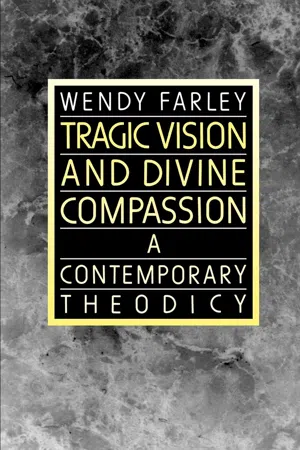
Offering an alternative to classic Christian theodicies (justification of God's goodness and omnipotence in view of the existence of evil), Wendy Farley interprets the problem of evil and suffering within a tragic context, advocating compassion to describe the power of God in the struggle against evil.
- English
- ePUB (mobile friendly)
- Available on iOS & Android
eBook - ePub
About this book
Information
Topic
Theology & ReligionSubtopic
Christian TheologyPART ONE
Tragedy, Suffering, and the Problem of Evil
1
Tragic Vision
O Hades, all receiving, whom no sacrifice can appease! Hast thou no mercy for me?
Evil as manifest in cruelty, injustice, and suffering is not simply “tragic,” particularly if tragedy evokes a sense of pathetic inevitability. Guilt and suffering cannot be understood simply as subjection to an inexplicable, irrational fate. Yet there is an element of the irrational in evil that evades clear concepts and orderly judgments. No conceptual scheme can thoroughly expel the bewilderment suffering evokes. The phenomenon of human suffering continues to bleed through the explanations that attempt to account for it.
Confidence in cosmic justice cannot completely obscure the rapacity of suffering as it devours the innocent and the helpless. Hopes in future vindication do not make hunger, racism, war, and oppression theologically irrelevant. It would be consoling to believe that suffering is a consequence of wrongdoing. But the correlation between suffering and punishment is exploded by genocide in Germany and Cambodia, by the torture of prisoners of conscience, by battered women and abused children—by the “human tears with which our earth is soaked from crust to core.”1
The cruelty of human suffering defies attempts to incorporate it into any order of justice. Instead of the just world we might envision, we seem to live in a tragic one. At least, a study of tragedy may enable theology to look at the problem of evil in a new light and to take suffering more seriously.
A deep passion for justice characterizes many of the biblical writings. This passion is seen both in the attempts to interpret Israel’s suffering as just punishment and in the failure of these attempts. The Deuteronomistic historian tried desperately to contain the story of Israel’s rise and fall within an ethical vision of reality. From Judges to Second Kings, the refrain is repeated: “and the people of Israel did what was evil in the sight of the Lord.” The catastrophes of war, defeat, and exile are strained through ethical categories: the good are blessed and the evil punished. The defeat and destruction of Israel might be bearable if they could be made to express the justice, however painful, of a righteous God. Punishment for evildoing is terrible, but it reveals the ultimate goodness and justice of the cosmic order.
Yet, something about the destruction of Jerusalem and its people seeped through the ethical vision of the Deuteronomistic historian. A tragic interpretation of suffering competes with an ethical one. A psalmist sees Israel sold “like sheep for slaughter” and can find no reason in it:
All this has come upon us,
though we have not forgotten thee,
or been false to thy covenant.
Our heart has not turned back,
nor have our steps departed from thy way,
that thou shouldst have broken us in the place of jackals,
and covered us with deep darkness.
Psalm 44:17–19
The biblical writers craved justice, sometimes preferring guilt and punishment to the emptiness of chaos and absurdity. But history did little to satisfy this longing. Israel was swallowed by Babylon, the bloodthirsty world power. It was later to know persecution at the hands of the Greeks and terror and slavery at the hands of the Romans. The law of history affords victory to the strong, however cruel.
The sufferings of Israel are a microcosm of the rest of history. Humanity thirsts for justice, but we live in a world where little girls are raped and beaten by their fathers and where war ravages the most helpless and wretched of the earth’s children. The hollow face of hunger does not seem to pursue only those who “deserve” to starve.
Christianity has long struggled with the need to understand the existence of evil in a world that faith insists is ordered by a gracious and powerful God. Its reflections on evil tended to be governed by the problematic of sin. The corruption of creation through human guilt, together with the atonement and forgiveness that healed creation, provided the paradigm through which evil and redemption were conceived. In this drama dominated by the Fall, suffering was relatively insignificant. Four kinds of theodicy emerged, which individually or in combination seemed to account for the brutalities of history. Sin and suffering were variously accounted for as punishment for sin, as elements of a larger aesthetic harmony, as purgation or pedagogy, or as presaging eschatological correction.
But there is a kind of suffering that destroys the power of these theodicies to spirit away the problem of evil. I am calling this phenomenon “radical suffering.” The distinguishing features of radical suffering are that it is destructive of the human spirit and that it cannot be understood as something deserved. Consider the testimony of a Chilean torture victim:
At one point, I realized that my daughter was in front of me. I even managed to touch her: I felt her hands. “Mummy, say something, anything to make this stop,” she was saying. I tried to embrace her but they prevented me. They separated us violently. They took her to an adjacent room and there, there I listened in horror as they began to torture her with electricity! When I heard her moans, her terrible screams, I couldn’t take it any more. I thought I would go mad, that my head and my entire body were going to explode.2
The obscenity of such an event annihilates the possibility of soothing ourselves with theories that justify the ways of God in an evil world. In the wake of such wanton cruelty, defenses of a divine order of justice become bitter mockeries.
Appeals to punishment and original sin to justify the torture of a mother and her child betray the ethical sensibilities that may have originally generated a penal theodicy. Attempts to include such extreme and unfair suffering within a paradigm of guilt and punishment offers, in Kant’s words, “an apology in which the defense is worse than the charge . . . and may certainly be left to the detestation of everyone who has the least spark of morality.”3
Thomas Aquinas argues that evil does not significantly undermine the goodness of creation. Particular creatures may suffer, but the diminishment of particular creatures is necessary to the good of the whole. “For if all evil were prevented much good would be absent from the universe.”4 Creation is good because the whole is good. This aesthetic metaphysics turns our eyes to the beauty of the cosmos by rendering particular sufferings invisible. But justice cannot tolerate a cosmic harmony whose edifice is maintained on the unavenged tears of tormented children.
It might be argued that suffering is good for people: it makes them stronger, more sensitive, more mature. It is true that suffering sometimes has this effect. But radical suffering destroys its victims, it does not make them stronger. Assuming that she survives, is it likely that the Chilean child will be a better person for having electric shocks applied to her fingers and toes? Such suffering is of another order than that which might be pedagogical.
Eschatology can console those who find no refuge in history. It can attest to a hope that evil is not the last word. But it is in history that we live, struggle, think, act, and suffer. Without denying the legitimacy of eschatological hopes, theology must seek a historical response to evil. Otherwise, consolation and hope may degenerate into excuses for remaining passive or indifferent in the face of radical suffering and injustice.
Theodicy cannot take the sting out of evil: the surd of destructive suffering remains. The longing for justice, for an ethical order, is not satisfied by historical experience. Neither is it satisfied by theories that attempt to obscure the horror of evil or justify the existence of suffering. In the face of radical suffering, traditional theodicies are unable to exorcise the demons that whisper that life is futile, suffering meaningless, and the cosmos an empty and evil void.
Tragedy enters into the hiatus between the longing for justice and the reality of suffering. Unlike traditional theodicies, tragedy does not attempt to penetrate the opacity of evil by providing justifications of suffering. It recognizes that certain kinds of suffering are irredeemably unjust. It sees justice languishing in history, where the innocent are destroyed while their murderers are honored and feted. The mothers of the “disappeared” in El Salvador are tortured and condemned as “terrorists,” while their tormentors are celebrated in Washington. Jesus writhes on the cross; Herod and Pilate become friends.
A tragic sense of life burns with a desire for justice, but, unlike theodicy, burns even more with anger and pity at suffering. In tragic vision, unassuaged indignation and compassionate resistance replace theodicy’s cool justifications of evil.
Historical Background
Job, Lamentations, the story of Saul, and certain psalms represent traces of a tragic sensibility in the Bible. But tragedy as a distinct literary genre begins with the Athenian playwrights, Aeschylus, Sophocles, and Euripides. Although the ancient tragedians gave profound expression to tragedy, sensitivity to tragic dimensions of existence reaches far beyond this literary genre. Unamuno describes tragedy as a distinct “sense of life.”5 Max Scheler, Karl Jaspers, and Nicolas Berdyaev interpret tragedy as central to ethical and religious experience.6 While there is no complete agreement on what constitutes tragedy, certain themes emerge with some regularity: attentiveness to suffering, freedom and responsibility, a world order that distorts this freedom, and resistance to tragic suffering. These elements will be examined in turn.
Suffering
W. Lee Humphreys argues that “at the heart of tragic vision lies human suffering, suffering triggered in important ways by the action of the hero, yet suffering that is necessary at the very core of the human situation in the world. In the face of this necessary suffering the hero does not remain passive.”7 Humphreys’s description hits several of the key elements of tragedy: action, external necessity, and resistance. But it is suffering itself that holds these elements together. Philosophers, theologians, playwrights, and novelists are in unanimous agreement that whatever else is entailed in tragedy, suffering lies at its very heart. This concern with suffering distinguishes tragedy from most Christian theology, which identifies guilt as the primary clue to the human condition.
While suffering is the essential subject matter of tragedy, suffering may be pathetic, cruel, or miserable without being tragic. Tragic suffering is distinguished by its destructive power and its irreducibility to fault. The poignancy of tragic suffering is especially pronounced when the hero is very good but is destroyed by something beyond his or her control. The destruction of a passionately good person makes the unfairness of tragic suffering nearly intolerable. There is nothing to appeal to which would make this suffering meaningful. It is antithetical to even the crudest notions of justice since it cannot be traced to punishment. It is not pedagogical since it cannot strengthen or purify the person. Tragic heroes and heroines are usually destroyed in the course of the story. Antigone is zealous in her piety and loyalty but ends by hanging herself. Prometheus teaches and protects human beings out of pity but is hurled into the abyss by Zeus. The suffering is raw, unmediated by justice or utility; it witnesses to the power of absurdity or malice or sheer force to bring down what is noble and good.
Freedom and Responsibility
As Humphreys’s definition of tragedy indicates, tragic suffering requires some action on the part of the hero. Tragedy does not portray human beings as passive puppets; people act and are responsible for the consequences of their actions. But neither does tragedy imagine that human action is unconstrained. Freedom is confined within a preexisting situation and is hedged by ignorance and conflict. Tragedy requires of its hero action within a situation where all action leads to disaster.
It is the genius of tragedy to recognize the complexity of responsibility. The Fates do not absolve the tragic hero from accountability, but neither is suffering resolved into penalty for negligent or corrupt freedom. Without real choice there may be pathos in suffering but not tragedy. Without a tragically structured environment, there is the justice of retribution but, again, not tragedy.
In Greek tragedy, hubris (zeal, passion, excess, wantonness) and hamartia (error, ignorance) conspire with the Fates to defraud the hero of control over a situation. Tragedy is heightened where there is action, responsibility, defeat, but little or no real sense of guilt. The action that condemns the hero is a guiltless action. Oedipus’s compulsive search for the truth evinces a moral zeal that has the ironic consequence of destroying him. His integrity is condemned beforehand by his ignorance of his true situation. His ruin cannot be traced to any wickedness or selfishness on his part. According to the information at his disposal, he was a brave, intelligent Greek citizen with the good fortune of winning a kingdom and a lovely wife. Oedipus was not in a position to know he was committing patricide and incest. Although he was deceived about his real situation, ignorance did not prevent the inner dynamic of his actions from bearing down on him. Oedipus’s actions brought about his downfall, but not in the sense that punishment follows crime. Freedom is betrayed, but responsibility remains intact.
Actions count, and choices are made in confrontation with genuine alternatives. In this we are responsible for our deeds and reap what we sow. Yet this freedom to decide and act is exercised on a larger stage on whic...
Table of contents
- Cover
- Half title
- Title
- Copyright
- Dedication
- Contents
- Preface
- Part One Tragedy, Suffering, and the Problem of Evil
- Part Two Toward a Theology of Resistance and Redemption
- Notes
- Selected Bibliography
- Index of Names
Trusted by 375,005 students
Access to over 1.5 million titles for a fair monthly price.
Study more efficiently using our study tools.
Frequently asked questions
Yes, you can cancel anytime from the Subscription tab in your account settings on the Perlego website. Your subscription will stay active until the end of your current billing period. Learn how to cancel your subscription
No, books cannot be downloaded as external files, such as PDFs, for use outside of Perlego. However, you can download books within the Perlego app for offline reading on mobile or tablet. Learn how to download books offline
Perlego offers two plans: Essential and Complete
- Essential is ideal for learners and professionals who enjoy exploring a wide range of subjects. Access the Essential Library with 800,000+ trusted titles and best-sellers across business, personal growth, and the humanities. Includes unlimited reading time and Standard Read Aloud voice.
- Complete: Perfect for advanced learners and researchers needing full, unrestricted access. Unlock 1.5M+ books across hundreds of subjects, including academic and specialized titles. The Complete Plan also includes advanced features like Premium Read Aloud and Research Assistant.
We are an online textbook subscription service, where you can get access to an entire online library for less than the price of a single book per month. With over 1.5 million books across 990+ topics, we’ve got you covered! Learn about our mission
Look out for the read-aloud symbol on your next book to see if you can listen to it. The read-aloud tool reads text aloud for you, highlighting the text as it is being read. You can pause it, speed it up and slow it down. Learn more about Read Aloud
Yes! You can use the Perlego app on both iOS and Android devices to read anytime, anywhere — even offline. Perfect for commutes or when you’re on the go.
Please note we cannot support devices running on iOS 13 and Android 7 or earlier. Learn more about using the app
Please note we cannot support devices running on iOS 13 and Android 7 or earlier. Learn more about using the app
Yes, you can access Tragic Vision and Divine Compassion by Wendy Farley in PDF and/or ePUB format, as well as other popular books in Theology & Religion & Christian Theology. We have over 1.5 million books available in our catalogue for you to explore.