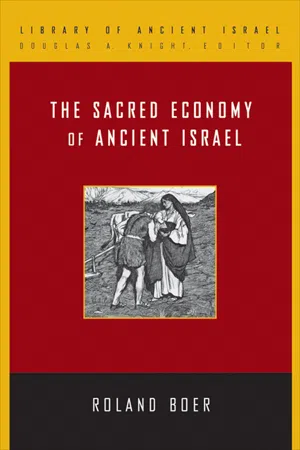
The Sacred Economy of Ancient Israel offers a new reconstruction of the economic context of the Bible and of ancient Israel. It argues that the key to ancient economies is with those who worked on the land rather than in intermittent and relatively weak kingdoms and empires. Drawing on sophisticated economic theory (especially the Régulation School) and textual and archaeological resources, Roland Boer makes it clear that economic "crisis? was the norm and that economics is always socially determined. He examines three economic layers: the building blocks (five institutional forms), periods of relative stability (three regimes), and the overarching mode of production. Ultimately, the most resilient of all the regimes was subsistence survival, for which the regular collapse of kingdoms and empires was a blessing rather than a curse. Students will come away with a clear understanding of the dynamics of the economy of ancient Israel. Boer's volume should become a new benchmark for future studies.
- 570 pages
- English
- ePUB (mobile friendly)
- Available on iOS & Android
eBook - ePub
The Sacred Economy of Ancient Israel
About this book
Information
Topic
Theology & ReligionSubtopic
Ancient ReligionCHAPTER 1
The Question of Theory
As is always the case, practice marched ahead of theory.
—Vladimir I. Lenin1
Régulation theory and Soviet-era Marxist scholarship—these two form the primary and perhaps unexpected theoretical groundwork of this study. Both are parts of a large and rich Marxist tradition of economic analysis that has a pedigree of well over a century and a half. I am up front about this basis, since I feel it is better to be transparent—at least as far as one is able—concerning one’s heuristic framework, rather than leaving it unexamined. All manner of tactics are used to avoid such examination: a claim to get on with the task at hand rather than bother with theoretical matters; a suggestion that the data are too thin for any larger models; the assumption that “economics” is a universal and neutral discipline that may be applied in all places and time; a dismissal of “ideological” elements in the name of “science.”2 Obviously our frameworks are all the stronger for us the more we leave them untouched. No doubt the reflex of some to my preferred framework will be negative, for a range of articulated and unarticulated reasons. Those who live under the long shadow of the anticommunist witch hunts of the US senator Joseph McCarthy (1908–57) may, on purely partisan political grounds, resist the deep engagement of my reconstruction with Marxist, Soviet, and indeed communist theories and terms. So too may those who see (mistakenly) that the “fall” of the Berlin Wall symbolizes the collapse of the socialist project. That is the topic of another debate, one that I have undertaken elsewhere and see no need to reprise here. In this work, I take a minimal position, holding that the analytical power of Marxist approaches remains at least unabated, if they have not been developed with greater sophistication in the last couple of decades (for instance, see Wickham).3 The proof is, of course, in the execution, but I also suggest that the framework I deploy in this work raises new questions and opens up new vistas. The value of a new proposal is not that it says the final word—impossible for the limited creatures that we are—but that it may generate new questions and areas of investigation that have not been considered earlier.
In light of all this, a question needs to be asked: what is the dominant framework or economic model in recent work on ancient Israel within the context of ancient Southwest Asia? As I will show in the next section, since the last decade of the twentieth century, it has been largely a neoclassical model, as that particular tradition of economic study has been appropriated by what is sometimes called neoliberalism. The theoretical analysis that follows should therefore be seen as a challenge to the obvious inadequacies of a neoclassical approach, an intervention in the best sense of the word. As will gradually become clear over the course of this book as a whole, it seems to me that the theoretical framework I develop here is best able to make sense of the available data, as well as the scattered insights from other approaches.4
I begin the following analysis by examining the inadequacies of neoclassical approaches. These will be familiar to the majority of scholars who have worked on economic matters relating to ancient Southwest Asia and ancient Israel. For that reason, I begin with such approaches, but I also do so to provide a springboard to the more fruitful approaches provided by Marxist methods. Thus, following the treatment of neoclassical economics, I discuss the key schools of Marxist economics that have provided or may provide viable resources for a study of ancient Southwest Asia: world-systems theory, the work of Karl Polanyi, Soviet-era Russian scholarship, and Régulation theory. I close with two further methodological issues: the need to deal squarely with the inescapable anachronism of any study of the past, and the vexed issue of how textual materials relate to their historical context.
NEOCLASSICAL ECONOMICS
[There] is ... a certain propensity in human nature, ... the propensity to truck, barter, and exchange one thing for another.
—Adam Smith5
I do not deploy the theoretical framework of neoclassical economics, despite the fact that it provides the resource for most of those who work on ancient economies, let alone for biblical societies.6 Yet deeply flawed is the neoclassical approach. Why? The reason may be found in what is called economics imperialism, in which neoclassical economics, through a process of chronic reductionism, attains the status of a false universal applicable to all human activity.7 The telltale sign of this economics imperialism is the tendency to describe it as “mainstream” economics, if not, by mutual consent, to drop the epithet and quietly universalize it as simply “economics.” In their landmark study,8 Fine and Milonakis speak of a triple reductionism crucial to economics imperialism: to the individual as the basic unit of analysis, an individual that is rational, self-interested, and focused on utility; to the “market” without any social basis; and to a “market” that is devoid of history. That is, the establishment of neoclassical economics is a process of individualizing, desocializing, and dehistoricizing economic analysis. I add that this process also involved detheologizing or even debiblicizing economics. Such reductionism provided the dialectical basis for economics imperialism: having excised social concerns, class, institutions, history, and religion, this redefined neoclassical economics then engaged, and continues to do so vigorously today, in colonizing these and every other area of the social sciences and humanities. Particularly from the 1980s onward, with the “fall” of communism, the extraordinarily narrow principles of rationality and equilibrium became a “universal grammar” for analyzing human behavior, institutions, history, geography, neural networks (neuroeconomics), and even religion.9 The imperializing pretensions are breathtaking. Here theology is at its most pernicious, for the assumption of theological absolutism is transmuted into a discipline that has overtly dispensed with its theological concerns— now without the traditional checks of theology.
In light of this development, it is not difficult to see how neoclassical economics might be applied to the ancient Levant, ancient Southwest Asia, or indeed any ancient society. But let me outline a couple of the key moments in a much larger account, for they reveal that the relation between reductionism and imperialism is dialectical, already embodied in the work of one Adam Smith.
In The Wealth of Nations, Smith offers the following well-known myth:
In a tribe of hunters or shepherds a particular person makes bows and arrows, for example, with more readiness and dexterity than any other. He frequently exchanges them for cattle or for venison with his companions; and he finds at last that he can in this manner get more cattle and venison, than if he himself went to the field to catch them. From a regard to his own interest, therefore, the making of bows and arrows grows to be his chief business, and he becomes a sort of armourer. Another excels in making the frames and covers of their little huts or moveable houses. He is accustomed to be of use in this way to his neighbours, who reward him in the same manner with cattle and with venison, till at last he finds it his interest to dedicate himself entirely to this employment, and to become a sort of house-carpenter. In the same manner a third becomes a smith or a brazier; a fourth, a tanner or dresser of hides or skins, the principal part of the clothing of savages. And thus the certainty of being able to exchange all that surplus part of the produce of his own labour, which is over and above his own consumption, for such parts of the produce of other men’s labour as he may have occasion for, encourages every man to apply himself to a particular occupation, and to cultivate and bring to perfection whatever talent of genius he may possess for that particular species of business.10
For Smith, this perfectly “natural” process is both the origin of the division of labor and reveals the natural propensity for human beings to “truck, barter, and exchange one thing for another.”11 This distinguishes us from the animals, for who ever saw a dog offer a bone as a fair and deliberate exchange with another dog? A little later, Smith goes on:
When the division of labour has been once thoroughly established, it is but a very small part of a man’s wants which the produce of his own labour can supply. He supplies the far greater part of them by exchanging that surplus part of the produce of his own labour, which is over and above his own consumption, for such parts of the produce of other men’s labour as he has occasion for. Every man thus lives by exchanging, or becomes in some measure a merchant, and the society itself grows to be what is properly a commercial society.12
We are all capitalists at heart, it seems, for we are natural merchants, constantly exchanging things with one another. Smith can be somewhat long-winded, so let me summarize the remainder of this myth. Once our primitives have all busied themselves with their natural propensity to produce and “truck,” they soon find that others have enough of whatever is on offer. I may have made plenty of toe ticklers, but now that the tribe or village is full of toe ticklers, I have nowhere to hawk my wares and get what I want. The solution: stockpile items that I am sure everyone will want: salt, sugar, dried cod, dressed leather, sex toys.... So when I want something, I can simply use these items in exchange. At last one of us happens upon the idea of using precious metals, weighed, then standardized, minted, and so on. Eventually, in our wisdom, we come up with credit, or virtual money.
In various forms, this myth has been repeated countless times in economics textbooks, in online forums, and in classes on economics. For economists, it is “the most important story ever told.”13 Its narrative from a natural division of labor, to barter, to money, and then in our sophisticated modern era, to banking and credit—this account has become so pervasive that it is regarded as common sense. The problem is that it is pure fantasyland. Where is this mythical village? Among North American Indians? Asian pastoral nomads? African tribes, Pacific Islanders, Australian Aborigines? A small Scottish town of shopkeepers? Or among Homo erectus, Homo heidelbergensis, Neanderthals, or Homo sapiens? Often in the same myth it moves from one place to the other, or indeed one species to the other. But the simple fact is that this village never existed. No such village has ever been found, nor will it be. Although it is necessary to point out the mythical status of this story and counter it with empirical evidence, that is insufficient to overcome the myth. No amount of “facts” will dent the power of the myth, as Sorel showed so well many years ago.14 Instead, it is more worthwhile to ask what truth the myth expresses, given that a myth is always split between fiction and a deeper and not always pleasant truth (part of the mixed heritage of the very sense of myth).15
That truth is that Smith, in resuscitating and refining the myth, had a distinct agenda: he needed to create a new being, “the economy.” The definite article is crucial, for “the” economy was to be a distinct entity, with its own rules, its own dynamic, which is distinct from politics, the state, and above all religion. What better way to do so than to concoct a myth in which “the” economy arose as a natural expression of human nature? But why did Smith and those who followed him wish to create such a being? A...
Table of contents
- Cover Page
- Advance Praise
- Halftitle
- Series Page
- Title
- Copyright
- Dedication
- Contents
- Foreword
- Preface
- Abbreviations
- Chronologies
- Introduction: On Economics and the Ancient World
- 1 The Question of Theory
- 2 Of Bread, Beer, and Four-Legged Friends
- 3 Clans, Households, and Patrons
- 4 Feeding the Nonproducers, or, (E)states
- 5 The Many Faces of Plunder, or, Tribute-Exchange
- 6 Spiral of Crises
- Conclusion: A Subsistence Regime for Today?
- Excursuses
- Glossary
- Bibliography
- Index of Ancient Sources
- Index of Modern Authors
- Index of Subjects
Trusted by 375,005 students
Access to over 1.5 million titles for a fair monthly price.
Study more efficiently using our study tools.
Frequently asked questions
Yes, you can cancel anytime from the Subscription tab in your account settings on the Perlego website. Your subscription will stay active until the end of your current billing period. Learn how to cancel your subscription
No, books cannot be downloaded as external files, such as PDFs, for use outside of Perlego. However, you can download books within the Perlego app for offline reading on mobile or tablet. Learn how to download books offline
Perlego offers two plans: Essential and Complete
- Essential is ideal for learners and professionals who enjoy exploring a wide range of subjects. Access the Essential Library with 800,000+ trusted titles and best-sellers across business, personal growth, and the humanities. Includes unlimited reading time and Standard Read Aloud voice.
- Complete: Perfect for advanced learners and researchers needing full, unrestricted access. Unlock 1.5M+ books across hundreds of subjects, including academic and specialized titles. The Complete Plan also includes advanced features like Premium Read Aloud and Research Assistant.
We are an online textbook subscription service, where you can get access to an entire online library for less than the price of a single book per month. With over 1.5 million books across 990+ topics, we’ve got you covered! Learn about our mission
Look out for the read-aloud symbol on your next book to see if you can listen to it. The read-aloud tool reads text aloud for you, highlighting the text as it is being read. You can pause it, speed it up and slow it down. Learn more about Read Aloud
Yes! You can use the Perlego app on both iOS and Android devices to read anytime, anywhere — even offline. Perfect for commutes or when you’re on the go.
Please note we cannot support devices running on iOS 13 and Android 7 or earlier. Learn more about using the app
Please note we cannot support devices running on iOS 13 and Android 7 or earlier. Learn more about using the app
Yes, you can access The Sacred Economy of Ancient Israel by Roland Boer in PDF and/or ePUB format, as well as other popular books in Theology & Religion & Ancient Religion. We have over 1.5 million books available in our catalogue for you to explore.