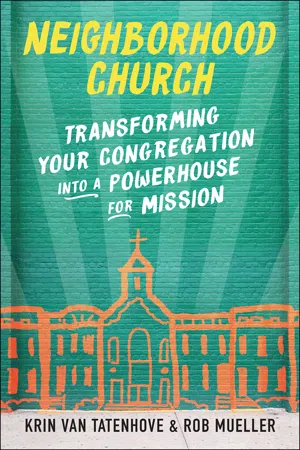
How can we embody the values of love, grace, and justice? As faith communities, how can our collective embodiment of these values shine even brighter? The answers to these questions must always unfold right here, right now, exactly where God has planted us. Neighborhood Churchacts as a resource to inspire churches to become a vibrant and engaging community partner with the families and neighborhoods living around them. The need for transformation is acute. Congregational decline continues across all mainline denominations. The abandonment of the church by the millennial generation is ubiquitous; no denomination is escaping it. This is, in part, a consequence of disconnection from our communities. Van Tatenhove and Mueller believe that, parish by parish, we can reverse this trend. They dare to have an audacious hope for local congregations not only as signs of Gods kingdom but as life-giving institutions that anchor their neighborhoods. Drawing on their combined sixty years of parish experience, wisdom from Asset-Based Community Development, and compelling case stories, Van Tatenhove and Mueller do more than just call us to incarnational ministry. They give practical, essential tools that lead to communal conversion, develop the DNA of listening, spur fruitful partnerships, promote integrated space, and sustain long-term visions. They believe these tools will spark true revival and unleash the power of incarnational ministry.
eBook - ePub
Neighborhood Church
Transforming Your Congregation into a Powerhouse for Mission
- English
- ePUB (mobile friendly)
- Available on iOS & Android
eBook - ePub
Neighborhood Church
Transforming Your Congregation into a Powerhouse for Mission
About this book
Information
Topic
Theology & ReligionSubtopic
Christian MinistryChapter 1
COMMUNAL CONVERSION
It is impossible to be truly converted to God without being converted to our neighbor.
—John R. W. Stott
Though it may be a dramatic demarcation line, conversion is never a onetime event. It is a perpetual process—a shedding of soul skins—as we grow into stronger, more flexible spirituality. When conversion means adopting a fundamental set of principles, and then wielding them defensively in our commerce with others, the results can be tragic. We have all seen this in practice. Social media thrives on contention, with true believers slinging opinions and invectives at each other over a myriad of issues. If we extricate our egos from the stream of debate, we see how much of it ends up dividing us rather than promoting unity.
Ongoing conversion is an antidote to this cancerous inflexibility. James Fowler, in his landmark work on stages of faith, talked about the critical evolution from Stage Three to Stage Four. He called it a movement from “Synthetic-Conventional Faith” to “Individuative-Reflective Faith.” It happens when we are willing to question the beliefs we inherited from our dominant culture or family. We awaken to healthy doubts about our cherished convictions. We begin to examine, without censorship, the worldviews of others. We question authority, and it can be a fearful and risky experience. As Fowler said, “When we are grasped by the vision of a center of value and power more luminous, more inclusive and more true than that to which we are devoted, we initially experience the new as the enemy or the slayer—that which destroys our ‘god.’ ”1
If we stay the course, we find the beauties inherent in Stages Five and Six. This is when we recognize the limits of logic and start to accept paradoxes. We begin to see life as a mystery. We often return to sacred stories and symbols, but this time without confinement to a theological or ideological box. We relish the diversity of myths and symbols in our world, gleaning what they teach us with an open mind. Not enough people reach this stage. Many who reach this stage find their deepest meaning in the service of others.
What is true for individuals is also true for our communities of faith. Our experience is that congregations can have “communal conversions.” This change is a turning, a revolving away from ourselves and toward the streets where God has planted us. Just as individuals learn to open their sealed mind-sets to the light of new truths, congregations can learn to embrace fundamental changes in perspective.
Two aspects of this transformation are essential: conversion from scarcity to abundance and conversion to our neighbors.
CONVERSION FROM SCARCITY TO ABUNDANCE
During times of stress and challenge, congregations often pull inside themselves like hermit crabs into a borrowed shell. This can be a reaction to internal conflict, radically changing neighborhoods, or fear about the fate of our denomination. This survival mentality flows from an outlook of scarcity. Old ways of doing ministry are no longer adequate, but there is no imagining of something different. Finances may be historically low, and no one proposes a scenario to turn things around. The same leaders cycle through petrified volunteer positions until they are bone-tired, without recognizing the gifts and potential of others.
A conversion from paucity to plenty must begin in the hearts and minds of each member. Rooted in the soil of gratitude for our faith and calling, it grows into new hope and vision.
What are the tools for this transformation? Take your pick! There are numerous books, small group studies, and meditations about the power of positive thinking. Often dismissed by the jaded or cynical, they nonetheless provide basic building blocks for fresh optimism. Central to this popular literature is a clear premise: gratitude for “what is” demands disciplined attention, a daily recounting of the many blessings our Creator showers on us.
How many of us sagaciously nod our heads as we hear Jesus say, “Do not worry! Which one of you by worrying can add a single hour to your life?” Then, in the fray of daily living, how often do we allow fear to cloud our lives? Many of us believe that nurturing an outlook of abundance is key to self-actualization, but when faced with daunting challenges, how often do we revert to notions of scarcity for ourselves, our families, our congregations?
Krin: As a recovering alcoholic, I believe that followers of Christ can learn a lot from the recovery community. Imbedded in our literature is the concept that gratitude is the lifeblood of a growing spirituality. Putting down our addictions, though essential, is just the first step. The hard work, the bulk of the work, has to do with changing our self-destructive personality traits and the thoughts that fueled them. My friends and I agree that ours is not primarily a drinking problem, but a thinking problem. As our literature says, “An honest regret for harms done, a genuine gratitude for blessings received, and a willingness to try for better things tomorrow will be the permanent assets we shall seek.”2 Addicts and alcoholics know that thankfulness is as necessary as air for our continued recovery. We call this “working our program,” and we know that daily discipline provides a reprieve from the “stinking thinking” we allowed to dominate our lives for so long.
It is not a stretch to say that the same is true for congregations desiring new vitality of mission. Their corporate self-conceptions, their theologies, their beliefs about their pasts and futures, all of these require a conversion from scarcity to abundance. We stand on the shoulders of giants who have embraced this process. Hebrew and Christian Scriptures brim with joyous optimism. Consider the witness of the Apostle Paul, whose ongoing conversion gave us words like these:
Finally, beloved, whatever is true, whatever is honorable, whatever is just, whatever is pure, whatever is pleasing, whatever is commendable, if there is any excellence and if there is anything worthy of praise, think about these things.
Philippians 4:8
I am confident of this, that the one who began a good work among you will bring it to completion.
Philippians 1:6a
For no matter how many promises God has made, they are “Yes” in Christ.
2 Corinthians 1:20a (NIV)
For such words and attitudes to become part of a congregation’s DNA, we need visible champions of positivity, vibrant encouragers whose enthusiasm functions like the yeast in Jesus’ parable, working its way through our community of faith.
This encourager can be you! To put it more bluntly, if you desire incarnational mission for your congregation—but are still held captive by limited thinking—you are part of the problem rather than the solution.
Krin: I remember Janet, an elder at a church I served on the edge of Los Angeles County. What an encourager! God had imbued her with indefatigable optimism and the spiritual gift of exhortation. Whenever any of us began to negatively focus on our deficiencies rather than our blessings, she would blurt out, “Crop failure!” Once you got beyond the seeming rudeness of her interruption—usually with a single glance at her winsome smile—her simple but profound message sank in: we reap what we sow!
That congregation was poor, situated in a lonely stretch of the high desert, but its dirt parking lot and faded chapel belied the vibrant conversion taking place at the heart of its membership. It was growing rapidly as a multigenerational, multiracial powerhouse of mission. This growth, like any, was sometimes uncomfortable, even painful, taxing available resources. It was tempting for some of us to lapse into a perspective of scarcity. At those key moments, Janet would inevitably remind us of crop failure!
I recall a particular challenge we faced. Our swelling educational program was outstripping available space in our facility. By then, a can-do attitude, fueled by cheerleaders like Janet, had become the norm. We bought used wooden sheds, refurbished them with the help of congregational carpenters, added window AC units, then lined the finished structures along a gravel pathway in the back. It wasn’t pretty, but it was functional.
I was standing there one Sunday morning with Janet, listening to the hum of voices engaged with each other and Scripture. She turned to me and said, “Now, that’s a harvest!”
In his popular book Five Practices of Fruitful Congregations, Robert Schnase talks extensively about the inner paradigm shift necessary for what he calls “extravagant generosity” to flow from a community of faith.
“Vibrant, fruitful, growing congregations practice extravagant generosity,” he says. “They thrive with the joy of abundance rather than starve with a fear of scarcity. They give joyously, generously, and consistently in ways that enrich the souls of members and strengthen the ministries of the church.”3
Congregations and their leaders who hope to convert from scarcity to abundance must be intentional in offering pathways to this new reality. First and foremost is a call for all church leaders to examine their own visions for ministry. This requires personal soul-searching and courageous receptivity to the feedback of others. We ask ourselves these penetrating questions. Am I modeling abundant optimism? Is my personal viewpoint a part of the joyful and contagious vision our leadership has adopted as its mission statement? If not, will I commit to the spiritual disciplines—including counseling and mentoring—that will help me grow?
The next step is to lead the congregation as a whole. We can offer worship experiences like those outlined in The Abundance of God by Rev. Erica Schemper, a minister in the Presbyterian Church (U.S.A.). With a theology focused on Creation’s goodness rather than “the Fall,” she leads us from Genesis to Revelation, showing how biblical narratives spill over with an abundance of beauty, grace, and hope. The consistent theme is that God has provided more than enough for our needs and the needs of our neighbors if we learn to share extravagantly.
“One of the strengths of this approach,” says Schemper, “is that it doesn’t . . . push us to a form of asceticism that is at odds with a Christian outlook that celebrates the goodness of the physical creation. Instead, it’s rooted in the idea that creation is good, God is gracious to the point of overflow, and we can work to ensure that everyone has what they need to thrive.”4
How critical is this conversion? Listen to these words by Walter Brueggemann from his essay “The Liturgy of Abundance, the Myth of Scarcity.” He decries what he calls the “demonic force” of consumerism that continues to reinforce fears of scarcity:
The conflict between the narratives of abundance and of scarcity is the defining problem confronting us at the turn of the millennium. The Gospel story of abundance asserts that we originated in the magnificent, inexplicable love of a God who loved the world into generous being. The baptismal service declares that each of us has been miraculously loved into existence by God. And the story of abundance says that our lives will end in God, and that this wellbeing cannot be taken from us. In the words of Saint Paul, neither life nor death nor angels nor principalities nor things—nothing can separate us from God. What we know about our beginnings and our endings, then, creates a different kind of present tense for us. We can live according to an ethic whereby we are not driven, controlled, anxious, frantic or greedy, precisely because we are sufficiently at home and at peace to care about others as we have been cared for.5
Reclaiming this recognition of abundance is also at the heart of asset-based community development. Its practitioners guide people through asset-mapping workshops. The purpose is to help them concentrate deeply on the resources already alive and present in individuals, their organization, and the wider community.
Suzy Yowell is director of the Growing Field, a nonprofit that focuses on building the capacity of historic sacred places. Their goal is to see churches, synagogues, and mosques better serve their communities as anchor institutions. They help these places restore their buildings and engage their neighborhoods in new and powerful ways.
Yowell embraces asset mapping wholeheartedly:
I believe it is the most valuable thinking tool a congregation can have. Identifying and mapping the strengths of your members, your building, and your community encourages and inspires your congregation. It empowers you to take action. It is too easy to get into the habit of thinking from a needs-based place when we are dealing with the everyday...
Table of contents
- Cover
- Half Title
- Title page
- Copyright
- Dedication
- Contents
- Introduction
- 1. Communal Conversion
- 2. The DNA of Listening
- 3. Transforming Partnership
- 4. Integrating Our Space
- 5. Sustaining the Vision
- Conclusion
- Appendix 1: Sample Asset-Mapping Workshop
- Appendix 2: Suggestions for Joint Use Agreements
- Appendix 3: Six Dimensions of a Partnership
- Appendix 4: Bibliography of Asset-Mapping Resources
- Notes
- Excerpt from Sailboat Church, by Joan S. Gray
Trusted by 375,005 students
Access to over 1.5 million titles for a fair monthly price.
Study more efficiently using our study tools.
Frequently asked questions
Yes, you can cancel anytime from the Subscription tab in your account settings on the Perlego website. Your subscription will stay active until the end of your current billing period. Learn how to cancel your subscription
No, books cannot be downloaded as external files, such as PDFs, for use outside of Perlego. However, you can download books within the Perlego app for offline reading on mobile or tablet. Learn how to download books offline
Perlego offers two plans: Essential and Complete
- Essential is ideal for learners and professionals who enjoy exploring a wide range of subjects. Access the Essential Library with 800,000+ trusted titles and best-sellers across business, personal growth, and the humanities. Includes unlimited reading time and Standard Read Aloud voice.
- Complete: Perfect for advanced learners and researchers needing full, unrestricted access. Unlock 1.5M+ books across hundreds of subjects, including academic and specialized titles. The Complete Plan also includes advanced features like Premium Read Aloud and Research Assistant.
We are an online textbook subscription service, where you can get access to an entire online library for less than the price of a single book per month. With over 1.5 million books across 990+ topics, we’ve got you covered! Learn about our mission
Look out for the read-aloud symbol on your next book to see if you can listen to it. The read-aloud tool reads text aloud for you, highlighting the text as it is being read. You can pause it, speed it up and slow it down. Learn more about Read Aloud
Yes! You can use the Perlego app on both iOS and Android devices to read anytime, anywhere — even offline. Perfect for commutes or when you’re on the go.
Please note we cannot support devices running on iOS 13 and Android 7 or earlier. Learn more about using the app
Please note we cannot support devices running on iOS 13 and Android 7 or earlier. Learn more about using the app
Yes, you can access Neighborhood Church by Krin Van Tatenhove,Rob Mueller in PDF and/or ePUB format, as well as other popular books in Theology & Religion & Christian Ministry. We have over 1.5 million books available in our catalogue for you to explore.