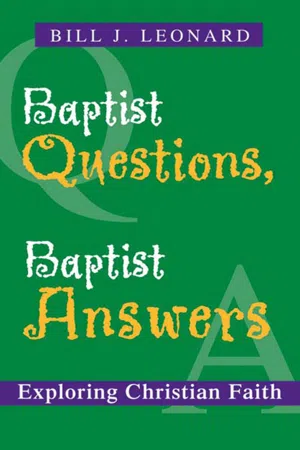
Respected Baptist historian and theologian Bill Leonard takes readers through the theological and practical questions that are important to Baptists. In a clear style and with great sensitivity to the varieties of beliefs among Baptist bodies, Leonard considers the big questions of faith. These include Baptist beliefs about God, Jesus Christ, the Bible, salvation, and the Christian life, among others. Drawing on historic statements of Baptist belief, contemporary history, and his own background and deep scholarship, Leonard provides reliable and accessible discussions of these issues. His work will be highly illuminating for Baptists of all denominational groupings as well as for others interested in the core of Baptist theological convictions and their various expressions. Leonard's is a strong and trusted voice, and this book will be a welcome resource.
- English
- ePUB (mobile friendly)
- Available on iOS & Android
eBook - ePub
About this book
Information
Topic
Theology & ReligionSubtopic
Christian Denominations1
Baptist History and Heritage

Theories of Baptist origins abound. Some believe that Baptists can be traced all the way back to Jesus’ baptism in River Jordan by John the Baptizer, a direct lineage of true New Testament churches. Others suggest a “kinship” with the Radical Reformation Anabaptists who promoted believers’ baptism and a free church tradition in the early days of the Protestant Reformation. Still others, I am among them, trace the origins to the seventeenth-century Puritans and their efforts to recover New Testament Christianity beyond the state churches and sectarian clamor of post-Reformation Europe.
So let us suggest that Baptists are a second-generation Protestant communion that began around 1609 with a group of English Separatist Puritans exiled in Amsterdam. This group determined that the church should be composed of believers only and that baptism should be given only after persons profess faith in Christ. The earliest Baptists were Arminian in their theology, appropriating the theology of the Dutch theologian Jacob Arminius (1560–1609). Their belief that Christ’s death on the cross was for the sins of the entire world and that all persons were potentially elected to salvation led to their designation as General Baptists. By the 1630s a second group of Baptists had developed in England. Known as Particular Baptists because of their Calvinist theology, they believed that Christ’s death was applicable only to the elect, whom God had chosen for salvation before the foundation of the world. God’s irresistible grace would draw the elect to salvation, overcoming their total depravity and keeping them until the end. Thus, from a historical perspective, Baptists begin at both ends of the theological spectrum with Arminian and Calvinist groups that inform much Baptist life and thought to this day.
In the twenty-first century Baptists claim a worldwide constituency of over forty million persons, with approximately thirty million living in North America. In the United States there are more than sixty different groups that claim the name Baptist in some form or another.
Baptists share many beliefs, even when they define those common doctrines a bit differently. These classic “Baptist distinctives” include the following:
- Biblical authority is normative for faith and practice.
- The church is a community of believers who can testify to an experience of grace through faith in Christ.
- Baptism is administered to those who testify to faith and is by immersion.
- Baptism and the Lord’s Supper are the two “ordinances” (some early Baptists said “sacraments”) of the church. (Some Baptists add footwashing to that list.)
- The authority of Christ is mediated through the congregation of believers. Each congregation has the autonomy to determine its ministry and method.
- Congregations may join together in “associations” of churches for mutual ministry and fellowship.
- The priesthood of all believers means that all baptized believers are “called” to minister to others in the world. Both laity and clergy are called to minister in the church and the world.
- Certain persons are “set aside” for the ministry of the Word and pastoral service in the church.
- Religious liberty should be normative in the state.
- Liberty of conscience means that believers can be trusted to interpret Scripture aright in the context of community under the guidance of the Holy Spirit.
This is not to suggest that all Baptists agree on what these ideas mean biblically and theologically. Rather, they represent certain distinguishing marks of identity that are applied variously by Baptist groups and individuals.
The Baptist family in the United States is vast and diverse. The following are but a few of the groups that claim the Baptist name in some form or another. They occupy various theological and historical positions and are located in various regions and cultures across the country.
1. American Baptist Churches in the U.S.A. (ABC USA): Numbering about one million members this group dates its beginnings with the founding of the General Convention of the Baptist Denomination for Foreign Missions in 1814. Spread throughout the United States, with particular strength in the Midwest and West, the ABC was earlier known as the Northern Baptist Convention and the American Baptist Convention.
2. Southern Baptist Convention (SBC): Founded in 1845 in a dispute over slavery between Baptists in the North and South, the SBC is the largest Baptist (and Protestant) denomination in the United States with some sixteen million members. Conservative in theology, its primary strength remains in the South and Southwest.
3. African American Baptists: Major African American Baptist denominations include the National Baptist Convention of the U.S.A., Inc.; the National Baptist Convention of America, Unincorporated; the Progressive National Baptist Convention; and the National Missionary Baptist Convention. African Americans came into the Baptist tradition during slavery under the influence of revivals and camp meetings in the South and Southwest. Debates over such things as denominational ownership of property, improvement of working conditions, and the authority of denominational leaders led to various divisions among black Baptist groups in the United States.
4. Appalachian Baptists: These include several Baptist groups, most of which are Calvinist in one form or another. They are identified with names such as the Primitive, Old Regular, United, and Union Baptists. One small but fascinating faith community is known as the Primitive Baptist Universalists, popularly but mistakenly called the “No Hellers” because they believe that ultimately all persons will be saved. Appalachian Baptists came into the mountains during the eighteenth and ninteteenth centuries, tend toward various types of Calvinism, and give little or no attention to direct missionary efforts, Sunday schools, or a paid ministry. Their numbers are generally in decline, but their sense of witness to New Testament orthodoxy is as strong as ever.
5. Landmark Baptists: “Old Landmarkists” insist that Baptists began with Jesus’ baptism by John the Baptist and can trace their lineage through multiple Baptist groups in church history. These dissenting communions—Montanists, Donatists, Cathari, Waldensians, Anabaptists, and Baptists—were “Baptist in everything but name,” offering a succession of Baptist churches all the way from the New Testament to the present. Landmark groups include the Baptist Missionary Association, the American Baptist Association, and various fundamentalist-related Baptist groups. Generally fundamentalist in their theology, Landmark Baptists are strong in the South and Southwest, especially in Oklahoma, Arkansas, and Texas.
6. Fundamentalist Baptists: Many Baptists hold fundamentalist beliefs regarding biblical inerrancy, Christ’s virgin birth, as well as his bodily resurrection and second coming. Most of these groups are suspicious of denominational alignments and prefer to associate in “fellowships” of pastors. Adherents to these Baptist communions number several million, and several ministerial “fellowships” include the Southwide Baptist Fellowship, the World Fundamentalist Association, and the Bible Baptist Fellowship.
7. Conservative Baptist Association of America: This group broke away from the American Baptist Convention in the 1940s over issues related to fundamentalism and liberalism. The denomination maintains various collective ministries, including certain missionary-sending organizations, and two theological seminaries.
8. Ethnic Baptists: Immigrant Baptist groups formed early in America. These include the Baptist General Conference formed in 1852 by Swedish immigrants, the North American Baptist Conference formed by German Baptists in 1843, and the Norwegian Baptist Conference founded in 1910 (and disbanded in 1954).
9. Recent Baptist Groups: The Alliance of Baptists, founded in 1986, and the Cooperative Baptist Fellowship, formed in 1991, are two Baptist groups formed by churches and individuals who left the Southern Baptist Convention as a result of disputes over biblical inerrancy and denominational control. They represent a more “moderate” coalitions of Baptists who moved away from the increasing fundamentalist orientation of the Southern Baptist Convention.
10. Reformed Baptists: Represented in various subgroups, Reformed Baptists have developed renewed energy in many churches through a resurgence of classic Calvinism. They represent an effort to reassert Calvinist doctrine and practice in Baptist churches new and old.
“Baptists multiply by dividing,” the old saying goes. Truth is, Baptist polity combines with theological diversity to create the possibility, if not the probability, for carrying out the gospel in a variety of Baptist-related ways. Baptist groups were formed as a result of historic causes (missions or antimissions), schism over doctrinal and social issues (slavery or fundamentalism/liberalism), ethnic and regional identity (German, Norwegian, African American, Hispanic, or Landmark), and internal disputes (denominational control, ministerial authority, congregational autonomy). Baptist differences over Calvinism and Arminianism mean that there are multiple approaches to understanding the nature of faith and salvation. Congregational church government means that Baptist churches may be started by a local group of believers without asking permission from any other governing body, whether bishops, presbyteries, synods, or conferences. Churches can be connected to larger Baptist denominations or associations or stand alone.
Baptists have no single, prominent historical founders such as Martin Luther, John Calvin, or John Wesley. Some of their early leaders died in prison or in exile while others only remained Baptists for a short period of time. Such was the case with John Smyth and Thomas Helwys, the two prominent founders of the first Baptist church in Amsterdam in 1609. Smyth (d. 1612) was educated at Cambridge and ordained an Anglican priest. Moving through Puritan Separatism he claimed Baptist views on the nature of a believers’ church and baptized the first group of Baptists. Shortly thereafter he left the Baptists for the Mennonites. Thomas Helwys (c. 1550–c. 1615) was trained in the law, helped underwrite the English exiles in Amsterdam, and brought them back to England. His work A Short Declaration of the Mystery of Iniquity (1612) was one of the first calls for complete religious liberty written in English. He died in prison.
Puritan preacher/theologian Roger Williams (1603–1683) and physician Dr. John Clarke (1609–1676) were instrumental in founding the first Baptist churches in America, one at Providence and the other at Newport, Rhode Island. Williams, the quintessential dissenter, introduced significant issues of religious liberty into Baptist life but only remained a Baptist for a short time. Clarke spent much of his life working to secure the charter for the Rhode Island colony with freedom of religion as its centerpiece. Isaac Backus (1724–1806) was a New England Baptist pastor who lobbied for religious liberty at the first Continental Congress.
William Carey (1761–1834) was one of the leaders in the modern global mission movement. Carey insisted that it was the “duty” of Baptists to take the gospel to the “heathen”; he set out for India in 1793 and spent his life teaching, preaching, and translating the Scripture into indigenous Indian languages. Adoniram Judson (1788–1850) and his spouse, Ann Hasseltine Judson (1789–1826), were the first American Baptist missionaries. Sent out as the Congregational missionaries to India, they accepted Baptist views on shipboard and requested funding for a new Baptist endeavor in Burma. Their request led to the founding of the General Missionary Convention of the Baptist Denomination in the United States in 1814, the first national mission society founded by U.S. Baptists. Both Judsons became models for missionary service among Protestants in general and Baptists in particular.
George Leile (c. 1750–1800) was another former slave who helped to found the Silver Bluff Baptist Church, probably the first African American Baptist Church in North America, sometime in the 1770s. He became the first Baptist missionary to Jamaica. Lott Carey (1780–1829) was a former slave who was the first African American Baptist sent as a missionary to West Africa. He organized churches and was even named interim governor of Liberia.
Henrietta Hall Shuck (1817–1844) joined her husband, J. Lewis Shuck (1814–1863), in traveling to China in 1834 as missionaries sent by the American Baptist Foreign Mission Society. She founded a girls’ school and wrote extensively about missionary work in China. Mary Webb (1779–1861) was born in Boston, where she experienced a childhood illness that left her with severe physical disabilities. A member of Second Baptist Church, she led in founding the Boston Female Society for Missionary Purposes, the first women’s mission organization in the United States. It united Baptist and Congregationalist women in raising funds for mission activities at home and abroad. Charlotte (Lottie) Moon (1840–1912) was one of the first single women sent to China by the Foreign Mission Board of the Southern Baptist Convention. She taught extensively in remote areas of China, insisting that women should be given more freedom to evangelize and have greater authority to do their own work.
In the twentieth and twenty-first centuries, the diversity of the Baptists is no more clearly illustrated than in the political and religious leaders who identified themselves as Baptists. These include civil rights leaders such as Reverends Martin Luther King Jr., Fred Shuttlesworth (Birmingham, Alabama), Gardner Taylor (Concord Baptist Church, New York), and J...
Table of contents
- Cover
- Title Page
- Copyright Page
- Dedecation Page
- Contents
- Welcome to the Book
- Chapter 1: Baptist History and Heritage
- Chapter 2: God
- Chapter 3: Jesus Christ
- Chapter 4: Holy Spirit
- Chapter 5: Humanity
- Chapter 6: Salvation
- Chapter 7: Church
- Chapter 8: Worship and Sacraments/Ordinances
- Chapter 9: Bible
- Chapter 10: Theology
- Chapter 11: Church and State
- Chapter 12: Christian Life
- Chapter 13: Reign of God
- Chapter 14: Polity
- For Further Reading
Trusted by 375,005 students
Access to over 1.5 million titles for a fair monthly price.
Study more efficiently using our study tools.
Frequently asked questions
Yes, you can cancel anytime from the Subscription tab in your account settings on the Perlego website. Your subscription will stay active until the end of your current billing period. Learn how to cancel your subscription
No, books cannot be downloaded as external files, such as PDFs, for use outside of Perlego. However, you can download books within the Perlego app for offline reading on mobile or tablet. Learn how to download books offline
Perlego offers two plans: Essential and Complete
- Essential is ideal for learners and professionals who enjoy exploring a wide range of subjects. Access the Essential Library with 800,000+ trusted titles and best-sellers across business, personal growth, and the humanities. Includes unlimited reading time and Standard Read Aloud voice.
- Complete: Perfect for advanced learners and researchers needing full, unrestricted access. Unlock 1.5M+ books across hundreds of subjects, including academic and specialized titles. The Complete Plan also includes advanced features like Premium Read Aloud and Research Assistant.
We are an online textbook subscription service, where you can get access to an entire online library for less than the price of a single book per month. With over 1.5 million books across 990+ topics, we’ve got you covered! Learn about our mission
Look out for the read-aloud symbol on your next book to see if you can listen to it. The read-aloud tool reads text aloud for you, highlighting the text as it is being read. You can pause it, speed it up and slow it down. Learn more about Read Aloud
Yes! You can use the Perlego app on both iOS and Android devices to read anytime, anywhere — even offline. Perfect for commutes or when you’re on the go.
Please note we cannot support devices running on iOS 13 and Android 7 or earlier. Learn more about using the app
Please note we cannot support devices running on iOS 13 and Android 7 or earlier. Learn more about using the app
Yes, you can access Baptist Questions, Baptist Answers by Bill J. Leonard in PDF and/or ePUB format, as well as other popular books in Theology & Religion & Christian Denominations. We have over 1.5 million books available in our catalogue for you to explore.