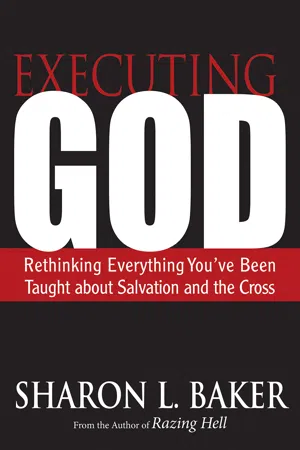
Why did God have to murder his only son to pay our debts? What kind of vengeful, violent God can only be satisfied by vicarious blood atonement? In Executing God, theologian Sharon Baker presents a biblically based and theologically sound critique of popular theories of the atonement. Concerned about the number of acts of violence performed in the name of God, Baker challenges cultural assumptions about the death of Jesus and its meaning to Christians. She ultimately offers a constructive alternate view of atonement based on God's forgiveness that opens up salvation to a wider group of people.
eBook - ePub
Executing God
Rethinking Everything You've Been Taught about Salvation and the Cross
- 208 pages
- English
- ePUB (mobile friendly)
- Available on iOS & Android
eBook - ePub
About this book
Information
Topic
Teología y religiónSubtopic
Teología cristiana1
God Gone Bad?
Religion Gone Bad?
Religion Gone Bad?
I give you a new commandment, that you love one another. Just as I have loved you, you also should love one another. By this everyone will know that you are my disciples, if you have love for one another.
—John 13:34–35
I like your Christ. I don’t like your Christians. They are so unlike your Christ.
—Gandhi
When religion is in the hands of mere natural man, he is always the worse for it; it adds a bad heat to his own dark fire and helps to inflame his four elements of selfishness, envy, pride, and wrath. And hence it is that worse passions, or a worse degree of them are to be found in persons of great religious zeal than in others that made no pretenses to it.
—William Law, “Christian Regeneration”
As he hung in midair, arms outstretched, feet pointing down toward the fiery abyss, Reverend Frank Scott, a passenger on the SS Poseidon, shouted out to God these words of desperation and anger: “What more do you want from us? We’ve come all this way no thanks to you! We did it on our own; no help from you. We didn’t ask you to fight for us, but damn it, don’t fight against us. Leave us alone!” That he even bothered to talk to God at all was quite surprising, given he had quit believing that God intervened in the world but instead simply left human beings alone to struggle through life and the blows it dealt. After leading a few disciples on a long, arduous, and deadly journey through the bowels of the capsized ship, Reverend Scott found himself staring at the locked door that marked their only way of escape. With death behind him, flames beneath him, and apparently no salvation ahead of him, he ironically—or perhaps not so ironically—reverted to a more traditional way of thinking about God.
For Scott, the only way to gain God’s favor, the only way to motivate God to move on his behalf, was through violence; God needed another bloody sacrifice. So many had already suffered brutal deaths in the twisted steel wreckage. Knowing he had little time to act, Scott had jumped through the flames and grabbed the wheel. Suspended in the air, slowly, painstakingly he edged his hands one by one around the wheel, turning it a few inches at a time. After what seemed like an eternity, the hatch opened so the few survivors could finally reach the bottom of the upside down ship and escape. He had helped to liberate his fellow passengers from the ship’s iron clad prison, but he knew he would never reach that hatch himself. In anguish, Reverend Scott cried out his last words to God: “How many more sacrifices?! How much more blood?! How many more lives?! You need another life?! Take mine!” And he let go of the wheel and fell to his death.1
We may scoff at Reverend Scott’s theology, but the fact remains that many Christians believe God required just such a sacrifice in order to save humanity from devil’s dominion of darkness in the fiery abyss of hell. We believe that God required Jesus to hang on the cross, suspended in midair, and die a sacrificial, violent death so we could escape the divine consequence: imprisonment in a place of eternal violence. In other words, we believe in a violent God of love.
We also believe that God doesn’t blink a divine eye at violence that we consider just. In fact, Christians use God’s violence to promote their own agendas. For instance, read about the psalmist who voices the community’s prayer for vengeance, asking God to get back at the enemy by dashing their babies heads against the rocks (Ps. 137:9). In more recent times, we saw the violent God image invoked by Baptist pastor Wiley Drake, the former second vice president of the Southern Baptist Convention. A few months after Obama was sworn into office in 2009, Drake exhorted Christians to pray according to the imprecatory Psalms and ask God to kill the President.2 Fortunately, God didn’t answer that prayer.
Some Christians find that belief in a tough, retributive, violent God undergirds and strengthens their faith, even though most would never explicitly express God in those words. Take Mark Driscoll, pastor of Mars Hill Baptist Church in Seattle, Washington, for example: In trying to prove that Christianity is not a sissy religion, he asked a few men to come up on stage and hit him. They refused. Not to be daunted, Driscoll hit himself a couple times and then said that in the book of Revelation, the Bible reveals a Jesus “with a tattoo down His leg, a sword in His hand and the commitment to make someone bleed.” He continued with confidence, saying, “That is a guy I can worship. I cannot worship the hippie, diaper, halo Christ because I cannot worship a guy I can beat up.”3 So not only do we need a tough, kick-ass God, we need a Rambo Jesus, too. It’s these violent images of God that lead to all sorts of violence on the part of Christians. Christianity is a killer of a religious tradition, as history will attest.
If we could read the headlines of history we might see something like the following: “God Says, ‘Christians Kill Thine Enemies!’” And we did. Three million men, women, and children massacred during the two hundred years of terror due to the Crusades (1095–1291). Another one million Christians killed by other Christians in the Albigensian Crusade of the thirteenth century (1208–1229). Seven and a half million more died as Protestants and Catholics killed each other in the Thirty Years War (1618–1648). An additional three million people died in the religious wars between Protestants and Catholics in France from 1562 to 1598. And up to sixty thousand innocent people accused as witches were executed in Europe from 1400 to 1800. Add to those numbers three-hundred thousand to five-hundred thousand people killed in Cromwell’s invasion of Ireland (1649–1653). Two-hundred thousand people were killed in Bosnia from 1992 through 1995, and fifteen million indigenous peoples were killed in the conquest of the Americas. And these are just the people killed by Christians over the centuries, not counting that fact that some historians add to the list the six million Jews and their supporters murdered during World War II.4
Christianity kills. When it runs off the rails, when it becomes an ideology, it’s a dangerous enterprise. Christians have a long history of doing violence against minorities, the poor, women, those who think differently, and the earth itself. If we look at our history, we people of faith have put society and the world at large in grave danger. Although Christianity is held up as the religious tradition that most especially preaches and teaches love and peace, its followers often practice hate and war. Well-known scientist and atheist Richard Dawkins argues that religion is dangerous “because it gives people unshakable confidence in their own righteousness. Dangerous because it gives them false courage to kill themselves, which automatically removes normal barriers to killing others. Dangerous because it teaches enmity to others [who are] labeled only by a difference of inherited tradition.”5 No matter what we might think of Dawkins and his tirade against religion, we have to admit, at least to ourselves, that a quick glimpse of our own Christian history seems to prove him right.
The violent rhetoric and subsequent violent practices of Christianity in the prosperous West are so entirely woven into the fabric of our societies that we consider them normal. When I speak to students in class about the problems associated with Christianity’s violent history and the violence intrinsic to some of our dearly held doctrines, they don’t understand what I’m talking about. For instance, I point out to them the violence of God built into traditional theories of hell and the atonement, and they fight back with one-liners they’ve heard from the lips of a pastor or a Sunday school teacher that justify God’s violent behavior. They respond with surprise and bit of defensiveness when they realize that there’s more than one way to interpret Bible passages that speak of eternal punishment, the meaning of the cross, and the stories of God’s violence in the Old Testament. I appreciate the students, like Josh, who ask, “What’s wrong with a violent God? God can do whatever God wants to do, right?” Right. But after we do the hermeneutical dance to justify God’s violence, we take it one step further: we justify our violence. In this chapter we will see a connection between violent Christian behavior and the image of God communicated through traditional doctrines of atonement. And I hope we’ll realize the importance of casting another light on these doctrines and reinterpret the behavior of God implicit in them so that we can transform the way we ourselves act in the world.
Atonement: Reconciliation between God and humans. First used in the early 1550s as “at-one-ment”—to be “at one” with God or others. Atonement came to be known as the means by which humans are brought into an intimate relationship with God.
JUSTIFYING VIOLENCE
“Strike in the name of the cross!” cries one impassioned Anglo-Norman poet geared up for battle in the twelfth century.6 But calling the masses to arms in the name of Christ or the cross or God was something the people heard quite often in those turbulent centuries. And it seems to have worked. Thousands of men, women, and children rushed to take up their own crosses and kill or be killed for the glory of God, the forgiveness of sin, the defeat of Christ’s enemies, and the furtherance of God’s kingdom.7
When I mention the various instances of Christian violence inflicted upon innocent people, invariably one of my students asks, “Wait! Are you saying that people actually fought and killed others and used Jesus and the cross to justify their actions? Doesn’t Jesus tell us to love our enemies? If so, why is Christianity so violent?” An important question.
Granted, much of Christian history can boast of feats of bravery, courage, and love in the face of adversity and crises. The church has cared for the poor and the oppressed through ministries on the local, national, and international levels. But the church has also participated in so much violence throughout the ages that we might want to start asking ourselves why. Why does a religious tradition, obviously founded on the commandments to love God and to love others, including our enemies, engage in such violence against the very others Jesus commands us to love? What arouses such atrocities? And what’s the cross got to do with it? Let’s see if we can unearth some answers.
VIOLENCE IS …
First, we need to think about what constitutes violence. How do we define violence? For the purpose of this book we’ll define violence as that which does harm through the misuse of power, hostile forms of aggression, brutality, and the use of force whether or not the victim offers resistance. We’ll talk about violence as the antithesis of justice. It insults human dignity and rapes God’s good creation.8 The violence we’ll focus on takes various forms, including physical, emotional, and psychological abuse. Think about the various “isms”—terrorism, sexism, racism, militarism, colonialism, classism—as forms of violence that haunt our Christian past and stain our Christian present. As dysfunctional and distant from most of us as all these “isms” seem, the blood of their victims cries out from the ground; the tears of their poor would fill the coffers of the wealthy; the screams of their defenseless children reverberate throughout our neighborhoods; and the pained lament of abused women, blacks, gays, Jews, Muslims, and overpowered, underrepresented people everywhere echoes throughout the world in newspapers, on TV, in hospital hallways, in unemployment lines, sometimes in silence, darkness, often alone, usually without hope.
Now I know we can’t blame all of the world’s violence on Christians or Christendom or religion in general. And most Christians throughout the centuries were and are peace-loving and compassionate toward others. The majority of the clergy through the ages didn’t sanction the crusades and the inquisitions, the genocides, and the political oppressions. And church theologians like Augustine (drawing upon Cicero), for example, worked toward constructing what we now call the “just war theory” in order to alleviate some of the fighting. Though, throughout the centuries, what various rulers and some clerics considered “just” is usually considered unjust, cruel, and barbaric today.
That said, however, we have certainly tangled ourselves up in much more than our fair share of violence. And that’s what I’m concerned about—the violence that we as Christians initiate, engage in, condone (even if by our silence), support, or encourage. If even one person suffers at the hands of Christians, then the rest of us have a responsibility to speak out against it and to rethink the theology that works to justify it. Untold numbers of innocent people have suffered untold forms of violence because Christians (albeit a minority in numbers) have used their theology to rationalize it and it’s time we rethought that theology in order to eliminate, or at least minimize, future suffering. That’s what I am doing in this book—rethinking, reinterpreting the theories surrounding one of most important doctrines of the faith in order to minimize the future violence these theories may continue to generate. So, in this chapter we’ll meander back and forth through the centuries of Christian history and try to pinpoint a catalyst for some of the violence that far too many believers have been able to rationalize.
As I mentioned earlier, there are different kinds of violence, each expressed by inflicting physical, emotional, or psychological harm and pain upon others or ourselves. As we look at Christian history, we can see at least three ways that violence has manifested itself in the lives and believers and their victims: the violence of war; the violence inflicted in order to increase piety; and the violence of abuse, induced in order to convert, punish, or to interrogate. So we’ll cover these three forms of violence, but first, let’s answer our question about why Christians can so easily justify violence.
VIOLENCE AND THE BIBLE
To be fair, much of the violence we see committed by Christians springs from good intentions. Devout believers throughout history thought they were defending God’s kingdom on earth. Of course, that fact doesn’t make them right or excuse their behavior. But most of those who killed, tortured, or tormented others did so because they thought God willed it—and they found support for that idea in Scripture and in the church’s doctrines.
Some of us have read the Bible so much and for so long and have heard it preached and taught over and over again for years in church that we think nothing of it when we come to passages that describe God doing or commanding violence. Yet, we see God as an executioner who kills Uzzah because he reached out to stop the ark from falling on the ground! He dies for an act of goodwill (2 Sam. 6:3–11). God plays the role of a mass murderer, wiping out thousands of innocent people because David took a census and counted heads—a census that in 2 Samuel 24:1–16, God incited him to take. God goes genocidal in 1 Samuel 15 and commands Saul to massacre all the Amalekites, including the women and children and animals.9 Nowadays people agonize over the genocides in Rwanda, Bosnia, and Darfur. We criticize people like the late Saddam Hussein or the drug lords in Colombia for killing indiscriminately. Yet we don’t question God about the unjust violence executed against the innocent masses in the Bible. In fact, not only do we not criticize or question, we strive to imitate God by doing violence ourselves and calling it God’s will.
The violence doesn’t stop with the Old Testament. The inaugural event of the Christian faith, our founding story, is the violent death of Jesus on the cross—a death that we typically believe God required, orchestrated, and approved. And we believe that this horrific death justly satisfied God and somehow redeemed us. As we’ll see later in this chapter, justifying God’s violence in the passion event som...
Table of contents
- Cover
- Half-title Page
- Title Page
- Copyright
- Dedication Page
- Contents
- Acknowledgments
- Introduction
- 1. God Gone Bad? Religion Gone Bad?
- 2. Truth in Metaphor
- 3. Traditional Doctrines—the Good, the Bad, and the Ugly
- 4. The Problem of God in the Atonement
- 5. What Is Justice?
- 6. An Economy of Forgiveness
- 7. The Costly Sacrifice: Nothing but the Blood
- 8. Re-Tuning At-one-ment
- 9. An Alternative View
- Afterword
- Notes
- Index
Trusted by 375,005 students
Access to over 1.5 million titles for a fair monthly price.
Study more efficiently using our study tools.
Frequently asked questions
Yes, you can cancel anytime from the Subscription tab in your account settings on the Perlego website. Your subscription will stay active until the end of your current billing period. Learn how to cancel your subscription
No, books cannot be downloaded as external files, such as PDFs, for use outside of Perlego. However, you can download books within the Perlego app for offline reading on mobile or tablet. Learn how to download books offline
Perlego offers two plans: Essential and Complete
- Essential is ideal for learners and professionals who enjoy exploring a wide range of subjects. Access the Essential Library with 800,000+ trusted titles and best-sellers across business, personal growth, and the humanities. Includes unlimited reading time and Standard Read Aloud voice.
- Complete: Perfect for advanced learners and researchers needing full, unrestricted access. Unlock 1.5M+ books across hundreds of subjects, including academic and specialized titles. The Complete Plan also includes advanced features like Premium Read Aloud and Research Assistant.
We are an online textbook subscription service, where you can get access to an entire online library for less than the price of a single book per month. With over 1.5 million books across 990+ topics, we’ve got you covered! Learn about our mission
Look out for the read-aloud symbol on your next book to see if you can listen to it. The read-aloud tool reads text aloud for you, highlighting the text as it is being read. You can pause it, speed it up and slow it down. Learn more about Read Aloud
Yes! You can use the Perlego app on both iOS and Android devices to read anytime, anywhere — even offline. Perfect for commutes or when you’re on the go.
Please note we cannot support devices running on iOS 13 and Android 7 or earlier. Learn more about using the app
Please note we cannot support devices running on iOS 13 and Android 7 or earlier. Learn more about using the app
Yes, you can access Executing God by Sharon L. Baker in PDF and/or ePUB format, as well as other popular books in Teología y religión & Teología cristiana. We have over 1.5 million books available in our catalogue for you to explore.