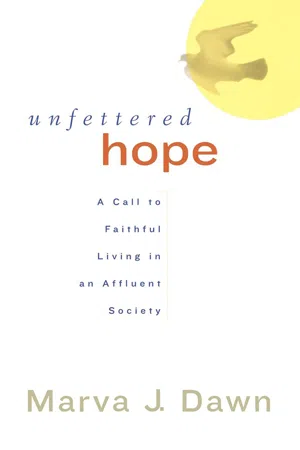
In this prophetic call to faithful Christian living, Marva Dawn identifies the epidemic socio-cultural attitudes that destroy hope in our modern lives. Because affluent persons don't know what to value--how to choose what's important and weed out the rest--we remain dissatisfied with what we have and are compelled to want more. Dawn demonstrates, however, how Christians can organize their lives to live in ways that allow them to love God and neighbor and, in the process, alleviate the despair in their lives and in the lives of others in the world.
- English
- ePUB (mobile friendly)
- Available on iOS & Android
eBook - ePub
About this book
Information
Topic
Theology & ReligionSubtopic
Christian MinistryChapter 1
Why Are Our Hopes So Fettered?
As the Introduction noted, the wealthy and the poor of our world experience two opposing categories of fetterings. This chapter’s multi-media collage will ask various questions to help us all ponder in what kinds of bondages our society and we ourselves are entrapped. (As I will explain in chapter 3, I have intentionally reserved discussion about our churches until later chapters.) Here I have purposely used a wide variety of sources and made the sketches relatively brief so that each section can be a starting point for your own deeper thinking. I pray that recognizing the depth of our enslavement will propel us all to renewed efforts to make appropriate choices for our own good and the good of others in the world.
Why Does the Technological Milieu Make Us Feel Overloaded and Overwhelmed?
Fifty years ago French sociologist/theologian Jacques Ellul warned that technology, in spite of its many lauded gifts, also presented great dangers.1 Its most important threat was its development into the totality of an unremittingly encompassing milieu. He realized that human beings would become immersed in, and completely subjected to, an omnipotence made possible by the intertwining of technology, money, politics, and other forces.2 He protested that it would be vanity to pretend that this monolithic technical world could be checked or guided, for people would discover that they were too enclosed within their artificial creation to find an exit (428). (We will see later that we do have possibilities for exits, but that we must attend to them with extreme care.)
This situation of an overbearing environment would be new in the history of humankind. Ellul called it a “profound mutation” (431) because technology and its paradigm would become the defining force of civilization. Prior to the 18th century, technology was applied only in certain narrow, limited areas (64), such as the production of clothing or goods for homes.
There was also a limitation of technical means, which was compensated for by the skill of the worker. Efforts had historically been made to improve the use of a tool, not the tool itself, so that results varied according to the skill of the workers, but Ellul realized that in the modern technological world the goal would be to eliminate this variability (67). We can immediately recognize this danger that lies in improving gadgets rather than persons’ skills: if our work does not require skill from us, it is not as satisfying. That, in turn, contributes to the increasing move to “entertainments” and consumption for our moments of enjoyment.
Two other dangers highlighted by Ellul were (1) that the primary criterion in a technological milieu is efficiency and (2) that the proliferation of means would bring about the disappearance of ends (80). Perhaps all of us in wealthier nations in the 21st century struggle with the pace of our societies and with this loss of ends because of too many means. We have so many things to do, we forget why we are doing them; we have so many things, we forget why they matter.
William Kuhns, an early commentator on technology, lauded Ellul’s comprehensive analysis of modern technology and his pioneering perception that it would become a distinct and unique centralizing force, with repercussions on every aspect of life. He especially commended Ellul for being the first to discern that technology would control values rather than be controlled by them.3 This is critical for our purposes in this book because, as chapter 2 will disclose, the problem is not technology and consumerism themselves, but the way their connection reverberates in our thinking about other aspects of life.
Ellul later identified three disturbing aspects of the connection between technology and consumerism that have become my primary concerns:
a. The technical world is one of material things ... [but] spiritual values cannot evolve as a function of material improvement.
b. Technical growth leads to a growth of power ... [but] when power becomes absolute, values disappear. . . . Power eliminates, in proportion to its growth, the boundary between good and evil, between the just and the unjust.
c. ... Technique [by which term Ellul signifies the conglomerate correlation of technology with capitalism, media, politics, the military-industrial complex, Mammon, and so forth] can never engender freedom.... The problem is deeper—the operation of Technique is the contrary of freedom, an operation of determinism and necessity.4
Ellul also thoroughly warned against the technological milieu’s attributes of totalitarianism, rationality, artificiality, automatism of choice, self-augmentation, monism, universalism, autonomy, efficiency, and necessity.
Because of these cautions and Ellul’s expansion and intensification of them in The Technological System and The Technological Bluff,5 he is often thought to be overly pessimistic about the technological milieu. However, Ellul cannot be rightly understood unless we know that he deliberately wrote in two very separate tracks. In his theological works he offered hope and practical suggestions for Christian life in the midst of the technological milieu, but he kept those works distinct from his sociological writings, in which he painted things as starkly as he could so that his argument could not be ignored.6 He knew that people thoroughly deafened and deadened by the surrounding ethos needed a megaphone to rouse their attention.
History convinces me that Ellul was right about the nature of our milieu. Ellul’s prophetic insights awaken us to the importance of learning how to put limits on technology and our employment of its devices. Consequently, in this chapter we will join Ellul in confronting boldly some of the ways that the technological world fetters us instead of freeing us.
In later chapters, then, we will look for true freedom by considering how the unfettered hope of the Christian faith empowers us to utilize what is good in our technological milieu without becoming enslaved by its values. We will see that one great gift of the Gospel is that it enables us to de-idolize, de-sacralize, de-divinize those elements of the technological milieu that begin unduly to take primary place in our lives and thereby fetter our hope. Why have churches not grasped this gift and wielded it for the sake of our own integrity, the well-being of our neighbors, and our mission to the larger world?
How Do Computers Manifest the Fettering of Hope by the Technological Milieu?
Several months ago I saw a cartoon that shows two persons on opposite sides of a computer desk. In panel after panel the one facing the computer tells his companion how he uses it to telecommute to work, to get whatever information he needs from the Internet, to find entertainment, to email his friends, and recently even to shop online. During the whole conversation, he has been tapping on the computer keys. After remaining silent for all the other panels, the companion finally asks his friend what he’s looking for. He responds, “A life.”
When we scan the landscape, we notice that similar expressions of depression or discomfort with the ways the technological, consumerist world overwhelms us appear in a diversity of advertisements, cartoons, and journal articles. These reactions pointedly demonstrate how crucial it is that we ask better questions about the technological milieu, its commodities, and their entrapments in order to understand the hopelessness they sometimes foster.
For example, let us ask whether using computers is really good for small children. Advertisements have emphasized that home computers would change the life of children, that education could be vastly improved with computers, and that families would be left behind if they didn’t buy one. Now major news journals are featuring in-depth articles on how computers aren’t really good for children, how two-dimensional play does not develop their skills as thoroughly as three-dimensional play, how an increasing number of children are overweight, how pediatric optometrists are discovering an exponential escalation of younger and younger children with eye problems correlative to increased use of computers in homes.7 Can we learn to let values from outside the technological world help us question the hype of its advertising?
A poignant warning can be found in Ellen Ullman’s Close to the Machine: Technophilia and Its Discontents, which raises its alert from the inside vision of a computer software engineer. Ullman admits that she would prefer to believe
that computers are neutral, a tool like any other, a hammer that can build a house or smash a skull. But there is something in the system itself, in the formal logic of programs and data, that recreates the world in its own image.... [I]t forms an irresistible horizontal country that obliterates the long, slow, old cultures of place and custom, law and social life.8
The notion of “the principalities and powers,” which I described in this book’s Introduction, helps us understand why the system “recreates the world in its own image.” The various workings of the powers that I sketch below contribute to the obliteration of other cultures as part of the major cultural replacement which is a principal straitjacket for hope.
Before exploring that replacement in chapter 2, however, let’s add more to our collage of questions about other dimensions of the hopelessness. What aspects of consumerism and its undergirding technological world cause you anything from mild frustration to severe tension or even despair?
Does the Computer Really Save Us Time and Worry?
While drafting this book I’ve been extremely careful to save files after every burst of writing. At one point, I had just saved a file and then decided to transfer one paragraph to another chapter. When I returned to the original file, the cursor froze, and nothing I tried could unlock the jam. I had no choice but to turn off the computer, wait a while, and begin again. But when I called up the file, it was gone. Totally gone! I would guess you might have had similar experiences.
I called several computer-literate friends to ask for help. No one knew how to locate the missing document. We tried every tool in their extensive repertoire; nothing worked. One teenage friend suggested a few things I hadn’t yet attempted and finally said, “Well, that’s technology. It likes to do that.” But why?
Then today we discovered that the zip codes on about ninety-five prayer-letter envelopes were all wrong—for the second time, even though two people had worked a long while to fix the problem after it happened the first time. Some addresses had the zip code for the next name on the list, but in other sections of the file all the codes were scrambled with no rhyme or reason to it, as far as the person who’d printed the labels could tell. That’s technology. It likes to do that.
So we feel ensnared. We “need” these machines to do our work, but often we lose more time than we save as we try to correct scrambled zip codes or to remember what we wrote so that we can recapture the way we crafted it. It is a strange bondage, and whenever a glitch occurs it deepens our fear of technology or steals our time, which in turn deepens our frustration or despair. We will never understand why these things happen, and they leave us frightened and/or overworked.
Does All This Information Help Us Think?
Almost everyone I know feels overwhelmed by the information glut of the technological milieu. We’re shackled in many ways—for example, by the impossibility of discerning what information is useful, the danger of idolizing information for its own sake, or the confusions of contextless information. Jacques Ellul particularly emphasized that “people ... deluged by information become incapable of making decisions. An excess of information ... results in total paralysis of the process of decision[-making].”9
Neil Postman traces one root of the modern info-glut to the telegraph because it first
gave a form of legitimacy to the idea of context-free information; that is, to the idea that the value of information need not be tied to any function it might serve in social and political decision-making and action, but may attach merely to its novelty, interest, and curiosity. The telegraph made information into a commodity, a “thing” that could be bought and sold irrespective of its uses or meaning.10
As Henry David Thoreau observed when the first telegraph messages were sent, suddenly there was an abundant flow of information that might not really be related to those who received it (67). We experience this now in our reading of the daily “news,” which consists largely of information that we can discuss with others, but that does not result in much meaningful action and thus dramatically reduces what Postman calls the “information-action ratio” (68). Perhaps we should ask (as does Jacques Ellul) whether the “daily news” really helps us understand and serve our world better. Might in-depth weekly journals provide less of a catastrophic and fragmentary perspective? How much of the news really relates to us?
What do we do with all the information we possess? Postman answers that we invent contexts for it, such as crossword puzzles (a “pseudo-context”), cocktail parties, radio quiz shows, television game shows, and Trivial Pursuits. These all supply some sort of answer to the question ‘“What am I to do with all these disconnected facts?’ And in one form or another, the answer is the same: Why...
Table of contents
- Cover
- Title
- Copyright
- Contents
- Introduction
- Chapter 1: Why Are Our Hopes So Fettered?
- Chapter 2: Why Does the Technological Society Overwhelm Us?
- Chapter 3: What Focal Concerns Are Worthy?
- Chapter 4: Do We and Our Churches Live by Our Focal Concerns?
- Chapter 5: How Can We Escape from Death and Despair?
- Chapter 6: How Can We Learn to Live the Language of Focal Concerns?
- Chapter 7: The Only Unfettered Hope Is Eschatological
- Works Cited for Further Study
- Scripture Index
- Subject Index
Trusted by 375,005 students
Access to over 1.5 million titles for a fair monthly price.
Study more efficiently using our study tools.
Frequently asked questions
Yes, you can cancel anytime from the Subscription tab in your account settings on the Perlego website. Your subscription will stay active until the end of your current billing period. Learn how to cancel your subscription
No, books cannot be downloaded as external files, such as PDFs, for use outside of Perlego. However, you can download books within the Perlego app for offline reading on mobile or tablet. Learn how to download books offline
Perlego offers two plans: Essential and Complete
- Essential is ideal for learners and professionals who enjoy exploring a wide range of subjects. Access the Essential Library with 800,000+ trusted titles and best-sellers across business, personal growth, and the humanities. Includes unlimited reading time and Standard Read Aloud voice.
- Complete: Perfect for advanced learners and researchers needing full, unrestricted access. Unlock 1.5M+ books across hundreds of subjects, including academic and specialized titles. The Complete Plan also includes advanced features like Premium Read Aloud and Research Assistant.
We are an online textbook subscription service, where you can get access to an entire online library for less than the price of a single book per month. With over 1.5 million books across 990+ topics, we’ve got you covered! Learn about our mission
Look out for the read-aloud symbol on your next book to see if you can listen to it. The read-aloud tool reads text aloud for you, highlighting the text as it is being read. You can pause it, speed it up and slow it down. Learn more about Read Aloud
Yes! You can use the Perlego app on both iOS and Android devices to read anytime, anywhere — even offline. Perfect for commutes or when you’re on the go.
Please note we cannot support devices running on iOS 13 and Android 7 or earlier. Learn more about using the app
Please note we cannot support devices running on iOS 13 and Android 7 or earlier. Learn more about using the app
Yes, you can access Unfettered Hope by Marva J. Dawn in PDF and/or ePUB format, as well as other popular books in Theology & Religion & Christian Ministry. We have over 1.5 million books available in our catalogue for you to explore.