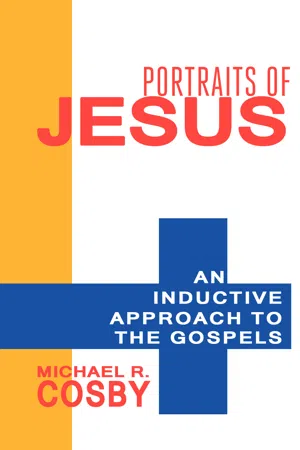
This book provides a learning-by-doing approach to the study of the Gospels. It allows students to uncover literary patterns, theological issues, and interpretive problems through close readings of primary sources. Questions are asked along the way that help readers understand the shape of the narrative, and the themes important to each Gospel writer.
- English
- ePUB (mobile friendly)
- Available on iOS & Android
eBook - ePub
About this book
Information
Topic
Theology & ReligionSubtopic
Biblical Studies1
The Rewards of Inductive Study of the Gospels
Years ago, while an undergraduate at the University of Mon-tana, I attended a seminar called a “Bible Study Dig In.” This weeklong study of Mark 1—8 opened what was for me a new world of inductive Bible study. I experienced in a captivating way not only how challenging but also how rewarding biblical study can be. Each of us received a copy of the Gospel of Mark, typed on 8½-by-11-inch paper, double-spaced, with wide margins. There were no paragraph divisions, no verse markings. We had only the text of Mark and line numbers down the left side of each page, indicating every fifth line so that we could keep track of where items were located by page and line number. The leader called this approach a manuscript study, and the purpose was to remove external guides, such as study-Bible notes, and force us to focus on what the text said.
Our somewhat eccentric leader, Paul Byer, who pioneered these studies of the Gospel of Mark, had bushy eyebrows that he brushed straight up. With childlike enthusiasm he almost skipped around the room, urging us to see every meaningful detail we could discover. We studied our manuscripts individually, then gathered in small groups to compare what we saw, and then met in a large group discussion led by Byer. We noticed vivid aspects of the Gospel author’s writing style. We saw that the order in which Mark’s stories are arranged has significance, and we started acting like detectives, searching for clues to solve a mystery. Byer’s enthusiasm was contagious, and soon we hardly noticed those wild eyebrows; we were too busy trying to crack the code.
Had I spent the week instead listening to a good scholar deliver lectures on the Gospel of Mark, I am confident that my life would not have been changed significantly. I probably would have been impressed with how brilliant the scholar was, and I most likely would have returned home with a notebook filled with lecture notes. But I doubt that I would have left with the belief that I, too, could see the intricate connections between stories in Mark’s Gospel. What made the week so life-changing was the way in which we became immersed in the study of the Gospel. The excitement of discovery caused many of us to return to our campuses and want to duplicate what we experienced at the “Dig In.”
We did not know we were practicing a form of literary criticism; we just knew we were having a great time trying to discover what we believed Mark was seeking to communicate about Jesus. We did not know we were learning how to do exegesis, nor did we know how dangerously subversive such study can be. When you seek to discover what the text says, instead of reading into the text your own theological bias, you might begin to conclude that you need to change some of your existing beliefs.
At that time, I assumed that a careful reading of the text alone could unlock the clues to correct interpretation. I did not understand much about cultural anthropology, and I knew nothing about the sociology of knowledge. It didn’t occur to me that ancient Mediterranean people saw reality differently than I did, and that only by learning more about their world would I be able to do successful detective work on individual biblical books. I didn’t fully appreciate that authors write within particular sociological settings and presuppose many shared understandings of the world with the people for whom they write. I didn’t realize that if I do not share these cultural views, I can easily misunderstand their words. I was unaware of the vast number of documents written by ancient Mediterranean authors that are found in the Old Testament Pseudepigrapha, the Dead Sea Scrolls, and such collections as the Loeb Classical Library. I had little idea of the relevance an ancient historian like Josephus might have for understanding the Gospel of Mark.
The interest generated through inductive Bible study, however, led me to such discoveries. Seeing things for myself instilled not only the necessary confidence but also the curiosity to look for details I had not seen before. The thrill of discovery established a pattern of looking closely, of not being content with pat answers or regurgitated data. I wanted to see it for myself, and this attitude carried over into my other course work at the University of Montana. It also shaped my approach to education.
Professors are painfully aware that students too often read only what is necessary to prepare for exams. Unfortunately, in Biblical Studies classes this means students often end up reading books about the Bible but not the Bible itself. I became aware of this during my doctoral work at Emory University, while assisting a very capable professor in teaching a course called “Biblical Literature and Faith.” For this introductory class, he used a good introduction to the Bible as his textbook and in the syllabus assigned readings from both the Bible and the textbook. As I graded the exams, however, it became obvious that the students were reading only the textbook. I determined that when I began teaching my own classes, I would devise some way to ensure that my students would read the Bible and see for themselves what it contains.
No matter how good the textbook, no matter how responsible the information it contains, it can never replace reading the Bible itself. People cannot move beyond the novice stage in Biblical Studies, or in any other field of literature, as long as they rely completely on secondary sources. There is no substitute for a careful, inductive analysis of the text, and I have found that students prefer this approach over reading someone else’s analysis.
The first time I taught “Life and Teachings of Jesus,” I used a standard text and received a less-than-enthusiastic response from my students. The book assumed that its readers already knew a significant amount about the Gospels and were ready to interact with critical issues of historical investigation. This was not a good assumption for my students. Unfortunately, the author answered questions that they were not yet ready to ask and that they did not perceive as important or legitimate. The issues the book addressed bewildered them, and they became frustrated and then bored with it. In itself the book was fine, but before my students were ready to interact with its contents, they needed a good, intensive study of the Gospels.
Many good books are available that explain the central themes of Gospel authorship, dates of writing, theological agendas, and so on. But when students see such issues for themselves as they study the Gospels, they become much better prepared to interact with the analyses of competent scholars. Until, by sufficient encounter with the biblical text, they see for themselves the issues involved in Gospel interpretation, they never adequately understand or appreciate scholarly books on the life of Jesus. My “Life and Teachings of Jesus” class therefore became a careful analysis of all four Gospels, and this manuscript began to take shape. My students became aware of scholarly methods of studying the Gospel narratives not from reading descriptions of them but from implementing these methodologies. The results are far more satisfying and convincing.
This book provides the resources needed to study the Gospels inductively. To complete the assigned readings, one has to look carefully at the Gospel stories. Instead of giving what I believe to be the correct answers, this book provides the tools needed for you to find answers for yourself. The focus is on reading the Gospels, not descriptions of them; and the questions, maps, explanations of historical matters, quotations from other ancient sources, and exegetical helps interspersed throughout the book are designed to enhance your reading of the primary text.
Although the book does not seek to duplicate the environment of a “Bible Study Dig In,” its observation questions, notes on cultural backgrounds, and questions focused on the significance of Gospel passages will help you discover the meaning of the stories in their ancient Mediterranean context and also ponder their relevance for life today. This combination of academic rigor (the detective work of seeking to uncover the Gospel authors’ intended messages) and vital interest in the relevance of the text for today (personal reflection and application) does justice to the intent of the first-century authors who wrote the Gospels. The Gospels are, after all, documents of faith that address important issues of belief and practice. Taking their messages seriously will challenge not only your historical views of Jesus of Nazareth but also your personal beliefs on the best way to conduct your life. In other words, you simply will not be able to complete this journey of historical discovery without having your opinions of Jesus changed in some ways. And you will not be able to reflect on the significance of his teaching and lifestyle without wrestling with their relevance for your own life and for society as a whole.
Jesus of Nazareth profoundly affected the course of human history, and the Gospels are the primary sources for studying his life. Carefully analyzing each of these accounts to discover its unique presentation of Jesus is therefore indispensable for those who desire to know about this person who is the focus of Christian beliefs. Obviously there are many conflicting views of Jesus, and there is little hope that people on a broad scale will reach a uniform set of conclusions about him. Different presuppositions, questions, and methods lead to different conclusions. But behind all of these stand the Gospels, and no one can make responsible decisions on the person of Jesus without first carefully studying these primary sources.
Use of B.C.E. and C.E. in Modern Scholarship
Increasingly, as Christian scholars interact with people from other religious backgrounds, the abbreviations B.C.E. (= before the common era) and C.E. (= common era) are used instead of B.C. (= before Christ) and A.D. (= anno Domini, Latin for “in the year of the Lord”). Jewish scholars, for example, do not wish to specify a year with reference to Jesus, whom they do not recognize as Messiah. So, to foster harmony, the abbreviation C.E. is now used to designate the same year as A.D. (e.g., A.D. 180 = 180 C.E.). Similarly, 44 B.C.E. designates the same year as 44 B.C. The dates are the same; only the way of abbreviating them is different.
FOUR GOSPELS—ONE JESUS
From the earliest encounters with Jesus no two people perceived events identically, and the stories of Jesus include the perspectives of the storytellers themselves. Each of the four canonical Gospels gives a unique portrait of Jesus that reflects not only how its author understood Jesus but also the author’s intended message to his audience. The Evangelists (= Gospel authors) did not write scientific histories of Jesus Messiah but accounts intended to influence the beliefs and behaviors of those for whom they wrote. The resulting differences among the Gospels have been known from an early time in the history of the church, and Christians have explained them in a variety of ways.
Evidence shows that in the second century C.E. some Christian leaders were studying the Gospels carefully, noting many differences among the accounts of Jesus. Scholars such as Irenaeus saw these distinctions as signs of the fullness of God’s revelation in Jesus Christ. Writing about 180 C.E., Irenaeus explained that each Evangelist focused on a different aspect of Jesus’ person and ministry, and he assigned the four creatures from Revelation 4 as symbols for the four Gospels.
Around the throne, and on each side of the throne, are four living creatures, full of eyes in front and behind: the first living creature like a lion, the second living creature like an ox, the third living creature with a face like a human face, and the fourth living creature like a flying eagle. (Rev. 4:6–7)
Irenaeus argues that the Gospel of Matthew focuses on Jesus’ humanity and therefore is symbolized by the human face, whereas Mark begins his Gospel with reference to an Old Testament prophecy, so that Gospel is symbolized by the soaring image of the eagle. Luke, he says, focuses on the sacrificial ministry of Jesus and is thereby symbolized by the calf (or ox), whereas John focuses on the deity of Jesus, resulting in the royal symbol of the lion.1
Down through the centuries others have disagreed with Irenaeus’s reasoning and have changed the symbols to reflect which one they believe applies to each Gospel, but to this day in Christian art the images of a man, an ox, a lion, and an eagle are frequently assigned to the Gospels. The reasons given may be fanciful at times, but they reveal a consistent recognition that the four biblical accounts of Jesus’ life are distinct.2 Augustine (354–430 C.E.), for example, after summarizing his understanding of the intent of Matthew, Mark, and Luke, says:
John, on the other hand, had in view that true divinity of the Lord in which He is the Father’s equal, and directed his efforts above all to the setting forth of the divine nature in his Gospel in such a way as he believed to be adequate to men’s needs and notions. Therefore he is borne to loftier heights, in which he leaves the other three [Gospels] far behind him; so that, while in them you see men who have their conversation in a certain manner with the man Christ on earth, in him you perceive one who has passed beyond the cloud in which the whole earth is wrapped, and who has reached the liquid heaven from which, with clearest and steadiest mental eye, he is able to look upon God the Word, who was in the beginning with God, and by whom all things were made. (Harmony of the Gospels 1.3.7)
Augustine proceeds to quote distinctive passages from John that focus on the deity of Christ, clearly revealing his detailed grasp of the many differences between the Gospel accounts. The way in which he explains this material differs substantially from interpretations provided by modern scholars, but his work is evidence of a great mind.
Thus, the existence of four canonical Gospels poses both a wonderful challenge and a complicated problem for studying the life of Jesus. On the one hand, these four, distinct witnesses contribute more to our knowledge of Jesus than any one of them could alone. On the other hand, the fact that Matthew, Mark, Luke, and John give uniquely different portraits of Jesus provides the basis for endless speculation on what he actually said and did.
For some Christians the diversity of the Gospel witnesses to Jesus brings stress, because for faith reasons they believe it to be important that there be a unitary presentation of the truth. This unfortunate mentality leads some to employ what I call the “blender method” of studying the Gospels. When they dump them all into a blender, so to speak, and hit the start button, an amorphous glop emerges, called a harmony of the Gospels. In the name of glorifying the Bible, they tragically destroy the carefully crafted contributions of the four Evangelists. While modern biblical scholars analyze the distinctions among the Gospels and seek to understand their overall messages, blender-method Christians employ severely outdated, naive methodologies designed to show how all the stories are really the same. After using this book to work through the Gospels, you will see with great clarity why the blender approach is completely out of touch with reality.
You will learn to look for and appreciate the distinctive compositional styles and theological perspectives of Matthew, Mark, Luke, and John. After some experience with studying the Gospels inductively, you will begin to nod knowingly as you see the telltale signs of the styles and content of the four authors. Rather than viewing these differences as a threat to faith, you will start to anticipate and enjoy seeing the distinctive portraits of Jesus unfold.
2
Mark the Evangelist
SECTION ONE: MARK AND ORAL PROCLAMATION
For centuries, Christian teachers largely ignored the Gospel of Mark because they viewed it as a shortene...
Table of contents
- Cover
- Title
- Copyright
- Map
- Contents
- Chapter One. The Rewards of Inductive Study of the Gospels
- Chapter Two. Mark the Evangelist
- Chapter Three. Luke’s Jesus: Reversing Social Expectations
- Chapter Four. Matthew’s Jesus: Authoritative Interpreter of the Law
- Chapter Five. John’s Jesus: The Descent and Ascent of the Eternal Logos
- Chapter Six. What Portrait Will You Hang on Your Wall?
- Appendix A: Jewish Religious Groups in the Time of Jesus
- Appendix B: How to Write an Exegesis Paper on a Gospel Passage
- Appendix C: Quests for the Historical Jesus
- Appendix D: The Rewards of Teaching Inductively
- Notes
- Index
Trusted by 375,005 students
Access to over 1.5 million titles for a fair monthly price.
Study more efficiently using our study tools.
Frequently asked questions
Yes, you can cancel anytime from the Subscription tab in your account settings on the Perlego website. Your subscription will stay active until the end of your current billing period. Learn how to cancel your subscription
No, books cannot be downloaded as external files, such as PDFs, for use outside of Perlego. However, you can download books within the Perlego app for offline reading on mobile or tablet. Learn how to download books offline
Perlego offers two plans: Essential and Complete
- Essential is ideal for learners and professionals who enjoy exploring a wide range of subjects. Access the Essential Library with 800,000+ trusted titles and best-sellers across business, personal growth, and the humanities. Includes unlimited reading time and Standard Read Aloud voice.
- Complete: Perfect for advanced learners and researchers needing full, unrestricted access. Unlock 1.5M+ books across hundreds of subjects, including academic and specialized titles. The Complete Plan also includes advanced features like Premium Read Aloud and Research Assistant.
We are an online textbook subscription service, where you can get access to an entire online library for less than the price of a single book per month. With over 1.5 million books across 990+ topics, we’ve got you covered! Learn about our mission
Look out for the read-aloud symbol on your next book to see if you can listen to it. The read-aloud tool reads text aloud for you, highlighting the text as it is being read. You can pause it, speed it up and slow it down. Learn more about Read Aloud
Yes! You can use the Perlego app on both iOS and Android devices to read anytime, anywhere — even offline. Perfect for commutes or when you’re on the go.
Please note we cannot support devices running on iOS 13 and Android 7 or earlier. Learn more about using the app
Please note we cannot support devices running on iOS 13 and Android 7 or earlier. Learn more about using the app
Yes, you can access Portraits of Jesus by Michael R. Cosby in PDF and/or ePUB format, as well as other popular books in Theology & Religion & Biblical Studies. We have over 1.5 million books available in our catalogue for you to explore.