In this highly useful book, Earl S. Johnson, Jr. explores the role of the deacon in the Presbyterian Church (U.S.A.). The author explains the freedom for churches to define the roles of deacons while also supplying many helpful suggestions. Johnson examines the ministry as it is described in sections of the Book of Order and analyzes how the word "deacon" is used in Scripture. In addition, Johnson provides historical information regarding the inclusion of women and offers innovative ways to incorporate the ministry of deacons into the larger ministry of the church. Fully revised based on the new Form of Government of the Presbyterian Church (U.S.A.), this book is invaluable for new deacons preparing for their roles, while also helping pastors and leaders who are training prospective deacons.
eBook - ePub
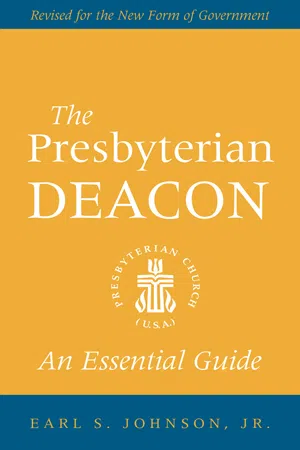
The Presbyterian Deacon
An Essential Guide, Revised for the New Form of Government
- 85 pages
- English
- ePUB (mobile friendly)
- Available on iOS & Android
eBook - ePub
About this book
Trusted by 375,005 students
Access to over 1.5 million titles for a fair monthly price.
Study more efficiently using our study tools.
Information
Topic
Theology & ReligionSubtopic
Christian DenominationsChapter 1
The Biblical Background
After the positions of apostle and elder, the ordered ministry of deacon was one of the first ones established by the New Testament church. According to Acts 6, the early Christians faced an enviable problem of church growth. Disciples were increasing in number, and the Hellenists (Greek-speaking Christians, in contrast to those who came from an Aramaic or Hebrew background) complained that their people were being shortchanged in a ministry that had been established to distribute food. The twelve disciples of Jesus (by this time Judas Iscariot had been replaced by Matthias; see Acts 1:23–26) called a meeting of the church leaders, and it was decided that a new group of seven should be chosen to “wait on tables” (diakonein trapezais) so that the others could continue in the work of preaching and praying. It is not a coincidence that all of the first deacons (diakonoi) had Greek names. Obviously it was true already in the first century: if you complain, you get the job! The fact that the leader of the initial group of deacons (Stephen) was stoned to death for teaching and preaching demonstrates that at the start the church had more in mind for them than menial tasks.
It is an interesting phenomenon that the early church decided to give one of its most important groups of church officers a mundane, commonplace name. In the modern world we would no doubt want people to feel important in their new position and give them a dignified title, something like Social Service Provider or Caring Minister. But the church chose the title diakonos, which, in its most literal sense, means a person who serves food to other people in a home or a restaurant, perhaps even akin to “slave.” Since their duties required them to meet the needs of others, even washing the feet of travelers, it was not always the most enviable of jobs.
Why did the early church choose such a humble title for their new leaders? Obviously they took it from the ministry and example of Jesus Christ, who taught his disciples that if anyone wants to be first in the kingdom of God, he or she has to be the servant of all (Mark 9:35). Jesus followed the example of the Suffering Servant in Isaiah, the one who would be exalted and lifted up (Isa. 52:13) by being wounded for the transgressions of others (Isa. 53). This servant Jesus knew was not a sycophant, or one who curried the favor of others to get ahead, but the afflicted one who bore the sin of many. It is one in whom God delights, and because God’s Spirit is in him, or her, brings forth justice to the nations (Isa. 42:1). The servant of the Lord does not call attention to himself or herself, but to God who has commanded the service:
You are my witnesses, says the Lord, and my servant whom I have chosen, so that you may know and believe me and understand that I am he. Before me no god was formed, nor shall there be any after me. I, I am the Lord, and besides me there is no savior. (Isa. 43:10–11)
The Gospels tell us repeatedly that Jesus called attention to the exalted status that comes from service:
- Those who want to be great among you must be your servant. (Mark 10:43, au. paraphr.)
- “For the Son of Man came not to be served but to serve, and to give his life a ransom for many.” (Mark 10:45)
- Whoever serves me must follow me, and where I am, there will my servant be also. Whoever serves me, God will honor. (John 12:26, au. paraphr.)
- “Servants are not greater than their master, nor are messengers greater than the one who sent them.” (John 13:16; see Matt. 10:24; Luke 6:40)
The earliest written reference in the New Testament to the ordered ministry of deacons (diaconoi) is found in Phil. 1:1 where Paul greets them with the bishops (episkopoi). A later writer (1 Tim. 3:8–13) provides the first list of personal qualifications that were required of deacons. They must do the following:
- Be tested by the church.
- Be bold in faith, holding fast to the mystery of faith.
- Be good managers of their own households (see the requirements for bishops: 3:4–5).
- Be capable of sustaining long-term relationships.
- Be committed and serious minded.
- Be honest, not double-tongued.
- Have no addictive personality traits, “not indulging in much wine” (see a more detailed discussion of all these requirements in chapter 3).
In return, the deacons will receive at least two major rewards:
- good standing for themselves and meaningful service and
- the privilege of following Jesus’ example (see G-6.0401).
Throughout the New Testament, service to God (diakonia) is considered to be a central characteristic of those dedicated to being Jesus’ disciples. Paul indicates that beyond the fact that Stephen was one of the first deacons, his whole family “devoted themselves to the service of the saints” (1 Cor. 16:15). For the early Christians, several spiritual traits were all bound together: “love, faith, service, and patient endurance” (Rev. 2:19). As Paul puts it in a wellknown passage in 1 Cor. 12:4–6, “Now there are varieties of gifts, but the same Spirit; and there are varieties of services, but the same Lord; and there are varieties of activities, but it is the same God who activates all of them in everyone.” The different gifts (charismata), services δiakoniōn), and action items (energēmatōn) all provide energy, enthusiasm, and power for the church “for the common good.” Deacons and other leaders are not called to suit themselves or to make themselves look good, but only to serve the Lord and the unity of the one church, for the purpose of interpreting the faith, healing the sick, prophesying, or providing spiritual discernment. God appoints different people to perform various tasks within the church (see a list in 1 Cor. 12:27–31), but the things they have in common are orders from the same God and the same desire to serve the body of Christ. Service is a characteristic not just of the deacon but of the apostle (Rom. 11:13; 2 Cor. 4:1; 6:3–4; Acts 1:17, 25), the evangelist, or the mission worker (2 Tim. 4:5), and even angels (Heb. 1:14: “Are not all angels spirits in the divine service, sent to serve for the sake of those who are to inherit salvation?”). It is a requirement of anyone who follows Jesus.
Although the admonition given to one Archippus in Col. 4:17 could apply to us all—“See that you complete the task [literally service] that you have received in the Lord”—the work given by God through Jesus Christ was not considered by the first Christians to be an onerous chore. It was a “ministry” (nrsv; in Greek, diaconia) “of the Spirit come in glory,” “a ministry of justification [righteousness] bound in glory” (2 Cor. 3:7–11), a ministry of forgiveness and reconciliation (2 Cor. 5:18–19), a ministry of generosity to the saints (2 Cor. 9:1, 12–13); it was, above all, a service of love, for indeed love is the highest of all the duties and gifts that God bestows (1 Cor. 13:13). Deacons may do a variety of things in many different congregations, but if they are not filled with the greatest gift to serve the greatest God, then they and their ministry will probably amount to nothing. Paul urges us all to pursue our callings with the utmost of energy and compassion. Let us use our gifts according to the grace given to us: prophecy in proportion to our faith; teaching in relation to our ability to teach; preaching in sermon delivery; giving and stewardship in generosity; ministry (diakonian) in serving (diakonia); and giving mercy and forgiveness in the absolute cheerfulness and abandonment of love (Rom. 12:6–8).
Questions for Study and Reflection
1. Read Acts 6:1–7. Can you see how the distribution of food to the hungry is to be considered an act of love given by God? What are the qualities that the disciples looked for in the first deacons? What does it mean to be “of good standing, full of the Spirit and of wisdom” (v. 3)? Do you see some of these traits in the members of your board of deacons?
2. Look at the qualifications required for deacons in 1 Tim. 3:8–13. Do you have all eight of them? Are there any you have to work on? Do you need to ask God to give you some of them?
3. What is meant in 1 Pet. 4:11 where it says that “whoever serves must do so with the strength that God supplies, so that God may be glorified in all things through Jesus Christ?” Is God strengthening you in your ministry as a deacon? Can you feel God’s power in the life of your church? What can you do as deacons where the congregation’s ministry is weak?
Chapter 2
Deacons in the Reformed Tradition and the Presbyterian Church
Men and Women as Deacons
When Presbyterians examine the background of the role of deacons in the Reformed tradition, it is not surprising that they discover that the influence of the reformer John Calvin has been substantial. In his Institutes of the Christian Religion and his commentaries on the Bible, Calvin carefully explained his understanding of the biblical concept of the diaconate and the way it should function in the church.1
In the Institutes, for example, Calvin makes it clear that the primary task of the deacons is to take care of the poor and distribute alms. He had made a careful study of the way deacons functioned in the Roman Catholic Church and was harshly critical that no more of the money for the poor reached those for whom it was intended than if it had been thrown into the sea (4.5.15). Frequently deacons merely functioned as liturgical and administrative assistants to bishops and priests, and too often they abused their office. When people misuse or steal money that has been given for a sacred purpose, Calvin contends, they mock the church with a false diaconate. The diaconate, he charges, was never established to create a license to steal and rob or to turn a ministry into sacrilegious plundering (4.5.16).
In Geneva, Calvin organized the work of the deacons into two different branches. Based on his interpretation of the New Testament, and in response to a welfare system already established in the city that had church leaders and civic employees both working with the disadvantaged, he created one group to manage and distribute the money collected, and a second to do the actual work of caring for the sick and poor (4.3.9). This bifurcation of responsibilities was partially based on his exegesis of Rom. 12:8 and 1 Tim. 5:9–10. Seeing that there were different types of ministries established in the Pauline churches, Calvin decided that one group should have administrative authority for the caring ministry of the church and that the other should do the hands-on work.
No doubt Calvin’s organization of the ministry to the poor derived from a deep commitment to the teaching and example of Jesus. In his discussion of Christian freedom, he urges his readers not to let their use of good things lead to gluttony and luxury (3.19.9) or to neglect of the weak (3.19.10). Anyone the Christian meets, Calvin writes, even if a stranger, is not a person who can be refused help. How can we say that anyone is ugly who has been given the image of God? A believer cannot argue that helping the poor is not worth the effort....
Table of contents
- Cover
- Half-title Page
- Title Page
- Copyright Page
- Contents
- Preface to the Second Edition
- Introduction
- Chapter 1: The Biblical Background
- Chapter 2: Deacons in the Reformed Tradition and the Presbyterian Church
- Chapter 3: Who Are the Deacons and What Do They Do?
- Chapter 4: Ordination Questions
- Chapter 5: Book of Confessions
- Chapter 6: The Call for Creative Diaconal Ministry in the Twenty-First Century and Beyond
- Appendix: A Litany for the Recognition of Deacons
- Glossary
- For Further Study
- Footnotes
Frequently asked questions
Yes, you can cancel anytime from the Subscription tab in your account settings on the Perlego website. Your subscription will stay active until the end of your current billing period. Learn how to cancel your subscription
No, books cannot be downloaded as external files, such as PDFs, for use outside of Perlego. However, you can download books within the Perlego app for offline reading on mobile or tablet. Learn how to download books offline
Perlego offers two plans: Essential and Complete
- Essential is ideal for learners and professionals who enjoy exploring a wide range of subjects. Access the Essential Library with 800,000+ trusted titles and best-sellers across business, personal growth, and the humanities. Includes unlimited reading time and Standard Read Aloud voice.
- Complete: Perfect for advanced learners and researchers needing full, unrestricted access. Unlock 1.5M+ books across hundreds of subjects, including academic and specialized titles. The Complete Plan also includes advanced features like Premium Read Aloud and Research Assistant.
We are an online textbook subscription service, where you can get access to an entire online library for less than the price of a single book per month. With over 1.5 million books across 990+ topics, we’ve got you covered! Learn about our mission
Look out for the read-aloud symbol on your next book to see if you can listen to it. The read-aloud tool reads text aloud for you, highlighting the text as it is being read. You can pause it, speed it up and slow it down. Learn more about Read Aloud
Yes! You can use the Perlego app on both iOS and Android devices to read anytime, anywhere — even offline. Perfect for commutes or when you’re on the go.
Please note we cannot support devices running on iOS 13 and Android 7 or earlier. Learn more about using the app
Please note we cannot support devices running on iOS 13 and Android 7 or earlier. Learn more about using the app
Yes, you can access The Presbyterian Deacon by Earl S. Johnson in PDF and/or ePUB format, as well as other popular books in Theology & Religion & Christian Denominations. We have over 1.5 million books available in our catalogue for you to explore.