The idea of hell can haunt dreams and disturb sleep. Many wonder at the justice (or injustice) of it all, feeling confounded by a God who deems it necessary to send the majority of humanity to burn there forever. Seventy percent of Americans believe in hell, as do ninety-two percent of those who attend church every week. Clearly, it's a hot topic. Baker offers readers a safe space to contemplate tough issues as they rethink traditional views of hell. In her candid and inviting style Baker explores and ultimately refutes many traditional views of hell, presenting instead theologically sound ways of thinking that are more consistent with the image of God as a loving creator who desires to liberate us from sin and evil. This is an excellent selection for general readers, students, pastors, professors, and grief counselors, and will provide clarity for those with questions about hell, God's judgment, and what happens to us when we die.
eBook - ePub
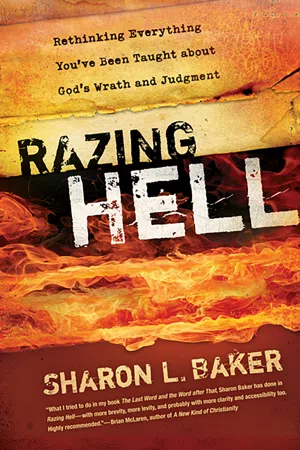
Razing Hell
Rethinking Everything You've Been Taught about God's Wrath and Judgment
- 232 pages
- English
- ePUB (mobile friendly)
- Available on iOS & Android
eBook - ePub
About this book
Information
Topic
Theology & ReligionSubtopic
Christian TheologyPART 1
Traditional Views of Hell, God’s Wrath, and Judgment
1
The Landscape
Through me the way into the suffering city, Through me the way to the eternal pain, Through me the way that runs among the lost. Justice urged on my high artificer; My maker was divine authority, The highest wisdom, and the primal love. Before me nothing but eternal things Were made, and I endure eternally. Abandon every hope, who enter here.
—Sign on the gate into hell, in Dante, Inferno, Canto 3
And besides all this, between us and you there is a great chasm fixed, so that those who wish to come over from here to you may not be able, and that none may cross over from there to us.
—Abraham, in the parable of the Rich Man and Lazarus, Luke 16:26
It’s a good thing I love to help struggling students. Within the span of a week, two of my students came to my office to talk about hell. Eric looked a bit despondent as he sat down in the chair near my desk.
“I had a discussion about evangelism with my roommate last night,” he said quietly.
“Oh?” I replied, trying to switch my attention from grading Hindu philosophy papers to Christian evangelism.
“Yeah. He thinks that even those who have not heard about Jesus will burn in hell forever.” Now he had my attention.
“Really? Do you believe that too?” I asked.
“Well … yes, I guess I do. But I don’t want to. Doesn’t it seem unjust of God to hold someone accountable for believing in a Jesus they’ve never even heard of? I mean, it’s not their fault, is it? Yet during all eternity they suffer for a choice they didn’t choose to make.”
As the conversation progressed, I couldn’t tell which bothered Eric more: the thought of an unjust God sending people to hell for all eternity, the idea of someone who had no control over whether or not they had faith in Jesus yet suffering horrendous eternal torture, or the fear he felt by expressing his doubts and angst over such firmly held doctrines. All three worried him and left him with the scary feeling of standing on the outside of his comfortable faith community as he questioned the status quo.
A few days later, Brooke knocked on the door. She bounced into my office and threw herself into a chair, obviously excited about something. Before I could expend any mental effort wondering at the cause of her exhilaration, she burst out with “Guess what we talked about in Bible class today!”
“Uh … the Bible?” I said.
“Hell!” she blurted out.
“Sorry?” I said, thinking she didn’t like my answer.
“No! Hell! We talked about hell in class!”
“Brooke, you’ve already told me hell bothers you, so why are you so excited about it?”
“Because of what the Bible doesn’t say about it! Maybe I can think differently about hell after all! Maybe God doesn’t really send people into eternal torture and we’ve been wrong all along!”
Brooke’s enthusiasm over the possibility of an alternate view of hell revealed the depth of her discomfort with a God who would exact such pain upon much-loved creatures and with the thought of anyone suffering such endless agony.
I went home thinking about my conversations that week with Eric and Brooke, their problems with traditional views of hell, the struggles they wrestled with, and their very different emotions involved in questioning their traditions—Eric scared about the consequences and Brooke excited about the possibilities, both feelings arising from asking the tough questions. The next morning the phone rang. Lisa sounded agitated on the other end. “I’m so irritated with God right now I could scream,” she said.
“Well, what’s God done now?”
“My grandmother lies dying in a nursing home, and a friend from church told me she will go to hell if she doesn’t receive Christ as her Savior before she dies! What a terrible thing to say at a moment like this! And if she’s right, what kind of God would send my sweet old grandma to suffer in hell forever? She’s never hurt anyone in her life!”
Hell again! If it were I, I’d be more upset with the friend than with God! But since I knew Lisa believed the same thing about hell that her church friend did, I asked her, “Lisa, you’ve always believed that God sends unbelievers to hell, too. Why are you all of a sudden so angry about it?”
“Because it’s my grandmother who’s in danger of going there!” was her vehement response. That makes sense. We seem to believe the horrible until it hits too close to home. Lisa and her grandmother were very close, and she couldn’t stand the thought that the woman she loved so much, who had shown her so much love, would suffer unendurable punishment forever. The threat of her much-loved grandmother’s potential eternal torment drove Lisa to question seriously what she had always believed about hell. Whatever the motive—either Eric’s despondency over those who don’t know about Jesus, or Brooke’s excitement over another view, or Lisa’s anguish over loved ones suffering forever—hell intrigues us, plagues us, causes us fearful discomfort, and begs us to think critically and honestly through its implications. With Eric, Lisa, and Brooke as conversation partners, we will do just that. We will search for the “truth” about hell.
THE JOURNEY BEGINS: A TOUR OF TRADITIONAL HELL
Hell has intrigued and attracted Christians for centuries. Fascinated by the mental images the idea evoked in their minds, artists throughout the ages created gruesome portrayals of hell and its wretched inhabitants. They usher us into the fiery pit, eternally aflame with burning putrid flesh. Foul-mouthed demons with malodorous breath devour vile sinners as blood drips from their fangs and human entrails hang grotesquely from clenched claws. We blanch in horror, our terror only eased by the awareness that this infernal fate falls on someone else and not upon us. But how did hell receive such wide press in a community based on Christian love? Theories abound.
Many Christian historians agree that concepts of eternal punishment, burning in a place like “hell,” developed for the most part during the time period between the Old and New Testaments as Greek and Persian religious thought infiltrated Jewish literature, culture, and beliefs. The seeds of these concepts developed further, took root in culture, and eventually found their way into the New Testament. We will trace the birth of hell as a place of fiery eternal punishment in chapter 10. For our purposes in this chapter, we know that the early Christian fathers read and interpreted the New Testament through a certain lens and handed down to us Christianity’s traditional view of hell.
The entry on hell in the Westminster Dictionary of Theological Terms describes it like this: “In Christian theology, the place of the dead after death in which the wicked endure eternal punishment and the total absence of God.” This definition is created from centuries of Christian thought on the topic of hell. So before we start talking about alternatives, let’s embark upon our tour of hell and see how our early church fathers, medieval theologians, and contemporary thinkers imagined it and how they handed it down to us.
Dante Alighieri wrote a classical piece titled The Divine Comedy (1308–21), which he broke down into three parts: Inferno, Purgatorio, and Paradiso. Dante describes the horrors of the inferno as Virgil, the ancient Latin poet, leads him through the nine increasingly evil and torturous circles of hell. During the tour, Virgil allows Dante to speak with hell’s inhabitants and to gloat at their dismal desolation. As Virgil leads him, Dante takes his readers along, describing in intricate detail the tortures and terrors he sees on his trip through the dungeons of hell. With that image in mind, let me act as your Virgil as I lead you through the various images of hell as thought and taught by the Christian tradition.
The ancient church fathers paint vivid pictures of what awaits those doomed to eternal fire. One of our earliest church fathers, Justin Martyr (ca. 160), says that hell’s inhabitants “will suffer punishment in eternal fire according to the merits of [their] deed” (1 Apology 17). Irenaeus (ca. 180), another early church theologian, believed that Scripture clearly reveals that “eternal fire is prepared for the sinner” (Against Heresies 2.28.7). The well-known Clement of Alexandria (ca. 195) writes that “all souls are immortal, even those of the wicked. Yet it would be better for them if they were not deathless. For they are punished with the endless vengeance of quenchless fire. Since they do not die, it is impossible for them to have an end put to their misery” (Fragments 6.2). Marcus Minucius Felix (ca. 200) agrees with Clement: “There is neither limit nor termination of these torments. There, the intelligent fire burns the limbs and restores them. It feeds on them and nourishes them” (Octavius 35). He believes that unceasing punishment in the fires of condemnation await the unrepentant sinner, whose burned body parts regenerate only to be burned off again.
I could quote plenty more, but I think these few excerpts give you a clear picture of the nature of hell as a place of eternal torment according to our tradition’s early theologians. As you can see, these men allowed their creative senses to run wild.
Taking their cue from the early church fathers and their interpretation of the Bible, medieval and modern theologians, pastors, and priests picked up the early Christian images of hell and expounded even more vividly on its unending horrors. The famous preacher Jonathan Edwards (1741) spins a verbal image of hell that sizzles with righteous indignation toward those who deserve its torments: “O sinner! Consider the fearful danger you are in: it is a great furnace of wrath, a wide and bottomless pit, full of the fire of wrath, that you are held over in the hand of that God, whose wrath is provoked and incensed as much against you, as against many of the damned in hell. You hang by a slender thread, with the flames of divine wrath flashing about it, and ready every moment to singe it, and burn it asunder.”
Edwards describes the experience of hell’s torrential fires with diabolical flourish:
[The wicked] shall forever be full of a quick sense within and without; their heads, their eyes, their tongues, their hands, their feet, their loins and their vitals, shall forever be full of glowing melting fire, fierce enough to melt the very rocks and elements. And also … they shall eternally … feel the torment, … not for one minute, nor for one day, nor for one year, nor for one age, nor for a hundred ages, nor for a million of ages, one after another, but for ever and ever; without any end, and never, never be delivered!
Imagine hell in the mind of Fray Luis de Granada (1588) as he describes the sinners’ lot: “There will the condemned in cruel rage and despair turn their fury against God and themselves, gnawing their flesh with their mouth, breaking their teeth with gnashing, furiously tearing themselves with their nails, and everlastingly blaspheming against the judge…. Oh tortured bodies that will have no refreshment but flames.” Even John Wesley (1758), who profoundly experienced and adamantly proclaimed the love of God, wrote:
The wicked will gnaw their tongues for anguish and pain; they will curse God and look upwards. There the dogs of hell, pride, malice, revenge, rage, horror, despair, continually devour them…. Consider that all these torments of body and soul are without intermission. Be their suffering ever so extreme, be their pain ever so intense, there is no possibility of their fainting away, no, not for one moment. (Sermon 15)
Another pastor of God’s flock paints a torturous picture of a family scene in the abysmal furnace: “Husbands shall see their wives, parents shall see their children tormented before their eyes…. The bodies of the damned shall be crowded together in hell like grapes in a winepress, which press one another till they burst.” This would be a diabolical vintage that one would be loathe to sip or to see others sip!
If you think these heinous representations of hell are horrific, take a look at these equally ghastly portraits of God, the mastermind behind this abysmal abyss. Edwards rants that “the God that holds you over the pit of hell, much as one holds a spider, or some loathsome insect over the fire, abhors you, and is dreadfully provoked: his wrath towards you burns like fire; he looks upon you as worthy of nothing else, but to be cast into the fire.” Granted, Edwards inflicts these words upon us only to talk later about God’s grace, but in the meantime, he treats us to a tyrannical image of a God whose very nature is supposed to be love. Edwards also argues that the suffering of those in hell will bring God joy: “Can the believing father in Heaven be happy with his unbelieving children in hell? … I tell you, yea! Such will be his sense of justice that it will increase rather than diminish his bliss.” When speaking of God’s response to the souls perpetually burning in the flames of hell, seventeenth-century theologian Richard Baxter says that “the God of mercy himself shall laugh at them…. God shall mock them instead of relieving them, … and he shall rejoice over them in their calamity.” Out of incredulity, I can’t resist one more quote, this one by seventeenth-century Vicar Peter Newcome: “The door of mercy will be shut and all bowels of compassion denied, by God, who will laugh at their destruction.” This surely is a surprising response from the God who loves sinners with an everlasting love, who so loved the world—even to the point of death—and who desires none to perish but all to be saved! But there’s more.
Hell and its hapless inhabitants do not suffer in vain. Their execrable torment enhances the existence of the exulted, righteous minority who bask luxuriously in heaven’s splendor. A great cloud of witnesses look on, rubbing their hands together in delight, in anticipation of the tortures to come. Peter Lombard (c. 1100) says that the “elect shall go forth … to see the torments of the impious, seeing which they will not be grieved, but will be satiated with joy at the sight of the unutterable calamity of the impious.” Andrew Welwood (c. 1744) believes that the saints, looking on from the comforts of their celestial abode, will revel in the torment of the less fortunate and be “overjoyed in beholding the vengeance of God.” Seventeenth-century clergyman Samuel Hopkins agrees, stating that “this display of the divine character will be most entertaining to all who love God. It will give them the highest and most ineffable pleasure. Should the fire of this eternal punishment cease, it would in great measure obscure the light of heaven, and put an end to a great part of the happiness and glory of the blessed.” Thomas Aquinas, one of the most influential theologians in church history, writes: “In order that the happiness of the saints may be more delightful to them and that they may render more copious thanks to God for it, they are allowed to see perfectly the suffering of the damned…. So that they may be urged to more praise God.” Remember the old lines attributed to Isaac Watts? They go like this: “What bliss will fill the ransomed souls, / when they in glory dwell, / to see the sinner as he rolls / in quenchless flames of hell.” All this from recovering sinners who are exhorted to weep with those who weep, to show the love of Jesus, and to obey the second most important commandment, to love others as they love themselves. Although the fodder for their active imaginations came from their interpretation of Scripture, we will see that the Bible does not speak as consistently or as clearly as do their personal visions of hell, a topic we will discuss in more depth in chapter 10.
TROUBLES WITH THE TRADITIONAL TOUR
This view of hell causes troubling questions to bubble to the surface, even for those who have always believed it. Although once in a while a student will offer a critique of the traditional view of hell in the classroom, most of them make an appointment to come and talk with me in the privacy of my office. Some students who struggle with these questions would go so far as to say that they don’t want to worship a mean God who inflicts such strict punishment. They have these types of thoughts and questions in common with Lisa, Brooke, and Eric. Some of you may think, “Okay, so you have trouble with hell. God can do what God wants, and God’s ways are higher than our ways, so get over it. After all, justice must be served.”
And that’s true. We cannot always figure out the ways of God. We all want justice (unless we are the ones getting served our share). At the same time, however, God has created us with the capacity to think, to reason, and to understand our faith. When we think through our beliefs, where they originate, and why we hold on to them, we stand in a long line of faithful Christians who have gone before us.
Anselm, archbishop of Canterbury, a very influential medieval theologian, reminds us that our faith seeks understanding, that when we make the effort to understand our faith and our beliefs, we honor God and we benefit others. So when friends and students come to me with questions about hell that haunt them in the middle of the night, we talk about the theological reasons for a rigorous view of hell. I encourage them to think through their objections, to voice their critiques of the traditional views, and to examine what the Bible says.
I asked Lisa why she clings so tenaciously to our traditional doctrines of hell even though, at the same time, she seriously questions them. We traditionally believe that the God we love and worship loves us first, loves us so deeply that we are worth dying for, yet we also believe that this same God casts innumerable multitudes into flames of punishment, not just for a specific time period with a beginning and an end, but for all eternity. As we discussed this inconsistency, we laughed as we thought back to the television series Lost in Space, which we both used to watch as kids. When faced with a conundrum, the robot on the show would say, “Does not compute.” Well, the disharmony between a loving God and a vengeful God found in our traditional doctrines of salvation and hell “does not compute.” This begs the question “Are we stuck with it?” Do we have to believe in eternal punishment, everlasting torture in a place in which evil perpetually coexists with God’s eternal, holy kingdom? Are we heretics if we find hell hard to believe? I don’t think so. And after seriously testing the waters of theological reflection, many of my students and friends, like Eric, Brooke, and Lisa, don’t think so either.
One of the problems that Lisa finds with constructing an alternate view of hell involves the fear of letting the wrongdoer off the hook too easily, of selling out to a feel-good theology that endorses a “Don’t-worry-be-happy-God-loves-you” mentality. She brings up an excellent point. We don’t want evildoers simply to “take a walk.” So we remind ourselves that we need a solution consistent with a God of love and justice and, even, wrath. At the same time the solution has to take sin seriously in a way that holds wrongdoers accountable and vindicates their victims. We also want a solution that keeps the hope of redemption alive for loved ones gone before us, ...
Table of contents
- Cover
- Title Page
- Copyright
- Dedication
- Contents
- Acknowledgments
- Introduction
- Part 1: Traditional Views of Hell, God’s Wrath, and Judgment
- Part 2: An Alternative to Hell, God’s Wrath, and Judgment
- Part 3: A New View of Hell
- Appendixes
- Index of Scripture
- Index of Subjects and Names
Trusted by 375,005 students
Access to over 1.5 million titles for a fair monthly price.
Study more efficiently using our study tools.
Frequently asked questions
Yes, you can cancel anytime from the Subscription tab in your account settings on the Perlego website. Your subscription will stay active until the end of your current billing period. Learn how to cancel your subscription
No, books cannot be downloaded as external files, such as PDFs, for use outside of Perlego. However, you can download books within the Perlego app for offline reading on mobile or tablet. Learn how to download books offline
Perlego offers two plans: Essential and Complete
- Essential is ideal for learners and professionals who enjoy exploring a wide range of subjects. Access the Essential Library with 800,000+ trusted titles and best-sellers across business, personal growth, and the humanities. Includes unlimited reading time and Standard Read Aloud voice.
- Complete: Perfect for advanced learners and researchers needing full, unrestricted access. Unlock 1.5M+ books across hundreds of subjects, including academic and specialized titles. The Complete Plan also includes advanced features like Premium Read Aloud and Research Assistant.
We are an online textbook subscription service, where you can get access to an entire online library for less than the price of a single book per month. With over 1.5 million books across 990+ topics, we’ve got you covered! Learn about our mission
Look out for the read-aloud symbol on your next book to see if you can listen to it. The read-aloud tool reads text aloud for you, highlighting the text as it is being read. You can pause it, speed it up and slow it down. Learn more about Read Aloud
Yes! You can use the Perlego app on both iOS and Android devices to read anytime, anywhere — even offline. Perfect for commutes or when you’re on the go.
Please note we cannot support devices running on iOS 13 and Android 7 or earlier. Learn more about using the app
Please note we cannot support devices running on iOS 13 and Android 7 or earlier. Learn more about using the app
Yes, you can access Razing Hell by Sharon L. Baker in PDF and/or ePUB format, as well as other popular books in Theology & Religion & Christian Theology. We have over 1.5 million books available in our catalogue for you to explore.