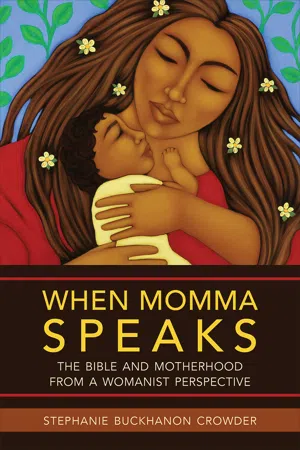
Stephanie Buckhanon Crowder provides an engaging womanist reading of mother characters in the Old and New Testaments. After providing a brief history of womanist biblical interpretation, she shows how the stories of several biblical mothersHagar, Rizpah, Bathsheba, Mary, the Canaanite woman, and Zebedee's wifecan be powerful sources for critical reflection, identification, and empowerment. Crowder also explores historical understandings of motherhood in the African American community and how these help to inform present-day perspectives. She includes questions for discussion with each chapter.
eBook - ePub
When Momma Speaks
The Bible and Motherhood from a Womanist Perspective
- 129 pages
- English
- ePUB (mobile friendly)
- Available on iOS & Android
eBook - ePub
About this book
Information
PART ONE
Setting the Stage
1
Being an African American Mother
We need mothers who are capable of being character builders, patient, loving, strong and true, whose homes will be uplifting power in the race. This is one of the greatest needs of the hour.
—Frances Ellen Watkins Harper, “Enlightened Motherhood,” 1892
This is not your mother’s idea of motherhood. Society no longer views the maternal through the eyes of Florida Evans from Good Times, Carole Brady from The Brady Bunch, or Mrs. Cleaver from Leave It to Beaver.1 Hollywood has made being a mommy as hot as haute couture. Images of Halle Berry, Beyoncé, Angela Bassett, Tyra Banks, and even rapper Lil’ Kim seek to add glitz and glamor to the maternal world. Mega-producer and self-proclaimed titan, Shonda Rhimes has added to the motherhood conversation in her recent book and TED Talk. She maintains saying “yes” to play makes for better work.2 Mothers throughout the United States watched the first African American First Lady, Michelle Obama. From the time she first appeared on the campaign trail in 2007 and throughout the Obama family’s White House days, women wanted to know how this Mom-in-Chief was nurturing her daughters, Sasha and Malia. Surely she would be the ultimate, übermom. Yes, the images of the maternal have shifted from aprons and kitchens to designer bags and boardrooms. Mommies rock!
Yet whereas these are modern-day presentations of motherhood, time will not forget the plethora of nameless so-called mammies and matriarchs. There are those who during slavery and the Reconstruction nursed not only their children, but “massah’s” children as well. These were hardworking, burden-bearing, heavy-load carrying foremothers who from sunup to sundown worked in the fields only to go home and provide for their own sons and daughters. It was only after they took care of somebody’s child that they could focus on being mother to their own. The field or the domestic job called them first.
At the cusp of the twentieth century, society stood in need of the work only a mother could do. The quote from Frances Ellen Watkins Harper alludes to this. The nurturing, maternal presence of a woman was the order of the day then. There is still a clarion call for such labor now. If indeed the work of mothers is that of character building, it is also the construction of stately, human edifices who will change the landscape of the environment.
Children spend hours upon hours at school and days and weeks at camp. In these places they encounter peers whose ways of thinking, doing, and believing are different from their own. Such distinctions are primarily due to different parents teaching their children in different ways at different times. So much of this teaching comes from a maternal figure. Thus there comes to the forefront the need for mothers in the home where children can learn sociological and spiritual values that will undergird them for life. Training in the home must combat what goes on outside of its environs. Along with primarily overseeing the domestic responsibilities of the house, mothers tend to be the principle teachers and nurturers.
The operative words are “primarily” and “tend.” It is no doubt that many children do not live in a two-parent household. Quite a few children reside with only a father and no maternal figure. Almost two million men are single fathers, and 16 percent of custodial single parents are men.3 In addition there are conditions in households where the mother is the breadwinner and the onus of dishes, bills, and homework lies with the dad. An estimated 195,000 men are stay-at-home dads who have remained out of the labor force for at least a year so that they can care for the family while their wives work outside the home.4 Thus there is no one-size-fits-all approach to what it means to be a mother, especially in an African American context. In many ways there is no norm. To each household its “motherly” own.
In addition, biological mothering does not mean that a woman is adept at motherhood. There is no magical, maternal gene that gets turned on because a woman gives birth or adopts a child. Motherhood is a process. It is a journey. It may or may not begin with desire, but a part of becoming a mother is perchance growing into this state of being.
There, I said it. This idea of motherhood is not monolithic. It is not universal. There are some “ifs,” “ands,” or “buts” that make the definition and its task nebulous at best. Nonetheless, what this research tries to do is show that there are some common ideas and tenets about maternal existence. There are aspects of motherhood that are indeed universal and warrant further investigation.
This labor of “character building,” as Harper calls it, has not always been easy for women of African descent. Whereas the independence in some African countries allowed mothers to rule, love, and nurture at will, the crisis of the Middle Passage and subsequent slave trade made this task arduous and painful at best.
Understanding motherhood within an African American context lends to some examination of its origin in West African cultures. Because Africans that were brought to America primarily came from West Africa, viewing maternity through this lens is a beginning. Scholars differ on whether West African ideas on motherhood were reconstituted in America or left behind altogether. Frazier argues that due to slavery, “there was no social organization to sustain whatever conceptions of life the Negro might have retained of his African heritage.”5 On the contrary, Herskovits maintains that there is the “presence of Africanisms in black family life and in various other aspects of black culture.”6 While they differ about origin, both arguments assert that the focus on consanguinity versus conjugality as approaches to family are at the core of the African versus Western family foundation. Consanguinity is the focus on bloodties that connect the family whereas a conjugality is based on legal procedures that bring people together as family i.e. marriage. African family structures hold to the idea of bloodlines as a means of creating community and commonality counter to Western ideas that tend to value marriage as a means of unifying people.
The arguments of Herskovits and Frazier have limits as well as advantages. Yet neither discounts the role of mother in elements of West African culture and its presence in America. In some West African countries, matrilineality serves as a means for determining the allocation of land, titles, and other properties among their mothers. In such societies, a woman’s children belong to the lineage of the mother. Children of the same mother belong to the same matrilineage regardless of paternity.7 Relationships are linked through the descent of the mother-line. It is the consanguineal connection or bloodline that forms the core of the community’s relationship and serves as the root of the extended family. The matrilineal ties include not only living family members but also the ancestors of the mother.
Even in cases of a patrilineal structure where ancestry is rooted in the father, the mothers still have a significant role that in some cases can transcend the role of their husbands. This is primarily due to family lineage rooted in the wives. They help to tie one family to another family, thus extending the bonds of not only one family but two. If a particular community practices polygamy, then there are even more connectors among various family groups. Another distinction between patrilineal and matrilineal frameworks is that the males in matrilineal societies cannot occupy the roles that are strictly analogous to those of females in patrilineal societies. If for no other reason, it is the women in both instances who bear the children.8
Although not the norm in West African cultures, matrilineality in this context provides a means for scrutinizing the strong female presence in chattel slavery. While acknowledging West African tribes organized around matrilineal culture, Sudarkasa presents a different view on African American households during slavery. She maintains that “Even though these female-headed houses were not African in origin, an understanding of the importance of consanguinity in African kinship helps to explain why they persisted among black Americans as an alternative form of household organization.”9 Perchance it is that African motherhood in America was and is a recontextualized survival tactic of women, particularly mothers, who had to adjust to oppressed status as chattel slaves.
FROM MATRILINEAL TO MAMMY
A change in environment produced a redefinition of communal structure and operation. Whereas mother as the center of family life and well-being in a West African context was something of value, this practice quickly gave way to an idea of woman as commodity and mother as supplier of the slave labor. The brutal conditions of slavery provided little room for the affective sentiment rooted in maternity. Because women’s bodies were sources of capitalistic exploitation, motherhood until the 1860s was a means to finance plantation labor. Sex at the pleasure of the slave master not only soothed his egregious desires but also provided the seed to tend to his fields. Ironically, sex under such circumstances made African women on American ground more asexualized. Biologically women were mothers as they gave birth, but there was no respect for the “maternal” gift they could offer their children. Women as mothers were breeders. Children of the mothers mere field hands in the making.
Slavery limited African American women’s marriage opportunities, citizenship, and humanity. There was little to no social context for issues of privatized motherhood. Children came through the loins of their mothers but did not belong to them. Slavery as a social and political milieu harnessed African American women’s sexuality and fertility.10 By redefining African American women as nonsexual beings and subsequently nullifying the humanity of children produced from sexual encounters with them, slavery uprooted what had been some West African ideas of the mother as the central force in tribe or nation building. Since the worth of women rested not in their maternal duties but in the fiscal possibilities, plantation life served to destroy communal mothering practices and accountability. By forcing women to focus on surviving rape while trying, without much success, to keep and to nurture their children, slavery took motherhood from being a social staple of the African community and made it a reflection of individualism at the hands of monetary gain.
Nonetheless the image of “mammy” as the intersection of race, gender, sexuality, and class emanated from the recontextualization of motherhood from a West African to enslaved American environment. The notion of a happy female slave who delighted in childbearing and child-rearing was the social and political product of an asexualized African woman on American soil. Conversely, mammy became a type of mother figure in a context where the responsibilities of mother were inconsequential. Yes, biologically enslaved women carried the label of “mother”; however, the familial duties were secondary to their duties as producers of field hands. She had no time to love her daughters or sons, and she did not need to be loved.11
The lack of attention women on plantations were to give their own children became the foundation for the development of the iconic...
Table of contents
- Cover
- Half Title
- Title Page
- Copyright
- Dedication
- Contents
- Acknowledgments
- Introduction
- Part One: Setting the Stage
- Part Two: Revealing the Characters
- Part Three: Final Act
- Selected Bibliography
- Index
Trusted by 375,005 students
Access to over 1.5 million titles for a fair monthly price.
Study more efficiently using our study tools.
Frequently asked questions
Yes, you can cancel anytime from the Subscription tab in your account settings on the Perlego website. Your subscription will stay active until the end of your current billing period. Learn how to cancel your subscription
No, books cannot be downloaded as external files, such as PDFs, for use outside of Perlego. However, you can download books within the Perlego app for offline reading on mobile or tablet. Learn how to download books offline
Perlego offers two plans: Essential and Complete
- Essential is ideal for learners and professionals who enjoy exploring a wide range of subjects. Access the Essential Library with 800,000+ trusted titles and best-sellers across business, personal growth, and the humanities. Includes unlimited reading time and Standard Read Aloud voice.
- Complete: Perfect for advanced learners and researchers needing full, unrestricted access. Unlock 1.5M+ books across hundreds of subjects, including academic and specialized titles. The Complete Plan also includes advanced features like Premium Read Aloud and Research Assistant.
We are an online textbook subscription service, where you can get access to an entire online library for less than the price of a single book per month. With over 1.5 million books across 990+ topics, we’ve got you covered! Learn about our mission
Look out for the read-aloud symbol on your next book to see if you can listen to it. The read-aloud tool reads text aloud for you, highlighting the text as it is being read. You can pause it, speed it up and slow it down. Learn more about Read Aloud
Yes! You can use the Perlego app on both iOS and Android devices to read anytime, anywhere — even offline. Perfect for commutes or when you’re on the go.
Please note we cannot support devices running on iOS 13 and Android 7 or earlier. Learn more about using the app
Please note we cannot support devices running on iOS 13 and Android 7 or earlier. Learn more about using the app
Yes, you can access When Momma Speaks by Stephanie Buckhanon Crowder in PDF and/or ePUB format, as well as other popular books in Theology & Religion & Biblical Criticism & Interpretation. We have over 1.5 million books available in our catalogue for you to explore.