eBook - ePub
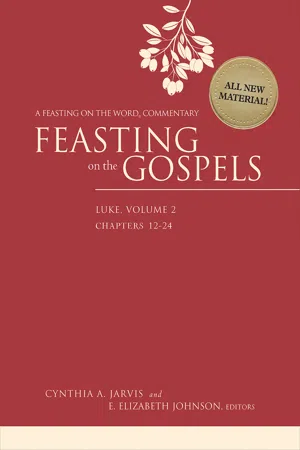
Feasting on the Gospels--Luke, Volume 2
A Feasting on the Word Commentary
- 368 pages
- English
- ePUB (mobile friendly)
- Available on iOS & Android
eBook - ePub
Feasting on the Gospels--Luke, Volume 2
A Feasting on the Word Commentary
About this book
Feasting on the Gospels is a new seven-volume series that follows up on the success of the Feasting on the Word series to provide another trusted preaching resource, this time on the most prominent and preached upon most preached upon books in the Bible: the four Gospels. With contributions from a diverse and respected group of scholars and pastors, Feasting on the Gospels includes completely new material that covers every single passage in the Gospels, making it suitable for both pastors who preach from the lectionary and pastors who do not. Moreover, these volumes incorporate the unique format of Feasting on the Word, giving preachers four perspectives to choose from for each Gospel passage: theological, pastoral, exegetical, and homiletical. Feasting on the Gospels offers a unique resource for all who preach, either continuously or occasionally, on the Gospels.
Information
Publisher
Westminster John Knox PressYear
2014Print ISBN
9780664259907
9780664235529
eBook ISBN
9781611645385
Topic
Theology & ReligionSubtopic
Biblical CommentaryLuke 12:1–12
1Meanwhile, when the crowd gathered by the thousands, so that they trampled on one another, he began to speak first to his disciples, “Beware of the yeast of the Pharisees, that is, their hypocrisy. 2Nothing is covered up that will not be uncovered, and nothing secret that will not become known. 3Therefore whatever you have said in the dark will be heard in the light, and what you have whispered behind closed doors will be proclaimed from the housetops.4”I tell you, my friends, do not fear those who kill the body, and after that can do nothing more. 5But I will warn you whom to fear: fear him who, after he has killed, has authority to cast into hell. Yes, I tell you, fear him! 6Are not five sparrows sold for two pennies? Yet not one of them is forgotten in God’s sight. 7But even the hairs of your head are all counted. Do not be afraid; you are of more value than many sparrows.8“And I tell you, everyone who acknowledges me before others, the Son of Man also will acknowledge before the angels of God; 9but whoever denies me before others will be denied before the angels of God. 10And everyone who speaks a word against the Son of Man will be forgiven; but whoever blasphemes against the Holy Spirit will not be forgiven. 11When they bring you before the synagogues, the rulers, and the authorities, do not worry about how you are to defend yourselves or what you are to say; 12for the Holy Spirit will teach you at that very hour what you ought to say.”
Theological Perspective
This is a particularly vexing text, both because verses 1–12 seem to pull in several different directions and because they describe a context that is alien to many Christians today, especially those living in a North American context. Throughout this chapter Jesus is preparing his listeners for the coming of God to judge and redeem, and instructing them on how to live in the light of that coming. In verses 1–12, directed to his disciples, he warns that everything is coming to light: the hidden will be revealed, whispers will become shouts; so the disciples should live forthrightly and not succumb to hypocrisy. He cautions them not to fear persecution, but rather to fear God’s judgment—all the while trusting that the judge is also the redeemer who fusses lovingly over even the hairs on their heads. Lastly he warns them not to close themselves off to the redeeming activity of God in the world and in their lives, lest they end up trapped in a hell of their own artifice.
It is important to acknowledge the significant contextual difficulties with this text. The presupposition of the presence of the Holy Spirit in the lives of the disciples suggests that this is a post-Easter text. Presumably it is written to a threatened community, a community sorely tempted to whisper in the darkness rather than shout from the rooftops, to fear persecution from secular and religious authorities, and to be wobbly in the face of the demand for public testimony to their faith. The parallels to the North American context, where Christianity remains a largely established (although arguably waning) element of the dominant culture, are difficult to maintain.
If anything, the temptations in our context are precisely the opposite of those described in verses 1–12. It is still culturally advantageous in many quarters to claim a Christian identity, so the threat of hypocrisy mutates; it is not that many who are in fact Christians will claim not to be, in order to evade persecution (as in Luke’s context), but rather that many who are not in fact Christians will claim to be, in order to enjoy the cultural benefits such an affirmation brings. Put another way, the threat of persecution is not a defining reality for many North American Christians—although it certainly is for some, as it clearly is for Christians in many other parts of the world. Perhaps, then, these are verses that relatively comfortable North American Christians need to “overhear,” as it were, calling us not only to reflect on our own (rather different) temptations to hypocrisy, but also to stand in solidarity with Christians whose contexts more directly reflect that of this passage.
Nevertheless, verses 4–7 certainly have relevance in a fear-stoked and fear-soaked culture. There may be little to fear in terms of state-sanctioned religious persecution in North America (annual screeds about the “secularization of our culture” notwithstanding). Nevertheless, surely our addictive consumer culture is a symptom of deep-seated fears: fear of loss—of vitality, power, opportunity—fear of aging, fear of failure, fear of missing out on the good life, fear of the “other” (variously defined according to political expediency), fear of death. It is significant that in this text Jesus does not exhort us to cast out fear altogether, but rather cautions us that our fear is misdirected.
It is tempting to succumb to an implicit dualism in the text: many things can kill the body, but it is the soul that ultimately matters, and only God can dispense with the soul. This reading can easily drift toward a gnostic dualism that denigrates the life of the body (and matter: an especially dangerous development, given our destructive relation to creation). Certainly many things can destroy the body, just as many things can warp the mind and fracture the psyche and unmake the personhood of a person. Here Jesus is affirming that there is a deeper kind of identity that only God can make, and that therefore only God can unmake.
In a world of increasing dehumanization, the fact that our identity is somehow tied up with God in a way that is inaccessible to (and therefore indestructible by) the world is itself good news. Thus God is the ultimate object of fear, because only God can ultimately make and unmake us. However, this same God cares for sparrows and counts the hairs on our heads, so fear in this case shades into reverence and awe rather than dread.
Verse 10 also presents a challenge in certain contexts. For Luke’s community this appears to be an admonition to those who are Christians—those who have received the Holy Spirit—to be true to that calling and not fall into apostasy in the face of persecution. It is significant that blasphemy against the Son of Man is forgivable, but blasphemy against the Holy Spirit is not (v. 10). If we take the Holy Spirit to be the judging and redeeming presence of God in the world and in our lives, then this makes sense. Certainly we can be forgiven for tangled theologies and misconceptions with regard to the person and work of Christ. Certainly we can be forgiven for any number of missteps and backslidings and exhibitions of the human propensity to sin and self-destruction.
However, if we cut ourselves off from the very source of forgiveness itself, how can there be forgiveness for that? If we finally close the door to the possibility of grace, then it may be that no redemption is possible, not because God withholds it, but because the only possible source of healing has been foreclosed. Of course this raises a host of thorny theological issues regarding election and predestination—protracted discussions of which do not a fine sermon make—but this text at least intimates the possibility that, as C. S. Lewis once put it, “the doors of hell are locked on the inside.”1
RICHARD FLOYD
Footnote
1. C. S. Lewis, The Problem of Pain (New York: Macmillan, 1944), 115.
Pastoral Perspective
How are the disciples of Christ to live, move, and have their being in a chaotic culture? The Gospel writer invites us to listen to the chaos of the crowd, of the thousands (literally ten thousand) as they yell, groan, and fight to eavesdrop on the words that Jesus is sharing with his disciples. Unfortunately, images of people seeking and desiring something so much that they trample one another come to mind too easily. Midnight sales on Black Friday, sports victories, concert halls, and blocked fire exits are all tragic locations or situations where people have trampled upon others in order to live.
If we are to surmise that the trampling crowd of thousands is present in the text for the sole purpose of seeing and hearing Jesus, it is an amazing irony. This irony is too often witnessed in our own congregations; for example, the perfectly abled congregant who has been seen parking in the handicapped location because it is closest to the sanctuary door; the rudely treated visitor who has mistakenly chosen to sit in someone’s sacred pew; or the frowning look on the parent who is trying to keep an infant silent during the worship service. Church members often step on one another in their effort to listen in on God’s word. Luke’s account of a mob trampling one another is a dramatic setup of Jesus’ warning to his disciples not to live a life that is hypocritical to the word of God. One cannot say, “I believe in Jesus Christ,” and then live a life that has little resemblance to life found in Jesus.
Historically, Luke may be addressing a congregation that is afraid to speak about Jesus because they might face punishment or death. In the face of persecution, it is easy to see how Luke’s congregation could have easily brought their testimony down to a sequestered whisper. Luke’s world seems a far cry from ours, where we are protected by freedoms of speech and religion. Even so, there are many pastors and church members who have suffered because they spoke of peace in a climate that was hell-bent on war. Churches have incurred great pain because they have stood up to a climate of fear with the message of the radical inclusiveness of God’s grace. Members have been excommunicated because they have chosen to love the wrong people. Because the bold proclamation of Christ comes with a cross to bear, it is much more comfortable to succumb to the temptation of hypocrisy and, like Peter, deny that you have ever met him (22:54–60).
Hypocrisy despite hearing the gospel will, according to the text, meet judgment. The covered will be uncovered. The secret will be made known. The whispered will be proclaimed. While there is a threat to the hypocrite—“whoever denies me before others will be denied before the angels of God” (v. 9)—the disciples of Jesus should take comfort in a God who takes a full account of their well-being: “But even the hairs of your head are all counted. Do not be afraid; you are of more value than many sparrows” (v. 7). Luke provides a hopeful account of the future. When you know your future, you can live your life in confidence.
Katherine, a young woman in my congregation, was diagnosed with cancer at a very young age. She fought the cancer with all the strength she could muster. She was one of the most honest people I have ever met. She openly struggled with trying to understand why she suffered. Katherine was not afraid to share her fears about life and death. There were times when she shared her anger about God. She shrank down to skin and bones; but what I found remarkable and most memorable is that she often greeted each day with the words, “This is the day that the Lord has made; let us rejoice and be glad in it” (Ps. 118:24). Even though there was not a hair on her head to be counted, it was a bold testimony to a God who is sovereign over all things.
Jesus is quite clear that the disciples should not be afraid to speak. Evident in this text is the desire of Luke’s Jesus to have his disciples testify. They are to acknowledge and speak about the one whom they follow. Is this possible in a culture that often hires a professional to do work that we once did for ourselves? We hire lawn services, painters, pet groomers, and anyone else who is far more talented in an area where we lack the gift. While hiring a professional may have a place in the culture, it does not have a place in the church. It is not uncommon for the pastor to be the only one who is called upon to pray. The pastor is called upon to teach. The pastor is called on to be the voice of the church in the community. This text invites everyone to be a voice or hand for God. Everyone is to have a voice in acknowledging the risen Lord. The pastor should seek the opportunity to persuade people to begin finding their voice in the proclamation of the gospel.
I remember the manager of a mission camp, hustling to get ready for the arrival of the next church mission team. He ordered plywood and shingles, pipes, wood, and wallboard. I had seen him prepare for other groups, and this seemed excessive. But he knew this congregation that was coming. They were up for the task. I figured that what made this mission team stand out was its skill, but he shook his head. He said that this is a group that “prepares devotionals, and shares their joys, struggles, and sorrows. They are not afraid to love the people with whom they work, and somehow or other it transfers into building houses better than any other group that comes up here.” Testimony to Jesus before others is far more than being a follower in name only; it is following him through word and deed.
DONOVAN ALLAN DRAKE
Exegetical Perspective
A Few Words of Caution. This Gospel lesson serves as a hinge text in the Lukan narrative. Not only does it indicate a new beginning in the travel narrative, but it also reflects back and continues Jesus’ tense relationship with the Pharisees; hence, the text begins with the temporal term “meanwhile” (v. 1). Jesus’ attacks on the Pharisees in Luke and the other Gospels have traditionally been misunderstood as Christian attacks on Judaism. When one fully recognizes the Judaism of Jesus and his first followers, however, one realizes that these attacks represent divisions within ancient Judaism itself and have no “anti-Jewish” intent. The reader is encouraged to keep this in mind when reading Jesus’ stark criticism of the Pharisees, which he made plain to the Pharisees and the lawyers in the previous pericope (11:37–54), and which he continues with his identification of them as hypocrites (v. 1).
Because the hostility regarding Jesus and his teachings is ever increasing, Jesus finds it necessary to provide some instruction about how the disciples are to prepare themselves for times of confrontation, public defamation, and perhaps even death. This text is the first of three strict warnings that Jesus gives to his disciples (12:1–12), and then to the large crowd (12:13–34, 35–48). What adds to the chaos of the scene is the fact that this crowd now includes those who question and deny Jesus’ authority and attribute his ability to perform miracles and healings to power he receives from Beelzebul (11:14–15). Yet Jesus persists. In the midst of, and in spite of, such a tension-filled environment, Jesus insists that they are to be fearless, vigilant, and, most of all, faithful.
A Private Warning against Hypocrisy (vv. 1–3). The crowd gathers with intention around Jesus so much that they trample on one another. Jesus takes a moment privately to caution his disciples about hypocrisy—that is, the hypocrisy of the Pharisees, as well as what could potentially be their own. Jesus refers to the Pharisees’ hypocrisy as “yeast,” a sour fermenting substance (actually fungi) used to make dough rise. In essence, Jesus is metaphorically stating that the Pharisees’ hypocrisy is so potent that it can even infect the disciples and incite the growth of hypocrisy within them. It is malignant and should be avoided at all costs. Additionally, Jesus advises them that this hypocrisy, although perhaps initially hidden, will nonetheless eventually be revealed (vv. 2–3; cf. Matt. 10:26–27). Another way to interpret this is that Jesus is referring to a person’s inner character; despite efforts to keep aloof and reserved, it will ultimately be revealed. Jesus implicitly states that they are to align themselves with God’s purposes, because their true nature, especially in the context of persecution, will in due course be disclosed.
Fear Not the Wrong Person (vv. 4–7). The hostility of the crowds is steadily increasing against Jesus and those who follow him; thus Jesus issues a warning regarding their possible harm. What is important to note is that Jesus is not concerned with such matters of human death as the how or the when (the why for them is their belief in Jesus), questions that plague the human psyche today. He does not offer any security or suggest any ways to protect oneself from bodily harm or death; that is the reality of their situation (cf. John 16:33).
Instead, what Jesus suggests is that they concern themselves with fearing God, the one who controls their fate after death. Death of the human body pales in comparison to death of the soul. God has the power to cast them into hell, the home of eternal damnation and punishment. This is certainly an important aspect of the text for those teaching or preaching about dealing with life’s tragedies.
Jesus ends his speech about whom to fear in a compounding manner that can lead to an ambiguous interpretation. On the one hand, he compares human life to that of a sparrow, in order to suggest that the former is of more value than the l...
Table of contents
- Cover
- Half-title Page
- Title Page
- Copyright Page
- Contents
- Publisher’s Note
- Series Introduction
- Luke 12:1–12
- Luke 12:13–34
- Luke 12:35–48
- Luke 12:49–59
- Luke 13:1–9
- Luke 13:10–17
- Luke 13:18–21
- Luke 13:22–30
- Luke 13:31–35
- Luke 14:1–6
- Luke 14:7–14
- Luke 14:15–24
- Luke 14:25–35
- Luke 15:1–10
- Luke 15:11–32
- Luke 16:1–13
- Luke 16:14–18
- Luke 16:19–31
- Luke 17:1–10
- Luke 17:11–19
- Luke 17:20–37
- Luke 18:1–8
- Luke 18:9–14
- Luke 18:15–17
- Luke 18:18–30
- Luke 18:31–34
- Luke 18:35–43
- Luke 19:1–10
- Luke 19:11–28
- Luke 19:29–40
- Luke 19:41–48
- Luke 20:1–8
- Luke 20:9–19
- Luke 20:20–26
- Luke 20:27–40
- Luke 20:41–47
- Luke 21:1–4
- Luke 21:5–8
- Luke 21:9–19
- Luke 21:20–28
- Luke 21:29–38
- Luke 22:1–6
- Luke 22:7–13
- Luke 22:14–23
- Luke 22:24–27
- Luke 22:28–30
- Luke 22:31–34
- Luke 22:35–38
- Luke 22:39–53
- Luke 22:54–65
- Luke 22:66–71
- Luke 23:1–12
- Luke 23:13–25
- Luke 23:26–31
- Luke 23:32–43
- Luke 23:44–49
- Luke 23:50–56
- Luke 24:1–12
- Luke 24:13–49
- Luke 24:50–53
- Contributors
- Author Index
Trusted by 375,005 students
Access to over 1.5 million titles for a fair monthly price.
Study more efficiently using our study tools.
Frequently asked questions
Yes, you can cancel anytime from the Subscription tab in your account settings on the Perlego website. Your subscription will stay active until the end of your current billing period. Learn how to cancel your subscription
No, books cannot be downloaded as external files, such as PDFs, for use outside of Perlego. However, you can download books within the Perlego app for offline reading on mobile or tablet. Learn how to download books offline
Perlego offers two plans: Essential and Complete
- Essential is ideal for learners and professionals who enjoy exploring a wide range of subjects. Access the Essential Library with 800,000+ trusted titles and best-sellers across business, personal growth, and the humanities. Includes unlimited reading time and Standard Read Aloud voice.
- Complete: Perfect for advanced learners and researchers needing full, unrestricted access. Unlock 1.5M+ books across hundreds of subjects, including academic and specialized titles. The Complete Plan also includes advanced features like Premium Read Aloud and Research Assistant.
We are an online textbook subscription service, where you can get access to an entire online library for less than the price of a single book per month. With over 1.5 million books across 990+ topics, we’ve got you covered! Learn about our mission
Look out for the read-aloud symbol on your next book to see if you can listen to it. The read-aloud tool reads text aloud for you, highlighting the text as it is being read. You can pause it, speed it up and slow it down. Learn more about Read Aloud
Yes! You can use the Perlego app on both iOS and Android devices to read anytime, anywhere — even offline. Perfect for commutes or when you’re on the go.
Please note we cannot support devices running on iOS 13 and Android 7 or earlier. Learn more about using the app
Please note we cannot support devices running on iOS 13 and Android 7 or earlier. Learn more about using the app
Yes, you can access Feasting on the Gospels--Luke, Volume 2 by Cynthia A. Jarvis,E. Elizabeth Johnson, Cynthia A. Jarvis, E. Elizabeth Johnson in PDF and/or ePUB format, as well as other popular books in Theology & Religion & Biblical Commentary. We have over 1.5 million books available in our catalogue for you to explore.