eBook - ePub
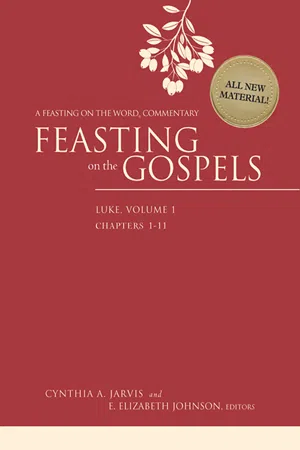
Feasting on the Gospels--Luke, Volume 1
A Feasting on the Word Commentary
- 368 pages
- English
- ePUB (mobile friendly)
- Available on iOS & Android
eBook - ePub
Feasting on the Gospels--Luke, Volume 1
A Feasting on the Word Commentary
About this book
Feasting on the Gospels is a new seven-volume series that follows up on the success of the Feasting on the Word series to provide another trusted preaching resource, this time on the most prominent and preached upon most preached upon books in the Bible: the four Gospels. With contributions from a diverse and respected group of scholars and pastors, Feasting on the Gospels includes completely new material that covers every single passage in the Gospels, making it suitable for both pastors who preach from the lectionary and pastors who do not. Moreover, these volumes incorporate the unique format of Feasting on the Word, giving preachers four perspectives to choose from for each Gospel passage: theological, pastoral, exegetical, and homiletical. Feasting on the Gospels offers a unique resource for all who preach, either continuously or occasionally, on the Gospels.
Information
Topic
Theology & ReligionSubtopic
Biblical CommentaryLuke 1:1–4
1Since many have undertaken to set down an orderly account of the events that have been fulfilled among us, 2just as they were handed on to us by those who from the beginning were eyewitnesses and servants of the word, 3I too decided, after investigating everything carefully from the very first, to write an orderly account for you, most excellent Theophilus, 4so that you may know the truth concerning the things about which you have been instructed.
Theological Perspective
It is a commonplace among Christians to regard the ancient texts of the New Testament as a transcendent source of revelation, a promise of salvation given under divine inspiration or intentionality, addressed to all human beings to reveal the faith. Yet even if we take the inspired character of the Gospels on faith, we do not forget that its texts—transcendent to a community of believers—are also historical documents, inscribed by human beings in the earliest moments of Christianity to deal with the tangled and conflictual tasks of church building, in lieu of well-settled doctrine, liturgy, or traditions. Considering this historicity, we must wonder at the opening of the Gospel of Luke with its dedication to a single person—a certain Theophilus. Brief reflection on the four-verse frame of this opening pericope—built around Luke’s address to Theophilus—tells us something about Luke’s skeletal theological method.
Who was Theophilus? His name appears at the opening of Luke, as well as that of its sequel, the Acts of the Apostles. However, we get precious little information on him. He might have been a real person, though centuries of exegesis, historical research, and archaeology have not revealed the identity of a historical Theophilus, any more than of a historical Luke. The alternative is that Theophilus is a figure of speech—a fictive character whose Greek name means “lover of God,” perhaps in the double-genitive sense of one who both loves God and is beloved of God.
To which reading do we incline? The Lukan author tells us only that Theophilus is a “most excellent” disciple, presumably in Luke’s circle, who has “been instructed” in the matters of his nascent faith, and that this Gospel was written so that Theophilus “may know the truth” more thoroughly than even his prior catechism (katēchēsis) had allowed. If Theophilus is a figural addressee, it follows that Luke—poetically, playfully—is pitching his opener to you: You, dear reader, are Theophilus, the “most excellent,” beloved-lover of God who is instructed, but yet incompletely. You are the Theophilus who needs to read this Gospel. Whether “Theophilus” was a budding early Christian, or a literary artifice to make us identify with the turns of his Gospel, Luke promises “him” nothing less than a true history of the Christian movement. In the long, solitary sentence spanning this short pericope, Luke gives us a taste of the dynamics of revelation, testimony, and theological traditioning that assured the place of this third of the four canonical Gospels in the history of Christianity.
Addressing Theophilus, Luke seems almost to be apologizing for throwing his lot into what has apparently become a cluttered field of early Jesus-movement histories. Yet his apology is necessary, for evidently early Christian teaching is still quite shaky in Luke’s view, and needs “an orderly account of the events that have been fulfilled among us” (v. 1). The rhetoric of the English/NRSV translation understates the more phenomenologically charged Greek language. The operative Greek verb in this verse (peplērophorēmenōn) is usually translated as “accomplished,” “fulfilled,” or “believed.” However, the compounding of plēro (“utterly, superlatively”) with phorēmenōn (“luminous or manifest event”) suggests that the events (pragmatōn) in question are not everyday sorts of happenings, but divine practices, originating in a transcendent source, and becoming realized in the phenomenal world. This is not the highly incarnate Gospel of John—with its lyrical declaration (John 1:1) that “in the beginning was the Word, and the Word was with God, and the Word was God.” Nevertheless, Luke’s first verses do likewise state that the theme of his Gospel is the spectacular revelation of God’s incarnation.
Nowhere does Luke imagine that the mere declaration of these great events could suffice to build up the new faith. Instead, he demonstrates the rudiments of a theological method that will become well entrenched in Christian communities over the next two thousand years. He immediately acknowledges that he is less the source of this testimony than a link in a traditioning of faith that has been “handed on to us.” The authenticity of this fledgling tradition is vouchsafed for Luke by two values: (1) the value of testimony from the original apostolic sources, “those who from the beginning were eyewitnesses and servants of the word” (v. 2); and (2) the value of careful historical research—“investigating everything carefully from the very first”—to vouch for the authenticity of the earliest witnesses, including sources with whom Luke undoubtedly had not spoken.
The idea of producing “an orderly account … so that you may know the truth” (vv. 3b–4a) could be advanced as the maxim that will guide theological reflection over the Christian centuries to come. In valuing “the truth,” Luke anticipates Anselm’s fides quaerens intellectum—the “faith seeking understanding”—that becomes a foundation for medieval theology. Moreover, in the value of an “orderly account” we see in embryonic form the Christian impulse to coherence and comprehensiveness that will gird the systematic theologies of the twenty-first century.
In a single sentence, Luke’s author presents the basic gestures of a foundational Christian theological method. Careful witness to the Word of God becomes a fundamental faith practice, ensconced as the essential, collective work of a Christian community. That practice promises to perpetuate the community by regularly rehearsing and remanifesting the revelatory truth that Luke will narrate in the chapters and verses to follow. Whether or not Luke is writing to a real-life Theophilus of his own times, or to us latter-day readers, it is clear that he is inviting us to become Theophili—beloved-lovers of God. He calls on us to respect the careful witness he has tried to array in his narrative of a revealed salvation history, and thus join in the unending project of those theologians who comprised the apostolic circle around Christ.
JORGE A. AQUINO
Pastoral Perspective
“It was a dark and stormy night …” “Call me Ishmael …” “A long time ago in a galaxy far, far away …” “In the beginning was the Word …”
It is worth remembering that as Christians our faith is not simply a collection of ideas or propositions or, for that matter, even a set of creeds or catechisms. Rather, we are inheritors of a story. In these opening verses of Luke’s Gospel the author tells Theophilus that he has decided to write an orderly report through which the truth may be known. How does Luke, who is neither an eyewitness nor an apostle, convey such truth? He tells a story: Once upon a time in a faraway land called Judea when Herod was king, there lived a man named Zechariah.
While our knowledge about Theophilus is limited, we know something about the diversity of the Greco-Roman world in which he lived. Even the Judaism of his day could hardly be called a monolithic entity. In a pentecostal world of varying beliefs, languages, and competing narratives that were held together by the metanarrative of the Pax Romana, Luke says to Theophilus, “Let me tell you my story, our story, and the lens through which we may make sense of the chaos of this world.”
In many ways our world is not that different from the world of Theophilus. There is no such thing today as “the” Christian experience, even if many wish it were so. We too live in a pentecostal world where other languages are spoken and other religions embraced. From capitalism to nationalism, competing stories and gods vie for our allegiance. In our postmodern world, what is “the” truth? Is there truth per se, or simply perspectives?
Undoubtedly congregations and their leaders will approach these questions in differing ways, but regardless of our differing perspectives, what we can do is tell our peculiar and particular story. We can borrow a page from Luke and say, “Yes, there are other accounts and other interpretations of that which has unfolded, but let me tell you our story as I have come to understand it after investigating everything carefully from the first.”
Whether we are pastors or teachers or congregational lay leaders, we are storytellers who invite others to participate in a drama that matters. During our “productions,” some of the chapters of the story are read aloud as we listen for the Word. At other times, we sing “the old, old story of Jesus and his love.” In the proclamation of the Word, the story is expounded upon and reexamined yet again for hints as to the living of our personal narratives. Holy Communion opens in the liturgical traditions with a Great Thanksgiving or a grand récit. It is our big story. It begins with creation and continues with the saints singing forever and ever amen. We remember the story of how our Lord took bread and broke it, and then we reembody that story so that we might become bread broken for the world and redeemed by his blood. Even in the rites of baptism, whether young or old, whether sprinkled or immersed, we are doing nothing less than weaving the story of an individual into the fabric of all those who have gone before us. It is a story of adoption and naming and grace and love.
This is our story. Our responsibility as congregational leaders is as simple as it is daunting: we are to help others live into our Christian stories, so that they might become part of the story; so that they might become a living, breathing sacrament of God’s grace.
Yet it is not just our faith communities who need to hear our foundational stories. Many Gen Xers and millennials believe the story of the church is one of hypocrisy, judgment, and irrelevancy. When asked about their religious affiliation, a growing number of young people respond by saying “none.” Their doubts about the institutional church notwithstanding, “nones” still hunger to be part of something larger. They still want to find their place in a story that matters. They still need to be reassured. Luke’s story is one where the poor, women, lepers, Samaritans, and other toys from the Island of Misfit Toys come to know that they too belong to the kingdom of God. There is not only room but a need for such a gospel of mercy in our world.
We live in a time when many of our congregations are hurting. Many of us are leaching members, some generations have all but disappeared from our pews, and we are unsure about how to fund our ministries. There is a yearning for the glory days of yesterday that are no more. In the midst of such change, our congregations need reassuring. So what will happen? How can the tide be turned? The answers are not clear. Perhaps we need to spend less time talking about doctrinal differences and more time sharing stories. Tell Luke’s story; tell our story; tell your story: tell the story of God’s redeeming love through which we make sense of the chaos of the world. After all, there was a time when Christianity was spread, not through force or coercion, but through the fascination and awe of a story. Whether we can rediscover and foster again such wonder may say much about the chapters that we have yet to write.
When we share our stories with others, we become part of their stories, and they become part of ours. Once Theophilus heard Luke’s story, he became part of that same story. What are the stories of and in your community? What stories have been forgotten or suppressed? What stories need to be sung aloud? As a congregational leader, how can you help others tell their individual stories, even as you ground them in that grand récit of grace in which we all participate? What stories of reassurance do they need to hear? What stories of challenge need to be uttered? Once upon a time there was a man named Luke …
JAMES R. LUCK JR.
Exegetical Perspective
Luke begins his Gospel (ca. 80–90 CE) with a formal prologue, a literary convention common among historians and other writers of his time. He is the only New Testament evangelist to do so. Matthew commences his narrative with a genealogy that stakes a claim for Jesus as the royal Davidic Messiah, Mark with a one-line heading that launches an apocalyptic tale told with thunder, John with a hymn that celebrates the dazzling glory of the man sent from heaven. The opening in each instance sets down markers of substance and style that inform the whole. Luke mentions his predecessors, alludes to his sources, touts his credentials as a longtime observer of events, acknowledges Theophilus, his patron, and states his basic purpose in writing. The style is elevated, the tone measured and self-assured. We are in the hands of a confident author who invites us, gently, into his narrative world.
Details and Puzzles. For a passage so brief, the prologue is surprisingly full of ambiguities that give rise to interpretive options and questions incapable of being resolved. Luke, for example, informs us that “many” prior to him had written about Jesus. How many we do not know, mainly because there is no way of telling how many writings failed to survive, but also because this sort of statement was common enough that it too may have been a literary convention.
However many prior authors there were and whatever the scope of their work, they depended on traditions handed on (orally) by eyewitnesses of Jesus’ career (v. 2). The authors were apparently not eyewitnesses, nor were the eyewitnesses authors, given that Luke seems to draw a distinction between those cited in verse 1 and those in verse 2. In any case, Luke himself is not an eyewitness but a third-generation Christian, as this passage and others indicate. As for the “eyewitnesses” and “servants of the word” who kept the Jesus tradition alive early on, it is unclear whether there was one group or two. Even if two, there is nothing to indicate, as some scholars have maintained, that the “servants” were charged with monitoring the accuracy of the tradition. They were involved in apostolic proclamation (Acts 13:5).
The most intriguing ambiguity in our text is Luke’s attitude toward his predecessors. He tells us they “have undertaken to set down an orderly account of the events that have been fulfilled among us” (v. 1). Does this imply Luke thought they failed? The very fact Luke felt compelled to compile an account of his own (v. 3) suggests that indeed he did, that at the very least he found the work of his predecessors inadequate and somewhat disordered. There is a bit of irony here. The one writing we are virtually certain Luke employed was the Gospel of Mark, and he followed its sequence closely, deviating from it only four times prior to the passion narrative. Luke made his major alterations in other ways: refining the prose, adding birth and infancy narratives, incorporating huge amounts of “new” teaching under the rubric of Jesus’ journey to Jerusalem, providing a distinctive passion narrative, enlarging the resurrection narrative, and, above all, writing a sequel of almost equal length, the Acts of the Apostles. If Luke imposes a new order on it all, a new pattern, it is not chronological but geographic. In the Gospel everything funnels into Jerusalem (9:51); in its sequel everything funnels out, “to the ends of the earth” (Acts 1:8).
Purpose. Luke’s stated purpose in composing his two-volume work is to provide Theophilus with a firm foundation for such instruction in the faith as he has already received (v. 4). (The NRSV renders asphaleia blandly as “the truth” [v. 4], but its fundamental meaning is “firmness, security.”) This raises tantalizing questions: (a) Why is it that Theophilus (about whom we know virtually nothing) and presumably others need to be reassured? (b) How is it that this immense two-volume undertaking is an appropriate vehicle for meeting that need?
An initial clue is tucked into the prologue, where Luke speaks of “the events that have been fulfilled among us” (v. 1). This turn of phrase is heavily freighted (cf. 1:20, 57; 2:6, 21, 22; 4:21; 9:31; 21:22, 24; 24:22, 44). It suggests that Luke views what transpired with Jesus, and what transpired with his followers right up through the mission to the Gentiles in Luke’s own day, as the fulfillment of God’s promises to Israel. Thus it seems Luke understands these events, and is about to narrate them, in the biblical mode.
That is just what he does. He writes a continuation of the biblical narrative, held together by a progression of prophecies and fulfillments. He reveres Jewish Scripture, makes use of quotations from it, and often adopts the style of the Septuagint. Not content with pericope or anecdote alone, he operates with a grand design. Reports, legends, sayings, itinerar...
Table of contents
- Cover
- Half-title Page
- Title Page
- Copyright Page
- Contents
- Publisher’s Note
- Series Introduction
- Luke 1:1–4
- Luke 1:5–25
- Luke 1:26–38
- Luke 1:39–56
- Luke 1:57–80
- Luke 2:1–7
- Luke 2:8–20
- Luke 2:21–24
- Luke 2:25–40
- Luke 2:41–52
- Luke 3:1–6
- Luke 3:7–14
- Luke 3:15–20
- Luke 3:21–22
- Luke 3:23–38
- Luke 4:1–13
- Luke 4:14–20
- Luke 4:21–30
- Luke 4:31–37
- Luke 4:38–44
- Luke 5:1–11
- Luke 5:12–16
- Luke 5:17–26
- Luke 5:27–39
- Luke 6:1–11
- Luke 6:12–16
- Luke 6:17–26
- Luke 6:27–36
- Luke 6:37–42
- Luke 6:43–49
- Luke 7:1–10
- Luke 7:11–17
- Luke 7:18–23
- Luke 7:24–35
- Luke 7:36–50
- Luke 8:1–3
- Luke 8:4–15
- Luke 8:16–21
- Luke 8:22–25
- Luke 8:26–39
- Luke 8:40–56
- Luke 9:1–9
- Luke 9:10–17
- Luke 9:18–27
- Luke 9:28–43a
- Luke 9:43b–50
- Luke 9:51–62
- Luke 10:1–16
- Luke 10:17–24
- Luke 10:25–37
- Luke 10:38–42
- Luke 11:1–13
- Luke 11:14–28
- Luke 11:29–36
- Luke 11:37–54
- Contributors
- Author Index
Trusted by 375,005 students
Access to over 1.5 million titles for a fair monthly price.
Study more efficiently using our study tools.
Frequently asked questions
Yes, you can cancel anytime from the Subscription tab in your account settings on the Perlego website. Your subscription will stay active until the end of your current billing period. Learn how to cancel your subscription
No, books cannot be downloaded as external files, such as PDFs, for use outside of Perlego. However, you can download books within the Perlego app for offline reading on mobile or tablet. Learn how to download books offline
Perlego offers two plans: Essential and Complete
- Essential is ideal for learners and professionals who enjoy exploring a wide range of subjects. Access the Essential Library with 800,000+ trusted titles and best-sellers across business, personal growth, and the humanities. Includes unlimited reading time and Standard Read Aloud voice.
- Complete: Perfect for advanced learners and researchers needing full, unrestricted access. Unlock 1.5M+ books across hundreds of subjects, including academic and specialized titles. The Complete Plan also includes advanced features like Premium Read Aloud and Research Assistant.
We are an online textbook subscription service, where you can get access to an entire online library for less than the price of a single book per month. With over 1.5 million books across 990+ topics, we’ve got you covered! Learn about our mission
Look out for the read-aloud symbol on your next book to see if you can listen to it. The read-aloud tool reads text aloud for you, highlighting the text as it is being read. You can pause it, speed it up and slow it down. Learn more about Read Aloud
Yes! You can use the Perlego app on both iOS and Android devices to read anytime, anywhere — even offline. Perfect for commutes or when you’re on the go.
Please note we cannot support devices running on iOS 13 and Android 7 or earlier. Learn more about using the app
Please note we cannot support devices running on iOS 13 and Android 7 or earlier. Learn more about using the app
Yes, you can access Feasting on the Gospels--Luke, Volume 1 by Cynthia A. Jarvis,E. Elizabeth Johnson, Cynthia A. Jarvis, E. Elizabeth Johnson in PDF and/or ePUB format, as well as other popular books in Theology & Religion & Biblical Commentary. We have over 1.5 million books available in our catalogue for you to explore.