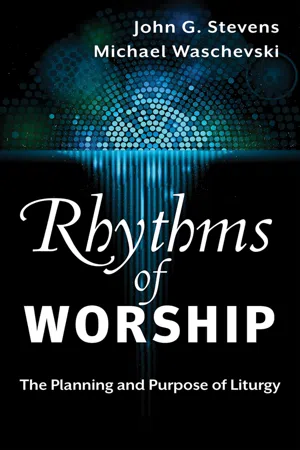
There are many books written for liturgical experts, but not many for laypeople. This book bridges that gap. In clear, everyday language, Waschevski and Stevens describe why Protestants worship and help to equip worship planners and leaders for excellence in their tasks. The authors explore the different elements of the worship service and how each expresses our Christ-centered faith. They also describe the feasts and festivals of the liturgical year, helping the reader understand and appreciate these special times and seasons in worship. An additional chapter considers music and arts in worship. Discussion questions at the end of each chapter invite discussion in local congregations. This book will be a valuable resource for pastors, worship committees, members, and all others who engage in worship planning and leadership.
eBook - ePub
Rhythms of Worship
The Planning and Purpose of Liturgy
- 96 pages
- English
- ePUB (mobile friendly)
- Available on iOS & Android
eBook - ePub
About this book
Information
Topic
Theologie & ReligionSubtopic
Christlicher DienstChapter One
The Order—Not Just a Grocery List
Take a look at your congregation’s worship bulletin. It is a description of what typically happens in your service of worship. First there is this, and then there is that. You begin at the top, and when you get to the bottom you are done. After socializing a bit, you can go home. Simple enough.
But worship is not just a random “grocery list” of things to do when we gather together. There is a dynamic, a flow, a sequence that makes worship meaningful and satisfying. There is a beginning, a middle, and an end. One action prepares for another, and that action flows into the next. When things are out of sequence, you sense that something is wrong. This isn’t just a matter of what you are used to. Something that is just stuck in somewhere is likely to violate the logic of worship. It will feel stuck in.
We are speaking here of the order of worship.1 The order makes sense. It follows an understandable sequence. It is similar to the order that is involved in going to dinner at the home of friends. You arrive at their house, go to the door, and ring the bell. The door opens, and there is a ritual of welcome, which continues as you enter their house and exchange comments and greetings that express the joy of being together and of sharing time with one another. This is followed by a time of conversation and visiting. Then you gather at the table and share the meal, enjoying the food and the company—an informal ritual celebrating the joy of life. Later there is a final ritual of departure at the door in which you express thanks and good wishes as you leave to go home. It just doesn’t make sense to reverse or mix up anything in this familiar sequence.
In the same way, there is a pattern of worship that reflects the church’s long history and tradition, a fourfold pattern that remains common within most mainline denominations:
1. Gathering in response to the love and invitation of God
2. Hearing and responding to God’s Word
3. Sharing the meal and giving thanks
4. Departing to serve God in the world
This common pattern is remarkably similar to the pattern of having dinner with friends. It too is a sequence that makes sense.
There is no need to start from scratch in order to establish the basic shape of a congregation’s worship. It does not need to be reinvented. It is a part of our heritage. Beyond this basic shape, or order, a congregation should give careful attention to its own denominational standards. There is just too much accumulated wisdom and experience in our denominational traditions to ignore.
Look again at your worship bulletin. In addition to major headings that reflect the fourfold structure of Christian worship and headings that indicate the specific actions within each of those sections, does the bulletin provide texts and tunes and actions to facilitate congregational participation? If the answer to this question is no, then your service has the character of a monologue. With the exception of the songs and hymns sung by the congregation and perhaps music provided by a choir or soloist, the only voice that is heard is the voice from the front, usually the voice of the pastor or worship leader. The congregation’s role is limited, passive, and submissive. But if the answer is yes, there is an expectation that the congregation is to participate actively in the service of worship. Every opportunity for the congregation to speak or sing or act in some particular way is in fact a kind of symbol that the people who have assembled for worship are invited and expected to participate actively (and probably not just in worship but also in the life of the congregation and in its witness and service to the world).
In this section, we have identified two important aspects of Christian worship. The first is its historic fourfold order, its overall sequence. The second is its interactive, responsive, participatory character. Both are crucial if the congregational worship we experience is to be as spiritually powerful and effective as it can be.
Worship forms us to live as disciples of Jesus Christ, here and now. In worship, God calls us into a disciple-forming dialogue, a living and continuing conversation. In worship we experience God’s welcome, grace, and love. In worship we are addressed, nurtured, equipped, and motivated to be God’s people, living our lives as part of God’s reign of love for all people and for the whole creation. Worship is not a time of escape from our real lives. It is not a fantasy journey into the long ago and far away. It is always a matter of what is happening now.
In the chapters that follow, we will consider what happens in each of the four major movements of a service of worship, looking at the content and dynamics of each segment. The purpose is to give a sense of the feel and function of each segment of the service of worship, and how it prepares for and flows into the next segment.
Questions for Reflection
1. What elements of the worship service are most engaging for you? Why?
2. Gather several weeks of your congregation’s worship bulletins. Do you find the order of worship fairly consistent or quite varied? Does your order of worship make sense to you? Why or why not?
3. Do you find major movements in your service of worship? Are they identified by understandable headings? How do they help identify where the service is going?
Chapter Two
The Gathering
Worship begins with gathering. That may sound overly simplistic, but it is actually very significant. Gordon W. Lathrop, a renowned Lutheran liturgical theologian, says simply, “The Church is an assembly of people. In order to have ‘church’ a group of people must first gather.”1
The elements that compose the gathering liturgy help us to move from our everyday activities and relationships into a time of gathering with others and centering on God’s presence and purpose. This transition actually begins before our arrival at the place of worship and well before the worship service itself begins. It includes washing and dressing, leaving home, traveling to the place of worship, greeting others who have assembled, and then settling into one’s pew or chair. Time has to be allowed for all these things to happen, even more so if one also has responsibilities such as serving as a greeter or an usher or singing in the choir.
The time for greeting that takes place before the service of worship begins is very important, and sufficient time should be allowed for it. Significant words are often exchanged during this time. Important information is shared. Support and encouragement are expressed. All these things, and more, are part of the formation of the community that has come together for worship. There may be some for whom the greeting time provides their one meaningful human contact for the week.
It is important that worship begin reliably on time. This means that one’s expected time of arrival should be comfortably earlier than the start of the service. Such an expectation can be an important part of a congregation’s worship education. This is not to make a fetish out of watching the clock. It is, rather, to encourage the members of the congregation to allow themselves sufficient time for their transition into worship before the service begins.
When the hour of worship arrives, a worship leader might welcome the congregation and share any information the congregation might need in order to participate meaningfully in the service. The leader might then say something like “Now let us prepare our hearts and minds to worship God together.” A musical prelude would naturally follow.
Or perhaps a short prelude might begin the service, with a note in the worship bulletin helping the congregation make good use of the prelude in preparation for the service. (For example: “Please use the prelude to make the transition from getting here to being here. Open yourself to the Spirit of God moving in our midst.”) The prelude might then be followed by a brief welcome from a worship leader and the sharing of any information the congregation would need in order to participate meaningfully in the service. Other announcements are best kept to a minimum so as not to derail the energy and the expectation that worship has begun.
Printed announcements in the bulletin or in a handout are effective ways of minimizing verbal announcements that do not pertain directly to the worship service itself. Opportunities and invitations for participation in the mission and ministry of the congregation make more sense later in the service as a response to the Word read and proclaimed.
The liturgy of gathering is and should be short and joyous, an affirmation of the gracious invitation of God. The call to worship proclaims the good news of God’s forgiving love for us and for all people. Selected verses of Scripture (often from Psalms or the Epistles) provide rich resources for the call to worship. The gracious invitation comes from God; praise and gratitude is our response. Therefore, the tone and mood that begin our worship should not be weak, apologetic, or tentative. God’s gracious love is the best news in the world!
The call to worship may be followed by a prayer of thanksgiving and a hymn, or a sung psalm, or another appropriate song of praise to God. Recalling and proclaiming the grace and goodness of God, our praise can then lead into confession and pardon. Because God’s loving grace is prior to our confession, we are freed from our defenses and can place ourselves in God’s holy presence with confidence—and without pretense. We have a history, we are just what we are, we are fallible, we are self-centered, and we are subject to the compromises and sins to which human life is prone. Yet God loves us still! We don’t need to wallow in our sense of sinfulness. We can simply come clean, be honest with God, and admit that as individuals and as members of families and communities and, indeed, as part of the church, we share the human condition and stand in need of God’s redeeming love and pardon.
Confession is followed immediately by the assurance of God’s pardon. Pardoned and reconciled with God, we are invited to be reconciled to one another. This movement of reconciliation—from Christ to us, and from each of us to those around us, and from all of us to the world—is often expressed in a liturgical action called the exchange of peace or the passing of the peace. It is the peace of Christ we are exchanging, not family news or a new recipe. This is not a coffee break in the midst of worship, but rather a significant theological and religious moment. We simply reach out to those around us in worship and say to them, “The peace of Christ be with you,” with the response, “And also with you.” We may also use other words appropriate to the message of forgiveness and reconciliation.
The liturgy of gathering may then appropriately conclude with the Gloria Patri,2 the Gloria in Excelsis,3 or other musical praises to God. In this way our sin, our confession, all our difficulties in all our relationships, and our prayers for pardon for all that is negative in our lives and in the church are taken up into God’s great love and grace given to us in Jesus Christ. We are now ready to turn away from our self-concern and to hear the word that God addresses to us today.
Questions for Reflection
1. What is your response to the suggestion that preparation for worship can begin even before one leaves home? How might we prepare ourselves to worship...
Table of contents
- Cover Page
- Halftitle
- Title
- Copyright
- Dedication
- Contents
- Acknowledgments
- Introduction
- 1 The Order—Not Just a Grocery List
- 2 The Gathering
- 3 Addressed by the Word
- 4 The Joyful Feast
- 5 Sent to Serve
- 6 Music and the Arts in Worship
- 7 Worship for Special Times
- 8 Celebrating Christmas (and Epiphany)
- 9 Advent as Preparation
- 10 Celebrating Easter
- 11 Lent and Holy Week: Journeying with Christ
- 12 The Great Fifty Days of Easter and Pentecost Day—Celebration Overflowing
- 13 Liturgical Odds and Ends: Meaningful Moments and Conversations
- 14 Is Worship Important?
- Notes
- Bibliography
Trusted by 375,005 students
Access to over 1.5 million titles for a fair monthly price.
Study more efficiently using our study tools.
Frequently asked questions
Yes, you can cancel anytime from the Subscription tab in your account settings on the Perlego website. Your subscription will stay active until the end of your current billing period. Learn how to cancel your subscription
No, books cannot be downloaded as external files, such as PDFs, for use outside of Perlego. However, you can download books within the Perlego app for offline reading on mobile or tablet. Learn how to download books offline
Perlego offers two plans: Essential and Complete
- Essential is ideal for learners and professionals who enjoy exploring a wide range of subjects. Access the Essential Library with 800,000+ trusted titles and best-sellers across business, personal growth, and the humanities. Includes unlimited reading time and Standard Read Aloud voice.
- Complete: Perfect for advanced learners and researchers needing full, unrestricted access. Unlock 1.5M+ books across hundreds of subjects, including academic and specialized titles. The Complete Plan also includes advanced features like Premium Read Aloud and Research Assistant.
We are an online textbook subscription service, where you can get access to an entire online library for less than the price of a single book per month. With over 1.5 million books across 990+ topics, we’ve got you covered! Learn about our mission
Look out for the read-aloud symbol on your next book to see if you can listen to it. The read-aloud tool reads text aloud for you, highlighting the text as it is being read. You can pause it, speed it up and slow it down. Learn more about Read Aloud
Yes! You can use the Perlego app on both iOS and Android devices to read anytime, anywhere — even offline. Perfect for commutes or when you’re on the go.
Please note we cannot support devices running on iOS 13 and Android 7 or earlier. Learn more about using the app
Please note we cannot support devices running on iOS 13 and Android 7 or earlier. Learn more about using the app
Yes, you can access Rhythms of Worship by Michael Waschevski,John G. Stevens in PDF and/or ePUB format, as well as other popular books in Theologie & Religion & Christlicher Dienst. We have over 1.5 million books available in our catalogue for you to explore.