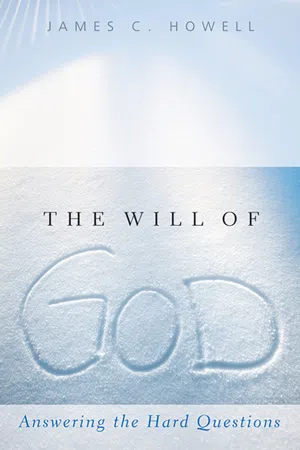
How are we to know the will of God? In this honest discussion, veteran pastor and theologian James C. Howell considers a number of issues relating to God's will, how it is known, how it is done, and how we respond when bad things happen and we feel God is absent or has turned away from us. In this sensitive presentation, Howell explores these questions and provides ways of recognizing the true things to which we can hold in the midst of hard times. Howell proceeds simply and practically to consider personal understandings of God, God's will for our lives, and ways in which God's will is lived. He reflects on what to do and believe when bad things happen, "why" they happen, and the quest for God in the midst of it all, recognizing that God's will is for good.
- English
- ePUB (mobile friendly)
- Available on iOS & Android
eBook - ePub
About this book
Information
Topic
Theology & ReligionSubtopic
Christian TheologyChapter One
The God Who Wills
Before we can say anything meaningful about the will of God, we have to ask, Who is God? and, What is God like? Sometimes we are tempted to say something or other about the will of God that frankly casts God as an unsavory brute, or as an iron-fisted despot, or as a conniving player of games. We need to say true things about God, and if we can divine who God really is, then we may as a natural reflex understand God’s will.
In the intellectual climate in which we have been reared, much like the philosophical world in which Christianity was born, God is defined with lots of words with the prefixes omni-, in-, and un- : omniscient, omnipotent, infinite, ineffable, unchanging. But do a string of grand adjectives tell the deep truth about God? In their effort to safeguard God’s greatness, do the omnis, ins and uns somehow throw a cloak over the heart of God? Does the Bible insist on so many expansive adjectives to explicate who God must be “by definition”?
The miracle of the Old and New Testaments seems to be that God is better than all the definitions. God is more like a story, a poem, an experience, intensely personal, breaking your heart and then thrilling your soul. Yes, God is all-powerful, but God’s power is consumed with love—and not some wispy, flighty kind of love, but love that is solid, strong, courageous, sorrowful, hopeful, joyful, enduring.
The phrase “God’s will” might feel like cold steel, an inflexible decree etched into time by a mighty potentate. But the will of the God of love is fraught with emotion. God is closer to me than my next breath, and God is determined to have a personal relationship with me. God loves me more than I love myself—and when you love, you will the good of the other person. You have desires for the one you love. You desire love from that person. You long for excellence in that person. God has wishes, God has a purpose, God makes choices, God is pleased (or displeased), God promises (and keeps promises), God delights, God grieves.
To know God’s will, we must know God’s heart. As shrouded in mystery and as occasionally baffling as God can be, we can know God’s heart—and perhaps it would be helpful to think back into the recesses of time to weigh what is in God’s heart.
When God Was Young
Let us go back to the beginning … or even before the beginning. Think back, far back in time, before your grandparents lived, before the great inventions of the modern world, before the Roman Empire, before the dinosaurs roamed the earth, before the big bang, or however it is you think the world came to be, before time itself, back when God was young.
God had a very important decision to make: “What kind of God am I going to be?” A perfectly understandable option would have been for God to settle on: “I’ll just be God”—and no one would have questioned God. But this God felt in God’s heart some urge to make something instead of dwelling in divine isolation, however splendid. That urge in God’s heart to make something is the beginning of the will of God. God willed to make something.
As we now know, God made something that is so mind-boggling, so grandiose and yet delicate, so ridiculously massive and yet unfathomably tiny, that you could spend your lifetime trying to comprehend it—and you would never get your mind around one millionth of it. God cast the galaxies across the expanse of space, God made this earth with a stunning array of life and wonder. You cannot begin to take it all in.
God decided to make something—but that wasn’t enough. As much as God delighted in constellations, nebulae, mountains, glaciers, forests, bacteria, orangutans, and wildflowers, God was lonely. Or so it seems: God wanted some creature with a peculiar affinity to God’s own heart. Having made something as extraordinary as the universe, God then made us. A woman, a man, a child, more women, men, children, and finally you, me, us.
At this crucial knot in time, God had another important decision to make: “How will I connect with these creatures that I’ve made?” God had a number of options. God could have said, “I will fashion a network of strings, and attach them to the heads, hands, and feet of each person. I will control them like marionettes, manipulating them so they will always do my will. They will never do wrong. They will never hurt one another. My will never will be left undone.” But God decided not to attach those strings to our heads, hands, and feet.
God could have said, “I will overwhelm them by my power. I will impress them with miracles repeatedly, I will make them tremble in awe so they dare not cross me. I will dazzle them with displays of my might, and guarantee that my will is done.”
But God decided to do something more impressive. Instead of manipulating us, instead of overwhelming us, God decided to love us. What a terrible risk for God to take! If you have done any loving, you know your heart gets broken. God wanted to love, God was and is love, so God took the risk, knowing full well that God’s heart would be broken. This was the most wonderful moment in the history of the universe: when God decided to love.
Looking back, we need not be surprised. God is love. God within God’s essence has never been anything but love. God was love when God was simply God. God was a communion of love, and when God made everything that was made, it was nothing but love. Dante called it “the Love that moves the stars.” Not to love would have been out of character for God. Manipulation and domination would have been impossible for God, since God is love.
When God was young, God courageously took on the risk of evil—and a hidden aspect of that risk was that God’s own self would be shrouded, concealed behind the smoke of God’s people behaving badly. God’s true self would be questioned and even disbelieved when God’s people couldn’t see God out in the open, running the show smoothly. It seems that God understood what was at stake, and risked everything anyway.
Perhaps God even anticipated how marvelous it would be when we did notice the love of God in the thick of mystery and even peril, and how the virtues of an open world, with light and shadow, with freedom squandered and then graciously returned, with love’s failure but then love’s restoration, outweigh what any other world might be like. Yet even if we wish the universe were different, at the heart of literally everything is this: God decided to love.
Is God in Control?
Funny thing about love: Love can do many things, but love never controls. Believers ask, “Is God in control? Surely God is in control!” But God is love and, as Paul wrote so eloquently, love “does not insist on its own way” (1 Cor. 13:5). God has something God wants you to do, to be; God very passionately wants things to turn out a certain way, a good way. This is because God loves. A God who loves cannot pervert love by acting as a tyrannical megalomaniac who must have his way or heads will roll.
Is God in control? In a way, yes—long-term, eventually; big picture, yes. But day in and day out, no, God does not control things that happen, or you and me. At times I do God’s will, but often I do not, and you don’t either. God chooses not to determine everything; love does not insist on its own way. So we cannot simply conclude that whatever happens equals God’s will. Lots of times God’s will doesn’t happen. Otherwise we wouldn’t need to bother hunting down terrorists or criminals (unless we want to reward them for doing God’s will). Otherwise we would simply go insane with rage against God every time a child dies.
If God loves more immensely than we can fathom, and yet if God does not insist on having God’s way in every little thing, then God’s heart is broken—all the time. Love “bears all things” (1 Cor. 13:7)—and we see this God of extraordinary grace grieving throughout the Bible, and throughout history. God waits, quietly, arms outstretched, pleading with us: “I was ready … to be found by those who did not seek me. I said, ‘Here I am’” (Isa. 65:1). Instead of huffing and puffing and blowing our house down, God stands at the door and knocks (Rev. 3:20).
But to say that God does not control everything, to say that God is not a divine manipulator begins to feel as if we are saying God is remote, God is uninvolved, God doesn’t care. Or else, God cares, but God is rather helpless, just standing by, shoulders slumped in exasperation on the sidelines when his team has just fumbled the game away. These feelings are understandable, palpable, and resonate in the aching heart. But God is far from uninvolved. God cares, more than you and I do.
God sees each one of us at every moment, with the intensity of a parent who looks up at the stage during a ballet recital: yes, there are two dozen ballerinas circling after an échappé, but the parent sees just one—my daughter, the love of my life. God, with extraordinarily focused panoramic vision, can pull this off for me, for you, for everybody else reading, those not reading, a few billion people simultaneously, not to mention my dog and the bird that just flew by my window. “His eye is on the sparrow, and I know He watches me,” as the old hymn put it.
Is God like a Parent?
But shouldn’t we feel a bit suspicious of this notion that God can be compared to a parent? Fond as many people may be of it, the idea of God-as-parent is riddled with difficulties. I cannot look at myself as an earthly father and say, “God must be like that.” God isn’t reducible to even the best humanity can muster. God is logarithmically beyond you and me on even our best days.
We cannot speak of God, as Karl Barth put it, by speaking of ourselves in a loud voice. God is so much greater, so unspeakably resplendent, so breathtakingly magnificent that our most cunning words, our most artistic painting, our most resounding symphony—the sum of all human genius—can only hint at a fraction of the wonder of God’s being. God truly is omniscient, omnipotent, infinite, ineffable, omnipresent; God is so … well, words fail us, as even the in-, un-, and omni- words crumble under the weight of God’s reality.
And yet, because God is all love before and after anything else, then God wants to be known, God wants a relationship, God wants to approach us and be approached by us. The way God does this is a mind-boggling surprise, and yet exactly what we would expect from a God who loves us. To understand God’s will, we can look into our own hearts, into our own minds; we can listen to our own bodies. We see plenty there that is not of God; and yet God invites us to look and listen.
And why? God tries to connect with us down here, across the huge chasm between us and God. How does God do it? Genesis tells us that God made us “in the image of God.” There is something in me that mirrors the mind and the heart of God. If I want to know the mind and the heart of God, I can look into my own mind and heart, and I can learn something there about God. God had to decide “What kind of God am I going to be?” You and I have to decide, all the time, “What kind of person am I going to be?” and so maybe from how we think about “What kind of person am I going to be?” or even “What is a parent like?” we can learn about how God decided to be one kind of God and not another.
I am a father. What kind of father will I be? Or, at this point, what kind of father have I been? The Apostles’ Creed speaks of God as the “Father Almighty”; and we could just as viably think of God as the “Mother Almighty.” But the one thing fathers (and mothers) like me down here on earth learn is that we are not almighty! I used to think I would be the kind of father who would shelter my children from all harm. What I have discovered is that the effort to shelter your children from all harm causes your children great harm.
I thought if I just hugged them enough, read to them every night, got them on the right team and with the right teacher, and if we did church, mission trips, prayer and Bible reading, they would turn out to be fantastic people—like following the recipe and baking a cake, perhaps? But then you discover that children are unique mysteries, and no formula can manufacture the person that fits your blueprint. They always surprise you, sometimes by breaking your heart, but other times by blossoming in some unimagined way.
I realize now I rather naively thought my children would always be with me, in my arms or holding my hand. But early on you hesitate but then relent, and you watch through tears as your child toddles off to day one of kindergarten, or you drive to a college campus and leave your child who’s no longer a child at all, and it feels as if it’s for good. Love lets the beloved child go, still loving, but letting go.
God really is a father, a mother to us. God gave us life, God loves. God is a spendthrift creator, not producing each of us as with a cookie cutter, or adding one by one as to a long line of toy soldiers. God weaves into each person’s DNA some dazzling potential for us to turn out not just one way but a dizzying number of ways, and God enjoys watching, waiting, groaning, and then laughing. God scoots us out into the world, hoping we will pay regular visits back home, and read the letters God has written, and live in a way that makes the family proud.
God is well aware that it’s dangerous out there. God made “out there”! But God decided: “I will not shelter them from all harm. What I will do is, I will love them; I will send my Son to be their brother. I will enter into their lives in such a powerful way that they can come to know my heart, so they can know my mind. And then they will know what I am calling them to do, and what my will for them is; and whenever they suffer, they can look to my Son.”
We cannot forget for a moment that God is almighty in a way human mothers and fathers are not. But then what does the almightyness of God look like? We see God’s might in God’s Son; we know what we know about the will of God by looking to God’s Son.
Jesus Is the Answer
One day this man named Jesus, who lived in the Middle East two thousand years ago, told his closest friends, “The one who sent me … is with me, for I always do what is pleasing to him” (John 8:29). You and I might fantasize about being able to say, “I always do what is pleasing” to God, but that would be fibbing. And yet we can still dream, can’t we?
Sometimes we debate God’s will, as if it is a memo God thought up just a few minutes ago. But to know God’s will, we Christians need to go back in time and get as close as possible to Jesus. Or perhaps in our own time we have come to discover a sense of the risen Christ’s presence. He is the ultimate embodiment of God’s will: he exhibited God’s will, spoke of it, fulfilled it. Jesus was, is, and always will be the will of God. God became flesh; so if you want to see God, start with your own heart, your own body—for we believe God took up residence in a body, with five senses, a heart, emotions, everything human in Jesus, who loved, laughed, desired, hungered, yearned, was disappointed, frustrated, and enraged, yet dreamed, wept, died, and finally leaped for joy.
Jesus is the answer to both our questions: What does God want me to do? and also, Why do bad things happen? as we will see. The more we know about Jesus, the more we focus on what Jesus did and said, on who he was (and is), the closer we will be to God’s will, the more clarity we will have about God’s will.
Not long before she died, Dorothy Day, one of the most stellar, down-to-earth, compelling Christians of the twentieth century, was asked to write some autobiographical reflections on her life. All she came up with was this:
The other day I wrote down the words “a life remembered,” and I was going to try to make a summary for myself, write what mattered most—but I couldn’t do it. I just sat there and thought of our Lord, and His visit to us all those centuries ago, and I said to myself that my great luck was to have had Him on my mind for so long in my life!1
We could shorten this book considerably and simply say, “Keep Jesus on your mind, and you will understand and do and be well within the will of God.” Of course, we need the real Jesus, not one we fabricate to suit our personal preferences. Jesus spoke, and his words rattle our complacent spirituality and turn our comfortable lifestyles upside down; but didn’t that voice from heaven say, “This is my Son, the Beloved … listen to him!” (Matt. 17:5)?
What did he say that could unveil God’s will for us? “Do not store up … treasures on earth” (Matt. 6:19). “Love your enemies” (Matt. 5:44). And when you have a dinner party, do not invite those who can invite you in return, but “invite the poor, the crippled, the lame, and the blind” (Luke 14:13). We may wish Jesus had not said so much, or perhaps that he had said something different. His words shock, jostle us off balance—and the mystery of God’s will is swept away into a cloud of flying dust every time we refuse him by saying, “Not your will, but my will be done.”
Jesus was more action than talk, and we might mimic Jesus: we see him touching the untouchable or feeding the hungry, and we go and do likewise with the best motives we can muster, with the humble confidence that we are in God’s will. We can even dare to go where Jesus’ closest friends failed to go, to the cross. We see his holy, beautiful hands, side, and feet pierced. We see him forgive those who just perpetrated this evil against him. We hear him welcome a common criminal into paradise. We are moved by his tender care for his mother watching her son die a horrific death. And we feel a profound understanding of suffering, evil, love, and God’s purpose building in our souls.
Jesus, too, had a choice to make. What kind of Son am I going to be? In recent years, those early gospels that didn’t make it into the Bible have gotten a lot of attention. “The Infancy Gospel of Thomas,” written perhaps more than one hundred years after our four Gospels, imagined Jesus trying to figure out what kind of kid he was going to be. A playmate poked fun at Jesus one day. Wielding not playground kid power, but divine power, Jesus waved his finger and struck the boy dead. Then, with the love of God rippling through his heart, he was filled with remorse. So he deployed that same power that struck the boy dead to raise him back to the land of the living. Jesus, in this legend, was trying to figure out, What kind of kid am I going to be?
Was Jesus’ Death God’s Will?
Jesus, perfectly mirroring God the Father, decided to be the kind of person who loves. The Gospel of John captures the essence of Jesus’ heart:...
Table of contents
- Cover Page
- Title Page
- Copyright
- Contents
- Preface
- Introduction
- Part 1
- Part 2
- Notes
Trusted by 375,005 students
Access to over 1.5 million titles for a fair monthly price.
Study more efficiently using our study tools.
Frequently asked questions
Yes, you can cancel anytime from the Subscription tab in your account settings on the Perlego website. Your subscription will stay active until the end of your current billing period. Learn how to cancel your subscription
No, books cannot be downloaded as external files, such as PDFs, for use outside of Perlego. However, you can download books within the Perlego app for offline reading on mobile or tablet. Learn how to download books offline
Perlego offers two plans: Essential and Complete
- Essential is ideal for learners and professionals who enjoy exploring a wide range of subjects. Access the Essential Library with 800,000+ trusted titles and best-sellers across business, personal growth, and the humanities. Includes unlimited reading time and Standard Read Aloud voice.
- Complete: Perfect for advanced learners and researchers needing full, unrestricted access. Unlock 1.5M+ books across hundreds of subjects, including academic and specialized titles. The Complete Plan also includes advanced features like Premium Read Aloud and Research Assistant.
We are an online textbook subscription service, where you can get access to an entire online library for less than the price of a single book per month. With over 1.5 million books across 990+ topics, we’ve got you covered! Learn about our mission
Look out for the read-aloud symbol on your next book to see if you can listen to it. The read-aloud tool reads text aloud for you, highlighting the text as it is being read. You can pause it, speed it up and slow it down. Learn more about Read Aloud
Yes! You can use the Perlego app on both iOS and Android devices to read anytime, anywhere — even offline. Perfect for commutes or when you’re on the go.
Please note we cannot support devices running on iOS 13 and Android 7 or earlier. Learn more about using the app
Please note we cannot support devices running on iOS 13 and Android 7 or earlier. Learn more about using the app
Yes, you can access The Will of God by James C. Howell in PDF and/or ePUB format, as well as other popular books in Theology & Religion & Christian Theology. We have over 1.5 million books available in our catalogue for you to explore.