Although this key Old Testament book is occasionally overlooked by Christians, Deuteronomy serves as an essential passing down to the next generations the fundamentals of faith as well as the parameters of life lived in accord with God's promises. Thompson provides theological perspectives on these vital themes and shows how they have lasting significance for Christians living in today's world. Thompson's sensitivity to the Jewish context and heritage and her insights into Deuteronomy's importance for Christian communities make this commentary an especially valuable resource for today's preacher and teacher.
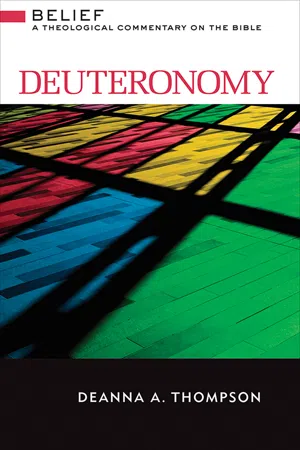
- 296 pages
- English
- ePUB (mobile friendly)
- Available on iOS & Android
eBook - ePub
About this book
In this fresh commentary, Deanna A. Thompson makes this important Old Testament book come to life. Recounting God's foundational relationship with Israel, Deuteronomy is set in the form of Moses' speeches to Israel just before entry into the promised land. Its instructions in the form of God's law provide the structure of the life that God wants for the people of Israel.
Information
Publisher
Westminster John Knox PressYear
2014Print ISBN
9781611643817
9780664233433
eBook ISBN
9781611643817
Topic
Theology & ReligionSubtopic
Biblical Commentary1:1–4:49
Moses’ First Speech: Retelling Israel’s Story
1:1–8
Resuming the Journey
The first chapter of Deuteronomy signals a different approach to telling the grand story of God’s liberating, covenantal relationship with Israel than is used in the first four books of the Pentateuch. In Deuteronomy, the story of God’s relationship with Israel is narrated primarily by Moses rather than by the omniscient narrator of Genesis, Exodus, Leviticus, and Numbers. In the opening verses of chapter 1, Moses stands before the Israelites in the wilderness and recounts for them the story of God’s past faithfulness to them. This is not a neutral retelling of Israel’s history; rather it highlights and clarifies the central theological theme of God’s faithfulness found throughout Deuteronomy.
The setting is “beyond the Jordan in the land of Moab” (v. 5), a land inhabited by the descendants of Lot’s son, Moab. The text notes that Moab is a mere eleven-day journey from Horeb (v. 2), which is the Deuteronomistic writer’s name for Sinai, the mountain where Moses was called by God to lead Israel (Exod. 3:1–12) and the place where he received the Ten Commandments (Exod. 31:18). But the people listening to Moses’ speech within the text—as well as the readers of Deuteronomy—know that despite their current proximity to Horeb, it actually took the Israelites forty years of desert wandering to arrive at their current location (v. 3). A central theme of this section and of the entire book is that Israel has not lived up to its side of the covenantal relationship it formed with God. This opening speech of Moses’ repeatedly emphasizes Israel’s rebellion, disobedience, and lack of trust in God’s covenantal claims, which led them to their many years of wandering the wilderness.
In verse 5, the Deuteronomistic writer uses the verb b’r, which means “to expound” or “explain,” to describe what Moses is doing in Deuteronomy with the law. As biblical scholar Robert Alter suggests, this one word also “provides a central rationale for the whole book.”1 The previous books of the Pentateuch have already set forth the teachings of the law. But in Deuteronomy, the repetition of torah becomes connected to the textual character not just of the law within the book of Deuteronomy but also with torah as it refers to all five books of Moses. The laws that God initially gave Israel are supplemented in Deuteronomy with further explanation of what it looks like to fulfill the law in the context of a land Israel can claim as its own.
“‘Resume your journey…. See I have set the land before you’” (vv. 6, 8). It is time for Israel to be on the move once again, up the east bank of the Jordan, headed toward Canaan, the land God has promised them. Moses insists that the time is now for the Israelites to live up to their side of the covenant they made with God and choose a life of obedience and blessing. Their location here is crucial; even as Israel is poised to enter a new future in a new land, these opening verses indicate that the Israelites can ill afford to forget their years in the desert or their years of enslavement before God freed them from Egypt. As Roman Catholic theologian Johann Baptist Metz discusses, memory is what gives human beings their historical identity. Metz writes, “Identity is formed when memory is aroused.”2 Moses’ act of remembering and retelling Israelite history, as Israel stands between its future and its past, makes an important theological point about Israelite identity: Israel’s relationship with the God who freed them from slavery is its identity, and after years of dishonoring that memory, it is time to remember, honor, and obey. Who they will be in the new land is bound tightly to who they were as God’s chosen people, enslaved and then freed.
The arc of Moses’ long struggle to lead this tiny band of people in remembering and honoring their past ends in Deuteronomy’s final chapter with his death on Mount Nebo, before he or anyone in Israel enters the land God has promised Israel. But here, in the opening chapters of the book, this central character of the Old Testament speaks to the people about their past, their present, and their future, leaving them with everything they need to become the people God calls them to be.
1:9–18
Expanding the Leadership
It is noteworthy that just after Moses’ rousing call to Israel to “resume [their] journey” toward Canaan, he immediately turns his attention toward expanding the leadership of Israel beyond himself. As we discussed in the introduction, the impending death of Moses before Israel enters the promised land is a theme that runs through the entire narrative. In this section, Moses’ move to expand the leadership marks the beginning of the transition of power that will be completed with his death.
Before shifting our attention to Moses’ expansion of leadership, however, it is important to notice the reference to blessing in verses 10–11. The claim “The Lord your God has multiplied you” confirms the fulfillment of God’s promise to Abraham in Genesis 15:5 and 22:17.
That God has been faithful to Israel in the past is a recurring theme throughout Deuteronomy. The words of Moses in verse 11, “‘May the LORD, the God of your ancestors, increase you a thousand times more and bless you as he has promised you!’” suggest God’s faithfulness in the past will also continue into the future. Further, that the Pentateuch begins with blessings recited throughout the book of Genesis and ends with Deuteronomy, where blessing again is a dominant theme, says that God’s saving activity of the exodus is set within the larger framework of God’s blessing for God’s people.3
Moses’ expansion of the leadership within Israel and the transition of power begin with Moses’ sharing the role of adjudicator of the disputes within Israel. In verses 12–18, we hear again the story of how Israel came to have judges as the Deuteronomistic writer recasts the stories of the judges from Exodus 18 and Numbers 11. While the three accounts of the story are similar in many ways, the differences offer clues about the theological agenda put forward in the book of Deuteronomy.
In Exodus 18, the story of the judges contains an important additional character not mentioned in Deuteronomy: Moses’ father-in-law, Jethro. In the Exodus version, Jethro visits Israel’s wilderness encampment and observes Moses playing the role of sole adjudicator of disputes for all the Israelites. Jethro tells his son-in-law, “‘You will surely wear yourself out…. The task is too heavy for you; you cannot do it alone’” (Exod. 18:18). Jethro urges Moses to find trustworthy men from among the Israelites who can help bear the burden of hearing the many cases of the Israelites. In Exodus, Moses heeds Jethro’s warning and selects “able men from all Israel” (18:25) to serve as judges.
A second version of the story appears in Numbers 11, where the Israelites are camped out close to Egypt and spend their days waxing nostalgic for the good old days of living in slavery in Egypt, where at least they were given fish to eat (Num. 11:4–6). In the Numbers version, Moses is the one complaining about the burden of leading this disgruntled group: “‘I am not able to carry all this people alone, for they are too heavy for me’” (11:14). In response to Moses’ plea, God proposes that Moses gather seventy elders of Israel upon whom God will “‘take some of the spirit that is on [Moses] and put it on them’” (11:17), allowing them to share the burden of adjudication with Moses. Moses follows God’s instructions and appoints the judges.
In Deuteronomy we hear the story a third time, and the differences in this version give us insight into the theological commitments behind Deuteronomy’s re-presentation of Israel’s history. Biblical scholar Martin Noth, author of the widely accepted Deuteronomistic History theory that argues for a Deuteronomistic author for Deuteronomy through Kings, proposed that the Deuteronomist often used a heavy editorial hand with the historical sources to which he had access. In this version the fact that there are too many Israelites (and too many disputes) for Moses to be the sole judge is offered as evidence of God’s rich blessings on Israel (v. 10). In contrast to the other two versions, Deuteronomy’s Moses is neither an overwhelmed adjudicator nor a complaining, reluctant leader. Instead he is portrayed as wise, respected, and in charge. He himself summons the tribes to elect fair judges, and the Israelites support him. In Deuteronomy, Moses is Israel’s wise and trusted leader, but his time has come to share the responsibility of leading Israel. That the book opens with Moses directing the election of judges also indicates the importance of life in the new land being ordered justly.
1:19–33
Israel’s Rebellious Refusal to Enter the Land
In Moses’ recounting of Israel’s history in Deuteronomy, we hear that God instructed the Israelites to travel from Horeb, where they received the Ten Commandments, to Kadesh-barnea, a place located in the hill country of the Amorites (v. 19). It is significant that Moses tells the people they must go and take possession of the land God has promised them while they are camped at Kadesh-barnea, for Kadesh represents an important place of failure for the Israelites. It is there that Miriam dies (Num. 20:1); it is there that Moses is reprimanded for striking the rock without invoking the name of the Lord (Num. 20:9–12); and it is there that Moses seeks permission to take Israel on the move through Edomite land and God rejects his request (Num. 20:14). This is the place where the entire generation of Israelites perished before they could stand before Moses at the edge of the promised land. These images of failure at Kadesh haunt the rest of chapter 1.
Verses 22–33 also offer a retelling of Numbers 13–14, and once again, Deuteronomy’s distinct accents in the story offer further insight into several key themes of the narrative. These verses continue to cast Moses as the faithful interpreter of the Lord’s covenantal promise to Israel. Here Moses tells the people, “‘See, the LORD your God has given the land to you: go up [from Kadeshbarnea], take possession, as the LORD, the God of your ancestors, has promised you’” (v. 21). Not only is Moses’ faithfulness stressed, but God’s fidelity is emphasized as well. It is up to Israel to live in faithful obedience in response.
After these reminders of God’s abiding care of Israel, Deuteronomy’s telling of the sending of spies from Kadesh, located just south of the promised land, into Canaan diverges significantly from its first telling in Numbers. In the Numbers version, God proposes that Israel send spies into Canaan. In Deuteronomy, the people propose the spying plan. In both stories, though, the spies return to Israel’s camp affirming the goodness of the land—”‘It is a good land that the LORD is giving us’” (Deut. 1:25). It is also the case that in both stories the Israelites express reluctance about going into the land. But in the Numbers version, the size of the inhabitants of Canaan lead Israel to complain, and they express a desire to be back in Egypt. Their complaints in turn make God angry, which prompts Moses into negotiating with God on Israel’s behalf. In Deuteronomy, which is likely first written during ...
Table of contents
- Cover
- Half-title Page
- Title Page
- Copyright Page
- Contents
- Publisher’s Note
- Series Introduction by William C. Placher and Amy Plantinga Pauw
- Acknowledgments
- Abbreviations
- Introduction: Why Deuteronomy? Why Now?
- 1:1–4:49 Moses’ First Speech: Retelling Israel’s Story
- 5:1–11:31 Moses’ Second Address: Reiterating the Role of Rules
- 12:1–26:19 A New Vision for a New Land: Comprehensive Covenantal Living
- 27:1–28:68 The Conclusion of Moses’ Second Address: What Will Israel Choose, Blessing or Curse?
- 29:1–32:52 Moses’ Third Address: The Covenant at Moab
- 33:1–34:12 Not Quite the Promised Land: God’s Faithfulness and Moses’ Death
- Final Thoughts
- For Further Reading
- Index of Scripture
- Index of Subjects
Trusted by 375,005 students
Access to over 1.5 million titles for a fair monthly price.
Study more efficiently using our study tools.
Frequently asked questions
Yes, you can cancel anytime from the Subscription tab in your account settings on the Perlego website. Your subscription will stay active until the end of your current billing period. Learn how to cancel your subscription
No, books cannot be downloaded as external files, such as PDFs, for use outside of Perlego. However, you can download books within the Perlego app for offline reading on mobile or tablet. Learn how to download books offline
Perlego offers two plans: Essential and Complete
- Essential is ideal for learners and professionals who enjoy exploring a wide range of subjects. Access the Essential Library with 800,000+ trusted titles and best-sellers across business, personal growth, and the humanities. Includes unlimited reading time and Standard Read Aloud voice.
- Complete: Perfect for advanced learners and researchers needing full, unrestricted access. Unlock 1.5M+ books across hundreds of subjects, including academic and specialized titles. The Complete Plan also includes advanced features like Premium Read Aloud and Research Assistant.
We are an online textbook subscription service, where you can get access to an entire online library for less than the price of a single book per month. With over 1.5 million books across 990+ topics, we’ve got you covered! Learn about our mission
Look out for the read-aloud symbol on your next book to see if you can listen to it. The read-aloud tool reads text aloud for you, highlighting the text as it is being read. You can pause it, speed it up and slow it down. Learn more about Read Aloud
Yes! You can use the Perlego app on both iOS and Android devices to read anytime, anywhere — even offline. Perfect for commutes or when you’re on the go.
Please note we cannot support devices running on iOS 13 and Android 7 or earlier. Learn more about using the app
Please note we cannot support devices running on iOS 13 and Android 7 or earlier. Learn more about using the app
Yes, you can access Deuteronomy by Deanna A. Thompson in PDF and/or ePUB format, as well as other popular books in Theology & Religion & Biblical Commentary. We have over 1.5 million books available in our catalogue for you to explore.