While there are many textbooks about the prophetic literature, most have taken either a historical or literary approach to studying the prophets. A Chorus of Prophetic Voices, by contrast, draws on both historical and literary approaches by paying careful attention to the prophets as narrative characters. It considers each unique prophetic voice in the canon, in its fully developed literary form, while also listening to what these voices say together about a particular experience in Israel's story. It presents these four scrollsâ€"Isaiah, Jeremiah, Ezekiel, and the Book of the Twelveâ€"as works produced in the aftermath of destruction, works that employ prophetic characters, and as the words uttered during the crises. The prophetic literature became for Israel, living in a context of dispersion and imperial domination, a portable and adaptable resource at once both challenging and comforting. This book provides the fullest picture available for introducing students to the prophetic literature by valuing the role of the original prophetic characters, the finished state of the books that bear their names, the separate historical crises in the life of Israel they address, and the "chorus of prophetic voicesâ€? one hears when reading them as part of a coherent literary corpus.
eBook - ePub
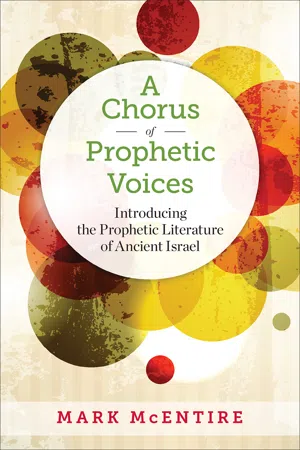
A Chorus of Prophetic Voices
Introducing the Prophetic Literature of Ancient Israel
- 272 pages
- English
- ePUB (mobile friendly)
- Available on iOS & Android
eBook - ePub
About this book
Information
Topic
Teología y religión1
Defining Prophetic Literature
Introducing the prophetic literature of the Old Testament should be a daunting task because it is a daunting collection. Its size, variety, and complexity have challenged every interpreter who has sought to make a coherent statement about this set of ancient scrolls that includes Isaiah, Jeremiah, Ezekiel, and the Book of the Twelve. The century of the historical-critical method’s dominance provided a fertile environment for introductions to the prophetic literature that attached the prophetic characters and various portions of their books to specific periods in Israel’s history. The great accomplishment of these efforts was the grounding of the Israelite prophets in the earthly world of politics, economics, war, and suffering. Materializing the prophets was an effective antidote to the church’s long-held tendency to spiritualize the words of the prophets and read them as a disparate collection of esoteric predictions of the distant future. To understand how this introduction operates and why it is organized in a particular way, it is necessary to review the story of the writing of introductions to the prophetic literature at the time of this focus on history, and follow the story to the present moment in the context of biblical studies.
APPROACHES TO INTRODUCING THE PROPHETIC LITERATURE
Two classic formulations of the historical approach serve to illustrate both its strengths and limitations. In 1967 the portions of Gerhard von Rad’s Old Testament Theology that addressed the Israelite prophets, primarily those in part 2 of volume 2, were excerpted and developed into an introduction to the prophetic literature.1 The English translation of this work was published under the title The Message of the Prophets and became a standard textbook on the subject for about a quarter century. After treating some introductory issues, the first prophet that von Rad’s work directly discussed was Amos, because he seems to have been the earliest, chronologically. The power of von Rad’s method is still evident in this discussion as it places this ambiguous prophetic figure within a moment of the development of Israel’s traditions when they needed radical critique, and the voice of Amos explodes in this context.2 Von Rad moved on to treat the other prophets that he placed in the same historical period—Hosea, Isaiah, and Micah. Another example of the historical/chronological approach is the first volume of Abraham Joshua Heschel’s classic work The Prophets: An Introduction, which begins with an introductory discussion of the nature of prophets and follows with individual chapters on Amos, Hosea, Isaiah 1–39, and Micah, before moving on to Jeremiah.3 Heschel did not treat all of the prophetic literature in this volume, but the parts he did examine are organized according to a historical scheme similar to the one used by von Rad.
Both of the major limitations of this approach to the prophetic literature arise from a division of the texts that departs from the form in which they are currently found in the canons of Judaism and Christianity. First, von Rad and Heschel separated a “book” like Amos from its place within the Book of the Twelve, between Joel and Obadiah, and they divided Isaiah into the three portions that had become standard by that time, stemming from the classic work of scholars like Bernhard Duhm and Karl Elliger.4 Hence the literary character of the final forms of the scrolls, and the relationship between the final forms and the individual texts of which they are composed, received little attention, if any. Both introductions had great difficulty in formulating any response to a question like “What is the book of Isaiah about?” The second limitation of a historical/chronological approach is the elevation of the prophetic figures themselves as the originators of the traditions, at the expense of those who composed the final forms, which were often works of artistic genius. Studies like von Rad’s followed the efforts of form criticism to get back to the original settings of the small units of prophetic speech, which were always understood to be the oral utterances of the named prophets. The placing of the prophets along a strict historical trajectory that ended in their supposed disappearance inevitably created a sense of decline in the quality of their collective work. In the historical-critical era the idea of decline was part of the scheme of Julius Wellhausen and other prominent scholars who saw a general decline in ancient Israelite religion, from the pristine morality of the eighth-century prophets to the stunted legalism of Second Temple Judaism. When they ignored the nature of the great prophetic scrolls as finished literary works, they missed the process of development of a great literary-theological tradition and saw only decline.5
At times von Rad tried to push back against the portrait of decline in his discussion of the prophets of the Persian period, but seemed to give up the point even as he started:
There can, of course, be no question of comparing messages of such matchless depth and range as those of Jeremiah, Ezekiel, and Deutero-Isaiah, each of whom represents a whole world of prophecy and theology, with those of Trito-Isaiah, Joel, Haggai, Zechariah, and Malachi. None the less we ought to be more chary of such summary judgments as “men of the Silver Age.”6
By contrast, an approach that begins with the final forms of the scrolls as literary works, recognizing that the last stage of their production is the one most responsible for how we view the whole, is more likely to see the prophetic tradition moving on an upward trajectory throughout these centuries, reaching the pinnacle of its power and creativity in the Persian period. Those whom the form critics judged to be of lesser ability were actually the ones who provided the view of their predecessors that makes them appear to be so powerful and profound. What von Rad identified so well as a “world of prophecy and theology” was the literary accomplishment of the end of the process.
A crucial shift in the reading of the prophetic literature took place in 1978, when Walter Brueggemann published The Prophetic Imagination. This groundbreaking book did not fit the format of an introduction to the prophetic literature, but it provided a new hermeneutical lens through which to read this literature. Brueggemann only began to apply this lens to a few prophetic texts in the book, but he and others have continued to use the approach much more broadly since then. In Brueggemann’s words, “The task of prophetic ministry is to nurture, nourish, and evoke a consciousness and perception alternative to the consciousness and perception of the dominant culture around us.”7 His understanding contends that the prophets were not just part of their own historical worlds, but also participated in an imaginative world that their own work helped to construct within the literature that presented them as characters.
Nevertheless, Brueggemann’s work should not be mistaken for an older view that the prophets were lone, detached, religious geniuses. Such an assumption had been present in the work of Walter Eichrodt, who understood the prophets as persons who were “freed from all ties of class or professional self-consciousness” and “capable of moving through life in majestic solitude.”8 The imaginative work of the prophets in Brueggemann’s understanding was deeply communal. This is why his continuing work throughout the remainder of the twentieth century could exist alongside and in important communication with the burgeoning sociological approaches championed by Norman Gottwald and Robert Wilson, which looked more broadly at human cultures and asked questions about the roles that prophets play within communities.9
Edgar Conrad’s Reading Isaiah, published in 1991, provides a superb example of how the ground was shifting beneath the study of the prophetic literature at the end of the twentieth century. Conrad’s work was a bold attempt to read the final form of the massive collection called Isaiah as a coherent literary work. He identified and called into question the assumptions behind historical-critical interpretive strategies, most significantly their tendency to place greater importance on materials that could be connected more directly to the great figures for whom the books were named, who had often been viewed through a “Romantic” lens.10 Instead, Conrad’s approach focused on the effects of reading Isaiah in finished form,11 but this is by no means an ahistorical reading of the text. Reading Isaiah very much depends on understanding the interactions between Israel and the other nations of that time, particularly Assyria and Babylon. The primary limitation of this work, however, is its examination of the book of Isaiah in relative isolation from the other components of the prophetic literature, particularly the Book of the Twelve, which address the same span of Israel’s story.
Another important step in this direction took place in 2002, when David L. Petersen published The Prophetic Literature: An Introduction. To my knowledge, this was the first full, book-length introduction to the prophets that devoted a separate chapter to each scroll. Petersen’s introductory chapter gives some attention to common features of the prophetic scrolls, and there are occasional references to how they might speak together, but for the most part the proclamation of each book is treated independently.12 In Petersen’s presentation the prophetic literature consists of four highly developed scrolls, each with its own powerful, literary voice, but they rarely get the opportunity to interact. Nevertheless, for an introductory textbook, this work brought the results of two decades of scholarship that had been shifting the emphasis away from a primarily historical approach that tended to fragment the prophetic scrolls, and toward one that could engage large, finished literary complexes.
Christopher Seitz’s 2007 work Prophecy and Hermeneutics: Toward a New Introduction to the Prophets seems to have been, in part, an attempt to address this transition. But the book’s preoccupation with defining a type of interpretation it calls “figural,” and with connec...
Table of contents
- Cover
- Half Title
- dedication
- Title Page
- Copyright
- Contents (Condensed)
- Contents (Full)
- List of Tables
- List of Discussion Boxes
- Preface
- Acknowledgments
- 1. Defining Prophetic Literature
- 2. The Scroll of Isaiah: Introduction and Response to the Assyrian Crisis
- 3. The Scroll of the Twelve: Introduction and Response to the Assyrian Crisis
- 4. The Scroll of Isaiah Continued: Response to the Babylonian Crisis
- 5. The Scroll of Jeremiah: Introduction and Response to the Babylonian Crisis
- 6. The Scroll of Ezekiel: Introduction and Response to the Babylonian Crisis
- 7. The Scroll of the Twelve Continued: Response to the Babylonian Crisis
- 8. The Scroll of Isaiah Continued Again: Response to the Restoration Crisis
- 9. The Scroll of Jeremiah Continued: Response to the Restoration Crisis
- 10. The Scroll of Ezekiel Continued: Response to the Restoration Crisis
- 11. The Scroll of the Twelve Continued Again: Response to the Restoration Crisis
- 12. Hearing the Scrolls Together
- Notes
- Index of Scripture
- Index of Modern Authors
- Index of Subjects
Trusted by 375,005 students
Access to over 1.5 million titles for a fair monthly price.
Study more efficiently using our study tools.
Frequently asked questions
Yes, you can cancel anytime from the Subscription tab in your account settings on the Perlego website. Your subscription will stay active until the end of your current billing period. Learn how to cancel your subscription
No, books cannot be downloaded as external files, such as PDFs, for use outside of Perlego. However, you can download books within the Perlego app for offline reading on mobile or tablet. Learn how to download books offline
Perlego offers two plans: Essential and Complete
- Essential is ideal for learners and professionals who enjoy exploring a wide range of subjects. Access the Essential Library with 800,000+ trusted titles and best-sellers across business, personal growth, and the humanities. Includes unlimited reading time and Standard Read Aloud voice.
- Complete: Perfect for advanced learners and researchers needing full, unrestricted access. Unlock 1.5M+ books across hundreds of subjects, including academic and specialized titles. The Complete Plan also includes advanced features like Premium Read Aloud and Research Assistant.
We are an online textbook subscription service, where you can get access to an entire online library for less than the price of a single book per month. With over 1.5 million books across 990+ topics, we’ve got you covered! Learn about our mission
Look out for the read-aloud symbol on your next book to see if you can listen to it. The read-aloud tool reads text aloud for you, highlighting the text as it is being read. You can pause it, speed it up and slow it down. Learn more about Read Aloud
Yes! You can use the Perlego app on both iOS and Android devices to read anytime, anywhere — even offline. Perfect for commutes or when you’re on the go.
Please note we cannot support devices running on iOS 13 and Android 7 or earlier. Learn more about using the app
Please note we cannot support devices running on iOS 13 and Android 7 or earlier. Learn more about using the app
Yes, you can access A Chorus of Prophetic Voices by Mark McEntire in PDF and/or ePUB format, as well as other popular books in Teología y religión & Crítica e interpretación bíblicas. We have over 1.5 million books available in our catalogue for you to explore.