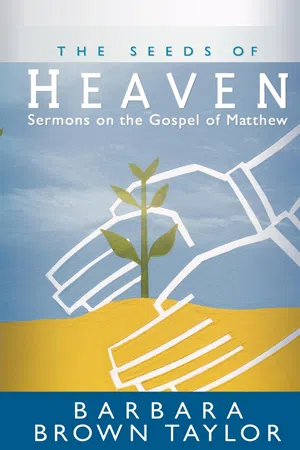
This wonderful collection of sermons by renowned preacher, author, and speaker Barbara Brown Taylor is based on the Gospel of Matthew. Each of the fifteen sermons, three of them appearing here for the first time in print, is based on a reading from Matthew, including "Exceeding Righteousness" (Matthew 5: 17-20), "The Problem with Miracles" (14: 13-21), "Family Fights" (18: 15-20), "Once More from the Heart" (18: 21-35), "Beginning at the End" (20: 1-16), and "On the Clouds of Heaven" (24: 29-44).
- English
- ePUB (mobile friendly)
- Available on iOS & Android
eBook - ePub
About this book
Information
Topic
Theology & ReligionSubtopic
Christian Ministry1
Exceeding Righteousness
“Think not that I have come to abolish the law and the prophets; I have come not to abolish them but to fulfil them. For truly, I say to you, till heaven and earth pass away, not an iota, not a dot, will pass from the law until all is accomplished. Whoever then relaxes one of the least of these commandments and teaches men so, shall be called least in the kingdom of heaven; but he who does them and teaches them shall be called great in the kingdom of heaven. For I tell you, unless your righteousness exceeds that of the scribes and Pharisees, you will never enter the kingdom of heaven.”
As the world grows smaller and followers of the world’s religions become literal next-door neighbors, the question of Christianity’s relationship with those neighbors gains urgency. What makes us like them? What makes us different? How do our beliefs affect our neighborliness? While it may take us a while to sort out our proximity to Hinduism or Taoism, our nearest neighbor is and always has been Judaism. We share Scripture. We share sacred sites. We share belief in the same God.
Ironically, it is this very closeness that has made us enemies over the years. We share one tradition that we interpret in different ways, because we do not share Jesus, or at least not as the Christ. His name divides Jews and Christians, the same way it divides the Bible in two. At issue is the Christian claim that Jesus is God incarnate, which for Judaism violates the first commandment. As I heard an Orthodox Jew say recently, “We believe in one God, period—no add-ons, no triumvirates.”
Early belief in Jesus’ divinity was based on many things. Even before his resurrection from the dead, there were miraculous feedings and healings. There were demonstrations of power over demons, storms, and even death itself. But just as important as those was the authority of his teaching, which sounded more like God to some of his listeners than what they were hearing from God’s authorized spokespersons. From the Sermon on the Mount to his teaching in the temple, Jesus said things that made people swoon—both with fervor and with disbelief—because he taught things contrary to Torah.
Some scholars note that he never contradicted written tradition—only the oral tradition of the Pharisees—but the fact is that much of what he said went beyond or around what God had said through Moses. Whether the subject was the primacy of the family or the observance of the Sabbath, Jesus had some disturbing things to say—things that finally got him and his followers excluded from the synagogue. In spite of the way some Christians tell the story, this happened not because the synagogue was narrow-minded or corrupt but because the synagogue was faced with a vital choice: to remain loyal to the word of God through Moses, or to believe that God was speaking a new, improved word through Jesus. The majority of the Jews stuck with Moses, while the followers of Jesus went on to gain many converts among the Gentiles.
Until that turn toward the Gentiles, proper observance of Torah was not a burning issue in the church. In some places, Jewish Christians observed Sabbath on Saturday and met to break bread on Sunday. Many kept the same dietary laws that they had always kept. But with the inclusion of Gentiles in the church, the whole body of Torah came under fresh scrutiny. What was essential and what was not? What constituted the minimum requirements for following a Jewish messiah, and what could be jettisoned as relics of the past? The Christian question was how to remain obedient to God in a changed world. The New Testament is the record of not one but several answers to that question, all of them conditioned by the belief that the end was coming very soon.
The Gospel of Matthew is one answer, in which Jesus insists that he has come not to abolish Torah but to fulfill it. As fresh as Jesus’ language sounded, as peculiar as the grammar of his life might seem, he did not intend to change one letter of the law, not one stroke of a letter, until all was accomplished. Jesus’ argument was not with Torah but with those who did not follow Torah. He was as committed to the practice of righteousness as any scribe or Pharisee. Indeed, he was more committed: “For I tell you, unless your righteousness exceeds that of the scribes and Pharisees, you will never enter the kingdom of heaven.”
This is a fascinating passage for all sorts of reasons. In the first place, it suggests that Jesus never intended to break with Judaism. If anything, he meant for his followers to become the most righteous Jews the world had ever seen. In the second place, the passage raises serious questions about Christianity’s dismissal of Torah. With the possible exception of at least eight of the Ten Commandments, most Christians no longer observe the law of Moses. We regard Torah as fundamental to Judaism, not Christianity. Jews believe in Torah. We believe in Jesus, who freed us from the law. Oh, really? Not the Jesus of Matthew 5. The Jesus of Matthew 5 came to fulfill the law, not to abolish it.
Matthew could have coined the phrase “Judeo-Christian tradition.” It summed up his understanding of Jesus as the Davidic messiah who had come to galvanize the people of God—not to choose a new people but to lead the already chosen people into the presence of God. No one was a greater champion of the Judeo-Christian tradition than Matthew.
So I am glad that he wasn’t around a couple of hundred years later when the Christian Bible was put together. I am glad that he wasn’t there to see his gospel set in a stack on the right (the New Testament), while all of his beloved sources—Isaiah, Deuteronomy, Exodus, the Psalms—were set on the left (the Old Testament). It meant that his project had failed. It meant that there was no Judeo-Christian tradition after all, but a Jewish one that had given rise to a Christian one, which had turned out so differently that it required a division in the book. The Torah of Moses on one side, the teaching of Jesus on the other—not one covenant but two, an old one and a new one—with some nonnegotiable differences between the two.
On the whole, I think, Christians have overlooked those differences more than Jews have. We continue to use the term “Judeo-Christian” as if the one tradition flowed smoothly into the next. The only way we can do that, however, is by hijacking Judaism. Too many of us equate the law of Moses with the law of sin and death. We proclaim Jesus as the giver of a new law—the law of love—an easy yoke to replace the hard one. Through his own life and death he showed us what true love—true obedience—looked like, and by raising him from the dead God made him the Lord and paradigm for all life.
This popular telling overlooks the fact that there are more than thirteen million Jews in the world today who do not experience Torah as the law of sin and death. For them, Torah is the way of life, granted by God within a covenant of pure grace. It is the incarnation of God’s love for humankind. It is the invitation to become holy as God is holy. Whether the yoke is easy or hard is not the point. The point is that it was given by God, as the crown and paradigm for all life.
So there is the choice, as Matthew’s community faced it. Which was the true paradigm for life: Torah or Christ? When Jesus said “Follow me,” instead of “Follow Torah,” he cut a new fork in the road. Weighing the alternatives, the majority of Jews decided to go on following Torah, while those who followed Jesus believed that they had found in him the embodiment of Torah. They were the ones for whom “Judeo-Christian” made sense. For the rest, there was no hyphen between the two, but only a slash, as in “either/or.”
As hard as Matthew worked to stress the continuities, there were discontinuities as well. It helps to remember that there was no one Judaism in Jesus’ day. There was the Judaism of the Galilee, which leaned toward the prophets, and the Judaism of Judea, which leaned toward the Temple. There was the Judaism of the Pharisees, who loved oral interpretation of Torah, and there was the Judaism of the Sadducees, who did not. There was the Judaism of Hillel, who taught that righteous Gentiles could enter the kingdom of heaven, and the Judaism of Shammai, who taught that they could not.
In this first-century stew of Jewishness, Jesus was one teacher among many with his own little-t torah—his own teaching about the capital-T teaching of Torah. On some points, his torah was very strict. He deepened the prohibition against murder to include anger, and the one against adultery to include lust. He narrowed the ground for divorce to unchastity, and said that remarriage after divorce was the same as sleeping around. On other points, his torah was very relaxed. As a Galilean, he was not scrupulous about some of the purity laws that chiefly concerned the priesthood in the Temple, and he was famously critical of the Pharisees’ oral extension of the law.
When they questioned him about his disciples’ poor handwashing techniques, they cited “the tradition of the elders”—for them, an oral tradition that was as old as Sinai and just as authoritative, but for other Jews, including Jesus, a strictly Pharisaic tradition that was not normative for everyone. There is nothing in the Torah of Moses about laypersons washing their hands before meals, Jesus pointed out to his critics, but the deeper question was one of authority that was not so easily settled.
On this point as well as others, Jesus was a fundamentalist. His teaching concerned what was written in Scripture, and he was skeptical of those who embellished it. But he was equally skeptical of those who gave every line of Scripture the same weight. Like other Jewish teachers of his time, he applied the hermeneutical principle of “light and heavy” to biblical commands. As far as he was concerned, the weightier matters of the law were justice and mercy and faith (Matt. 23:23). The lighter weight jots and tittles were not to be neglected, but neither were they allowed to get in the way. When obeying a light law got in the way of obeying a heavier law, then light yielded to heavy, so that God’s will might be fulfilled.
So which was heavier, ritual cleanliness or open table fellowship? Open table fellowship, Jesus taught. Healing a withered hand or Sabbath observance? Healing a withered hand, Jesus taught. And that, of course, was where the trouble started. Who says what is light and what is heavy? By what authority are such judgments made? It was Jesus’ answers to those questions, and not his violation of the law, that got him set outside the synagogue. After announcing his total loyalty to Torah in the middle of Matthew 5, Jesus went on to say—not once but six times—“You have heard that it was said . . . But I say to you . . .” If he had been offering an improvement on the teaching of other rabbis, then the formula might not have been shocking, but he was not. He was offering an improvement on the teaching of God through Moses. By what authority did he do such a thing?
“But I say to you,” he said. He did it by his own authority, and when he was through there was a clear fork in the road. One way led to following Torah as it had been revealed by God to Moses. The other way led to following the teaching of this man, who claimed dominion over Torah itself—not against it, but over it—with God’s own power to say what was heavy and what was light in the doing of God’s will.
“Think not that I have come to abolish the law and the prophets; I have come not to abolish them but to fulfil them.” Whether you attribute that pronouncement to Matthew or to Jesus, the truth of it lies in the word “fulfil,” a word Matthew uses sixteen times in his Gospel to describe how Jesus brought Scripture to life. Jesus did this not by acting it out exactly as it was written on the page, but by acting like the one to whom all Scripture pointed. He did it by acting as God’s son. For those who followed him, Jesus did not recite Torah; he was Torah. In his words and in his deeds, he was the living justice, mercy, and faith of God. Jesus did not interpret Torah; he fulfilled Torah in his flesh, and he promised those who followed him that they could fulfill it too. By example, he taught his followers that there would be times when this fulfillment would go further than the Torah on the page—that was the dangerous part. There would be times when the deepest possible obedience to God would look like disobedience to the keepers of the traditions of the elders, and no amount of arguing would settle the dispute about which commands were weighty and which were light.
This dangerous teaching of his—and our equally dangerous decision to believe it—still reverberates in our life together. It still fuels many of our church fights about how to remain obedient to God in a changed world. Do we follow the Torah on the page or the torah we are led to by the spirit of Jesus? By what authority does any of us challenge the tradition of our own Christian elders?
The same teaching also fuels the ongoing division between us and our first cousins the Jews. We share Scripture. We share sacred sites. We share belief in the same God, but we do not share Jesus, who taught a different torah from the Torah of Moses. For Jews, it is too light. For Christians, it is weighty—not the abolition of the law and the prophets but the fulfillment of them, in a life and death that lifted Torah off the page.
While we honor the commitments that divide us—both in the church and between church and synagogue—it would be good to remember that we share one more thing, and that is a call to exceeding righteousness. “For I tell you, unless your righteousness exceeds that of the scribes and Pharisees, you will never enter the kingdom of heaven.”
In the best of both our traditions, this righteousness has never been a matter of following rules but of honoring relationships—with aliens as well as kin, with enemies as well as allies. The Torah of Moses and the torah of Jesus both agree on that. When we honor our neighbors—when we love them as ourselves—then, and only then, are we ready to discover what the law, the prophets, and the gospel are all about.
2
The Marginal Messiah
Now when John heard in prison about the deeds of the Christ, he sent word by his disciples and said to him, “Are you he who is to come, or shall we look for another?” And Jesus answered them, “Go and tell John what you hear and see: the blind receive their sight and the lame walk, lepers are cleansed and the deaf hear, and the dead are raised up, and the poor have good news preached to them. And blessed is he who takes no offense at me.”
As they went away, Jesus began to speak to the crowds concerning John: “What did you go out into the wilderness to behold? A reed shaken by the wind? Why then did you go out? To see a man clothed in soft raiment? Behold, those who wear soft raiment are in kings’ houses. Why then did you go out? To see a prophet? Yes, I tell you, and more than a prophet. This is he of whom it is written, ‘Behold, I send my messenger before thy face, who shall prepare thy way before thee.’ Truly, I say to you, among those born of women there has risen no one greater than John the Baptist; yet he who is least in the kingdom of heaven is greater than he.”
Most Christians are so familiar with the name “Jesus Christ” that it is easy to forget what a hard-won combination that was at first. Based on evidence that can be found in the New Testament, there were at least two early candidates for the job of Christ: Jesus the carpenter’s son and John the Baptist, whom many believed to be the true Messiah of God. According to Luke, John’s birth was also a miraculous one announced by the angel Gabriel. John was furthermore descended from priests on both his mother’s and his father’s sides, which meant that he wasted no time at all as a woodworker’s apprentice. John was an evangelist from the word go.
While Jesus sat down to fancy suppers in town with people who drank too much and laughed too loud, John lived an austere life in the wilderness with his equally austere disciples. If he found something to eat, he ate. If he didn’t, he didn’t. He avoided alcohol altogether, the same way he avoided anything that might soften the sharpness of his focus on God.
Everything about John set him apart as a holy man: his way of life, his clothing, and above all his message. No one had heard anything like it in five hundred years. Ever since the time of Ezra and Nehemiah, the land of Israel had been passed from one superpower to another—from Greece to Egypt to Syria to Rome. The promised land had become a tarnished trophy handed from one empire to the next. The chosen people had become a conquered people, whose value lay chiefly in their ability to pay taxes. What was missing in all of this was any reaction from God. Hello? Is anybody there?
Where were the prophets who had once spoken for God to the people? Where was Nathan, opening King David’s heart to the full impact of his affair with Bathsheba? Where was Elijah, calling down fire from heaven so that no one who saw it could doubt the power of God? Where was Amos, shouting himself hoarse about God’s disgust with Israel’s obscene wealth and empty religion?
Those voices had been missing in Israel for a long time when John the Baptist appeared...
Table of contents
- Cover
- Half title
- Title
- Copyright
- Contents
- Preface to the New Edition
- Introduction to the 1990 Edition
- 1. Exceeding Righteousness
- 2. The Marginal Messiah
- 3. The Open Yoke
- 4. The Extravagant Sower
- 5. Learning to Live with Weeds
- 6. The Seeds of Heaven
- 7. The Problem with Miracles
- 8. Saved by Doubt
- 9. Crossing the Line
- 10. God’s Rock
- 11. Risking Life
- 12. Family Fights
- 13. Once More from the Heart
- 14. Beginning at the End
- 15. On the Clouds of Heaven
Trusted by 375,005 students
Access to over 1.5 million titles for a fair monthly price.
Study more efficiently using our study tools.
Frequently asked questions
Yes, you can cancel anytime from the Subscription tab in your account settings on the Perlego website. Your subscription will stay active until the end of your current billing period. Learn how to cancel your subscription
No, books cannot be downloaded as external files, such as PDFs, for use outside of Perlego. However, you can download books within the Perlego app for offline reading on mobile or tablet. Learn how to download books offline
Perlego offers two plans: Essential and Complete
- Essential is ideal for learners and professionals who enjoy exploring a wide range of subjects. Access the Essential Library with 800,000+ trusted titles and best-sellers across business, personal growth, and the humanities. Includes unlimited reading time and Standard Read Aloud voice.
- Complete: Perfect for advanced learners and researchers needing full, unrestricted access. Unlock 1.5M+ books across hundreds of subjects, including academic and specialized titles. The Complete Plan also includes advanced features like Premium Read Aloud and Research Assistant.
We are an online textbook subscription service, where you can get access to an entire online library for less than the price of a single book per month. With over 1.5 million books across 990+ topics, we’ve got you covered! Learn about our mission
Look out for the read-aloud symbol on your next book to see if you can listen to it. The read-aloud tool reads text aloud for you, highlighting the text as it is being read. You can pause it, speed it up and slow it down. Learn more about Read Aloud
Yes! You can use the Perlego app on both iOS and Android devices to read anytime, anywhere — even offline. Perfect for commutes or when you’re on the go.
Please note we cannot support devices running on iOS 13 and Android 7 or earlier. Learn more about using the app
Please note we cannot support devices running on iOS 13 and Android 7 or earlier. Learn more about using the app
Yes, you can access The Seeds of Heaven by Barbara Brown Taylor in PDF and/or ePUB format, as well as other popular books in Theology & Religion & Christian Ministry. We have over 1.5 million books available in our catalogue for you to explore.