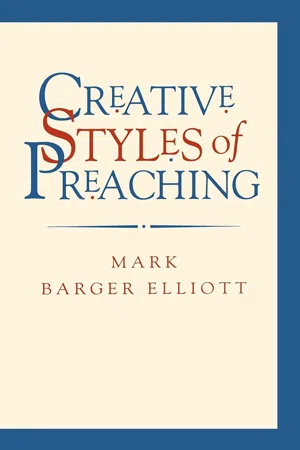
This useful book on newer preaching styles is designed for students and experienced clergy alike. It consists of nine chapters, each treating a different contemporary approach to preaching, such as Narrative, Evangelistic, African American, Topical, Pastoral, Biblical, Literary, and Imaginative styles. Each chapter is illustrated by sermons from well-known preachers. This book will prove an invaluable travel guide to the homiletical landscape, and it will aid pastors who want to keep their sermons fresh, invigorating, and relevant to the life experiences of their congregations.
- English
- ePUB (mobile friendly)
- Available on iOS & Android
eBook - ePub
Creative Styles of Preaching
About this book
Information
Topic
Theology & ReligionSubtopic
Christian MinistryChapter 1
Narrative Preaching
If we were pressed to say what Christian faith and life are, we could hardly do better than hearing, and living a story. And if asked for a short definition of preaching could we do better than shared story?
Morris J. Niedenthal and Charles L. Rice1
Introduction
Charles Campbell places the origin of narrative preaching with H. Grady Davis, who wrote in 1958 that “we preachers forget that the gospel itself is for the most part a simple narrative of persons, places, happenings, and conversation.”2 In the past forty years, homileticians including Fred Craddock, Edmund Steimle, and Eugene Lowry have absorbed Davis’s observation and fashioned what is called “narrative preaching,” a style that recognizes the power of stories to shape and nurture our faith.
But even after forty years, confusion still exists as to what classifies a sermon as “narrative.” Is it a twenty-minute story that alludes to a scripture text? A loosely connected series of illustrations that relate to one another like reports on the evening news? A first-person sermon with costume and headdress? In his essay, “Narrative and Preaching: Sorting It Out,” John McClure lists four types of “narrative preaching.”3 McClure’s categories are, of course, broad, but they are helpful in suggesting models one might appropriate if wishing to preach narratively.
The first type of narrative preaching occurs when the “narrative aspects of the Biblical text are related in some way [to the sermon].” In other words, narrative preaching includes sermons in which the form of the sermon is intentionally shaped by the form of a narrative text. A second type, suggests McClure, comes from sermons that follow the structure of a short story or movie. Edmund Steimle observes that, “Every sermon should have something of the dramatic form of a play or short story: tightly knit, one part leading into and dependent upon the next, with some possibility of suspense and surprise in the development.”4 In recent years, Eugene Lowry has developed Steimle’s proposal into the “homiletical plot.”
A third classification for narrative preaching, notes McClure, is when “preachers are told to use their imagination and learn to think metaphorically in order to name grace in human experience.” In this model the sermon is shaped not only by the genre of story, but by the preacher’s imagination. Fred Craddock, for example, maintains that inductive preaching and the work of the imagination are more effective in communicating the gospel than a deductive model based on argument. McClure’s final category stresses the potential for narrative to shape a church’s theological worldview—in other words, sermons that refer to “faith-stories that are generated in a congregational context.” Edmund Steimle, in the book Preaching the Story, writes of such a style where a sermon is defined by the intersection between the world of the preacher, the congregation, and the biblical text.
While most people have applauded the work of Craddock, Steimle, and Lowry, others in recent years have questioned its theological implications. Charles Campbell, for example, has argued that narrative preaching, while full of good intentions, overemphasizes the human “story” at the cost of the “story” of Jesus Christ. “The problem,” writes Campbell, “is that up until now narrative homiletics has provided no resources for thinking carefully about the ways preaching contributes to the upbuilding of the church . . . beyond the individual hearer.”5
In this chapter, Thomas Long offers questions that assist in unpacking the particular literary characteristics of a narrative text; Eugene Lowry describes “the homiletical plot,” as well as specific designs for narrative sermons; Fred Craddock clarifies what makes a sermon “inductive”; Edmund Steimle suggests intersections a narrative preacher might observe; and Charles Campbell points to where a narrative sermon might go astray.
Thomas G. Long: Preaching a Narrative Text
Sunday morning scripture selections usually head straight for the narratives: Joseph and his brothers, Jacob wrestling with the angel, Jesus and the wedding at Cana. Narratives offer the preacher raw material from which to craft a sermon: characters, conflict, and actions and words that can be interpreted. But to preach a narrative text faithfully, Thomas G. Long suggests we need to attend to the specific literary characteristics of a narrative text. To discern these characteristics, we ask of the text two questions: 1) What is the rhetorical function of this narrative? 2) What literary devices does this genre employ to achieve its rhetorical effect?6
1) What is the rhetorical function of this narrative? Long believes a story impacts a listener in one of two ways. First, it encourages the listener to identify with one of the characters in the story. For example, we read how Mary and Martha entertained Jesus and imagine ourselves in the room and how we might respond.7 Fred Craddock adds, “Those who write plays know that the key to holding interest and making an impact . . . lies in the identification of the audience with characters and critical events portrayed.”8 Choosing what character to spotlight is a first step in preaching a narrative text.
Second, a story impacts the reader by making claims on how we live our lives. For example, after reading about Joseph and his brothers are we suddenly drawn to call a sibling we haven’t spoken to in months? Long writes, “Each new story is placed alongside the old stories for comparison. Sometimes the new story confirms our worldview, but on other occasions it challenges that world—and we must choose in which world we will live.”9
2) What literary devices does this genre employ to achieve its rhetorical effect? In any text that employs narrative, certain “dynamics” or “devices” must be considered. Long suggests we pay particular attention to these:
Narrative techniques: Notice who is telling the story. “In general,” writes Long, “biblical narrators are both in the background and omniscient. . . . [Therefore] the question becomes, When is the reader informed?”10 For example, in the very first line of the Gospel of Mark the narrator reveals Jesus is the son of God. How does the placement of this information shape the rest of the gospel?11
Character development: What changes do the characters experience? What roles do they play in the story? For example, does the character have depth or is he a stereotype? Is he a complex individual like Paul or does he perform a specific role like King Herod?12
Plot Designs: Each story usually has a plot comprised of a beginning, a middle, and an end. How do these three parts interact? What is emphasized and what is left out?13
Word Choice: Are certain words unique or unusual? Do they carry particular meaning within the entire canon of scripture?14
Location: Where is the narrative taking place? It this important to the story?15
Parallel Stories: Long writes, “Biblical stories are sometimes designed to remind us of other narratives.”16 To what other narratives does this text point?
Placement of the Story: What role does this specific passage have in relationship to the narrative flow of the entire book?
Long’s approach invites a preacher to engage a narrative text with the thoroughness of a literary critic and the imagination of a poet. His questions remind us that in order to preach a narrative faithfully we must grapple with its “devices” and “dynamics.” We will devote an entire chapter to this style later in the book.
Eugene Lowry: The Homiletical Plot
In Eugene Lowry’s The Homiletical Plot, he writes, “Can you imagine a playwright telling in advance how the story will end? . . . The term plot is key both to sermon preparation and to sermon presentation.”17 “Central, then, to what defines a narrative sermon,” writes Lowry, “is sequence.”18 While Long offers questions we might ask of a narrative text, Lowry’s approach is primarily for nonnarrative texts. He writes, “I do not utilize the five-step process when preaching a biblical narrative sermon. The reason is clear: the biblical narrative already has its own plot.”19 Lowry’s model includes five steps:
1) Oops!: Upsetting the equilibrium: The first task of a preacher is to present a problem, an idea, that raises questions or conflict. Lowry calls this the “itch,” “the human predicament,” that seeks to hold a congregation’s attention.
2) Ugh!: Analyzing the discrepancy: Lowry believes “the greatest weakness of the average sermon is the weakness of diagnosis.”20 This part of the sermon elaborates on the issues and tensions raised in the beginning of the sermon and how they relate to our lives.
3) Aha!: Disclosing the clue to resolution: At this point, the preacher offers a solution based in the gospel that ideally comes as a surprise or “reversal.”
4) Whee!: Experiencing the gospel: The good news arises as a counterpoint to the problems raised in steps one and two. Lowry writes, “Seldom in preparing a sermon have I had difficulty in discerning what the gospel had to say about the issue at hand . . . the problem [was usually] that I had not probed deeply enough in my diagnosis.”21
5) Yeah!: Anticipating the consequences: The final step is addressing what happens after the benediction. Lowry writes, “The critical matter left for explication has to do with the future—now made new by the gospel.”22
Ronald Allen remarks that the strength of Lowry’s method is that it “encourages a church to name and analyze a disequilibrium that has taken place in the community.”23 Lowry’s model does not shy away from problem areas that can arise in a congregation or a text. Rather, the model affirms these questions and understands that to leave them unaddressed would be counter to the character of the gospel.
Eugene Lowry: Four Designs for Narrative Sermons
In How to Preach a Parable, Lowry moves from a theoretical to practical model of narrative preaching and offers four templates to place over a text. Lowry writes, “Choosing from the several options of sermonic design is not the first step in the formation of a narrative sermon—it is the central task.”24 Lowry’s four options include:
1) Running the Story: In this model both the text and the shape of the sermon are interwoven. “The preacher will highlight,” writes Lowry, “elaborate, amplify, and creatively enflesh certain portions while moving through the text.”25
2) Delaying the story: In certain sermons, a preacher might delay the story, in particular if it offers a resolution to issues or conflicts raised in the sermon. “Sometimes,” writes Lowry, “there are pastoral reasons to begin a sermon with a current congregational concern, then turn to the text for resolution.”26
3) Suspending the story: Sometimes a helpful approach is to begin with the text but then step out of the narrative flow to address a particular concern. Lowry explains that, “It may be that the preacher will move to a contemporary situation in order to ‘find a way out’ of issues the text raises.27 The preacher then returns to the text and concludes the sermon.”
4) Alternating the story: The final approach divides the narrative portion of the text into “sections, episodes, or vignettes, with other kinds of material filling in around the biblical story.”28
The model we choose is determined by the focus of the text and whether this issue is best explored and resolved “in the text, or before it, or after it, or outside it.” “Once the sermonic intention is clear,” writes Lowry, the hard work is done and “other kinds of preparation steps fall into place.”29
Fred Craddock: The Inductive Sermon
In 1971, Craddock took stock of the current approaches towards preaching and set off in a new direction. At the time most preaching was “deductive,” focusing on a proposition later developed into three points. Craddock observed, however, that people don’t live deductively. He commented that, “Everyone lives inductively. . . . No farmer deals with the problem of calfdom, only with the calf.”30 Craddock saw there might be room for a style of preaching that involved the listeners’ imagination. He called this style “inductive.” “Simply stated,” writes Craddock, “deductive movement is from the general truth to the particular application or experience while inductive is the reverse.”31 In an inductive sermon, “thought moves from the particulars of experience that have a familiar ring in the listener’s ear to a general truth or conclusion.”32 In other words, the congregation is invited to “retrace” the journey the pastor has taken in crafting the sermon with the intention to “see if [the congregation] comes to that same conclusion.”33
Three skills are required to become an “inductive” preacher. 1) Cultivate the ability to notice and re-create “concrete experiences.” 2) Structure the sermon like a “good story or a good joke” and build anticipation. Craddock remarks that, “The period between the father’s announcement of a family trip and the trip itself may be the children’s greatest happiness.”34 3) Allow the listener to complete the sermon. The preacher does not “throw the ball and catch it himself.” As a model, Craddock points to Jesus and the fact that “Jesus’ preaching depended not simply on the revelatory power of his parables but also upon the perceptive power of those who attended to them.”35
Fred Craddock gazed into the homiletical forest and found a new path in the midst of well-worn trails. He understood the preparation for preaching involved not only exegetical ...
Table of contents
- Cover
- Title
- Copyright
- Contents
- Preface
- Acknowledgments
- Chapter 1 Narrative Preaching
- Chapter 2 African American Preaching
- Chapter 3 Evangelistic Preaching
- Chapter 4 Topical Preaching
- Chapter 5 The Four Pages of the Sermon
- Chapter 6 Preaching the Literary Forms of the Bible
- Chapter 7 Pastoral Preaching
- Chapter 8 Biblical Preaching
- Chapter 9 Imaginative Preaching
- Notes
Trusted by 375,005 students
Access to over 1.5 million titles for a fair monthly price.
Study more efficiently using our study tools.
Frequently asked questions
Yes, you can cancel anytime from the Subscription tab in your account settings on the Perlego website. Your subscription will stay active until the end of your current billing period. Learn how to cancel your subscription
No, books cannot be downloaded as external files, such as PDFs, for use outside of Perlego. However, you can download books within the Perlego app for offline reading on mobile or tablet. Learn how to download books offline
Perlego offers two plans: Essential and Complete
- Essential is ideal for learners and professionals who enjoy exploring a wide range of subjects. Access the Essential Library with 800,000+ trusted titles and best-sellers across business, personal growth, and the humanities. Includes unlimited reading time and Standard Read Aloud voice.
- Complete: Perfect for advanced learners and researchers needing full, unrestricted access. Unlock 1.5M+ books across hundreds of subjects, including academic and specialized titles. The Complete Plan also includes advanced features like Premium Read Aloud and Research Assistant.
We are an online textbook subscription service, where you can get access to an entire online library for less than the price of a single book per month. With over 1.5 million books across 990+ topics, we’ve got you covered! Learn about our mission
Look out for the read-aloud symbol on your next book to see if you can listen to it. The read-aloud tool reads text aloud for you, highlighting the text as it is being read. You can pause it, speed it up and slow it down. Learn more about Read Aloud
Yes! You can use the Perlego app on both iOS and Android devices to read anytime, anywhere — even offline. Perfect for commutes or when you’re on the go.
Please note we cannot support devices running on iOS 13 and Android 7 or earlier. Learn more about using the app
Please note we cannot support devices running on iOS 13 and Android 7 or earlier. Learn more about using the app
Yes, you can access Creative Styles of Preaching by Mark Barger Elliott in PDF and/or ePUB format, as well as other popular books in Theology & Religion & Christian Ministry. We have over 1.5 million books available in our catalogue for you to explore.