The church's development and use of sacraments has evolved in many ways from the days of the early church to the present. This sourcebook provides key theological texts that played a role in those movements. Johnson traces the history and theology of individual sacraments along with their liturgical context in the church's worship. He includes materials previously developed in James F. White's classic collection, Documents of Christian Worship: Descriptive and Interpretive Sources (Westminster John Knox Press, 1992), and supplements these to provide a wide range of indispensible materials. He also contributes helpful background notes to give the reader the full breadth and depth of the church's thought on these important topics. This book will be of great value to those studying the history of Christian worship and the development of the sacraments.
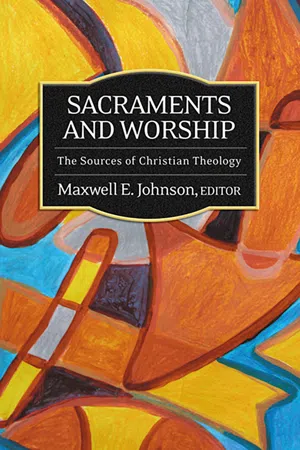
- 408 pages
- English
- ePUB (mobile friendly)
- Available on iOS & Android
eBook - ePub
About this book
Information
Topic
Theology & ReligionSubtopic
Christian Rituals & PracticeCHAPTER 1 | |
Sacraments in General and Sacramental Theology |
Scholastic theological approaches to the study of the sacraments and to sacramental theology began with a treatise or section entitled Sacramenta in generis, that is, “Sacraments in general,” before going on to treat the individual sacraments themselves in subsequent sections. This volume is no exception. Beginning with Augustine’s famous and ecumenically influential definition that “the word is joined to the element and the result is a sacrament, itself becoming, in a sense, a visible word,” this chapter proceeds historically through the patristic and medieval periods, the latter of which witnesses the development of “seven sacraments,” thanks to the Sentences of Peter the Lombard and Thomas Aquinas’s Summa.
In the next section the challenge to the medieval sacramental system represented by Luther’s 1520 Babylonian Captivity and the works of other Protestant reformers and the renewed defense of the seven sacraments at the Council of Trent leads through the subsequent centuries to what has been called the Copernican revolution in modern sacramental theology, especially in light of the Second Vatican Council in the Roman Catholic Church in the early 1960s.
The final section of this chapter, then, provides selections from contemporary influential sacramental theologians such as Karl Rahner on the relationship of the church and sacrament, James F. White on the numbering of sacraments from an ecumenical Protestant perspective, Louis-Marie Chauvet on the relationship between Word and sacrament, and others, including a contemporary feminist approach offered by Susan Ross and an Eastern theological perspective from M. Daniel Findikyan. Thus this chapter provides a concise overview of the historical development and particular issues that constitute that area of study called sacramental theology.
|
Definitions of a Sacrament, Key Concepts, and the Number of Sacraments in Early and Medieval Theologians
|
EARLY THEOLOGIANS
Augustine of Hippo
Augustine treats the notion of what constitutes a “sacrament” in several of his writings, rather than in a special treatise on the sacraments.
Augustine of Hippo, Treatise on the Gospel of John, LXXX, 3 (ca. 416), trans. Paul F. Palmer, in Sacraments and Worship (London: Darton, Longman & Todd, 1957), 127–28.
Why does He not say: you are clean because of the baptism with which you were washed, but says: “because of the word that I have spoken to you” [John 15:3], unless the reason is that even in water it is the word that cleanses? Take away the word and what is water but water? The word is joined to the element and the result is a sacrament, itself becoming, in a sense, a visible word as well…. Whence this power of water so exalted as to bathe the body and cleanse the soul, if it is not through the action of the word; not because it is spoken, but because it is believed? … This word of faith is of such efficacy in the Church of God that it washes clean not only the one who believes in the word, the one who presents [the child for baptism], the one who sprinkles [the child], but the child itself, be it ever so tiny, even though it is as yet incapable of believing unto justice with the heart or of making profession unto salvation with the lips. All this takes place through the word, concerning which the Lord says: “You are already clean because of the word that I have spoken to you.”
Augustine of Hippo, Against Faustus the Manichaean, XIX, 11 (ca. 398), trans. Bernard Leeming, in Principles of Sacramental Theology (London: Longmans, 1960), 562–63.
In no religion, whether true or whether false, can men be held in association, unless they are gathered together with a common share in some visible signs or sacraments; and the power of these sacraments is inexpressibly effective, and hence if contemned is accounted to be a sacrilege.
Augustine of Hippo, Questions on the Heptateuch, III, 84 (ca. 410), trans. Bernard Leeming, in Principles of Sacramental Theology, 563.
How, then, do both Moses and the Lord sanctify? … Moses, by the visible sacraments through his ministry; God by invisible grace through the Holy Spirit, wherein is the whole fruit of the visible sacraments; for without that sanctification of invisible grace, what use are visible sacraments?
Augustine of Hippo, Commentary on the Psalms, LXXIII, 2 (ca. 416), trans. Paul F. Palmer, in Sacraments and Worship, 128–29.
If we weigh well the two testaments, the old and the new, the sacraments are not the same, nor are the promises made the same…. The sacraments are not the same, since there is a difference between sacraments that give salvation and those that promise a Saviour. The sacraments of the New Law give salvation, the sacraments of the Old Law promised a Saviour.
Augustine of Hippo, On Baptism against the Donatists, IV, II, 18 (ca. 400), trans. Paul F. Palmer, in Sacraments and Worship, 123.
When baptism is given in the words of the gospel, no matter how great the perverseness of either minister or recipient, the sacrament is inherently holy on His account whose sacrament it is. And if any one receives baptism from a misguided man, he does not on that account receive the perversity of the minister, but only the holiness of the mystery, and if he is intimately united to the Church in good faith and hope and charity, he receives the remission of his sins…. But if the recipient himself is perverse, that which is given is of no profit while he remains in his perversity; and yet that which is received does remain holy within him, nor is the sacrament repeated when he has been corrected.
Augustine applies the terminology of “sacrament” to the annual celebration of the Pascha.
Augustine of Hippo, Letter 55 to Januarius 1, 2; in Easter in the Early Church: An Anthology of Jewish and Early Christian Texts, selected, annotated, and introduced by Raniero Cantalmessa (Collegeville, MN: Liturgical Press, 1993), 108–9.
Here you must know, first of all, that the Lord’s birthday is not celebrated in a sacrament but his birth is simply remembered, and for this it was only necessary to mark with festive devotion each year the day on which the event took place. But there is a sacrament in any celebration when the commemoration of the event is done in such a way as to make us understand that it signifies something that is to be taken in a holy manner. This is in fact how we keep the Pascha. Not only do we call to mind again what happened, that is, that Christ died and rose again, but we also do not leave out the other things about him which confirm the signification of the sacraments. For, since he “died for our sins and rose for our justification,” as the apostle says, a certain passage from death to life has been consecrated in the passion and resurrection of the Lord.
Leo I
Leo’s statement “What was visible in our Redeemer when on earth has become operative in sacramental signs” has become a standard and key text in sacramental and liturgical theology.
Leo I, De Ascensione Domini II, in Benedictine Daily Prayer: A Short Breviary, ed. Maxwell E. Johnson (Collegeville, MN: Liturgical Press, 2006), 300-301.
The Lord’s resurrection brought us joy; so should his ascension, as we recall the event that exalted our lowly nature beyond the angels and highest created powers to the Father’s side. These divine actions provide a sure foundation; through them God’s grace works marvelously to keep our faith firm, our hope confident, and our love ardent, even though the visible events as such are now a part of history.
It takes great strength of mind and a faithful and enlightened heart to believe without hesitation in what escapes the bodily eye and to desire unswervingly what cannot be seen. Yet how could our hearts be inflamed and how could one be justified by faith if our salvation arose only from what is visible? Therefore, what was visible in our Redeemer when on earth has become operative in sacramental signs [Quod itaque Redemptoris nostri conspicuum fuit, in sacramenta transivit]. And, in order that faith might become stronger and more perfect, teaching replaces sight, and the hearts of the faithful are illumined by God to accept its authority.
Even the blessed Apostles, despite the signs they saw and the sermons they heard, were fearful when the Lord suffered, and did not accept his resurrection unhesitatingly. So much did his ascension influence them, however, that all fear was turned to joy. Their minds contemplated the divine Christ at the Father’s side; no earthly trial could distract them from the fact that Christ had not left the Father when he descended nor left the disciples when he returned.
Therefore, beloved, the Son of Man who is Son of God has in an ineffable way become more present to us in his Godhead now that he has departed from us in his humanity. Faith now reaches to the Son, who is equal to the Father, and no longer needs the bodily presence of Jesus, in which he is less than the Father. For though his incarnate nature continues to exist, faith is summoned to touch the only-begotten Son, not with bodily sense but with spiritual understanding.
MEDIEVAL THEOLOGIANS
The definition of what constitutes a sacrament becomes more precise.
Hugh of St. Victor
Hugh of St. Victor, On the Sacraments of the Christian Faith, I, 9 (1140), trans. Roy J. Deferrari, in Hugh of Saint Victor on the Sacraments of the Christian Faith (Cambridge: Medieval Academy of America, 1951), 155.
Now if any one wishes to define more fully and more perfectly what a sacrament is, he can say: “A sacrament is a corporeal or material element set before the senses without, representing by similitude and signifying by institution and containing by sanctification some invisible and spiritual grace.” This definition is recognized as so fitting and perfect that it is found to befit every sacrament and a sacrament alone. For every thing that has these three is a sacrament, and every thing that lacks these three can not be properly called a sacrament.
For every sacrament ought to have a kind of similitude to the thing itself of which it is the sacrament, according to which it is capable of representing the same thing; every sacrament ought to have also institution through which it is ordered to signify this thing and finally sanctification through which it contains that thing and is efficacious for conferring the same on those to be sanctified.
Peter Lombard
Peter Lombard, “Distinction I,” 2–7, trans. Owen R. Ott, in The Four Books of Sentences, IV (ca. 1152), in LCC 10:338–41.
“A sacrament is a sign of a sacred thing” [Augustine]. However a sacrament is also called a sacred secret just as it is called a sacrament of the deity, so that a sacrament both signifies something sacred and is something sacred signified; but now it is a question of a sacrament as a sign.
Again, “A sacrament is the visible form of an invisible grace” [Augustine].
“A sign is something beyond the appearance, which it presses on the senses, for it makes something else enter thought” [Augustine].
“Some signs are natural, such as smoke signifying fire; others are given” [Augustine] and of those which are given, certain ones are sacraments, certain ones are not, for every sacrament is a sign, but not conversely.
A sacrament bears a likeness of that thing, whose sign it is. “For if sacraments did not have a likeness of the things whose sacraments they are, they would properly not be called sacraments” [Augustine]. For that is properly called a sacrament which is a sign of the grace of ...
Table of contents
- Cover
- Half-title Page
- Title Page
- Copyright Page
- Contents
- Series Introduction
- Introduction
- Abbreviations
- 1. Sacraments in General and Sacramental Theology
- 2. Liturgical Theology
- 3. Sacraments and Rites of Christian Initiation
- 4. The Eucharist
- 5. Liturgies of the Word
- 6. Occasional Sacraments and Services
- 7. Liturgy and Time
- Permissions
- Suggestions for Further Reading
- Index
Trusted by 375,005 students
Access to over 1.5 million titles for a fair monthly price.
Study more efficiently using our study tools.
Frequently asked questions
Yes, you can cancel anytime from the Subscription tab in your account settings on the Perlego website. Your subscription will stay active until the end of your current billing period. Learn how to cancel your subscription
No, books cannot be downloaded as external files, such as PDFs, for use outside of Perlego. However, you can download books within the Perlego app for offline reading on mobile or tablet. Learn how to download books offline
Perlego offers two plans: Essential and Complete
- Essential is ideal for learners and professionals who enjoy exploring a wide range of subjects. Access the Essential Library with 800,000+ trusted titles and best-sellers across business, personal growth, and the humanities. Includes unlimited reading time and Standard Read Aloud voice.
- Complete: Perfect for advanced learners and researchers needing full, unrestricted access. Unlock 1.5M+ books across hundreds of subjects, including academic and specialized titles. The Complete Plan also includes advanced features like Premium Read Aloud and Research Assistant.
We are an online textbook subscription service, where you can get access to an entire online library for less than the price of a single book per month. With over 1.5 million books across 990+ topics, we’ve got you covered! Learn about our mission
Look out for the read-aloud symbol on your next book to see if you can listen to it. The read-aloud tool reads text aloud for you, highlighting the text as it is being read. You can pause it, speed it up and slow it down. Learn more about Read Aloud
Yes! You can use the Perlego app on both iOS and Android devices to read anytime, anywhere — even offline. Perfect for commutes or when you’re on the go.
Please note we cannot support devices running on iOS 13 and Android 7 or earlier. Learn more about using the app
Please note we cannot support devices running on iOS 13 and Android 7 or earlier. Learn more about using the app
Yes, you can access Sacraments and Worship by Maxwell E. Johnson in PDF and/or ePUB format, as well as other popular books in Theology & Religion & Christian Rituals & Practice. We have over 1.5 million books available in our catalogue for you to explore.