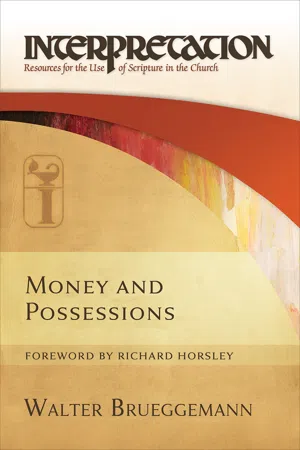
The Bible is rich with complex and diverse material on the topic of money and possessions. Indeed, a close look at many scriptural texts reveals that economics is a core preoccupation of the biblical tradition. In this new work, highly regarded preacher and scholar Walter Brueggemann explores the recurring theme of money and possessions in the Old and New Testaments. He proposes six theses concerning money and possessions in the Bible, observing their contradictory nature to the conventional wisdom and practice of both the ancient world and today's society. Brueggemann advises us to reassess the ways in which our society engagesor does not engagequestions of money and possessions as carriers of social possibility. He invites the church to move toward an alternative neighborly economy that is more consistent with the gospel we confess.
eBook - ePub
Money and Possessions
Interpretation: Resources for the Use of Scripture in the Church
- English
- ePUB (mobile friendly)
- Available on iOS & Android
eBook - ePub
Money and Possessions
Interpretation: Resources for the Use of Scripture in the Church
About this book
Information
Topic
Theology & ReligionSubtopic
Biblical CommentaryCHAPTER 1
Introduction
A Material Faith
Any study of money and possessions in the Bible is confronted with a mass of data that is complex and diverse in a way that refuses any systematic summary. Indeed, one can find in Scripture almost anything on the topic one wants to find. E. J. Dionne, after attending a Republican rally with many appeals to Ronald Reagan by a great variety of Republican speakers, was moved to quip: “Republicans of all sorts can appeal to the authority of Ronald Reagan in the same way that all Christians of every sort can appeal to the Bible as an authority.” All readers can find what they want in the Bible concerning money and possessions. It is impossible in any survey to notice or discuss every possible reference, so one's treatment of the subject is sure to be selective.
I
As a way to begin this particular selective discussion, I propose six theses concerning money and possessions in the Bible that will provide a general frame of reference for the textual particularity that follows. In light of these theses I will survey, in canonical sequence, a variety of texts that variously witness to the truth of these theses.
1. Money and possessions are gifts from God. “All good gifts are sent from heaven above.” For that reason a proper response to such gifts is gratitude: “Then thank the Lord, O thank the Lord, for all his love.” This affirmation is grounded in the doxological confession that God is the creator of the world and all that is in it. The lyrical poetry of Genesis 1 attests that without God there is only chaos. It is the creator God who transforms chaos into a living, generative environment that is blessed and fruitful in a way that produces abundance. That Genesis narrative, echoed in the Psalms, singularly credits the Creator with all plant and animal life. In its doxologies, Israel knows that all commodities of value are derivative from the generativity of the earth and that money (gold and silver) is a social symbol of value that derives from created commodities. In the Old Testament, in an agricultural economy, the three great money crops are grain, wine, and (olive) oil.1 These are the produce of a generative earth, and that produce could be and was converted into wealth that eventuated in social well-being, social power, and social control.
The insistence that possessions are gifts and not achievements or accomplishments is a decisive check in biblical faith on any temptation to imagine self-sufficiency or autonomy. When the gift quality of possessions is forgotten, one can imagine that one has made the produce one's self. This temptation is reflected in the illusionary claim of Pharaoh, the great cipher of self-sufficiency, whom God reprimands for his imagined autonomy:
Thus says the Lord GOD:
I am against you,
Pharaoh king of Egypt,
the great dragon sprawling
in the midst of its channels,
saying, “My Nile is my own;
I made it for myself.”
(Ezek. 29:3)
Pharaoh could not remember that it was the other way around: the Nile had made him, and the Nile is a river wrought by the creator God. This gift quality is the most elemental claim the Bible makes concerning money and possessions. It is an exceedingly important claim in a society like ours that easily imagines it is self-sufficient in its unrestrained eagerness for more. When the giver of all good gifts is forgotten, the gifts themselves are sure to be distorted in destructive ways.
2. Money and possessions are received as reward for obedience. This claim that runs throughout the Bible voices a robust quid pro quo connection between obedience and prosperity. That connection is clearly voiced in Psalm 1, which functions as an introduction to the book of Psalms:
Happy are those
who do not follow the advice of the wicked,
or take the path that sinners tread,
or sit in the seat of scoffers;
but their delight is in the law of the LORD,
and on his law they meditate day and night.
They are like trees
planted by streams of water,
which yield their fruit in its season,
and their leaves do not wither.
In all that they do, they prosper.
(Ps. 1:1–3)
And then the psalm adds tersely: “The wicked are not so!”
Prosperity arises in the wake of obedience to Torah, because the creator God is not indifferent to human conduct. Thus the commandments of the Sinai Torah are disclosures or regulations for bringing one's life into sync with the ordered quality of creation that is not negotiable. Taken in the most healthy way, such obedience consists in the joy of being in sync with God and not a burden, because it is simply an acting out in real life of one's true life with God and delight in God's companionship. A life in sync with the purposes of God is a life that will flourish!
Of course such a connection between obedience and prosperity that is based on mutual trust can be hardened into hard-nosed bargaining in the form of works righteousness. In such a distortion of glad obedience, one may obey in order to prosper, or one may imagine that one is owed prosperity for obedience. But such a bargaining expectation abuses and distorts a love relationship of glad responsiveness. The old temptation of works righteousness in our society, moreover, has morphed into the form of hard-nosed calculation in a market ideology in which there are no free lunches and no glad gratitude but only payouts for performance and production.
The distortion of this claim is even more pernicious when the rhythm of obedience that leads to prosperity is reversed, as in the case of Job. In that distorted rendering, Job's adversity is reckoned by his friends to be a result of disobedience. The biblical tradition knows, in its wise honesty, that the simple sequence of obedience–prosperity is not a fully reliable one. There are enough undeniable exceptions to evoke doubt around the so-called issue of theodicy. Thus this thesis is a guiding assumption of biblical faith that affirms that human conduct matters to human well-being because the Creator is not indifferent to conduct. In some great part, human conduct chooses human futures. But a guiding assumption cannot be reduced to a close, rigid calculus.
3. Money and possessions belong to God and are held in trust by human persons in community. In church practice, it is this claim that stands behind all thinking about stewardship. As is evident in the odd narrative of Isaiah 22, a steward is the “master of the household” who is responsible for its proper management, a role assigned to the human couple in the Genesis creation narrative concerning having “dominion” (Gen. 1:28). The steward is not the owner but is accountable to the owner (see also the parables of Jesus: Matt. 20:8; Luke 12:42; 16:2–4). In biblical faith, what human persons “possess” is in fact held in trust by God, who is the legal, entitled owner. Thus the psalmist can gladly assent:
The earth is the LORD's and all that is in it,
the world, and those who live in it;
for he has founded it on the seas,
and established it on the rivers.
(Ps. 24:1–2)
The whole earth is the creation that belongs to the Creator who “has the whole world in his hands.” This means, of course, that the stewards, all those who hold possessions in trust, are accountable for their use and management. When their possessions are well managed, they flourish, to the credit of the Creator. When they are mismanaged long enough, they may be withdrawn from the steward who has distorted the intent of the Creator-owner.
That reality of “held in trust” is readily forgotten. Thus in 2 Samuel 3:12, the wily general, Abner, sends a message to David: “To whom does the land belong?” Abner is urging David to seize the land that is under the control of Saul. He has no notion that the land belongs to YHWH. Implied in his question to David is an invitation to David that if David wants the land, that is, if he wants to rule, he can do so and Abner will help him do it. More broadly, this was a risky assumption in ancient Israel about ownership of the land. Over time, Israel (and especially its kings and moneyed class) could imagine that the land could be held and used with impunity. Thus Ahab in the narrative of Naboth's vineyard (1 Kgs. 21). But as history eventuated, it became clear that the land finally belonged to YHWH, and Israel lost the land through its mismanagement. In the New Testament, the same risk of mismanagement is reflected in the parable of Luke 12:16–21, in which the main character is saturated with first-person pronouns, imagining that it all belonged to him. But of course as the narrative ends, his mismanaged “ownership” and autonomy are exposed as false.
4. Money and possessions are sources of social injustice. When possessions are held in trust, they may be well managed according to the will of “the owner,” that is, for the sake of the neighborhood. But when possessions or money are viewed as “mine” without accountability, then they may be deployed in destructive ways at the expense of the common good.
The tradition of Deuteronomy is insistent that money and possessions must be managed in the practice of justice, that is, for the good of the entire community. That tradition further insists that Israel, in covenant with God and compelled by Torah, is to handle possessions and money differently from all others, so that economic resources are subordinated to the common good, that is, for the well-being of the neighbor, most particularly the neighbor without resources. Deuteronomy is clear that this is the mandate of the Creator-owner of worldly goods. As a result, the tradition makes a close connection between remembering God as owner and doing neighborly justice. Conversely, forgetting God is closely linked to the practice of exploitative injustice:
In the pride of their countenance the wicked say, “God will not seek it out”;
all their thoughts are, “There is no God.”
They lurk in secret like a lion in its covert;
they lurk that they may seize the poor;
they seize the poor and drag them off in their net.
They stoop, they crouch,
and the helpless fall by their might.
T...
Table of contents
- Cover
- Half Title
- Series Page
- Title Page
- Copyright
- Dedication
- The Three Cries of History
- Contents
- Series Foreword
- Foreword by Richard Horsley
- Preface
- Chapter 1: Introduction: A Material Faith
- Chapter 2: Israel's Core Narrative: No Coveting!
- Chapter 3: Deuteronomy: The Great Either-Or of Neighborliness
- Chapter 4: Joshua, Judges, 1–2 Samuel, 1–2 Kings: The Contest
- Chapter 5: 1–2 Chronicles, Ezra, Nehemiah: Empire and Extraction
- Chapter 6: The Psalms: Torah, Temple, Wisdom
- Chapter 7: Proverbs and Job: Wise Beyond Smart
- Chapter 8: The Prophets: Wealth Ill-Gotten and Lost, Wealth Given Again
- Chapter 9: The Five Scrolls: Scripts of Loss And Hope, Commodity and Agency
- Chapter 10: The Gospels: Performance of an Alternative Economy
- Chapter 11: Acts: Community amid Empire
- Chapter 12: Paul: Life in the Land of Divine Generosity
- Chapter 13: The Pastoral Epistles: Order in the Household
- Chapter 14: The Letter of James: The Deep Either-Or of Practice
- Chapter 15: The Book of Revelation: The Ultimate Alternative
- Bibliography
- Index of Scripture
- Index of Subjects
Trusted by 375,005 students
Access to over 1.5 million titles for a fair monthly price.
Study more efficiently using our study tools.
Frequently asked questions
Yes, you can cancel anytime from the Subscription tab in your account settings on the Perlego website. Your subscription will stay active until the end of your current billing period. Learn how to cancel your subscription
No, books cannot be downloaded as external files, such as PDFs, for use outside of Perlego. However, you can download books within the Perlego app for offline reading on mobile or tablet. Learn how to download books offline
Perlego offers two plans: Essential and Complete
- Essential is ideal for learners and professionals who enjoy exploring a wide range of subjects. Access the Essential Library with 800,000+ trusted titles and best-sellers across business, personal growth, and the humanities. Includes unlimited reading time and Standard Read Aloud voice.
- Complete: Perfect for advanced learners and researchers needing full, unrestricted access. Unlock 1.5M+ books across hundreds of subjects, including academic and specialized titles. The Complete Plan also includes advanced features like Premium Read Aloud and Research Assistant.
We are an online textbook subscription service, where you can get access to an entire online library for less than the price of a single book per month. With over 1.5 million books across 990+ topics, we’ve got you covered! Learn about our mission
Look out for the read-aloud symbol on your next book to see if you can listen to it. The read-aloud tool reads text aloud for you, highlighting the text as it is being read. You can pause it, speed it up and slow it down. Learn more about Read Aloud
Yes! You can use the Perlego app on both iOS and Android devices to read anytime, anywhere — even offline. Perfect for commutes or when you’re on the go.
Please note we cannot support devices running on iOS 13 and Android 7 or earlier. Learn more about using the app
Please note we cannot support devices running on iOS 13 and Android 7 or earlier. Learn more about using the app
Yes, you can access Money and Possessions by Walter Brueggemann in PDF and/or ePUB format, as well as other popular books in Theology & Religion & Biblical Commentary. We have over 1.5 million books available in our catalogue for you to explore.